
What Happens When You Get Audited by the IRS
Nothing gets your heart pounding quite like an official-looking envelope from the IRS or the state tax agency. When that letter arrives, it means they're formally reviewing your tax return to make sure everything adds up.
It’s crucial to remember one thing: the first contact will always be by mail. Any surprise phone call or email demanding money is a scam, not an audit. This official notice isn't an accusation; it's simply a request for more information to verify that your return followed the tax laws correctly.
Receiving an Audit Notice and Your First Steps

Seeing that government letter on your kitchen counter can trigger a wave of panic, but take a deep breath. An audit is a structured process with clear rules—it's not a guilty verdict waiting to happen. That initial notice is your roadmap, giving you the essential details for the journey ahead.
Your first job is to read that notice from top to bottom. It will tell you whether the audit is from the IRS or the Michigan Department of Treasury and, most importantly, what the scope of the review is. It will also specify the type of audit you’re facing, which is a huge clue as to how things will proceed.
Understanding the Initial Notice
Most audits start out as a correspondence audit, which is handled entirely through the mail. This is by far the most common and least intimidating type. It’s often triggered by a simple math error or a request for documentation to back up a specific deduction you claimed, like charitable donations or business expenses.
In less common situations, the notice might schedule an office audit (at an IRS office) or a field audit (at your home or business), which are much more in-depth. But no matter the type, your first moves are always the same.
Key Takeaway: An audit notice is not a bill. It’s a request for information. How you respond—or if you respond—is what will shape the entire process and its final outcome.
Your Immediate Action Plan
As tempting as it is to stick the letter in a drawer and forget about it, that’s the worst thing you can do. Ignoring the notice forces the auditor to make a decision with only the information they have, which almost never works out in your favor.
Instead, stay calm and get organized. Here’s what to do right away:
- Confirm it's legit: Real audits start with a letter in the mail. If you get an aggressive phone call or a threatening email, it's a scam.
- Check the tax year: The notice will specify which tax return is being reviewed. This helps you narrow your search for the right records.
- Circle the deadlines: There will be a firm date for your response. Missing it can make things much more complicated.
- Start gathering documents: Pull together all the records related to the items mentioned in the notice—receipts, bank statements, mileage logs, and anything else that proves your numbers.
Getting your paperwork in order and understanding exactly what the auditor is asking for will set the stage for a smoother, more efficient process. A calm, prepared response is your best first defense.
The Three Main Types of Tax Audits Explained
Not all audits are created equal. The moment you understand which kind of review you’re facing, the entire process becomes much clearer. The IRS notice will tell you the format, and each one comes with a different level of intensity.
Think of it like a pop quiz versus a final exam. A simple math error on your return might just mean a quick, open-book style check-in you can handle from home. A more complicated issue could require a scheduled meeting. A serious discrepancy, on the other hand, might lead to a comprehensive review where every detail is on the table.
Let's break down the three main audit types, starting with the most common and working our way up to the most intensive.
The Correspondence Audit: An Open-Book Quiz
The correspondence audit is, by far, the most common and least scary type of review. The whole thing is handled through the mail—you’ll never meet an IRS agent face-to-face. It's the agency's go-to method for resolving pretty straightforward issues.
So what triggers it? Usually, it’s a simple discrepancy that the IRS computer system flags, like:
- A math error in your calculations.
- A mismatch between the income you reported and the W-2 or 1099 forms your employer or clients sent in.
- A need for proof to back up a specific deduction, like charitable donations or student loan interest.
The notice you get in the mail will be very specific about what they need. It might ask for a copy of a donation receipt or a Form 1098-E to verify your student loan interest deduction. All you have to do is mail back the requested documents by the deadline. Because they’re so routine, these audits make up the vast majority of all IRS examinations.
The Office Audit: A Sit-Down Meeting
A step up in seriousness is the office audit. As the name implies, this one requires you to visit a local IRS office and meet with an auditor in person. It’s definitely more involved than a correspondence audit, but it’s still targeted.
An office audit isn't a free-for-all investigation into your entire financial life. The auditor will have a specific list of items they want to discuss, and the meeting is designed to stick to those issues.
The IRS notice will lay out exactly which documents you need to bring with you. This type of audit often comes up for issues that are just too complex to sort out through the mail—think significant self-employment income, unreported tips, or questionable rental property expenses. For Michigan taxpayers with small businesses or side hustles, this format isn't uncommon. Getting ready for this meeting means having your records organized and being prepared to walk the auditor through your bookkeeping.
The Field Audit: The Deep Dive
The most comprehensive and serious type of review is the field audit. This is what most people imagine when they hear the word "audit." An IRS agent, known as a revenue agent, comes to you—conducting the examination at your home, your place of business, or your accountant's office.
This audit is reserved for the most complex tax returns, typically involving large businesses or individuals with a high net worth. Field audits are incredibly thorough, often covering multiple years and potentially scrutinizing every single line item on your return. The agent will dig into business records, bank statements, and your internal financial controls. Given the high stakes and deep complexity, this is the point where hiring a tax attorney isn't just a good idea—it's essential for protecting your rights and your assets.
Navigating the Audit Timeline and Document Requests
An audit doesn't just happen overnight. It’s a process that unfolds over a specific—and often frustratingly slow—timeline, from that first notice in the mail to the final decision. Getting a handle on this timeline and knowing what to expect when the document requests start rolling in is absolutely crucial. How prepared you are at this stage can change the entire tone and outcome of the audit.
The clock starts ticking the moment you open that letter. Inside, you’ll find a strict deadline for your response, usually 30 days. Let me be clear: this is not a suggestion. Missing this deadline won’t make the audit disappear; it will just force the auditor to make a decision without your side of the story, and that rarely works out in your favor.
This infographic breaks down the general timeline and what's involved in the different types of audits.
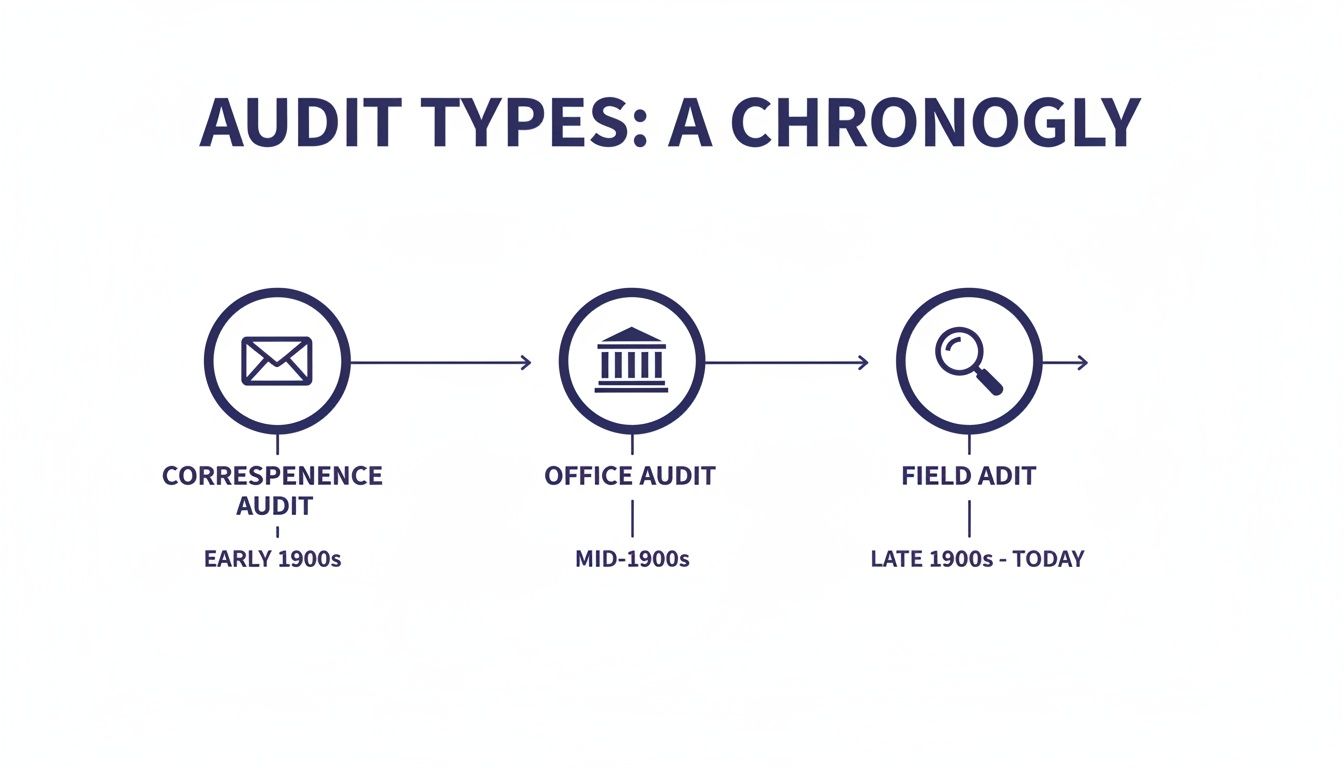
As you can see, things get a lot more involved and time-consuming as you move from a simple correspondence audit (done by mail) to a full-blown field audit at your home or office.
Common Document Requests
No matter the type of audit, it all boils down to one thing: providing proof for what you claimed on your tax return. The auditor is essentially saying, "Show me the receipts." This is where diligent self-employed record keeping becomes your best defense.
You’ll need to have clear, organized copies of documents ready to go. We're talking about things like:
- Bank and Credit Card Statements: These are used to verify every dollar of income you deposited and every expense you paid for.
- Receipts and Invoices: You'll need these for all claimed business expenses, from office supplies and software to client dinners and travel.
- Mileage Logs: If you took a vehicle deduction, they’ll want to see a detailed log of your business trips, including dates, destinations, and purpose.
- Legal Documents: This could include anything from sales contracts and loan agreements to partnership or incorporation papers.
A quick pro tip: organize everything by category and year before you send it off. Making the auditor's job easier can lead to a much smoother and faster process for you. Just handing over a shoebox full of crumpled papers is the fastest way to a prolonged, painful examination.
Brace for System-Wide Delays
Even if you respond immediately with perfectly organized records, you’ll still need a healthy dose of patience. The IRS is buried under a mountain of backlogs that can drag an audit out for many months, and sometimes, well over a year. You can learn more about what to expect by reading our detailed guide on how long an IRS audit typically takes here: https://www.michigantaxattorneys.net/blog/how-long-does-a-irs-audit-take/
The audit timeline is often out of your hands. While you have to meet your deadlines, the agency is running on its own schedule, which has been severely hampered by staffing shortages and processing delays.
Amended returns have been hit particularly hard. The National Taxpayer Advocate recently reported that the IRS took an average of over 13 months to process business amended returns and over 5 months for individual ones. Those kinds of delays can create a lot of financial uncertainty.
This slow pace can be incredibly stressful, but it also highlights why having a well-documented and professionally managed response is your best strategy. Your goal is to present a clear, verifiable record that backs up your tax return, leaving no room for doubt. By understanding the timeline, anticipating what they’ll ask for, and preparing for delays, you can face the audit process with a lot more confidence and control.
Understanding Potential Audit Outcomes and Penalties
After weeks or even months of back-and-forth with an auditor, the examination finally wraps up. This is the moment you’ve been waiting for, when the IRS delivers its final verdict on your tax return. The outcome will fall into one of three buckets, and each one sets you on a different path.
It's a common misconception that an audit always ends with a tax bill. Sometimes, the process just confirms you did everything right. But if the auditor does find errors, it’s important to understand the financial implications, because they can add up fast.
The Three Possible Audit Results
Once the auditor finishes their review, you'll receive a report with their findings. This document will officially state one of three conclusions.
Here’s a breakdown of what each outcome means in plain English:
- No Change: This is the best news you can get. It means the auditor examined your return and found everything to be in order. You owe nothing more, no penalties are applied, and you’ll get a letter closing the case. You can breathe a sigh of relief.
- Agreed: In this scenario, the auditor found discrepancies and proposed changes to your tax liability—and you agree with their assessment. You'll sign an agreement form, which finalizes the additional tax, interest, and any penalties. From there, you just need to arrange payment.
- Disagreed: If you believe the auditor’s findings are incorrect, you don't have to accept them. This is where your right to appeal comes in. You can request a meeting with the auditor's manager, or you can take a more formal route and file an appeal, which sends your case to an independent division within the IRS for a second look.
The next steps you take are entirely determined by whether you accept the auditor’s adjustments.
Key Insight: An auditor's report isn't the final word unless you agree to it. You always have the right to challenge their findings and present your case.
Common Penalties and Their Financial Impact
If your audit ends in an "agreed" or "disagreed" outcome where the IRS says you owe more tax, you’ll almost certainly see penalties tacked onto the bill. These aren’t random fees; they are specific charges tied to the type of error found on your return. A simple math error is treated very differently from a deliberate attempt to deceive the IRS.
Here’s a look at some of the most frequent penalties you might encounter.
| Penalty Type | Triggering Action | Penalty Rate/Amount |
|---|---|---|
| Accuracy-Related Penalty | Negligence, substantial understatement of tax, or significant valuation misstatements. | Typically 20% of the underpaid tax amount. |
| Failure to Pay Penalty | Not paying the tax shown on your return by the due date. | 0.5% of the unpaid tax for each month or part of a month the tax remains unpaid, capped at 25%. |
| Failure to File Penalty | Not filing your tax return by the due date (including extensions). | 5% of the unpaid tax for each month or part of a month the return is late, capped at 25%. |
| Civil Fraud Penalty | An underpayment of tax resulting from intentional deceit or fraud. | A steep 75% of the portion of the underpayment that is due to fraud. |
As you can see, the penalties for an honest mistake are significant, but they pale in comparison to the consequences of fraud. The IRS looks closely at intent. An honest mistake that leads to a 20% accuracy-related penalty is one thing, but intentionally hiding income could trigger the massive 75% civil fraud penalty.
Can Penalties Be Removed?
Even if the IRS assesses penalties, you aren't necessarily stuck with them. There's a formal process called penalty abatement that allows taxpayers to request the removal of certain penalties.
The most common path to success is demonstrating "reasonable cause." This means you have to prove you made a good-faith effort to follow the tax laws but couldn't due to circumstances outside your control. Think serious illness, a death in the family, a natural disaster, or even relying on incorrect advice from a tax professional.
To explore this option, you can learn more about how penalty abatement works and how Form 843 is used to request it. Having an experienced professional argue on your behalf can dramatically improve your chances of getting penalties waived.
Protecting Your Rights and Knowing When to Get Help

It’s easy to feel cornered when you’re facing an IRS audit. The thought of going up against a massive government agency can be intimidating, but it’s critical to remember you aren't powerless. The IRS is required to follow a specific set of rules known as the Taxpayer Bill of Rights, which ensures you’re treated fairly from start to finish.
Think of these rights as your shield. They protect your privacy and confidentiality and guarantee your right to challenge the IRS's findings and make your case. Most importantly, they give you the right to hire professional representation—a move that becomes more and more critical as the audit gets more serious.
Part of understanding what happens when you get audited is realizing you don't have to go through this alone. You have options for who stands beside you.
Your Representation Options
Once that audit notice lands in your mailbox, you have three main choices for how to handle representation. Each brings a different level of experience and strategic benefit to the table.
- Representing Yourself (Pro Se): This really only makes sense for the simplest correspondence audits where the fix is obvious, like sending in a missing 1099 form. For anything more complex, going it alone is a huge risk. You could easily say something or hand over a document that unintentionally opens up a whole new can of worms for the auditor.
- Hiring a CPA or Enrolled Agent: These professionals know accounting and tax preparation inside and out. They are perfectly capable of handling most office audits, where the main task is organizing financial records and talking to the auditor about technical tax rules.
- Hiring a Tax Attorney: A tax attorney brings everything a CPA offers and adds two game-changing advantages: deep legal expertise and the protection of attorney-client privilege. They are the only professionals qualified to build legal arguments, navigate complex tax law, and fight for you in Tax Court if it comes to that.
Deciding on the right support is one of the most important calls you'll make. For a deeper dive, check out our guide on choosing an IRS audit representative: https://www.michigantaxattorneys.net/blog/irs-audit-representative/
When a Tax Attorney Becomes Essential
While a CPA is a great asset for many routine audits, some situations absolutely demand the skillset of a tax attorney. Bringing one on board sends a clear signal to the IRS: you are taking this seriously and are fully prepared to defend your position.
Here are a few scenarios where a tax attorney is indispensable:
- Complex Field Audits: These are the deep-dive examinations into your business or personal finances. An attorney will manage the entire audit, control exactly what information the auditor sees, and shield you from an investigation that creeps beyond its original scope.
- Significant Tax Liabilities: When the amount of money on the line is substantial, the risk is just too high not to have a legal expert in your corner. They can negotiate settlements and challenge the IRS on points of law in a way other professionals can't.
- Potential Criminal Allegations: If there is even a whisper of tax evasion or fraud, you need to stop talking to the IRS immediately. Only a tax attorney can offer the protection of attorney-client privilege, which legally shields your conversations from the government.
Crucial Point: Your conversations with an accountant are not privileged. If an audit uncovers something that looks like fraud, your accountant can be forced to testify against you. An attorney cannot.
Protecting your rights also means keeping your financial data secure, which underscores the importance of solid cybersecurity and accounting practices. A tax attorney ensures your financial information is handled properly while also upholding your legal and constitutional rights every step of the way. They become a strategic buffer between you and the auditor, managing all communications and building a defense grounded in tax law. In a high-stakes audit, that legal protection is your ultimate safeguard.
Your Post-Audit Action Plan
The auditor has finished their review and sent you the final report. This is a big moment, but it doesn't always mean you're at the end of the road. What happens next really hinges on the outcome of the audit and, just as importantly, how you decide to respond.
Your next move will depend on whether the result is “no change,” “agreed,” or “disagreed.” Let's walk through a clear action plan to help you navigate the aftermath, close this chapter, and move forward, no matter what the report says.
Step 1: Break Down the Audit Report and Outcome
The first thing you need to do is sit down and carefully read the final report from the auditor. This document is the official word on the outcome and will lay out any proposed changes to what you owe.
- No Change: This is the best-case scenario. It means the audit is closed, you don't owe any more tax, and you can breathe a sigh of relief. File the notice with your records and you're done.
- Agreed: If the auditor's findings make sense to you and you agree with them, you'll sign an agreement form. This makes the changes official and kicks off the payment process.
- Disagreed: If you're looking at the report and believe the auditor got it wrong, do not sign the agreement. This is your green light to start the appeals process.
Step 2: Settle Up if You Owe More Tax
If the audit concluded with an "agreed" outcome and you have a new tax bill, you need to deal with it right away. Ignoring it is the worst thing you can do, as that's how you trigger the IRS collection machine, which can lead to serious actions like liens on your property or levies on your bank account.
You generally have a few ways to handle the tax debt:
- Pay in Full: The most straightforward path is to pay the full amount by the due date on the notice.
- Request a Payment Plan: If you can't pay it all at once, you can almost always set up an installment agreement to make manageable monthly payments.
- Submit an Offer in Compromise (OIC): For people facing true financial hardship, an Offer in Compromise is a formal process that may allow you to settle your tax debt for less than you owe.
An audit assessment starts the clock on collections. Taking proactive steps to resolve the debt—even if you can't pay it all at once—is crucial for protecting your assets from forced collection actions.
Step 3: File an Appeal if You Disagree
If you’re convinced the audit findings are incorrect, you have the right to fight them. The first informal step is usually to ask for a conference with the auditor's manager to see if you can work it out.
If that doesn't solve the problem, your next move is to file a formal appeal with the IRS Independent Office of Appeals. This is where having professional representation becomes incredibly important. An experienced tax attorney knows how to build a solid legal argument, present your case effectively, and negotiate a better result. Just remember, the appeals process runs on strict deadlines, so don't wait to take action.
Finally, treat this entire experience as a lesson. Look at the issues the auditor raised and use them to tighten up your record-keeping and accounting. Shoring up your financial systems is the single best way to avoid going through this all over again in the future.
Frequently Asked Questions About Tax Audits
Getting that audit notice in the mail can feel like a punch to the gut. Suddenly, your mind is racing with questions and a whole lot of "what ifs." Let's cut through the noise and get you some straight answers to the most common worries Michigan taxpayers have.
Knowing what you're up against is the first, and most important, step in taking back control.
What Makes the IRS Flag a Return for an Audit?
While it's true that some audits are completely random, most are not. The IRS uses a powerful computer system with a scoring program called the Discriminant Information Function (DIF). Think of it like a credit score for your tax return—it analyzes your numbers and flags returns that look statistically unusual.
A high DIF score doesn't automatically mean you did something wrong, but it does get a human agent to take a closer look. Common triggers that can raise your score include:
- Disproportionately High Deductions: Claiming charitable donations or business expenses that seem way out of line with your reported income.
- Mismatched Income: The income you report doesn't line up with the W-2s and 1099s the IRS received from your employers or clients.
- Forgetting Income: Failing to report all your earnings, especially from side hustles, freelance work, or investment gains.
- Claiming 100% Business Use of a Vehicle: This is a classic red flag. Auditors know it's extremely rare for a vehicle to be used exclusively for business with zero personal miles.
Any of these can be enough to put your return on an auditor's desk.
How Many Years Back Can the IRS Audit?
Thankfully, the IRS doesn't have an unlimited amount of time to dig into your past. There's a rule called the statute of limitations that sets a deadline. For the vast majority of cases, the IRS has three years from the date you filed your return to start an audit.
But that window can get a lot wider in specific situations. If you've significantly understated your income—we're talking by 25% or more—the look-back period jumps to six years.
Here's the most critical part: if the IRS suspects you committed fraud, or if you simply never filed a return in the first place, there is no statute of limitations. They can go back as far as they need to. This is precisely why it's a good rule of thumb to keep all your tax records for at least seven years.
What Happens If I Just Ignore the Audit Notice?
Simply put, ignoring an IRS notice is the worst thing you can do. It doesn't make the problem go away; it just takes away your ability to defend yourself.
If you don't respond, the auditor has no choice but to make a decision based only on the information they have on hand. Unsurprisingly, that decision will almost always be against you. You'll then receive a "Notice of Deficiency," which is a legal letter giving you 90 days to either pay up or file a petition with the U.S. Tax Court.
Miss that 90-day deadline, and the proposed tax bill becomes a final, legally enforceable debt. The IRS will then move into collection mode, which can get aggressive fast. We’re talking about federal tax liens on your home, levies on your bank accounts, and wage garnishments. What started as a simple review can quickly snowball into a full-blown financial crisis.
