
What an IRS Audit Representative Does and Why You Need One
That letter from the IRS is enough to make anyone's stomach drop. But it's crucial to remember that an audit notice is the start of a conversation, not a guilty verdict. This is where an IRS audit representative becomes your most valuable asset.
Think of them as your professional shield—a qualified expert like a tax attorney, Certified Public Accountant (CPA), or Enrolled Agent who steps in to handle the IRS for you. They manage every piece of communication and strategically defend your financial interests, often meaning you never have to speak directly to an auditor yourself.
Your First Line of Defense Against an IRS Audit

While that official IRS envelope feels personal, an audit doesn't automatically mean you did something wrong. The IRS computer systems flag returns for all sorts of reasons. It could be purely random, or it could be that certain items on your return—like unusually high deductions compared to your income—caught the system's attention.
The notice you receive is your initial roadmap. It will tell you why your return was selected and what kind of audit you're facing. Understanding these different audit types is the first step in crafting the right defense.
The Different Types of IRS Audits
Audits aren't one-size-fits-all. They come in a few different flavors, ranging from simple paper-based inquiries to deep-dive investigations, and each one needs a different game plan.
- Correspondence Audit: The most common by far, this audit is handled entirely through the mail. The IRS simply asks for documents to back up specific items, like medical expenses or charitable donations. It sounds simple, but a sloppy or incomplete response can quickly make things worse.
- Office Audit: This one requires you (or your representative) to visit a local IRS office for an in-person meeting. The auditor will have a list of specific records they want to see to substantiate the items under review.
- Field Audit: This is the most serious and comprehensive audit. An IRS agent comes to your home or business to conduct a thorough examination of your financial records. Given the level of scrutiny, having professional representation here is absolutely critical.
No matter the type, bringing in an expert right from the start is the smartest move you can make. Your representative is more than just a tax preparer; they're a skilled negotiator who ensures every response is strategic and every one of your rights is protected. To get a better sense of the initial process, check out our guide on what happens if you get audited.
An audit notice is a serious matter, but it's a manageable challenge with expert guidance. The goal is to control the narrative from the outset, preventing a minor inquiry from turning into a major financial headache.
The financial stakes are no joke. In a recent fiscal year, the IRS closed over 505,000 tax return audits, recommending a staggering $29 billion in additional taxes. That breaks down to an average of about $57,370 per audit, a clear sign of how aggressive these examinations can be. While the overall audit rate might seem low, the risk shoots up for higher-income individuals and business owners. You can read more about the latest IRS tax audit statistics and trends.
The Three Professionals Who Can Represent You Before the IRS

When that dreaded letter from the IRS arrives, you can't just have your usual tax preparer handle it. The federal government grants what are called "unlimited practice rights" to only a select group of professionals. These are the only people authorized to represent any taxpayer, for any tax issue, in front of any IRS office.
Choosing the right kind of IRS audit representative isn't just a detail—it's a critical strategic move that hinges on the unique facts of your situation. Getting to know the distinct advantages of each professional will help you pick the one who can best navigate your case toward a positive resolution.
You have three main options for full representation. Each brings a very different toolkit to the fight, making them better suited for different types of audits.
Enrolled Agents: The IRS Specialists
Think of an Enrolled Agent, or EA, as a pure tax specialist—a true IRS insider. They earn their credentials directly from the IRS, either by passing a grueling three-part exam on federal tax law or by having extensive prior experience working for the agency. Their entire career is built around tax regulations and IRS procedure.
This sharp focus gives EAs an incredibly deep, hands-on knowledge of how the IRS operates from the inside out. They know the procedural rules, the administrative hurdles, and the nuances of the tax code like the back of their hand.
An EA is a fantastic choice when your audit is tangled up in complex tax code issues but isn't likely to head toward criminal charges or the U.S. Tax Court. Their specialization makes them masters at cutting through the red tape of a standard audit.
Certified Public Accountants: The Financial Detectives
Certified Public Accountants (CPAs) are the number crunchers and financial detectives of the tax world. They are licensed by the state, and their expertise goes far beyond just preparing tax returns; it covers auditing, accounting systems, and sophisticated financial planning. This broad financial expertise is their superpower during an audit.
A CPA is at their best when they're digging into financial statements, verifying complex business transactions, and even rebuilding a financial picture from messy or incomplete records. They know how to organize your finances and present them in a clear, compelling story that answers the auditor’s specific concerns.
The real value of a CPA shines when an audit comes down to proving your numbers are legitimate. They build a rock-solid case from your financial evidence, making them the perfect choice for audits focusing heavily on business records, investments, or complex documentation.
For busy CPA firms, especially during tax season, using an accounting answering service can be a game-changer. It helps manage the flood of calls and ensures that every potential client, especially those facing an urgent audit, gets the timely response they need.
Tax Attorneys: The Legal Defenders
When an audit has the potential to become a legal battle, a tax attorney is your most powerful ally. They are the only representatives who can provide legal advice that’s protected by attorney-client privilege, which is a massive advantage in any high-stakes case.
This privilege means everything you discuss about your audit is completely confidential and can’t be used against you by the IRS. Even more importantly, if your dispute with the IRS can’t be settled and you have to go to court, a tax attorney is the only professional who can represent you in U.S. Tax Court.
You need to bring in a tax attorney when:
- The stakes are high: The audit involves a huge potential tax bill, steep penalties, or any suggestion of tax fraud.
- Legal interpretation is the core issue: Your disagreement with the IRS isn't about the numbers, but about how a specific tax law should be interpreted.
- A court battle is a real possibility: You need an advocate who can take your case from the audit room straight to the courtroom without missing a beat.
What Does Granting Power of Attorney Actually Mean?
To have an IRS audit representative officially take the reins, you need to make it legal. This happens with a specific document: IRS Form 2848, Power of Attorney and Declaration of Representative. I know, "power of attorney" sounds like a big deal, and it is—but maybe not in the way you think.
It’s not about signing away your rights. It's about strategically handing over the burden to someone who knows how to carry it. Think of it like hiring a general contractor for a major home renovation. You wouldn't want to deal with every plumber, electrician, and inspector yourself, would you? You hire an expert to manage the chaos, act on your behalf, and get the job done, while you still have the final say on the big picture.
Empowering Your Advocate to Act
Filing Form 2848 is what gives your representative the legal standing to step into your shoes with the IRS. As soon as that form is on file, the IRS is required to contact them, not you. This is huge. It immediately takes you out of the direct line of fire and cuts down on the stress.
With that power, your representative can get to work:
- Handle all communications: They’ll be the ones talking to the auditor, revenue officer, or appeals agent.
- Receive all notices: Any official IRS mail about the audit goes directly to their office, so nothing gets lost in the shuffle.
- Access your tax information: They can pull your confidential tax records for the specific years and issues listed on the form.
- Negotiate and sign agreements: With your approval, they can negotiate settlements and sign the closing documents to resolve the audit.
Granting power of attorney is your shield, not a surrender. It puts a skilled professional between you and the IRS, making sure every move is strategic and serves your best interests. And remember, the final decision to accept a settlement always rests with you.
This document is the key that starts the engine. It’s what lets your representative build a defense, argue tax law, and push for a resolution without you having to be in every meeting.
What Power of Attorney Doesn't Mean
It's just as important to understand the limits here. The authority you grant with Form 2848 is strictly confined to the tax matters and years you list on the form. It’s a very specific, narrow permission.
Your representative can't touch your bank account, sell your assets, or make any decisions outside of the tax issue at hand.
More importantly, they can't agree to a final settlement or tax bill without your explicit go-ahead. Their job is to bring you a proposed resolution, walk you through the pros and cons, and give you their expert opinion. The ultimate "yes" or "no" is always your call. This keeps you firmly in the driver's seat.
When you see this document as a tool for delegation, not abdication, the whole process feels much more manageable. You’re simply hiring a specialist for a tough job, freeing yourself up to run your business and live your life while they handle the IRS.
Your Representative’s Role Through Every Audit Stage
Think of an IRS audit not as a single event, but as a drawn-out, multi-stage process. A good IRS audit representative is your project manager, strategist, and advocate, guiding your case through every single phase. Their job is to control the narrative, anticipate what the auditor will do next, and build a defense that gets you the best possible result.
The first step in this process is formally giving your representative the authority to speak for you. This is done with an IRS Power of Attorney, or Form 2848.
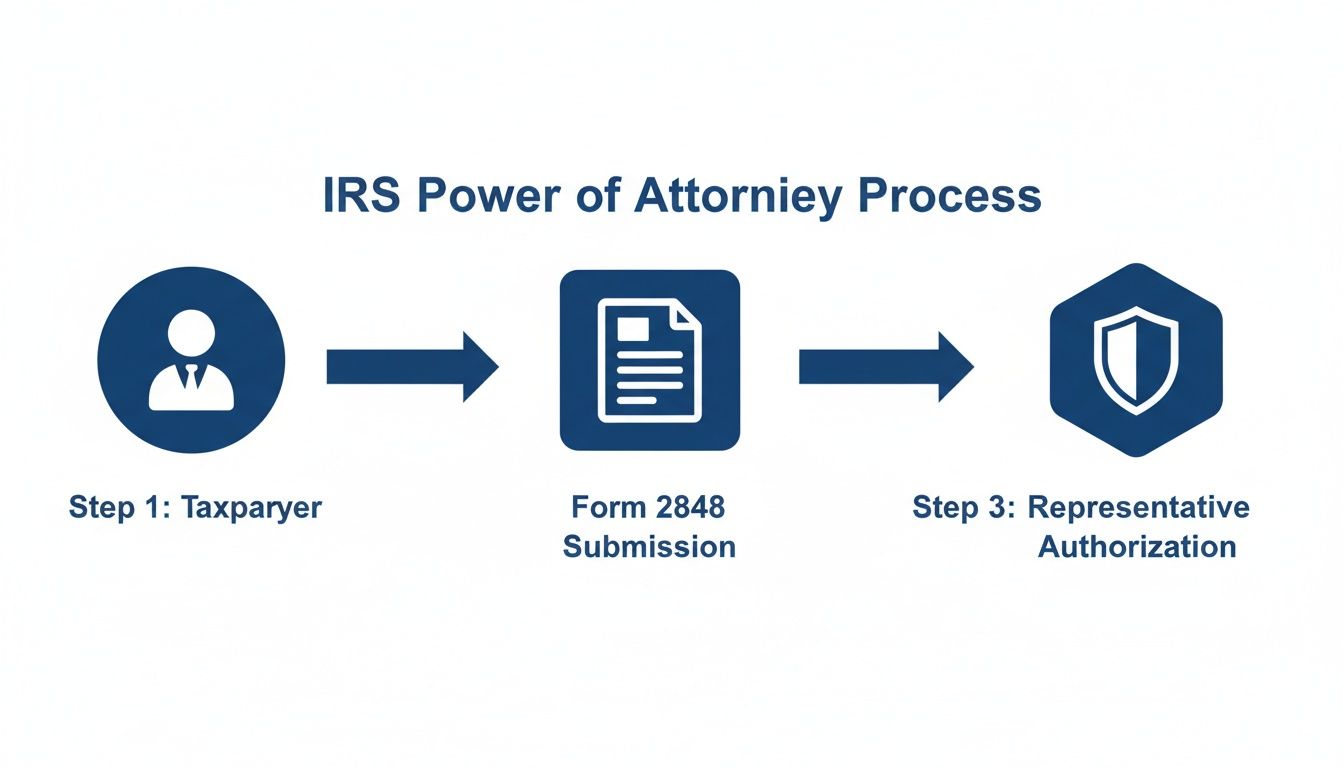
This simple document is what puts your expert squarely between you and the IRS, allowing them to handle everything from that point forward.
Stage 1: The Initial Response and Strategy
The moment that dreaded IRS notice arrives, the clock starts ticking. Your representative’s first move is to analyze the letter to figure out exactly what the IRS is looking at, the years involved, and the type of audit they’re conducting. They will immediately file Form 2848, which officially tells the IRS to direct all future communication to them, not you.
This is a critical first step. It ensures you never have to speak directly with an auditor, which prevents you from accidentally saying something that could hurt your case. From here, your representative establishes a controlled, professional line of communication and begins mapping out the defense.
Stage 2: Document Gathering and Case Building
This is where the real work begins. Your representative will give you a detailed list of every single document needed to support the items on your tax return. This isn’t just about dumping a box of receipts on their desk; it’s about carefully organizing proof into a clear, persuasive story that directly answers the auditor’s questions.
To manage what can be an enormous amount of paperwork, many professionals use specialized document automation software. This helps create an organized, professional submission package that’s easy for the auditor to review.
A well-organized case file does more than just answer questions—it sends a powerful message to the auditor. It shows that you are serious, prepared, and have professional backing, which can often lead to a smoother and faster audit process.
Your rep will meticulously review every document, checking for consistency and making sure only relevant information is handed over. This is key to preventing "scope creep"—where an auditor starts digging into other areas of your finances that weren't part of the original inquiry.
Stage 3: Managing Communications and Interviews
Once the case is built, your representative takes over all contact with the IRS agent. They handle every phone call, respond to every email, and manage all formal requests for more information. If the auditor demands a meeting, your representative goes in your place.
Their experience is invaluable here. They know the kinds of questions auditors ask, how to answer precisely without giving up unnecessary information, and how to keep the conversation focused. This skilled management prevents you from making a simple mistake that could turn a small issue into a major problem.
Stage 4: Negotiation and Proposed Adjustments
After reviewing everything, the auditor will issue a report with their findings. This report will likely propose changes to your tax bill. This is when your representative’s negotiation skills truly shine.
They will dissect the auditor’s position, pinpoint weaknesses in their arguments, and push back with counter-arguments based on tax law and the evidence provided. The goal is simple: challenge every proposed adjustment that isn’t 100% justified to minimize any extra tax, penalties, and interest. This is a high-stakes game. In a recent fiscal year, IRS agents concluded over 505,000 examinations, uncovering $29 billion in additional taxes. With audit rates for taxpayers earning over $10 million now at 11.0%, having an expert negotiator is more important than ever.
Stage 5: Final Resolution and Appeals
If your representative reaches a fair agreement with the auditor, they’ll review all the final paperwork before you sign off. But if you and the auditor can’t see eye-to-eye, the fight is far from over.
Your representative will then guide you through the IRS appeals process. The Office of Appeals is an independent branch of the IRS that takes a fresh look at disputed cases. Your rep will prepare a formal protest and argue your case before an Appeals Officer, who has far more flexibility to settle and compromise. In many situations, a skilled representative can achieve a much better outcome in Appeals than was ever on the table during the initial audit. For those facing penalties, you might find our guide on how to request penalty abatement with Form 843 helpful.
How to Choose the Right IRS Audit Representative for Your Case
Picking the right professional to defend you is, without a doubt, the most important decision you'll make during an audit. This single choice sets the tone for everything that follows—the strategy, the negotiations, and ultimately, the outcome. For folks here in Michigan, that means finding an IRS audit representative who has the right credentials, sure, but also relevant experience and a handle on local tax issues.
Think of it like hiring a specialist for a complex medical procedure. You wouldn't ask your family doctor to perform heart surgery; you’d seek out a proven expert who knows that procedure inside and out. The same logic holds true for an IRS audit. Your mission is to find the professional whose skills are a perfect match for the unique challenges of your tax situation.
Vetting Your Potential Representative
Finding the right fit means looking past a fancy title or the size of a firm's name on a billboard. You need to get into the details of what they actually do and how they operate. A little systematic vetting now will help you choose with confidence and sidestep some very costly mistakes later on.
A great place to start is by making a simple checklist of what matters. A quality representative should easily tick every box, showing not just that they're competent, but that they're committed to your specific case.
Here are the key things to dig into:
- Credentials and Licensing: First things first, confirm they are a licensed Tax Attorney, CPA, or Enrolled Agent in good standing. This isn't just a nice-to-have; it's the absolute minimum requirement.
- Specific Audit Experience: Don't be shy. Ask them directly about their track record with cases like yours. Have they dealt with audits for Michigan small businesses? High-net-worth individuals? Cryptocurrency gains? The specific deductions you claimed?
- State-Level Knowledge: How familiar are they with the Michigan Department of Treasury? A local firm will instinctively understand the state’s enforcement quirks and how a federal audit could spill over and affect your state tax filings.
- Communication Style: Find out who you'll actually be talking to. Will you have a direct line to the person managing your defense, or will you be handed off to a junior associate or paralegal? When you're stressed, clear and consistent communication is everything.
A top-tier representative doesn’t just answer your questions; they anticipate them. They should be able to break down complex tax rules into plain English and give you a clear roadmap of what to expect every step of the way.
Understanding Fee Structures
Of course, cost is a factor. But be careful—the cheapest option is rarely the best. What you really need is transparency. Your representative should be able to clearly explain their fee structure, whether it’s a flat fee for the entire case, an hourly rate, or a retainer.
If someone promises you a specific outcome or makes big guarantees, that's a major red flag. A trustworthy professional will give you a realistic, honest assessment of your situation and a clear engagement letter that spells out all the costs involved. No surprises.
Local Michigan Firm vs. National Chain: A Comparison
For taxpayers in Michigan, one of the biggest decisions is whether to hire a local firm or one of the large, out-of-state national chains you see on TV. While national companies have a wide reach, a dedicated local firm brings powerful, distinct advantages to the table. They have on-the-ground knowledge of local IRS offices and state tax authorities that can be incredibly valuable, often leading to a more personal and effective defense strategy.
Here's a quick breakdown of what that difference often looks like:
| Feature | Local Michigan Firm | Large National Firm |
|---|---|---|
| Case Handling | Your case is typically managed by a senior attorney or partner from start to finish. | You may be assigned to a case manager or junior associate you never actually speak with. |
| Local Expertise | Deep understanding of Michigan Department of Treasury issues and local IRS field office procedures. | General knowledge of federal tax law but limited insight into state-specific nuances. |
| Communication | Direct access to your representative, ensuring you can get quick answers and timely updates. | Often routed through call centers, leading to frustrating delays and impersonal service. |
| Strategy | A personalized strategy built around the specific facts of your case and local enforcement priorities. | Frequently use a standardized, one-size-fits-all approach to resolving cases. |
Ultimately, a local firm offers a partnership. You're not just another case number in a massive system; you're a neighbor, and your case gets the focused, expert attention it deserves.
Take Control of Your IRS Audit Today
That IRS notice in your mailbox can make your stomach drop. It’s an intimidating piece of mail, but facing it with a clear strategy is the only way to get through to the other side. An IRS audit is a serious financial challenge, there's no doubt about it, but it’s completely manageable when you have the right professional in your corner. You absolutely do not have to go through this alone.
An IRS audit representative is your shield and your advocate. Think of them as a seasoned guide who knows the terrain inside and out. Their job is to step in and manage every single interaction with the IRS, from the very first phone call to negotiating the final settlement. Choosing a qualified and experienced pro isn't just a good idea—it's the single most important step you can take toward a positive outcome.
Your Path to a Resolution
This is where you stop worrying and start acting. A specialized firm like Defense Tax Partners takes all the complex rules and procedures we've discussed and puts them to work for you. We manage the entire audit process from start to finish, freeing you up to focus on your life and business without the constant weight of the IRS on your shoulders.
Our team handles everything:
- Initial IRS Inquiries: The moment you hire us, we take over all communications. This immediately stops you from accidentally saying or doing something that could hurt your case.
- Strategic Defense: Our attorneys dive deep into your records, building a strong, evidence-based case to defend your financial position and challenge the IRS's assumptions.
- Final Negotiation: We fight to minimize any potential tax liability and work toward a resolution you can actually live with, one that aligns with your financial reality.
Having a pro on your side is more critical now than ever. In a recent fiscal year, the IRS closed 505,514 audits and assessed an additional $29 billion in taxes. And with audit rates for millionaires climbing as high as 11.0%, it's clear the agency is targeting complex cases where expert representation is no longer a luxury—it's a necessity. You can see the full breakdown in the official IRS Data Book.
An audit doesn't have to control your life. When you hire an expert, you're not just getting a representative; you're buying back your peace of mind and taking the first real step toward putting this problem behind you for good.
Don't let fear and uncertainty dictate what you do next. The best way forward is to talk through the specifics of your case with someone who has seen it all before. If you're looking for ways to settle tax debt, our guide on the Offer in Compromise program is a great place to start.
Take that first step today. Contact Defense Tax Partners for a free, confidential consultation. We'll review your IRS notice, answer your questions, and lay out a clear, no-obligation plan to get you back on track.
Frequently Asked Questions About IRS Audit Representation
Getting that notice from the IRS instantly sparks a dozen questions. It's natural to feel a bit overwhelmed, but getting clear answers is the first step toward taking control. Let's walk through some of the most common things people ask when they're thinking about hiring an IRS audit representative.
Do I Really Need a Representative for a Simple Audit?
It's tempting to handle a "simple" mail audit yourself, especially if it seems like just a request for a few documents. But here's the thing: even the most straightforward-looking audits can spiral. One disorganized response or an answer that unintentionally raises more questions can turn a small inquiry into a much larger investigation.
Think of it this way: a professional representative acts as a strategic filter. They make sure the IRS gets exactly what they asked for—nothing more, nothing less. By managing the process with precision from the very start, they prevent the scope from creeping and work to get the matter closed quickly and cleanly.
What Is the Typical Cost for an IRS Audit Representative?
The cost really depends on how tangled your situation is. Some representatives charge a flat fee to see the whole process through, while others might bill hourly. It's also pretty standard to pay a retainer, which is an upfront fee that goes into a trust account.
A word of caution: be skeptical of anyone who promises a guaranteed win for a rock-bottom price. A trustworthy professional will be upfront about their fees after they've had a chance to really dig into your case during an initial consultation. Their focus is on achieving the right outcome, not just a cheap one that could end up costing you far more down the road.
The investment in a qualified representative often pays for itself by minimizing additional taxes, preventing costly penalties, and saving you countless hours of stress and lost productivity.
How Long Does an IRS Audit Usually Take?
There’s no single answer here—an audit can take anywhere from a few months to well over a year. The timeline really hinges on a few key things:
- Type of Audit: A mail audit is usually the quickest. A field audit, where they come to your home or office, is the most involved and takes the longest.
- Complexity of Issues: If your audit involves tricky business dealings, spans multiple tax years, or touches on complicated areas of tax law, it's naturally going to take more time.
- Availability of Records: The faster you can get your documents in order and hand them over to your representative, the more efficiently they can build your defense.
Your representative’s job is to manage this timeline. They’ll keep you in the loop, push to keep things moving, and know how to avoid bureaucratic delays. They understand the deadlines and who to call at the IRS to get things done.
Can I Still Hire a Representative if My Audit Has Already Started?
Yes, absolutely. It is never too late to call in an expert. Even if you've already had a few back-and-forths with the auditor, an IRS audit representative can jump in, file a Power of Attorney, and immediately take over all communications.
Bringing in a professional mid-stream can be a game-changer. They can assess the situation, correct any early mistakes, and reset the tone with the auditor. From that point forward, they'll handle everything with the expertise needed to secure the best possible outcome for you.
