
How long does a irs audit take: A Practical Timeline
When that letter from the IRS arrives, one question usually drowns out all the others: **how long is this audit going to take?When that letter from the IRS arrives, one question usually drowns out all the others: how long is this audit going to take? There’s no single answer, as an audit can wrap up in a few months or stretch on for more than a year. The timeline really hinges on the specific type of audit you’re facing.
Understanding Your IRS Audit Timeline
The phrase "IRS audit" can conjure images of a long, drawn-out investigation, but that's not always the case. In fact, many audits are fairly simple and resolved entirely through the mail. The key to getting through the process is to first understand that not all audits are created equal.
The IRS has different levels of review, and knowing which one applies to you is the first step in creating a clear roadmap. Think of it like a vehicle inspection. A quick check of your registration is simple, much like the most common type of audit. A more thorough review at a designated service center is a bit more involved. And a full, on-site examination is the most comprehensive of all.
The Three Main Audit Categories
Each type of audit has its own procedures, documentation requirements, and, of course, its own timeline. The complexity of the issues on your tax return and how organized your records are will also be major factors. For Michigan taxpayers, getting a handle on these differences can turn that initial anxiety into a structured plan.
Here are the three main categories of IRS audits you might encounter:
- Correspondence Audit: This is the most common and least intimidating audit, handled completely by mail.
- Office Audit: This type requires you to bring your documents to a local IRS office for an in-person review.
- Field Audit: This is the most in-depth audit, where an IRS agent comes to your home or place of business.
An audit's timeline isn't set in stone. It's shaped by the type of audit, the complexity of the tax issues involved, and how prepared and cooperative you are throughout the process.
To give you a better sense of what to expect, the table below provides a quick overview of each audit type, its typical duration, and what it generally involves.
IRS Audit Timelines at a Glance
This quick-glance table compares the three main IRS audit types, helping you set realistic expectations for the road ahead.
| Audit Type | Average Duration | Complexity | What It Involves |
|---|---|---|---|
| Correspondence Audit | 3-6 Months | Low | Mailing documents to the IRS to verify specific deductions or credits. |
| Office Audit | 6-12 Months | Medium | Meeting with an auditor at an IRS office to review financial records. |
| Field Audit | 1-2+ Years | High | An agent conducting an in-depth review at your business or residence. |
As you can see, the level of intrusion and the time commitment can vary dramatically. Knowing where you stand is the first step toward a successful resolution.
The Three Types of Audits and Their Timelines
So, how long does an IRS audit really take? The honest answer is: it depends entirely on the type of audit you’re facing. Not every audit is the high-stakes, in-person grilling you see in movies. In fact, most are surprisingly low-key and handled completely through the mail.
Knowing which type you're up against is the first step in figuring out what to expect and how long it will all last. Each has its own process, level of intensity, and, of course, its own timeline. Let's break them down, starting with the most common.
Correspondence Audits: The Quickest Resolution
The overwhelming majority of IRS audits are correspondence audits. Think of this as the IRS simply asking for a receipt. They aren't launching a full-scale investigation; they just need to verify a specific item on your return, like a charitable donation, a tuition credit, or a reported income figure that doesn't quite match their records.
You’ll get a letter in the mail asking for documents to back up that one item. That’s it. You send the information back, and the whole thing is handled without ever speaking to an agent. Because the scope is so laser-focused, these audits are almost always the fastest to close.
Most correspondence audits are wrapped up within three to six months, assuming you provide clear, organized documents right away.
Office Audits: A Deeper Review
Next up is the office audit, which is a more formal and time-consuming process. For this, you’ll be asked to come into a local IRS office and meet an auditor face-to-face. The scope here is usually wider than a mail audit, digging into several related items on your return.
For instance, an office audit might scrutinize all of your claimed business expenses, your full schedule of itemized deductions, or the income and losses from a rental property. Because there's more to review and a formal meeting involved, the timeline naturally stretches out. An office audit typically takes anywhere from six to twelve months to fully resolve.
Field Audits: The Most Comprehensive Examination
The most intensive and lengthy audit is the field audit. This is the one people dread. An IRS agent will actually come to your place of business, your home, or your representative’s office to conduct a thorough examination of your financial records. These are generally reserved for complex situations, like audits of large businesses or individuals with very complicated financial lives.
A field audit is a deep dive. The agent will likely review your entire tax return—and possibly returns from other years—not just a few line items. Given the sheer volume of information and the detailed back-and-forth required, these can easily last for one to two years, and sometimes even longer.
This infographic gives a great visual breakdown of what to expect for each audit type.
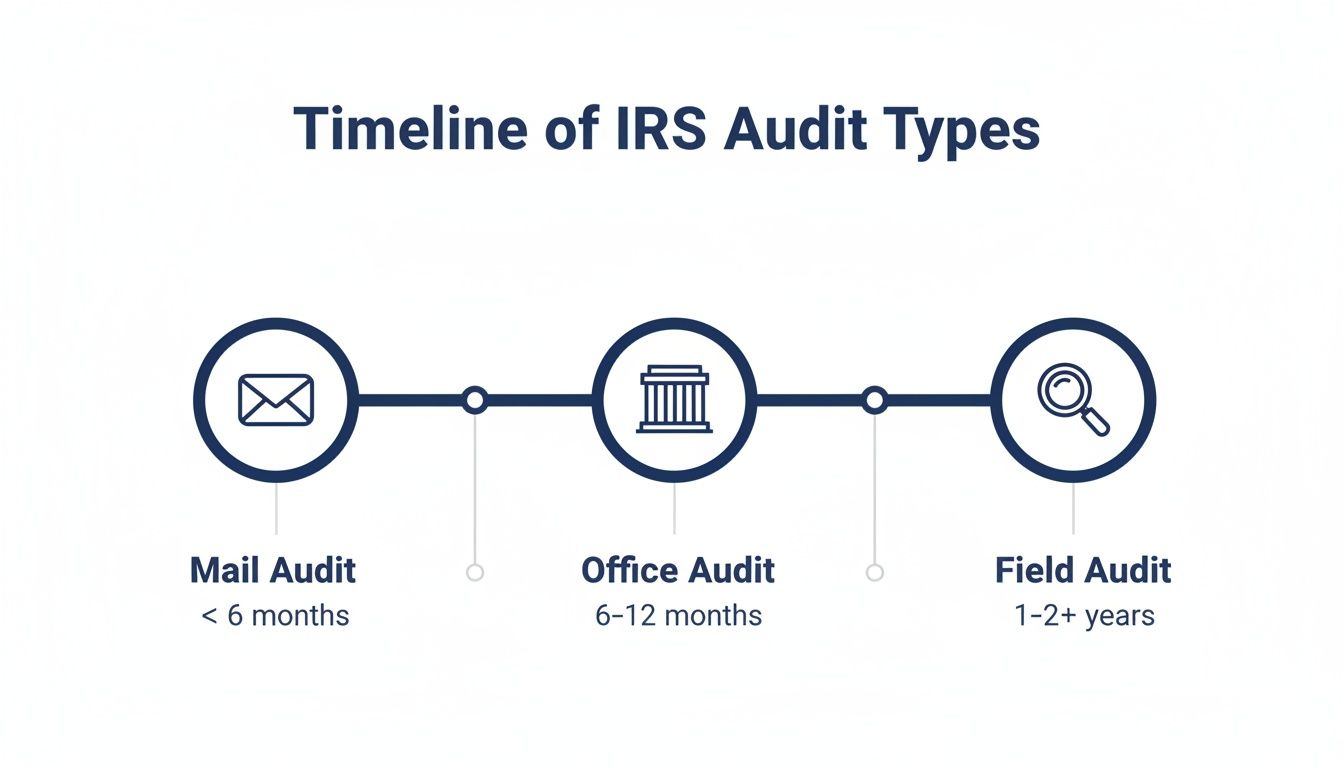
As you can see, the time commitment ramps up significantly as you move from a simple letter to a full, on-site examination. IRS data backs this up, confirming mail audits often close in under six months, office audits can take up to a year, and field audits frequently extend from 12 to 24 months or more. If you're looking for more details, you can discover insights about how the IRS audit process works and find some more in-depth timeline information.
What Factors Can Change Your Audit Timeline?
While the type of audit—correspondence, office, or field—gives you a ballpark estimate of the timeline, several other factors can drastically change how long the process actually takes. Think of it like a road trip. The type of audit is your destination, but the complexity of your tax return and your own responsiveness are the traffic and road conditions that determine when you’ll actually arrive.
These two variables, the complexity of your finances and how you handle the audit process, are the most significant drivers of your audit experience.
The Complexity of Your Tax Return
A simple tax return with W-2 income and the standard deduction is usually a quick review for an IRS agent. But as you add layers of financial activity, you also add time to the audit.
Expect the process to take longer if your return involves any of these elements:
- Business Income and Expenses: If you're self-employed, the IRS will want to see detailed proof for all your claimed expenses.
- Rental Properties: Owning rental properties means the agent needs to verify income, depreciation schedules, and all related property expenses.
- Significant Investments: A high volume of stock trades, capital gains, and losses requires a much more thorough validation process.
- Foreign Bank Accounts or Assets: This is a major red flag for the IRS and brings a whole new level of scrutiny, often adding months to the audit.
Your Responsiveness and Organization
How you respond to the IRS is one of the few things you can actually control. A slow or disorganized response sends a signal to the auditor that this will be a difficult case, which often encourages them to dig even deeper. On the other hand, providing prompt, clear, and well-organized documents builds trust and helps move things along quickly.
Auditors can get through organized financial records far more efficiently. This really underscores the difference between structured data vs unstructured data in a practical sense. A Detroit business owner with immaculate books might wrap up a complex field audit faster than someone with a shoebox full of receipts facing a simple correspondence audit.
Your ability to provide clear, complete, and timely information is the single greatest tool you have to shorten the duration of an IRS audit.
It's also important to remember that broader IRS backlogs can affect your individual case. The National Taxpayer Advocate’s annual report recently showed the IRS took an average of over 13 months to process business amended returns. While that’s not an audit, it gives you an idea of how systemic delays can slow everything down.
Other things are simply out of your hands. The specific issues being examined, the individual examiner’s caseload, and whether a specialist needs to be called in all play a role. If your auditor is overloaded with cases, yours might sit untouched for weeks. If your audit involves a complex real estate transaction that requires an expert review, that will add more time. In situations where you believe a tax was assessed incorrectly, you may need to seek a tax abatement. For more on that process, see our guide on how to properly file for a tax abatement using Form 843.
Navigating the Five Stages of an IRS Audit

To really get a handle on how long an IRS audit might take, it helps to understand the journey ahead. Every audit, whether it's a simple letter or a full-blown field examination, follows a predictable path. Think of it as a roadmap with five distinct stops.
Knowing what's coming removes the fear of the unknown. It allows you to anticipate the next turn and prepare for it. Let's walk through the five stages of an IRS audit, from that first dreaded letter to the final resolution.
Stage 1: The Audit Notification
This is where it all starts. You'll receive an official notice from the IRS, almost always by mail, informing you that your tax return has been flagged for examination. The letter will be very specific, naming the tax year in question and often pointing out the exact items under review.
Crucially, this initial notice tells you what kind of audit you’re facing—correspondence, office, or field. It will also give you the name and contact info for the agent or department handling your case. This is your signal to start gathering your records.
Stage 2: The Information Request
Right after the notification, the IRS will ask for specific documents to back up the numbers on your return. For a simple correspondence audit, this might just be a request for a few receipts or bank statements. For more complex office or field audits, this can be a much longer, more detailed list.
This is formally known as an Information Document Request (IDR). Your speed and thoroughness in responding to the IDR directly influence the audit's timeline. This is where organized bookkeeping really pays off.
Stage 3: The Examination
Here's the heart of the audit. The IRS agent meticulously reviews the documents you've provided and compares them to your tax return. For a mail audit, this happens entirely behind the scenes. For office or field audits, this stage involves face-to-face meetings where the examiner will likely ask pointed questions about your records.
The agent is trying to understand the story behind your finances. It’s a period of analysis and clarification, and it can involve several rounds of communication. If you want a deeper dive into the questions and scenarios you might face, you can read more about what happens if you get audited in our detailed guide.
Stage 4: The Agent's Findings
Once the examiner has finished their review, they will issue a report outlining their findings. This document, often called a Revenue Agent Report (RAR), details any proposed changes to your tax bill. You'll get a chance to review this report thoroughly.
This stage is a critical fork in the road. You can agree with the findings and accept the proposed changes, or you can disagree and get ready to challenge the decision.
Stage 5: The Final Resolution
This last step is all about reaching a conclusion. If you agree with the agent’s findings, you'll sign an agreement form. The IRS will then send a final notice for any balance due, and just like that, the audit is officially closed.
But if you disagree, you move into the appeals process. This can easily add several more months to the clock, but it also opens the door to negotiating a better outcome with the IRS Office of Appeals. Once an agreement is reached there or the appeals process runs its course, your audit is finally complete.
How Professional Representation Can Expedite the Process

Trying to face the IRS by yourself can feel like you’re navigating a labyrinth in the dark. It’s an incredibly stressful situation where a simple misplaced word or a disorganized document can add months—or even years—to the audit. When you bring in an experienced tax attorney, the entire dynamic shifts from a confusing ordeal to a professionally managed process.
Your attorney becomes your shield and your spokesperson, handling every phone call, letter, and request from the IRS. This creates an immediate professional buffer, so you don't have to worry about accidentally saying something that could complicate your case. They speak the same language as the auditors and know exactly how to present information in a way that’s clear, correct, and complete.
Streamlining Communication and Strategy
One of the biggest advantages of having a pro on your side is their ability to see a few moves ahead. A seasoned tax attorney knows what auditors are trained to look for and can get your documents and arguments ready before the IRS even asks for them. This foresight cuts through the frustrating back-and-forth that often stalls audits for people who go it alone.
Think of it like this:
- Proactive Document Preparation: Instead of scrambling for receipts, your attorney will help you assemble a polished, organized package that directly addresses the auditor's key questions.
- Strategic Negotiation: Tax professionals are expert negotiators. They know how to challenge an auditor’s incorrect assumptions and work towards a fair resolution far more effectively than someone without that experience.
This hands-on management directly shrinks the timeline by sidestepping the common delays caused by missing information or procedural confusion.
"A tax professional doesn't just defend you; they streamline the entire audit. Their expertise in IRS procedure and negotiation can be the difference between a process that drags on for years and one that concludes efficiently."
The Value of Local Michigan Expertise
For taxpayers here in Michigan, working with a local firm provides another critical edge. They're not just tax experts; they're experts on how tax law is applied right here. They have practical experience dealing with the IRS offices in Detroit and other Michigan locations, which means they understand local priorities and personnel. To keep your filings in order and help avoid lengthy audits in the first place, using professional tax compliance services can be a game-changer.
Ultimately, hiring an expert is an investment in your peace of mind and your time. It minimizes your stress, protects your rights, and almost always leads to a faster, better outcome. If you've received that dreaded notice, your first step should be learning what a dedicated IRS audit representative can do for you.
Common Questions About IRS Audit Timelines
Even with a good understanding of the process, you're bound to have questions once an audit starts. Let's tackle some of the most frequent concerns we hear from Michigan taxpayers about the timelines and rules of the road.
Does the IRS Have a Deadline to Complete an Audit?
This is a common point of confusion. The IRS generally has three years from the date you filed your return to start an audit. This is called the statute of limitations. But once they begin, there's no hard-and-fast deadline for them to finish it.
That initial three-year window isn't always set in stone. It can change dramatically:
- The clock extends to six years if the IRS believes you've understated your income by more than 25%.
- There's no time limit at all in cases of suspected fraud or if you never filed a return in the first place.
So, while the IRS tries to wrap things up within their statutory window, the audit itself can keep going once it's underway.
Can I Request an Extension to Gather My Documents?
Absolutely. The IRS is usually reasonable about granting extensions, provided you have a good reason and you ask for it professionally. The key is to be proactive—don't wait until the day before your deadline.
It's always best to make this request in writing as soon as you know you'll need more time. A short, one-time extension is pretty standard. However, asking for multiple or very long delays can start to look like a stalling tactic, which is why having a tax professional handle these communications can be a smart move.
What if the Statute of Limitations Is About to Expire?
As that three-year deadline approaches, you might get a request from the IRS to sign a form extending it. This is a pivotal moment in any audit, and you shouldn't take it lightly.
If you agree, you’re giving the agent more time to dig through your records. If you refuse, they might be forced to make a quick decision based on the incomplete information they have—a decision that rarely works in the taxpayer's favor.
Deciding whether to extend the statute of limitations has significant consequences. We strongly recommend consulting with a qualified tax attorney before signing any consent form.
How Long Do I Have to Pay After an Audit?
If the audit wraps up and you owe more tax, the IRS will send a formal bill with a payment due date. If you can't pay the full amount right away, don't panic. You have options.
You might be able to set up a payment plan, officially known as an Installment Agreement, or explore other tax relief programs. An experienced tax attorney can be invaluable here, helping you negotiate the best possible terms and protecting your assets from aggressive collection actions like liens or levies.
