
IRS: irs currently not collectible status – What It Means for Your Debt
When the IRS comes knocking, the pressure can feel immense. But what if you truly can't afford to pay what you owe? That's where a little-known but powerful provision called Currently Not Collectible (CNC) status comes into play.
Think of CNC as the IRS officially hitting the 'pause' button on your tax debt. It's a formal recognition that, right now, you don't have the financial means to pay your tax bill without experiencing what they call "severe financial hardship." In plain English, this means paying the IRS would prevent you from covering essential living costs like rent, food, or medical care. It's not forgiveness—the debt doesn't disappear—but it provides critical breathing room when you need it most.
What It Means to Be Currently Not Collectible

Being placed in Currently Not Collectible status means the IRS has reviewed your finances and agrees that you simply can't pay them at this time. It’s their way of acknowledging that trying to collect from you would do more harm than good, potentially pushing you into an even deeper financial hole.
Let's put this in a real-world context. Say you're a skilled tradesperson in Detroit, just getting by, when a past tax issue catches up with you. The IRS says you owe thousands, but you're already struggling to cover your mortgage and utility bills. Forcing you to pay would be devastating. This is precisely the kind of situation CNC status was designed for—to provide a lifeline to hardworking people across Michigan facing a temporary, but serious, financial crisis. You can learn more about the specific IRS guidelines for economic hardship to see how they define it.
The Immediate Impact of CNC Status
The moment the IRS places your account in CNC status, the most aggressive and stressful collection tactics come to a halt. The relief is immediate and palpable. It’s a shield that lets you focus on stabilizing your life without the constant threat of enforcement actions.
Here's a quick look at the major aspects of CNC status to give you a clearer picture.
CNC Status At a Glance: Key Features and Implications
| Feature | Description |
|---|---|
| Pause on Collections | The IRS will immediately stop most collection activities, including wage garnishments, bank levies, and property seizures. |
| Interest & Penalties | These continue to accrue. The underlying tax debt will grow while your account is in CNC status. |
| Tax Liens | The IRS may still file a Notice of Federal Tax Lien to protect its interest, but won't actively seize property. |
| Future Refunds | Any future tax refunds you are owed will be automatically seized and applied to your tax debt. |
| Regular Reviews | The IRS will periodically review your financial situation to see if you can resume payments. |
This table shows that while CNC offers a powerful reprieve, it's not a permanent "get out of jail free" card.
Most importantly, CNC stops these specific actions in their tracks:
- Wage Garnishments: Your employer will no longer be ordered to send a portion of your paycheck to the IRS.
- Bank Levies: The IRS will stop seizing funds directly from your bank accounts.
- Property Seizures: Active efforts to take your physical assets will cease.
It is important to understand that CNC status is not a permanent solution. While it provides temporary relief, interest and penalties continue to accumulate on your outstanding tax balance, causing the total amount you owe to grow over time.
The whole point of this temporary suspension is to give you a chance to get back on your feet. The IRS understands that trying to wring money out of someone who can't afford basic necessities is a losing game for everyone involved.
How the IRS Determines Your Financial Hardship
When you ask the IRS for Currently Not Collectible status, they don't make a decision based on your story or a gut feeling. It’s all about the numbers. The entire process boils down to a single, critical calculation.
The IRS essentially creates a budget for you based on your unique circumstances and then compares it to your actual income. If there’s nothing left over at the end of the month, they’re likely to agree that you can’t afford to pay your tax debt right now.
The Core Calculation: Income vs. Allowable Expenses
The IRS takes a hard look at every dollar you earn and subtracts what they consider to be reasonable and necessary living expenses. This isn't about what you actually spend; it’s about what the IRS allows you to spend based on a set of national and local standards.
To get a clear picture of how this works, you first need to calculate your disposable income the way the IRS would. They look at specific categories, each with its own set of rules.
Here's a breakdown of what the IRS generally considers "allowable":
- Housing and Utilities: This covers your core shelter costs—things like rent or mortgage, property taxes, home insurance, and essential utilities like gas, electricity, and water. The approved amounts are tied to local standards for your specific county here in Michigan.
- Food, Clothing, and Miscellaneous: For everyday necessities, the IRS uses a national standard that varies based on your income level and the number of people in your household.
- Transportation: Whether you drive or take the bus, the IRS has an allowance for it. This can cover car loan payments, fuel, maintenance, and insurance, or the cost of public transit, all based on a mix of local and national data.
- Out-of-Pocket Health Care: This category includes your health insurance premiums, co-pays, prescription costs, and other medical expenses not covered by insurance.
If your total monthly income is the same as—or even less than—these combined allowable expenses, the IRS will generally agree that you’re facing a financial hardship.
Proving Your Case with Documentation
You can't just tell the IRS you're struggling; you have to prove it with detailed financial records. The primary tool for this is a Collection Information Statement, which for most people is Form 433-F.
This form is a complete financial snapshot, and every number you put on it must be backed up with solid evidence. For a closer look at the different types of collection forms and how they work, check out our guide on Form 433-A (OIC), which is often used in more complex cases.
Get ready to gather a stack of documents. The IRS will want to see things like:
- Recent pay stubs or proof of income
- Bank statements from the past three to six months
- Mortgage statements or rental agreements
- Copies of your utility bills
- Statements for any car loans and auto insurance
- Proof of your healthcare premiums and other medical costs
The IRS uses this paperwork to verify every claim you make on your Form 433-F. If the numbers show that your income is completely consumed by these necessary expenses, you have a strong case for CNC status.
One last, crucial point: the IRS won't even consider your request for irs currently not collectible status until you are fully caught up on filing your taxes. If you have any unfiled tax returns, getting those submitted is the absolute first step. It's a non-negotiable part of the process.
Your Step-by-Step Guide to Requesting CNC Status
Think of requesting Currently Not Collectible status not as just asking for a break, but as building a formal, documented case for the IRS that proves you’re facing a genuine financial hardship. Approaching it with a clear, methodical plan is your best bet for a successful outcome.
The very first hurdle is compliance. Before the IRS will even look at your hardship request, you must have filed all of your past-due tax returns. This is an absolute must—it shows the IRS you're making a good-faith effort to get right with your obligations.
Preparing Your Financial Case
Once all your returns are filed, it’s time to gather the evidence. This is the most crucial part of the process, where you collect all the financial documents needed to paint a clear and accurate picture of your situation for the IRS.
Here’s a checklist of the core documents you’ll need:
- Proof of Income: Your most recent pay stubs, Social Security statements, or if you're self-employed, a profit and loss statement.
- Bank Records: Gather statements for all your checking and savings accounts, typically for the last three to six months.
- Housing Expenses: This could be your latest mortgage statement or a copy of your current lease.
- Utility Bills: Collect recent bills for essentials like electricity, water, and gas.
- Other Debts: Pull together statements for any car loans, student loans, or credit cards.
- Medical Costs: Include proof of health insurance premiums and any major out-of-pocket medical bills.
The IRS essentially boils all this information down to a simple calculation to see if you qualify for hardship.
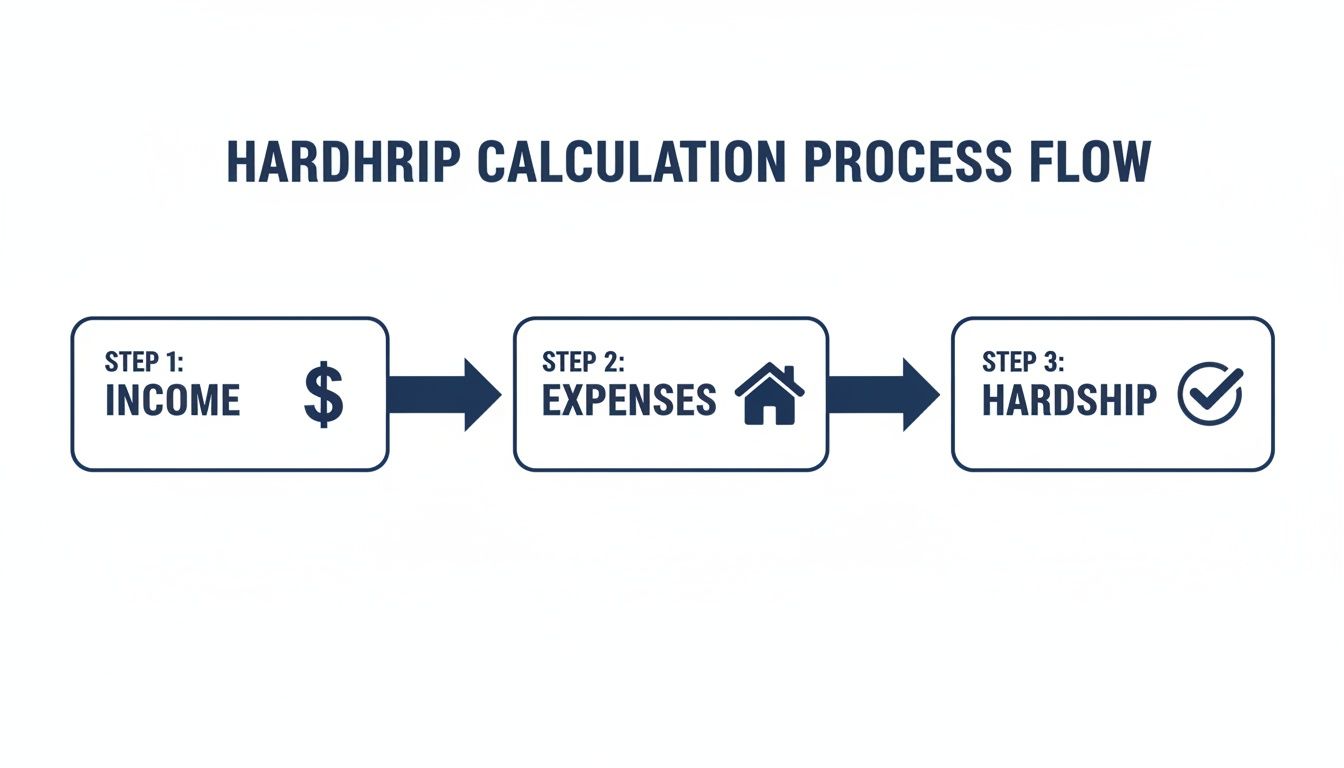
This flow—from what you earn to what you need to spend—is how the IRS ultimately decides whether to grant you irs currently not collectible status.
Completing and Submitting Your Application
With your paperwork organized, you’re ready to fill out the official IRS Collection Information Statement. For most individuals, this means tackling Form 433-F. Accuracy here is everything. Every single number you put on that form needs to line up perfectly with the documents you’ve gathered.
Even one small mismatch between your Form 433-F and your bank statements can be enough for the IRS to deny your request. Take the time to double-check every entry—this form is the heart of your CNC application.
Once the form is complete, put together your full application package. This will include the signed Form 433-F along with copies of all your supporting financial documents. A neat, organized package makes the IRS agent's job easier, which can only help your case.
Now, you submit it. The hard part is the waiting, as it can take the IRS several months to review your file and make a decision. Stay patient, and be ready to respond quickly if they reach out for more information.
Life After Your CNC Status Is Approved

Getting that IRS Currently Not Collectible status approved feels like a massive weight has been lifted. The relentless collection calls will finally stop. The constant fear of a bank levy or wage garnishment is gone, and you can finally breathe. This breathing room is exactly what CNC status is designed for—to give you a stable footing to work on improving your financial situation without the IRS breathing down your neck.
But it’s crucial to see CNC for what it is: a temporary shield, not a permanent cloak of invisibility. The tax debt itself doesn't just vanish. Think of it like hitting the pause button on a movie; the story isn't over, and when you press play again, it picks up right where you left off, often with more intensity.
The Ongoing Reality of Your Tax Debt
Even though active collections are on hold, your tax liability continues to evolve in the background. Two major things are still happening that you absolutely need to be aware of.
First, the meter keeps running. Interest and penalties continue to rack up on your unpaid balance. So, the amount you owed when you entered CNC status will be significantly less than what you owe when you eventually come out of it.
Second, you can almost always expect the IRS to file a Notice of Federal Tax Lien.
A tax lien is the government’s legal claim against your property to secure payment of your tax debt. It attaches to all your assets, like your house, car, and financial accounts, making it tough to sell anything or get new credit until the debt is settled.
This lien is a public record, which means it will likely damage your credit score and act as a major hurdle if you try to get a mortgage, car loan, or any other line of credit.
The IRS Review Process
The IRS won't just set your file aside and forget about it. The agency will periodically check in on your financial health to see if you can start paying again. These reviews typically happen every one to two years.
What usually triggers a review? Your annual tax return. If you file a return showing a substantial jump in income, it raises a red flag in their system. An agent will then likely take a fresh look at your file to determine if your financial hardship is over.
If they decide you’re back on your feet, they can revoke the IRS Currently Not Collectible status and move you toward a payment solution, like an Installment Agreement. The IRS’s ultimate goal is always to get you back to resolving your debt as soon as you are able.
Comparing CNC to Other Tax Relief Options
When you're facing a significant tax debt, figuring out the best way forward can feel overwhelming. The IRS has a few different programs to help, but choosing the right one is critical. Think of it like this: you wouldn't use a band-aid for a broken leg. The solution has to fit the problem, and when it comes to tax debt, that means matching the relief option to your specific financial reality.
The three main paths the IRS offers are an Installment Agreement (IA), an Offer in Compromise (OIC), and Currently Not Collectible (CNC) status. Each is designed for a completely different financial situation. Picking the wrong one isn't just a mistake; it can lead to a rejected application or a defaulted agreement, putting you right back in the path of aggressive IRS collections.
The Installment Agreement: For Those Who Can Make Payments
An Installment Agreement (IA) is the most common and straightforward solution. It’s basically a payment plan. This option is for people who can't pay their full tax bill right now but have enough steady income to make monthly payments over time.
You're a good candidate for an IA if your income reliably covers your necessary living expenses, and you still have a predictable amount left over each month. If you can afford to chip away at the debt—even if it's a small amount—without putting your family's basic needs at risk, the IRS will almost always steer you toward an IA. The typical term for these agreements is up to 72 months.
The Offer in Compromise: For a One-Time Settlement
An Offer in Compromise (OIC) is a much higher bar to clear. This program lets a taxpayer settle their tax liability for less than the full amount owed. It sounds great, but it's incredibly tough to get approved. The IRS accepts less than 40% of OIC applications because the standards are so strict. You can dive deeper into the specifics in our guide on what an Offer in Compromise is.
An OIC is really meant for someone whose financial situation makes it highly unlikely they could ever pay the full debt before the collection statute runs out. You have to convince the IRS that the amount you're offering is the most they can ever hope to get from you.
Currently Not Collectible: For True Financial Hardship
That brings us back to IRS Currently Not Collectible status. This is the safety net. CNC is reserved for people experiencing such severe financial hardship that they have nothing left after paying for basic necessities. If your income minus your IRS-allowed living expenses equals zero—or is a negative number—CNC is the only appropriate path.
CNC status is the IRS's way of officially recognizing that you simply cannot afford to pay anything toward your tax debt right now without giving up food, shelter, or other essentials. It's not a payment plan; it's a temporary pause on collections.
So, how do you know which path is yours? It boils down to this:
- Can you pay the full debt over time? An Installment Agreement is your best bet.
- Can you pay a portion of it in a lump sum or over a short period? It might be worth exploring an Offer in Compromise.
- Can you pay absolutely nothing right now without going under? You need to pursue Currently Not Collectible status.
Taking a hard, honest look at what you can truly afford is the first step toward finding a realistic solution and finally putting your tax problems behind you.
To make it even clearer, let's break down how these three options stack up against each other.
Comparing Tax Relief: CNC vs. Installment Agreement vs. Offer in Compromise
This table breaks down the key differences between the three main IRS tax relief options to help you determine the best fit for your financial situation.
| Feature | Currently Not Collectible (CNC) | Installment Agreement (IA) | Offer in Compromise (OIC) |
|---|---|---|---|
| Who It's For | Taxpayers with no disposable income after essential living expenses. | Taxpayers who can afford monthly payments to pay the full debt over time. | Taxpayers who cannot pay the full debt but can pay a portion in a lump sum or short-term payments. |
| Impact on Debt | Pauses collections; debt remains and accrues interest/penalties. | Debt is paid in full over a set period (up to 72 months). | Settles the debt for less than the full amount owed. |
| Collection Status | IRS stops all active collections (levies, wage garnishments). | IRS collection actions are stopped as long as you make payments on time. | Collections are suspended during the application process. If approved, the remaining debt is forgiven. |
| Approval Difficulty | Moderate; requires proof of severe financial hardship. | Easiest to obtain, with streamlined options for some taxpayers. | Very difficult; strict eligibility and low acceptance rates (often <40%). |
| Duration | Temporary; reviewed annually or every two years. Status can be revoked if finances improve. | Lasts until the debt is fully paid, or the collection statute expires. | A one-time settlement. Once paid, the tax liability is resolved permanently. |
Understanding these distinctions is the foundation for a successful tax resolution strategy. Each option serves a vital purpose, but only one will be the right tool for your specific circumstances.
When to Hire a Tax Professional for Help
Trying to get the IRS to grant you Currently Not Collectible status can feel like navigating a labyrinth in the dark. While you can certainly attempt the process on your own, some situations make hiring a professional less of a luxury and more of an absolute necessity.
Think of a tax pro as your seasoned guide who not only has a map of that labyrinth but also knows all the shortcuts and potential dead ends. They speak the IRS's language fluently and can frame your financial situation in a way that clearly demonstrates hardship.
Situations Demanding an Expert’s Touch
You should seriously think about bringing in an expert if your financial life is anything but straightforward. This is especially critical in these scenarios:
- Self-Employment or Business Ownership: The IRS puts business owners' income and expenses under a much stronger microscope. A tax professional ensures your financial reporting is rock-solid and can withstand that scrutiny.
- High-Dollar Tax Debts: When the stakes are high and you owe a significant amount, the IRS isn't going to grant relief easily. An experienced tax attorney knows how to build a powerful case and isn't afraid to push back.
- Feeling Completely Overwhelmed: Let's be honest—the forms, deadlines, and constant worry can be incredibly stressful. Handing the reins to a professional can provide immediate relief and a clear path forward.
A skilled tax attorney does a lot more than just fill out forms. They become your shield, stepping between you and the IRS to manage all communication and negotiations. Their job is to protect your rights and your assets every step of the way.
An expert's touch ensures your Collection Information Statement (Form 433-F) is perfect, which dramatically increases your chances of getting approved for IRS Currently Not Collectible status on the first try. They also have a trained eye for spotting other relief options, like penalty abatement, that you might not even know exist.
Beyond just CNC status, a tax professional can also clarify other complex issues, like the intricacies of IRS rules regarding 1099 forms for attorney fees. When you partner with a firm like Defense Tax Partners, you're not just getting help with paperwork—you're getting a strategic plan designed to achieve the best, most permanent resolution for your tax problems.
Common Questions About CNC Status
Even after you get the basics down, you're bound to have some specific questions about how Currently Not Collectible status works in the real world. Let's tackle some of the most common ones I hear from clients so you can go into this process with your eyes wide open.
How Long Does IRS Currently Not Collectible Status Last?
Think of CNC status as a temporary pause, not a permanent stop button. The IRS will be checking in on your financial situation, usually every one to two years. They'll often just look at the income you report on future tax returns to see if things have improved.
If your income bounces back to a point where you can afford to make payments, the IRS will likely take you out of CNC and restart collections. The only other way it ends is if the ten-year statute of limitations on your tax debt expires. But be careful—actions like filing for bankruptcy or submitting an Offer in Compromise can pause that ten-year clock, extending it further than you might think.
Will a Tax Lien Be Removed If I Get CNC Status?
This is a big one, and the answer is almost always no. Getting placed in CNC status won't automatically get rid of a Notice of Federal Tax Lien that the IRS has already filed.
The IRS files a lien to protect its legal claim to your property, and they see that as a separate issue from your current inability to pay. That lien will stick around—hurting your credit and making it tough to sell assets—until the debt is fully paid, settled, or the collection statute runs out.
Key Takeaway: CNC status is fantastic for stopping aggressive collections like wage garnishments and bank levies. But it doesn't erase the debt itself or the government's legal claim against your property secured by a tax lien.
Can CNC Status Help with State Tax Debt?
Unfortunately, no. An IRS Currently Not Collectible status is a federal program that only applies to the money you owe the IRS. It offers zero protection from state tax agencies like the Michigan Department of Treasury.
Every state has its own set of rules and programs for handling financial hardship. You'll have to work with them directly to find a solution for your state tax problems. While CNC doesn't cross over, understanding federal relief options can be useful; our guide on filing Form 843 for tax abatement can offer some context for penalty relief requests. A tax professional can be invaluable here, helping you navigate both the federal and state systems at the same time.
