
A Practical Guide to IRS Form 433-A OIC for Tax Debt Relief
Think of Form 433-A (OIC) as the financial foundation of your entire Offer in Compromise. It's the detailed financial statement you provide the IRS to prove, with hard numbers, that you simply can't pay your full tax debt.
This isn't just another tax form. It’s a complete snapshot of your financial life—assets, income, and everyday living expenses. The IRS pores over this document to calculate your Reasonable Collection Potential (RCP), which ultimately determines whether they'll accept your settlement offer.
Your Path to an IRS Settlement
It's tempting to see Form 433-A (OIC) as just paperwork, but that's a mistake. It’s the primary evidence you have to argue for a financial fresh start. The whole point is to present a clear, honest, and verifiable picture of your financial reality. Why? Because the IRS needs this level of transparency to legally justify settling your tax bill for less than what you owe.
The Core of Your Offer in Compromise
The Offer in Compromise (OIC) program is a lifeline for taxpayers who are under serious financial strain. It allows them to resolve their tax liabilities for a lower amount, but only if they can demonstrate that paying the full debt would cause significant economic hardship. Form 433-A (OIC) is how you make that case.
The form demands a comprehensive breakdown of everything from your bank accounts and vehicles to your monthly grocery and utility bills. It's the central document in the IRS's evaluation of your genuine ability to pay, ensuring any settlement they agree to is based on what you can realistically afford.
Key Financial Concepts the IRS Will Scrutinize
When an IRS examiner picks up your file, they are immediately focused on two critical calculations derived from your Form 433-A. Getting these right is everything.
- Net Equity in Assets (NEA): This isn't what you think your assets are worth; it's what the IRS believes they could get for them in a quick, forced sale, minus any outstanding loans. This covers everything from your home and cars to retirement accounts and other investments.
- Monthly Disposable Income (MDI): This is calculated by taking your gross monthly income and subtracting your allowable monthly living expenses. The key word here is "allowable"—the IRS has strict national and local standards for what they consider a necessary expense, which might not match your actual spending.
The combination of these two figures is what establishes your Reasonable Collection Potential (RCP). This RCP is effectively the minimum offer amount the IRS will even consider.
Crucial Takeaway: The IRS isn't just looking at your bank balance on a single day. They are conducting a deep financial analysis of your past, present, and future earning potential to see what they could realistically collect over time. Your Form 433-A (OIC) has to be bulletproof to withstand that level of scrutiny.
Differentiating Form 433-A (OIC) from Other Versions
It is absolutely vital to use the correct version of the form. The IRS has several "433" forms, and they are not interchangeable. Submitting the wrong one is a fast track to getting your application rejected before it's even reviewed.
Many taxpayers get confused between the OIC-specific version and the standard Form 433-A. Here's a quick breakdown to keep them straight.
Form 433-A (OIC) vs Standard Form 433-A
| Feature | Form 433-A (OIC) | Standard Form 433-A |
|---|---|---|
| Primary Use | Exclusively for Offer in Compromise (OIC) applications. | Used for setting up Installment Agreements or proving Currently Not Collectible status. |
| Calculation Focus | Designed to calculate the Reasonable Collection Potential for a one-time settlement. | Used to determine an affordable monthly payment amount over time. |
| Level of Detail | Extremely detailed; requires extensive documentation for all financial claims. | Detailed, but the documentation requirements are often less stringent than the OIC version. |
| Submitted With | Must accompany Form 656, the official Offer in Compromise application. | Typically submitted as a standalone document or with an Installment Agreement request. |
Choosing the right form is the non-negotiable first step. For taxpayers here in Michigan, understanding the local nuances of how the IRS field offices process these forms can be a game-changer. For example, navigating an https://www.michigantaxattorneys.net/irs-tax-settlement-westphalia-mi/ requires a solid grasp of this entire process.
Given the complexities, many people authorize a professional to represent them. If you're considering that route, you'll need the right paperwork; this guide on IRS Form 2848, Power of Attorney and Declaration of Representative is a great resource.
Assembling Your Financial Documents for the OIC

Before you touch Form 433-A (OIC), the real work begins. You need to gather every single piece of financial paperwork that tells your story. I can't stress this enough: the success of your Offer in Compromise hinges on providing concrete, verifiable proof for every number you put on that form.
Think of it as building a legal case for your financial situation. Without solid evidence, your argument falls apart under the IRS's microscope. This isn't just about grabbing a few bank statements; it’s about weaving a clear, consistent financial narrative that justifies your request to settle. Any gaps or inconsistencies can trigger delays, endless information requests, or a flat-out rejection.
Foundational Income Verification
First things first, you have to prove what you earn. The IRS will look at all household income sources, typically averaging them over the last three to six months to get a clear picture.
- If you're a W-2 employee: Your life is a bit simpler here. Pull together your pay stubs for the last three months. Make sure they clearly show your gross pay, every deduction (taxes, insurance, 401k), and your final take-home pay. If you get bonuses or commissions, you’ll need proof of those, too.
- For the self-employed and contractors: This is where you need to be meticulous. You'll have to create a Profit and Loss (P&L) statement covering at least the last six to twelve months. Crucially, this P&L must be backed up by bank statements showing the corresponding business deposits and expenses.
- Don't forget other income: All money coming in counts. This includes Social Security, pension payouts, unemployment, rental income, alimony—everything. Have the most recent award letters or statements ready for each source.
Complete Asset Documentation
Next, you need to lay all your cards on the table regarding what you own. The IRS uses this information to calculate your "Net Realizable Equity," which is a cornerstone of how they determine your ability to pay.
Start with your most accessible assets. Gather three months of statements for every single bank account you have—checking, savings, money market, even PayPal or crypto accounts. Be prepared to explain any large or out-of-the-ordinary deposits.
From there, move on to your other major assets:
- Real Estate: You'll need your most recent mortgage statements, property tax bills, and ideally, a current market analysis to show what your home is worth.
- Vehicles: For any car, truck, or RV, have the title, registration, and loan statements handy. You’ll also need to look up the current private party value from a reliable source like Kelley Blue Book.
- Retirement & Investments: Collect the latest statements for all 401(k)s, IRAs, stocks, bonds, or other investment accounts.
Substantiating Your Monthly Expenses
Finally, it’s time to document where your money goes each month. The IRS has its own ideas about what constitutes a "necessary" living expense, using national and local standards as a benchmark. If your actual costs are higher, you absolutely must prove why.
The IRS will only allow expenses they consider necessary for your family's health and welfare or for producing income. If your utility or medical bills are higher than average, you need airtight documentation to justify them.
Compile your most recent bills and statements for all your recurring expenses:
- Housing & Utilities: Mortgage or rent payments, plus your average monthly costs for power, gas, water, and trash services.
- Transportation: Car loan or lease statements, along with records showing what you spend on gas, insurance, and routine maintenance.
- Health Care: Pull together your insurance premium statements and receipts for out-of-pocket costs like prescriptions and co-pays.
- Other Debts: Get the latest statements for any student loans, credit cards, or personal loans.
This whole process can feel a lot like getting ready for an audit. In fact, it's often helpful to look over an ultimate audit preparation checklist to get in the right mindset.
It's a demanding task, but it’s the single most important step you can take. For taxpayers in Michigan, having a local team on your side can make all the difference. At Defense Tax Partners, we know how to package this information effectively for the IRS, ensuring your form 433-a oic stands on a rock-solid foundation. You can find out more about how our Michigan-based firm handles complex tax issues at https://www.michigantaxattorneys.net/.
A Section-by-Section Walkthrough of Form 433-A OIC
Let's be honest, opening up Form 433-A OIC feels like you're about to take a final exam you never studied for. It's dense, invasive, and demands a staggering amount of financial detail. But we're going to pull it apart, piece by piece, and translate the IRS-speak into real-world, actionable steps.
Think of each section as a puzzle piece that, when put together, creates the full picture of your financial situation for the IRS. If one piece is wrong or missing, the entire picture—your case for an Offer in Compromise—falls apart. Our goal is to build a solid, verifiable financial statement that leaves the IRS examiner with no choice but to see things from your perspective.
Section 1: Personal and Household Information
This first part seems simple, but it's amazing how many applications get tripped up right at the start. This is where you list the basics: you, your spouse, and any dependents living with you. Precision is everything here. Make absolutely sure that every name, Social Security number, and address is an exact match to what's on your most recent tax returns. Any discrepancy will flag your file and cause delays.
One of the key things to get right is defining your "household." The IRS isn't just asking about your immediate family. A household includes anyone who chips in for shared expenses like rent, groceries, and utilities. So, if you've got a roommate, an adult child living at home, or another relative contributing to the bills, their financial input has to be accounted for, even if they aren't part of the OIC itself.
Section 4: Your Personal Assets
Here’s where the IRS starts doing the math on what you can afford to pay. You have to lay all your cards on the table, listing everything you own. This means everything from the cash in your pocket to the balance in your 401(k). Being anything less than completely transparent is not an option.
Bank Accounts and Cash: You'll need to list every single place you hold money—checking, savings, money market accounts, even PayPal or cryptocurrency wallets. Be prepared to hand over the last three months of statements for every account. The IRS will be scrutinizing these for your average cash balance and looking for any large or unusual deposits that need a good explanation.
Real Estate and Vehicles: When you own property, you don’t list its Zillow value. The IRS wants to know its Quick Sale Value (QSV), which is what they believe they could get in a forced, fast sale. Typically, this is calculated at 80% of the fair market value.
For example, let's say your home in Michigan is appraised at $300,000. For the OIC, its QSV would be $240,000. If you still owe $200,000 on your mortgage, the net equity the IRS will count against you is $40,000.
It's a similar story for your cars. You'll need to look up their current private party value using a source like Kelley Blue Book, not what a dealer would give you on a trade-in. The good news is the IRS does allow an exemption for equity in your primary vehicle, which is currently up to $4,650. This can make a real difference in reducing your total asset calculation.
Section 5: Monthly Household Income and Expenses
This is the heart of Form 433-A OIC and, frankly, the section that receives the most scrutiny. This is where you and the IRS will determine your Monthly Disposable Income (MDI)—the amount they believe you have left over after paying for your necessary living expenses.
Calculating Your Income: You must report your gross monthly income from every source. If you're a W-2 employee, this is pretty straightforward. If you're self-employed, however, you'll need to put together a detailed Profit & Loss statement covering the last six to twelve months, backing it all up with bank statements. If your income bounces around—like from commissions or freelance gigs—you need to average it out to present a realistic monthly figure.
Justifying Your Expenses: This is where you'll get introduced to the IRS Collection Financial Standards. These are the rulebooks for what the IRS considers a reasonable amount to spend on basic living costs.
- National Standards: These are fixed amounts for things like food, clothing, and personal care. You can usually claim up to this standard amount without having to produce a mountain of receipts.
- Local Standards: These cover housing, utilities, and transportation costs. They are specific to your county to reflect the varying costs of living across the country.
So what happens if your actual, necessary expenses are higher than these standards? You can claim your higher costs, but you have to prove they are essential for your family's health and well-being or to keep your job. For instance, if you have abnormally high medical bills or utility costs for a legitimate reason, you must submit copies of every bill and statement. Simply saying your costs are high won't fly; you need undeniable proof.
Sections 6 and 7: Business Information
If you’re self-employed or run a sole proprietorship, these sections are required. They essentially act as a condensed financial statement for your business.
Section 6: Business Information: This is the general overview of your operation—business name, address, and your Employer Identification Number (EIN), if you have one. You’ll also list all your business assets, from tools and equipment to accounts receivable (money clients owe you).
Section 7: Sole Proprietorship Information: Here, you'll break down the numbers to calculate your monthly net business income. You'll start with your gross monthly business income and then subtract your average monthly business expenses. Every single expense you claim, whether it's for supplies, inventory, or the business use of your home, must be ordinary, necessary, and fully documented.
Getting these sections right is crucial. The net income figure you arrive at here feeds directly back into Section 5, becoming a major component of your total household income. From our experience at Defense Tax Partners, we know that a meticulously prepared and well-documented form 433-a oic is often the single most important factor in getting a fair settlement for our clients here in Michigan.
How to Calculate Your Minimum Offer Amount
This is it—the most critical calculation in your entire Offer in Compromise application. The number we land on here determines the absolute lowest offer the IRS will even look at, so getting it right is everything. We're going to pull back the curtain on the IRS’s formula for Reasonable Collection Potential (RCP), which is the bedrock of every OIC decision.
The RCP formula isn't nearly as intimidating as it sounds. It boils down to a simple, two-part equation:
Net Realizable Equity in Assets + Future Remaining Income = Your Minimum Offer Amount
Think of this as the IRS's financial snapshot of you. It’s their internal calculation of what they believe they could realistically collect through enforcement actions like liens and levies. Our job is to walk through this math from their perspective, helping you build a realistic, data-backed offer that actually has a fighting chance.
Every piece of information you put on Form 433-A (OIC)—from assets and expenses to your income—flows directly into this calculation.
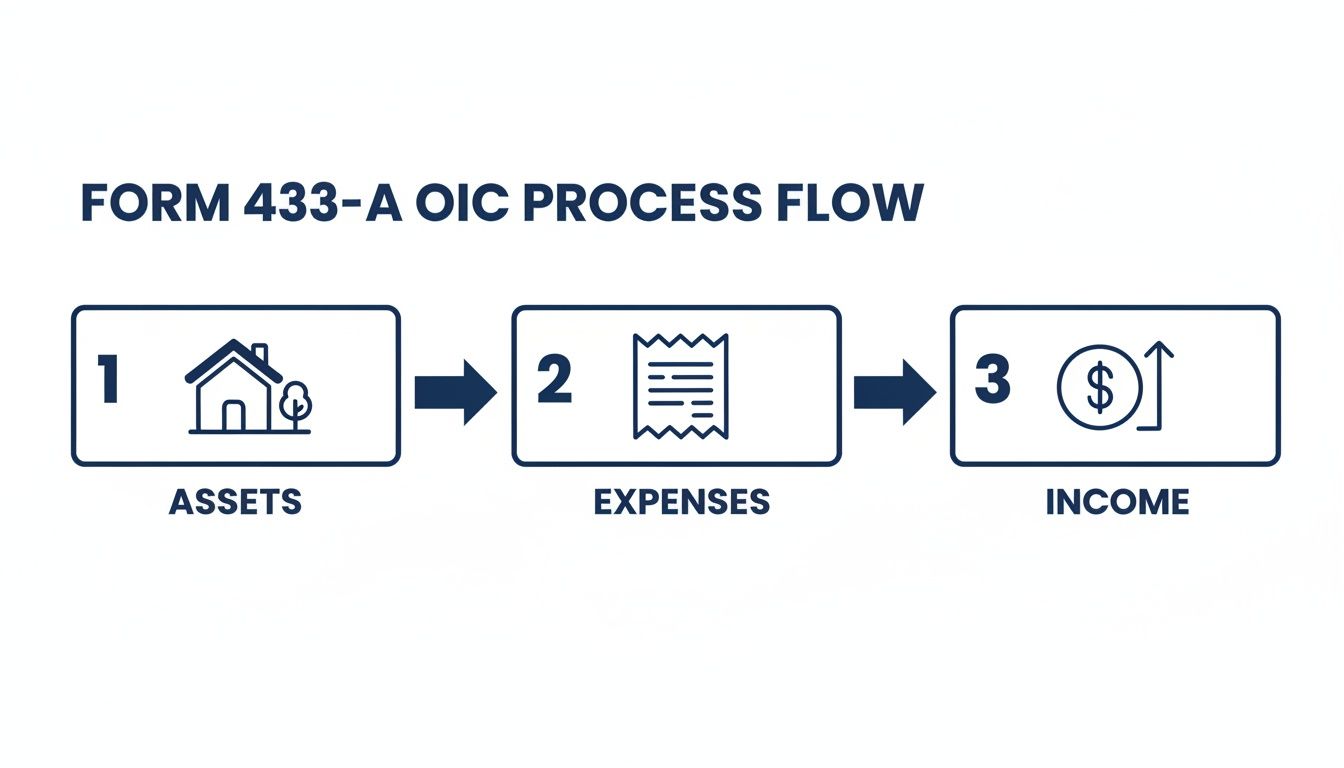
As you can see, the core sections of Form 433-A (OIC) are the essential building blocks for this final number. Let's break down how each part works.
Calculating Net Realizable Equity in Assets
The first part of the formula looks at what the IRS could get from your assets if they were liquidated quickly. This isn't about what you think they're worth; it's about a forced-sale scenario.
Here’s how we calculate it:
- List Every Asset: You'll start by listing everything you own, pulling directly from your Form 433-A (OIC). This includes bank accounts, real estate, vehicles, and even retirement funds.
- Find the Quick Sale Value (QSV): The IRS typically values assets at 80% of their fair market value. For instance, a home worth $250,000 has a QSV of $200,000 in their eyes.
- Subtract Liens and Exemptions: From that 80% value, we subtract what you still owe on it (like a mortgage or car loan). The IRS also allows for certain exemptions that can make a big difference, such as up to $4,650 in equity for one vehicle.
The leftover amount is your Net Realizable Equity (NRE) for that asset. Add up the NRE for all your assets, and you've got the first half of the RCP formula solved.
Expert Insight: I've seen people try to undervalue assets to get a lower offer, and it's a huge mistake. IRS examiners have access to sophisticated valuation tools and will instantly flag anything that looks off. Accuracy and honesty are non-negotiable here.
Calculating Future Remaining Income
The second piece of the puzzle projects your ability to pay over the coming months. This calculation hinges on your Monthly Disposable Income (MDI), which we determined back in Section 5 of the form. The math changes based on which payment plan you propose.
- Lump Sum Cash Offer: If you can pay the offer in five or fewer months, the IRS multiplies your MDI by 12.
- Periodic Payment Offer: If you need more time—between six and 24 months—they multiply your MDI by 24.
Let's say your MDI is $200. For a lump sum offer, your "Future Remaining Income" would be $2,400 ($200 x 12). But if you choose the periodic payment route, that figure doubles to $4,800 ($200 x 24). As you can see, this decision dramatically impacts your minimum offer.
Putting It All Together: A Michigan Example
Let’s run through a hypothetical scenario for a family in Lansing, Michigan, to see how the RCP formula plays out in the real world. This is exactly the kind of calculation we perform for our clients at Defense Tax Partners to arrive at a solid offer amount.
Sample Reasonable Collection Potential (RCP) Calculation
| Financial Component | Calculation Detail | Value |
|---|---|---|
| Assets (NRE) | ||
| Primary Home Equity | $200,000 QSV – $185,000 Mortgage | $15,000 |
| Vehicle 1 Equity | $10,000 QSV – $8,000 Loan – $2,000 Exemption | $0 |
| Bank Accounts | Combined average balance | $1,500 |
| Total Net Realizable Equity | $16,500 | |
| Future Income (Lump Sum) | ||
| Monthly Disposable Income | $250 | |
| Future Income Multiplier | MDI x 12 | $3,000 |
| Total Future Remaining Income | $3,000 | |
| Minimum Offer Amount (RCP) | Total NRE + Total Future Income | $19,500 |
Based on this calculation, the absolute floor for an offer is $19,500. Any offer submitted below this amount would almost certainly be rejected out of hand.
This number, derived directly from the details on your Form 433-A (OIC), must be precise and fully backed by documentation to give your application the credibility it needs to move forward.
Common Mistakes and Pro Tips for a Stronger Application
Filing a Form 433-A (OIC) is one of those times when the details can make or break you. Even small mistakes can lead to an outright denial, sending you right back to square one. Having guided countless Michigan taxpayers through this maze, we've seen the same handful of preventable errors sink otherwise solid applications.
Let’s be frank: an IRS examiner’s job is to verify every single number you put down. If your bank statements don't match the income you declared, or if a property value seems suspiciously low, they will absolutely dig deeper. This means, at best, a long delay; at worst, a rejection.
Miscalculating Your Disposable Income
One of the first places people go wrong is in calculating their monthly disposable income. It's a common assumption that you can just list your actual monthly spending, and the IRS will accept it. That's a critical misunderstanding of how this works.
The IRS operates on a strict set of Collection Financial Standards. These are predetermined, non-negotiable amounts for allowable living expenses like food, housing, and transportation. If your actual spending is higher, the burden of proof is on you to show that the excess is essential for your family's health and welfare or to produce your income. Just wanting to keep your lifestyle isn't a valid reason.
- Common Mistake: Claiming a $700 monthly payment for a luxury car. The IRS won't care about your actual payment; they'll substitute the local standard for transportation ownership costs, which is always much lower.
- Pro Tip: Before you even write a number down, pull up the IRS's national and local standards for your county. If your real costs are higher, you need to start gathering the paperwork—bills, receipts, everything—to build a case. Without that hard evidence, the IRS will use their number, which will make your disposable income look much higher than it really is.
Incorrectly Valuing Your Assets
Another major tripwire is how assets are valued. People often guess what their house or car is worth, or worse, they intentionally lowball the figure hoping no one will notice. Trust me, they notice.
IRS examiners use the same valuation tools as real estate agents and car dealers. They can spot an unrealistic number from a mile away.
Don't forget, you are signing the Form 433-A (OIC) under penalty of perjury. Intentionally undervaluing assets isn't just a simple error; it can be seen as an attempt to defraud the government. The consequences for that go far beyond just having your offer denied.
For your home, for example, the IRS wants the Quick Sale Value (QSV), which is calculated as 80% of its Fair Market Value. You can't just guess or use an appraisal from five years ago. For vehicles, you need the current private party value from a source like Kelley Blue Book, not the lower trade-in value a dealer might offer you.
Failing to Document Fluctuating Income
This is a huge challenge for our self-employed, freelance, and commission-based clients in Michigan. It's tempting to submit records from a few slow months to make your average income seem lower. This strategy always backfires.
The IRS will almost certainly ask for six to twelve months of bank statements to get a full, accurate picture of your earnings. Their agents are trained to spot these kinds of income inconsistencies.
- Common Mistake: A landscaper submitting a Profit & Loss statement that only covers the slow winter months.
- Pro Tip: Get ahead of it. Prepare a detailed P&L that covers a full 12-month cycle and have every single bank statement ready to back it up. This kind of transparency builds credibility with the examiner and shows you’re presenting an honest, year-round financial snapshot.
Getting Your Offer Submitted and What Comes Next
You've done the heavy lifting and navigated the complexities of Form 433-A (OIC). Now it's time to get your Offer in Compromise package in front of the IRS. This is more than just dropping an envelope in the mail; you're submitting a comprehensive proposal that argues for your financial fresh start.
This final package needs to be flawless. It must include Form 656 (the actual offer agreement), your meticulously prepared Form 433-A, all the backup documentation, the application fee, and your first payment. Think of it as your final argument—every piece has to be present and accounted for to prevent a quick dismissal on a technicality.
The Waiting Game: IRS Timelines
Once you mail that package, brace yourself for a wait. The IRS process is notoriously slow, and it's important to have realistic expectations from the get-go. You should get a letter from the IRS within a few weeks confirming they’ve received your OIC. Hang onto that letter; it’s the official starting gun for their review.
After that, your case gets assigned to an IRS Offer Examiner. This is where the timeline can really stretch, taking anywhere from a few months to well over a year, depending on their workload. The examiner will go through your Form 433-A OIC with a fine-tooth comb, so expect them to contact you or your representative with questions.
Staying on the Straight and Narrow During the Review
This is absolutely critical. While your offer is pending, you must stay completely current with all your tax obligations. No exceptions.
This means you have to:
- File every tax return on time.
- Make all your required estimated tax payments.
- Pay any new taxes you owe as they become due.
If you slip up on any of these, the IRS will automatically kick your offer out, no matter how strong it was. It's a deal-breaker, plain and simple.
An accepted OIC is a conditional agreement. The IRS doesn't just watch you during the review; they monitor your compliance for five full years after your offer is accepted. One mistake can void the deal, and your original tax debt comes roaring back to life.
Keep in mind that eligibility for the OIC program is also tied to specific income levels. The IRS has detailed rules based on adjusted gross income (AGI) that vary by family size and even location, designed to ensure the program helps those who truly need it. If your AGI is too high, you might still get the application fee waived if your current monthly income is low enough. The IRS website has the full breakdown of these requirements.
Getting through this final stretch takes patience and a sharp eye for detail. Having a professional in your corner to manage the back-and-forth with the IRS can make all the difference. For those of us here in Michigan, local experience matters. You can check out our Michigan tax attorney locations to find an expert near you.
Article created using Outrank
