
How to Remove Tax Liens in Michigan A Practical Guide
That letter from the IRS, the Notice of Federal Tax Lien, is enough to make anyone's stomach drop. It feels final, like you’ve already lost your property. But take a breath. A tax lien is simply the government’s legal claim against your assets to secure a debt, and understanding exactly what that means is the first step toward getting it resolved.
What a Tax Lien Really Means for Michigan Residents
When the IRS files a federal tax lien, it’s a public notice that they have a legal claim to your property as security for what you owe. Think of it as the government putting a hold on your assets.
This notice protects the government's interest in all your property—your home, your car, your bank accounts, and even assets you get after the lien is filed. It’s a serious situation, but it's not the same as the government showing up to take your things. That’s a common misconception, and knowing the difference is critical.
The Critical Difference Between a Lien and a Levy
I see it all the time with new clients in Michigan: they mix up "lien" and "levy," causing a ton of unnecessary panic. They are two very different things, and understanding this distinction is key to creating a calm, strategic plan.
- A Tax Lien is just a claim. It secures the government’s interest in your property and will wreak havoc on your credit. It makes selling or refinancing assets nearly impossible, but it doesn't involve the immediate seizure of your property.
- A Tax Levy is an action. This is the actual seizure of your property to satisfy the tax debt. A levy is how the IRS can legally take money from your bank account or garnish your wages. A lien almost always comes before a levy.
Imagine a small business owner in Detroit with a tax lien. She might find it impossible to get a new loan for a piece of equipment she needs. The lien has clouded her credit, scaring off lenders. But the IRS hasn't taken her existing equipment—that would be a levy.
Key Takeaway: A tax lien secures the debt by attaching to your property, making it difficult to sell. A tax levy is the actual seizure of that property. The lien is a warning shot; the levy is the consequence of not heeding it.
Real-World Consequences for Michigan Families
The damage from a tax lien goes far beyond your credit score. For a family in Grand Rapids, it could instantly halt their plans to refinance their home for a much-needed lower mortgage payment. Understanding the full impact of a lien means knowing how it affects your ability to transfer property, which is a major roadblock when you're thinking about selling a house with a lien.
Because the lien attaches to all your assets, it can complicate estate planning and create massive hurdles for major life events. And since it's a public record, it can even hurt your professional reputation. Learning how to remove a tax lien isn't just about paying a bill; it's about reclaiming your financial freedom and getting that cloud out from over your head.
How to Get a Federal Tax Lien Off Your Record
So, you've discovered the IRS has filed a federal tax lien against your assets. It’s a serious situation, but it's not a dead end. This isn't just about paying a bill; it's about navigating a complex system and choosing the right strategy for your specific financial circumstances.
The path you take often hinges on where you are in the collections process. A lien is a legal claim against your property, while a levy is the actual seizure of that property. Understanding the difference is your first critical step.
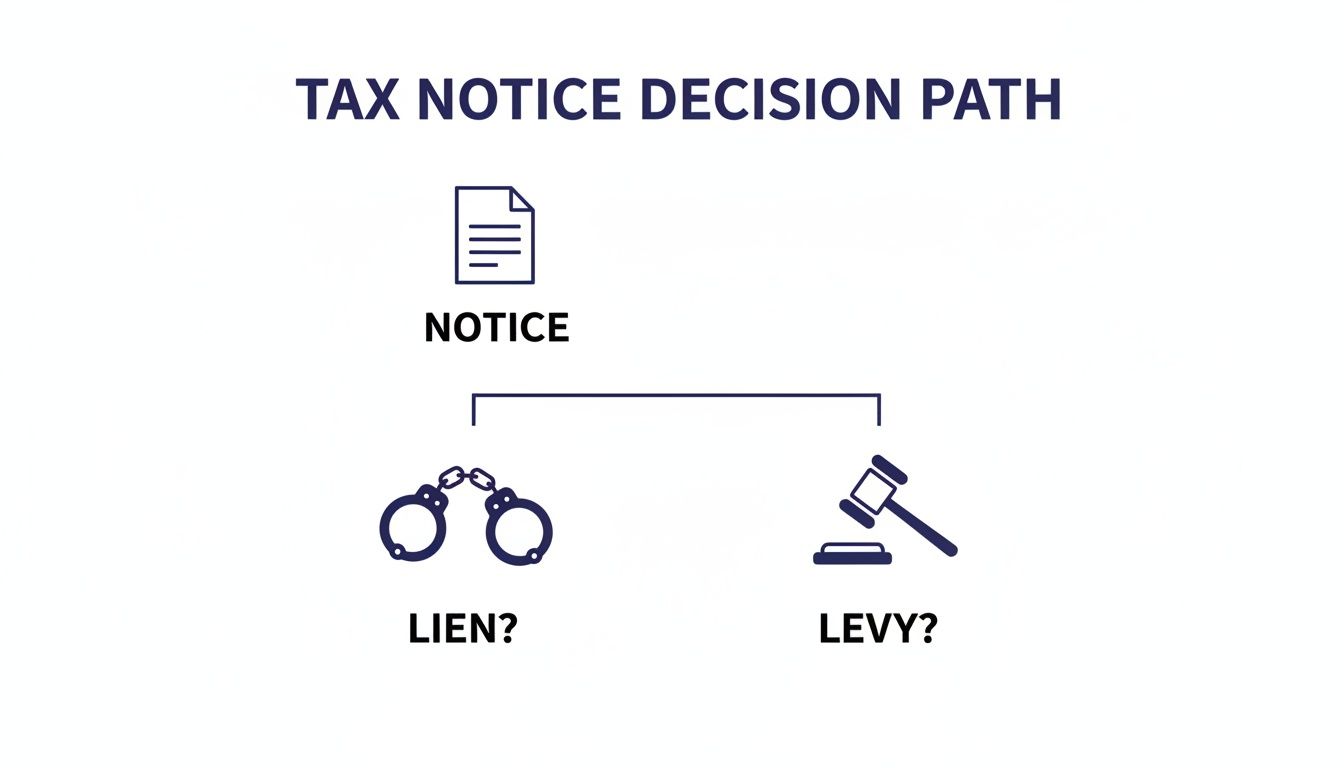
This flowchart shows the two main roads a tax problem can travel down. A lien secures the government's interest, but a levy is when they start taking things. Knowing which path you're on dictates your next move.
The Most Direct Route: Paying in Full
Let's start with the most straightforward approach: paying the tax debt in full. It’s the cleanest way to resolve the issue, though I know from experience it’s not always the most realistic.
Once you pay the entire balance—including the original tax, penalties, and interest—the IRS is legally obligated to file a Certificate of Release of Federal Tax Lien within 30 days. This officially states the debt is satisfied.
But here’s a crucial detail many people miss: a "release" doesn't erase the past. The original Notice of Federal Tax Lien (NFTL) can still haunt your credit report for up to seven years. It shows you paid, but the black mark remains.
A far better outcome is a lien withdrawal. A withdrawal essentially erases the public notice as if it never happened. Since a policy change around 2010, the IRS has had the power to withdraw an NFTL after you've paid if it's in everyone's "best interests." This is a powerful tool for cleaning up your credit, but you often have to ask for it. You can learn more about the critical differences between a release and a withdrawal from the legal experts at McGuireWoods.
What If You Can't Pay It All Right Now?
For most Michigan residents, writing a check for the full amount is simply not an option. Fortunately, you're not out of luck. There are ways to manage the lien's impact, especially when you need to sell property or get a loan. These strategies provide breathing room by addressing the immediate problem the lien is causing.
-
Discharge of Property: This removes the lien from one specific asset, not your entire debt. Let's say you own a home in Lansing and get a great offer, but the tax lien is scaring off the buyer's bank. A discharge allows the sale to go through with a clean title. The IRS gets the net proceeds from the sale, which are then applied to your tax bill.
-
Subordination: This strategy doesn't remove the lien but lets another creditor jump ahead of the IRS in the repayment line. Imagine you're a Detroit business owner who needs to refinance a critical piece of equipment to lower your payments. A subordination convinces the new lender to move forward because their claim now takes priority over the government's.
Real-World Scenario: We worked with a client who needed to sell a rental property in Ann Arbor to pay his tax debt. No buyer could get financing because of the lien. We successfully petitioned the IRS for a discharge of the property. The sale closed, the IRS received its cut from the proceeds, and our client was able to use the remaining funds to fully resolve his tax liability.
Comparing IRS Tax Lien Removal Strategies
Choosing the right path can feel overwhelming. To make it clearer, here’s a breakdown of the most common federal tax lien strategies, who they're for, and what you need to consider.
| Strategy | Primary Goal | Best For… | Key Consideration |
|---|---|---|---|
| Payment in Full | Eliminate the debt and the lien completely. | Individuals with the funds to clear the entire tax liability at once. | You must request a withdrawal in addition to the release to fully clear your public record. |
| Discharge of Property | Remove the lien from a single asset to allow for its sale or transfer. | People needing to sell a specific piece of property (like a house or car) that is encumbered by the lien. | The IRS typically requires the net proceeds from the sale to be paid toward the tax debt. |
| Subordination | Allow another creditor to take priority over the IRS lien. | Taxpayers who need to refinance a mortgage or secure a loan where the lender requires first-lien position. | This doesn't reduce your debt; it just changes the priority of creditors. |
| Offer in Compromise | Settle the tax debt for less than the full amount owed. | Taxpayers with significant financial hardship who cannot realistically pay their debt in full. | Requires extensive financial disclosure and has strict eligibility criteria. The lien is released upon completion. |
| Bankruptcy | Restructure or discharge certain tax debts under court protection. | Those with older income tax debts who meet specific timing rules (Chapter 7) or need a payment plan (Chapter 13). | Property tax liens are secured debts and rarely discharged. This is a complex legal process. |
Each option is a tool designed for a specific job. The key is picking the right one for your financial situation, which often requires a careful analysis of your assets, income, and long-term goals.
Advanced Strategies for Overwhelming Tax Debt
Sometimes, the debt is just too big for the solutions above. When you’re facing a mountain of tax debt, you need a more comprehensive approach.
An Offer in Compromise (OIC) is a formal agreement with the IRS to settle your tax liability for less than what you owe. This isn't a get-out-of-jail-free card; you have to prove that you realistically can't pay the full amount. Acceptance requires a deep dive into your finances, but if you succeed and meet all the terms, the IRS will release the lien. We cover the details in our guide on what an Offer in Compromise is.
Finally, there’s bankruptcy. It’s a common myth that you can’t get rid of tax debt in bankruptcy. While it's true for some taxes, older income tax liabilities can often be discharged. However, property tax liens are secured debts and almost never go away through bankruptcy alone. A Chapter 13 bankruptcy can be more helpful, as it reorganizes your debt into a multi-year repayment plan, giving you a structured way to eventually get the lien released.
The Critical Difference: Understanding a Lien Release vs. a Lien Withdrawal
Paying off a tax debt feels like crossing the finish line, but in reality, there's one more crucial step. So many people I've worked with think that once they send that final payment, the whole ordeal is behind them. That’s a common and costly misconception. You have to understand the difference between a lien release and a lien withdrawal to truly clear your name and your credit.
When you pay your tax liability in full, the IRS is legally obligated to issue a Certificate of Release of Federal Tax Lien within 30 days. This document officially states that your debt is satisfied. While that’s good news and stops any further collection actions, it doesn't wipe the slate clean. The original Notice of Federal Tax Lien remains on your public record for years, like a permanent scar showing your past financial trouble.
Think of it like a default on your credit report. Even after you pay it off, the negative mark stays there, telling every future lender that you once had a problem. That's a lien release. A withdrawal is a completely different animal.

Why a Lien Withdrawal is the True Goal
A lien withdrawal is the most powerful tool you have for a complete financial recovery. When the IRS agrees to a withdrawal, they effectively treat the Notice of Federal Tax Lien as if it never happened. It's removed from the public record entirely, giving you a fresh start. For anyone trying to buy a house, get a business loan, or just rebuild their credit, a withdrawal is what you should be aiming for.
Simply put, a lien release says, "The debt was paid." A lien withdrawal says, "This lien shouldn't have been here, or it’s in everyone’s best interest to make it disappear."
This distinction has become even more important over the last few years. While major credit bureaus stopped including tax lien data on consumer credit reports back in 2018 under the National Consumer Assistance Plan, that doesn't mean the information vanished. It’s still public record. Specialized credit agencies, mortgage lenders, and background check companies can—and do—still access it. You can read more about this change in this retrospective on removing public records from credit reports. The only surefire way to make that lien truly disappear is to get a withdrawal.
How to Qualify for a Lien Withdrawal
The IRS won't just hand you a withdrawal; you have to ask for it, and you have to have a good reason. The official request is made using IRS Form 12277, Application for the Withdrawal of Filed Form 668(Y), Notice of Federal Tax Lien.
From my experience, the IRS is most likely to approve a withdrawal under a few specific circumstances:
- The lien was filed improperly. This happens more than you'd think. Maybe they filed it while you were already in an installment agreement or sent the notice to an old address.
- You're in a Direct Debit Installment Agreement. If you agree to a payment plan with automatic withdrawals from your bank account, the IRS may grant a withdrawal as a show of good faith.
- A withdrawal will help you pay the tax faster. Let’s say removing the lien would allow you to refinance your home. If you use the cash from that refinance to pay the IRS immediately, they'll often agree because it helps them collect the money.
- It’s in the "best interest of the taxpayer and the government." This is the most flexible, and often most powerful, argument. It requires a bit of strategic thinking.
For example, I once worked with a Michigan-based contractor who had finally paid off a huge tax debt. The "released" lien was still showing up, preventing him from getting the bonding he needed to bid on a major construction project. We successfully argued that withdrawing the lien was in the government's best interest. Why? Because a successful, growing business would generate significantly more tax revenue in the future, far outweighing the benefit of leaving a historical stain on his record. This kind of strategic approach is often what it takes to get a withdrawal approved and put these issues behind you for good.
How to Handle Michigan State Tax Liens
When you’re staring down a tax lien from the Michigan Department of Treasury, you need to throw out the IRS playbook. The state has its own rules, its own timelines, and from what I've seen firsthand, its own surprisingly aggressive enforcement style. Assuming the process is the same as dealing with the feds is a common—and often costly—mistake.
It all usually kicks off with a "Notice of Intent to Assess." Too many people brush this document aside, and that's where the trouble starts. Michigan can, and will, move much faster than the IRS to file a state tax lien after that notice goes out. Once it's on the books, a Michigan lien operates just like a federal one: it latches onto all your property, both real and personal, within the state. Your credit takes a massive hit, and selling any assets becomes nearly impossible.
Navigating Michigan's Enforcement Process
One of the biggest shifts is who you'll be up against. Forget an IRS Revenue Officer; you'll be dealing with a Revenue Officer from the Michigan Department of Treasury. These are state agents, and their world revolves exclusively around Michigan tax law. They have serious authority when it comes to collections.
Getting anywhere with them requires knowing the local landscape. Let's say you're a small business owner in Detroit with a lien for unpaid sales tax. The state's approach to things like penalty abatement or setting up a payment plan is far less cookie-cutter than the IRS's. The state officer holds more discretionary power, which can be a good thing or a bad thing, depending on how you approach it.
A successful negotiation with a Michigan revenue officer often comes down to one thing: presenting a clear, well-documented case for financial hardship that speaks their language and fits squarely within the state's specific guidelines—not the federal ones.
Key Options for Resolving a Michigan State Lien
While some of the strategies might sound familiar, the execution is completely different. You have to use Michigan-specific forms and follow the Treasury’s unique procedures to the letter.
Here are your main avenues:
- Pay the Debt in Full: This is the cleanest way out. Once the debt is cleared, the state issues a Certificate of Discharge of Tax Lien. It's on you to make sure this gets properly recorded to clear your property's title.
- Request a Lien Release or Discharge: Just like with the IRS, you can ask to have the lien discharged from a specific property, usually to allow a sale to go through. The state, of course, gets its cut from the sale proceeds.
- Settlement and Compromise: Michigan runs its own Offer in Compromise program, which can be an incredibly effective tool for taxpayers who truly qualify.
The state’s property tax system adds yet another layer of complexity. Delinquent property taxes are a huge problem across the country, with a reported $22 billion in unpaid taxes last year. Michigan ranked eighth in the nation, with $517.9 million in delinquencies in a single year. This just goes to show how often people are dealing with state and local tax problems, sometimes right alongside federal ones. This report on property tax sales digs into the details.
The Michigan Offer in Compromise
For those who genuinely can't pay their full state tax liability, Michigan’s Offer in Compromise (OIC) program is a lifeline. But don't think it's an easy out. The eligibility criteria are tough and laser-focused on your current financial situation and your potential to earn in the future.
Before they'll even look at your offer, you must be current on filing all of your required Michigan tax returns. From there, the state launches a deep dive into your finances to calculate your "reasonable collection potential."
We recently helped a client in Lansing with this exact situation. She was a freelance artist, and we had to prove that her future income was far too unpredictable to ever cover the full tax debt. We built a comprehensive case file to show that her OIC was truly the state's best option for recovering any money at all. If you think this might be a path for you, we've broken down the process in our guide to the Michigan Offer in Compromise.
Getting a Michigan state tax lien removed for good requires a hyper-local strategy. The forms are different, the people are different, and the procedures are different. Having someone in your corner who knows the Michigan system inside and out can be the key to getting a final, favorable resolution.
Knowing When to Call in the Pros
Handling a tax issue yourself can feel like a good way to save money, but it's crucial to know when you're in over your head. A simple notice from the IRS is one thing; a legal claim against your property is another entirely. Once that tax lien is filed, the game changes, and the stakes get a lot higher.

Trying to navigate the maze of tax lien removal without an experienced guide can backfire, fast. You could easily miss a non-negotiable deadline, lock yourself into a punishing payment plan, or completely overlook a better option like a lien withdrawal that could clear your name.
Red Flags That Scream "Get an Expert"
Knowing your limits is a sign of strength. If any of these situations sound familiar, it’s time to stop DIY-ing and make a strategic move to protect your financial well-being.
Think of these as your cue to pick up the phone:
- The Lien Is Financially Crippling: When the amount owed is so large that paying it in full is just not in the cards, you need a professional negotiator who can build a case for something like an Offer in Compromise.
- Your Business Is on the Line: A lien can freeze business credit, scare off clients, and make it impossible to meet payroll. This requires immediate, targeted intervention to prevent a catastrophe.
- You're Hitting a Brick Wall: If you're getting the runaround from an IRS or Michigan Treasury agent, a tax attorney can bypass the red tape and speak their language.
- It's More Than Just a Lien: When you're also dealing with unfiled returns, an audit, or payroll tax issues, you've got a tangled mess that demands a single, cohesive strategy.
At Defense Tax Partners, we do more than just file paperwork. We dig in, build a solid case for you, and go head-to-head with tax authorities. Our goal is always to secure a resolution that protects your property and gives you a clear path forward.
The Strategic Advantage of Professional Help
Hiring a tax firm isn't just about getting advice; it's about gaining leverage. The moment we step in, the IRS knows they're no longer dealing with an intimidated taxpayer. They're dealing with a professional who knows the rules, your rights, and their obligations. That changes the entire dynamic.
For example, we immediately scrutinize the lien itself. Was it filed correctly? A procedural error on their part could be grounds for a full withdrawal. We also know how to build a persuasive case for penalty abatement, which can slash your total debt by thousands.
If you are researching firms, understanding how lawyers enhance their online visibility can offer some insight into finding a reputable and accessible team.
Ultimately, our job is to become a shield between you and the tax agency. This move alone drastically reduces your stress and stops you from accidentally saying something that could weaken your case. We take over the calls, manage the deadlines, and fight for a resolution that makes sense for your financial reality.
Common Questions About Removing Tax Liens
When you're facing a tax lien, you're bound to have questions. It’s a stressful situation, and the path forward isn't always clear. Drawing from our experience helping countless Michigan residents, here are some practical answers to the questions we hear most often.
How Long Does It Take to Remove a Lien After I Pay It Off?
Once you’ve paid the tax debt in full, the clock starts ticking. The IRS is legally required to issue a Certificate of Release of Federal Tax Lien within 30 days.
But here’s a critical point many people miss: a release isn't the same as a removal. The release just updates the public record to show the debt is paid. The original lien, however, can linger on your credit report for years, acting as a red flag for lenders.
To truly wipe the slate clean, you'll need to go one step further and request a lien withdrawal. This is a separate process that can take several more months, largely depending on how backed up the IRS is at the time. Michigan’s Department of Treasury has its own similar, but separate, procedure for state liens.
Can I Sell My House If There’s a Tax Lien on It?
Yes, you can, but it definitely adds a layer of complexity to the sale. A tax lien attaches directly to your property, giving the government a legal claim to your equity. That debt has to be settled before, or during, the closing.
The most common approach is to have the outstanding tax balance paid directly out of the proceeds from the sale. Another powerful tool is applying for a discharge of property. This is a formal request to the IRS to remove the lien from just that specific property, clearing the way for the sale to proceed. It requires careful planning and coordination between you, the IRS, your buyer, and the title company.
Expert Tip: Don't let a lien derail your property sale. Proactively applying for a discharge is often the cleanest way to handle the situation. It lets you use the sale proceeds to satisfy the government's claim without causing major closing delays.
Will an Offer in Compromise Get Rid of a Tax Lien?
Ultimately, yes, but an Offer in Compromise (OIC) is a marathon, not a sprint. While an OIC can be a fantastic way to settle your tax debt for less than you owe, the lien stays firmly in place until you’ve met every single condition of the agreement.
This means you must make all your scheduled payments on time and stay current on all your tax filings and payments for five years after the offer is accepted. Only after you've successfully jumped through all those hoops will the IRS release the lien. From there, you can finally petition for a withdrawal to have it removed from the public record entirely.
What Happens If I Just Ignore a Tax Lien?
Ignoring a tax lien is, without a doubt, one of the worst things you can do for your financial health. That lien acts as a legal claim on everything you own—and everything you will own in the future. We're talking about your house, your car, and your bank accounts.
The immediate damage is to your credit score, which will take a nosedive, making it incredibly difficult to get a mortgage, car loan, or even a credit card.
But it gets worse. A lien is often the government’s first step before taking more aggressive action, like a levy (seizing your bank account) or a wage garnishment. All the while, interest and penalties keep compounding, digging you into an even deeper hole. If your finances are truly in a dire state, you might want to learn more about IRS Currently Not Collectible status as a temporary measure, but it's not a permanent solution. The only real way out is to face the problem head-on.
