
A Guide to the Michigan Offer in Compromise Program
When you're staring down a mountain of state tax debt that feels impossible to pay, a Michigan Offer in Compromise (OIC) can be a powerful lifeline. It’s an agreement you make with the Michigan Department of Treasury to settle your tax bill for a smaller amount than what you originally owed.
This isn't just about getting a discount. The OIC is a formal resolution designed for situations of genuine financial hardship, where you can clearly demonstrate that you simply cannot pay the full tax liability now or in the foreseeable future. It offers a path to a fresh start when other payment plans just aren't realistic.
Understanding The Michigan Offer In Compromise

Before 2014, taxpayers in Michigan who were hit with a massive assessment from the Department of Treasury had very few ways out. The options were pretty much limited to paying in full or getting stuck in a cycle of appeals and collections.
Everything changed with the introduction of Michigan's OIC program under Public Act 240. This legislation created a structured pathway for people to resolve overwhelming state tax debts, from income and withholding to corporate taxes.
It's crucial to understand that this isn't a free pass. The state is making a calculated business decision. They will only accept your offer if they're convinced that the amount you're proposing is the most they can ever hope to collect from you.
State Vs Federal OIC Programs
One of the biggest points of confusion for taxpayers is the difference between the state and federal programs. They share a name, but that's where the similarities end. They are completely separate processes for entirely different tax debts.
To clear things up, here’s a quick comparison:
Michigan OIC Vs IRS OIC at a Glance
| Feature | Michigan Offer in Compromise (State) | IRS Offer in Compromise (Federal) |
|---|---|---|
| Agency | Michigan Department of Treasury | Internal Revenue Service (IRS) |
| Taxes Covered | State taxes (e.g., income, sales, withholding) | Federal taxes (e.g., income, payroll, estate) |
| Application | Separate application and forms required for Michigan | Separate application and forms required for the IRS |
| Evaluation | Judged based on Michigan-specific rules and formulas | Judged based on federal guidelines and formulas |
Simply put, owing taxes to both the State of Michigan and the IRS means you have two separate problems that require two separate solutions. An approval from one agency has absolutely no bearing on the decision of the other. For a deeper dive into the mechanics, you can learn more about what an Offer in Compromise is and how it generally works here: https://www.michigantaxattorneys.net/blog/what-is-an-offer-in-compromise/
The entire Michigan OIC program hinges on a single concept: "doubt as to collectibility." The state isn't just forgiving your debt. It's concluding that accepting your settlement offer is a better financial move than spending time and resources trying to collect a larger sum they know they'll never get.
Purpose And Legal Framework
The OIC program serves two important functions. First, it gives taxpayers a legitimate way to get out from under crushing debt and get back on solid financial ground. Second, it allows the state to recover tax revenue that would otherwise be lost or deemed uncollectible.
This kind of structured settlement process is rooted in general tax law principles, which recognize the need to balance aggressive tax collection with the economic realities that people face. It’s a pragmatic solution that benefits both the taxpayer and the state.
Who Can Actually Settle a Tax Debt with Michigan?
Let's get one thing straight: a Michigan tax settlement isn't a free-for-all discount program. The Michigan Department of Treasury has a very strict set of rules, and if you don't meet every single one, your application for an Offer in Compromise (OIC) is dead on arrival. Think of these rules as the first line of defense; you have to get past them before you can even start making your case.
Before we get into the why the state might accept your offer, you have to clear these initial hurdles. These are hard and fast requirements with absolutely no wiggle room.
The Non-Negotiable Prerequisites
To even have a shot at a tax settlement, you must meet a few basic criteria. The state does this to ensure that only taxpayers who are playing by the rules and are in genuine financial distress get considered.
- All Your Tax Returns Must Be Filed: You can't ask the state to forgive an old debt while you're creating a new one. Michigan demands that you are completely current on all your required tax filings before they'll even glance at your OIC.
- No Active Bankruptcy: If you're in the middle of a bankruptcy case, you're out. The bankruptcy court is in charge of your debts at that point, and the state won't step in to negotiate a side deal.
- The Tax Debt Must Be Final: The amount you owe has to be officially on the books and past the point of any appeals. An OIC is not a tool to argue about whether you owe the money; it’s a way to resolve your inability to pay a debt that’s already been finalized.
Once you can confidently check all three of those boxes, you can proceed to the real heart of the application: giving the state a compelling reason to accept less than what you owe.
The Three Official Reasons for an Offer
The Michigan Treasury will only accept an OIC for one of three specific reasons. Your entire application needs to be built around proving, with hard evidence, that your situation squarely fits into one of these categories.
An offer is much more than just a plea for help. It's a detailed financial argument, and your success hinges on proving that accepting your offer is the most practical and beneficial move the state can make under its own guidelines.
By far, the most common and successful path is the first one.
1. Doubt as to Collectibility
This is the bread and butter of the Michigan OIC program. You're essentially telling the state, "Look at my finances. There is serious doubt you will ever be able to collect the full amount I owe." Since the program was revamped in 2014, it has become a crucial option for taxpayers who can prove 'doubt as to collectibility.' You need to show that the amount you're offering is the most the state can realistically get from your current assets and future income. For the state's official take, you can review their program overview.
This is a numbers game, plain and simple. It doesn't matter why you got into debt or whether it feels fair. The only thing that matters is proving—with bank statements, pay stubs, and other financial documents—that you simply don't have the money to pay in full.
Example Scenario: A self-employed carpenter in Grand Rapids hurts her back and can no longer work full-time, causing a huge drop in her income. She has a $50,000 state tax bill looming. After selling off a few non-essential assets, her remaining financial picture—what she owns plus what she can realistically earn—is nowhere near enough to cover the debt. She can submit an OIC based on "Doubt as to Collectibility," offering an amount that truly reflects the maximum the state could ever hope to get from her.
2. Doubt as to Liability
This one is a much tougher sell and rarely used. With this argument, you're not claiming you can't pay the bill. Instead, you're arguing that the tax was assessed incorrectly and you don't actually owe it in the first place. You can typically only use this path if all other appeal options have expired and you've uncovered new, compelling evidence to support your claim.
3. Exceptional Circumstances
Think of this as the last-resort category for truly unique and severe situations. To qualify here, you have to prove that paying the tax would create an extreme "economic hardship." We're not just talking about being tight on cash; this means paying would leave you unable to cover basic necessities like food, shelter, and medical care for your family. The bar for proving this is incredibly high and requires overwhelming evidence of your dire circumstances.
Your Step-by-Step Application Guide

When it comes to filing a Michigan Offer in Compromise, think of yourself as building a case, not making a plea. The Michigan Department of Treasury isn't looking for a sob story; they need a perfectly assembled financial package that leaves zero room for doubt. This means every detail matters, right from the start.
A single missing signature, a miscalculated expense, or an incomplete form can stop your application dead in its tracks. The key is to be meticulous and treat every document as a crucial piece of evidence supporting your claim.
Phase 1: Assembling Your Financial Dossier
Before you even think about filling out any forms, your first job is to become an expert on your own finances. You need to gather every document that paints a clear, honest picture of your economic situation for the state. Getting all this together upfront will save you countless headaches later.
Here’s a practical checklist of what you’ll need to pull together:
- Proof of Income: Grab your last three months of pay stubs, recent W-2s, and any 1099s. If you’re self-employed, you'll need to have your profit and loss statements ready.
- Bank Statements: Collect three to six months of statements for every single bank account you have—checking, savings, you name it. Be ready to explain any unusually large deposits or withdrawals they might flag.
- Asset Information: The state needs to know what you own. This includes vehicle titles, property deeds, and statements from any retirement or investment accounts.
- Monthly Expense Records: Pull together recent utility bills, your mortgage or lease agreement, car loan statements, and any other records that prove your necessary living expenses.
Think of this phase as creating an undeniable financial snapshot. The more organized and thorough you are here, the stronger your application will be from the get-go.
Phase 2: Completing Michigan Form 5181
Once you have your financial life organized in a pile of documents, it’s time to tackle the main event: Form 5181, Offer in Compromise. This is the official document where you formally present your case to the state, detailing your financial data and making your settlement offer.
Accuracy is everything on this form. Double- and triple-check every number to make sure it matches your supporting documents. Be clear and direct in your explanations. An application that's vague or incomplete is one of the surest ways to get a rejection letter.
The law that created the OIC program is very specific: taxpayers must submit a complete and fully signed Form 5181. The grounds for an offer are standardized—things like genuine financial hardship—and if your application doesn't meet these basic requirements, it can be rejected outright or delayed while the state asks for the missing pieces.
These strict rules exist for a reason. As you can see from Michigan's own public reports, the state has clear guidelines and sticks to them. For a closer look at what they expect, you can review Michigan's OIC reporting and guidelines.
Phase 3: Building Your Submission Package
The final step is putting it all together into a professional, easy-to-review package for the Michigan Department of Treasury. Don't just slap a staple on a messy pile of papers. Make it as easy as possible for the examiner to see you’ve done your homework.
Follow this simple checklist to make sure your submission is solid:
- The Completed Form 5181: The signed and dated form goes right on top. Make sure every person required to sign has done so.
- Organized Supporting Documents: Arrange your financial records logically behind the form. Use binder clips or separate folders to group like-documents (all bank statements in one section, pay stubs in another, etc.).
- A Final Review: Before you seal that envelope, do one last sweep. Is the form signed? Are all the pages there? Does every number you listed have a document to back it up?
This level of care shows you’re serious and respect the process, which can only work in your favor. As you work through the detailed process of putting your OIC application together, tools that help with efficiency can be a game-changer. You might want to look into solutions for legal document automation to help manage the sheer volume of paperwork.
By taking these steps methodically, you can turn a truly intimidating task into a manageable project and seriously improve your chances of reaching a successful Michigan tax settlement.
How Michigan Calculates Your Minimum Offer Amount
When you submit a Michigan Offer in Compromise, the Department of Treasury doesn't just pull a number out of a hat. They have a very specific, data-driven formula they use to figure out the absolute minimum amount they believe they could ever squeeze out of you over time. This magic number is called your Reasonable Collection Potential, or RCP.
Think of it like this: if you were trying to sell something valuable, you'd want to know its rock-bottom price—the lowest you'd ever accept. The state is doing the same thing. They're calculating the least they're willing to take to close your account, based entirely on your financial reality.
Your offer must meet or exceed this calculated RCP. If it comes in even a dollar short, it's almost guaranteed to be rejected. Understanding how they get to this number is the single most important part of building a successful Offer in Compromise.
The Core Formula: Reasonable Collection Potential
The state’s whole evaluation boils down to a surprisingly straightforward equation. It’s a two-part formula that looks at your finances from both a "right now" and a "down the road" perspective.
(Net Value of Your Assets) + (Your Potential Future Income) = Reasonable Collection Potential (RCP)
This formula essentially asks two questions: What could you pay us today if you sold off your assets? And what could you afford to pay us over the next few years from your paycheck? Let’s break down exactly what the state is looking at for each piece of this critical puzzle.
Analyzing Your Assets
First, the Treasury does a deep dive into everything you own. They’re not concerned with what you originally paid for an item; they only care about its quick-sale or "liquidation" value—what it would fetch on the open market today. From that value, they subtract any loans or liens you have against the asset.
Here are the common assets they scrutinize:
- Real Estate: They’ll find the current market value of your home and then subtract your outstanding mortgage balance to determine your equity.
- Vehicles: Using standard industry guides, they'll find the value of your cars, trucks, or motorcycles and subtract what you still owe on your auto loans.
- Bank Accounts: The cash you have on hand in checking, savings, and other deposit accounts is counted dollar for dollar.
- Investments: This includes stocks, bonds, and retirement funds like a 401(k) or IRA. While some retirement accounts have protections, the state will still consider their value.
The Treasury adds up the net value from all these sources to get the first half of the RCP. This number represents the lump sum you could theoretically come up with immediately.
Projecting Your Future Income
The second part of the equation gets a bit more personal. The state needs to figure out your ability to make monthly payments over time, and they do this by comparing your income to your necessary living expenses. They aren't trying to leave you destitute; instead, they use standardized, allowable expense figures to determine what you reasonably need to live on each month.
Here’s how they calculate it:
(Your Average Monthly Income) – (Your Allowable Monthly Expenses) = Your Monthly Disposable Income
Once they have your monthly disposable income, they multiply it by a set number of months—usually between 48 and 60. This projects your future ability to pay. That final number gets added to your asset total to arrive at your RCP.
Let's walk through a quick example to see how this plays out in the real world.
Sample Reasonable Collection Potential (RCP) Calculation
Here's a simplified breakdown showing how a taxpayer's assets and income are used to calculate a minimum offer amount for a Michigan OIC. This example table illustrates the process for a family in Lansing owing $75,000 in back taxes.
| Financial Component | Example Value | Contribution to Offer |
|---|---|---|
| Home Equity | $10,000 | $10,000 |
| Vehicle Equity (2 cars) | $5,000 | $5,000 |
| Savings Account Balance | $1,000 | $1,000 |
| Total Net Asset Value | $16,000 | $16,000 |
| Monthly Combined Income | $5,000 | – |
| Allowable Monthly Expenses | ($4,800) | – |
| Monthly Disposable Income | $200 | (Used for next step) |
| Future Income Potential ($200 x 48 months) | $9,600 | $9,600 |
| Total RCP / Minimum Offer | $16,000 (Assets) + $9,600 (Income) | $25,600 |
In this scenario, even though the family owes a staggering $75,000, the state's own formula shows their realistic ability to pay is only $25,600. An offer below this amount would be dead on arrival.
However, an offer of $26,000 suddenly becomes a serious, viable proposal. It meets the state’s minimum collection standard, giving this family a real shot at settling their massive tax liability for just a fraction of the original amount.
Navigating a Rejection and Next Steps
Getting a rejection letter for your Michigan Offer in Compromise can feel like a punch to the gut. But it’s critical not to view it as a final "no." Instead, think of it as a detailed note from the Michigan Department of Treasury explaining exactly what they found lacking in your application.
A denial isn't the end of the road; it’s more like a detour. The most common reasons for rejection are often fixable, running the gamut from an offer that’s just too low to something as simple as missing paperwork. The key is to use that rejection notice as a roadmap to fix the problems and build a much stronger case for your next attempt.
Understanding Common Reasons for Denial
Most OIC rejections come down to just a few core issues. The state isn't trying to be difficult—they are required to follow a very specific formula and set of legal guidelines for the program. Figuring out precisely why your offer was turned down is the absolute first step toward getting it approved.
Here are the most common reasons a Michigan Offer in Compromise gets denied:
- Offer Below Reasonable Collection Potential (RCP): This is, by far, the number one reason for rejection. If the state calculates that it could collect more from you over time than what you offered, your proposal will be denied flat out.
- Incomplete or Missing Documentation: The Treasury needs a complete and verifiable picture of your finances. A single missing bank statement, an unsigned page, or an unproven expense can be enough to sink the entire application.
- Clear Ability to Pay: An OIC is designed for taxpayers who genuinely cannot pay their full tax debt. If the Treasury's review of your finances shows you could pay the full amount through an installment plan—even if it would take years—they will reject your offer. Convenience isn't a factor they consider.
The calculation for your minimum offer is often the central point of disagreement in a denial.
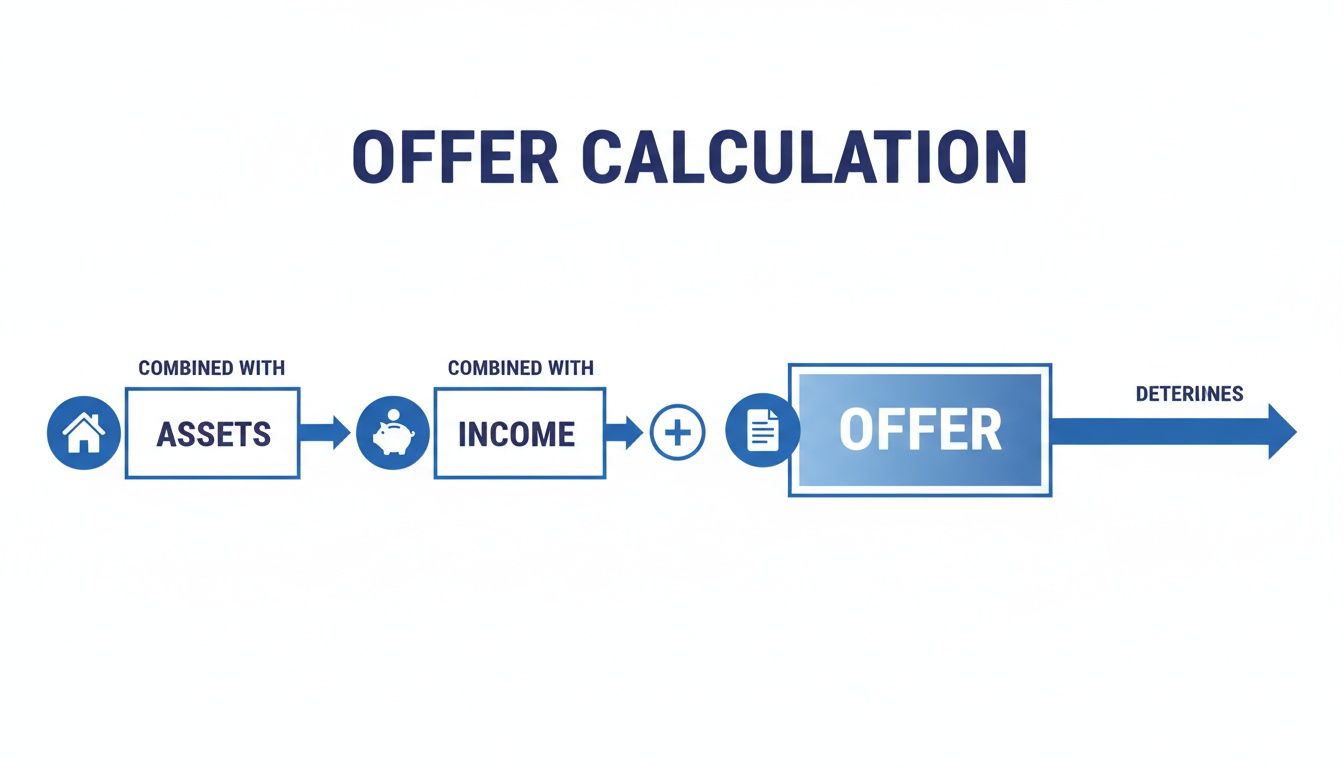
As you can see, your offer is a direct product of your net asset value plus your projected future disposable income. A denial almost always means the state's valuation of one of these components was significantly higher than yours.
Developing Your Post-Rejection Strategy
With the rejection letter in hand, it's time to map out a new plan. Your next move depends entirely on the specific reasons the Treasury gave for the denial. You have a few solid paths forward.
A rejection doesn't mean your financial hardship isn't real. It just means the story you told with your application wasn't convincing enough under the state's strict rules. Your job now is to rebuild that argument with better evidence and more precise numbers.
If the state said your offer was too low, the solution is to dive back into the RCP formula. Scrutinize every single asset valuation and every expense you claimed. Did they disallow an expense you believe is absolutely necessary for your family's health and welfare? Do you have solid documentation to prove a lower value for your car or home equity? This is where you need to strengthen your case.
On the other hand, if the denial was due to an error you believe the state made, you have the right to a formal appeal. This is a much more complex legal process where you officially challenge the Treasury's decision. You'll need to present a compelling, evidence-based argument showing exactly how their assessment was incorrect according to their own guidelines. This is where getting professional help can make all the difference.
Your strategic options boil down to these three:
- Revisit and Resubmit: The most common path. You adjust your offer amount or gather stronger documentation to directly address the state's specific concerns and try again.
- File a Formal Appeal: If you have a rock-solid case that the Treasury misinterpreted your financial data or misapplied its own rules, you can formally challenge their findings.
- Explore Alternatives: If an OIC truly isn't in the cards, it's time to pivot. You can shift your focus to negotiating another solution, like a manageable installment agreement or penalty abatement.
A rejection can feel like a major setback, but with a clear understanding of the issues and a focused strategy, it can become a stepping stone to finally putting your Michigan tax debt behind you for good.
Why Partner with a Tax Professional for Your OIC
You can file a Michigan Offer in Compromise on your own, but it’s definitely not a simple DIY project. Think of it less like filling out a standard tax form and more like performing complex surgery on your finances. One small miscalculation of your Reasonable Collection Potential (RCP) or a single missing document can get your offer rejected flat out, sending you right back to square one.
This is where bringing in an experienced tax professional makes all the difference. They don't just fill out paperwork; they build a solid, defensible case designed to pass the intense scrutiny of the Michigan Department of Treasury. Their expertise turns what might be a hopeful longshot into a strategic, well-supported proposal.
Navigating the Intricate Details
A seasoned tax attorney knows the state's unwritten rules and how Treasury examiners think. They understand exactly what gets flagged, which expenses are likely to be disallowed, and how to frame your financial story in the most accurate—and compelling—way possible. This kind of insider knowledge is invaluable.
Here’s what a professional handles for you:
- Perfecting the RCP Calculation: They dig deep into your assets, income, and the state’s allowable living expenses to calculate a fair offer—one that is both defensible and the lowest you can realistically propose.
- Assembling a Bulletproof Package: A pro makes sure every form is pristine, every required document is attached, and every potential question the state might have is answered proactively.
- Handling All State Communications: They become your shield, managing every call, letter, and negotiation with the Treasury. This keeps you out of stressful conversations where one wrong word could undermine your case.
Partnering with a professional is an investment in your financial future. Their goal is to prevent the common mistakes that lead to rejection and significantly increase the likelihood of getting your michigan offer in compromise accepted the first time.
Maximizing Your Chance of Success
Ultimately, hiring a tax professional is about putting the odds firmly in your favor. They know how to translate the story of your financial hardship into the precise language and numbers the Treasury requires, bridging the gap between your reality and the state’s rigid criteria.
They understand the specific economic pressures taxpayers face across Michigan and can tailor a strategy to your unique circumstances. To better understand how local representation can make a difference, you can explore the benefits of working with tax attorneys in different Michigan locations.
If you’re staring down a significant state tax debt, don't leave the outcome to chance. A consultation with an expert will give you a clear-eyed assessment of your options and a professional roadmap for resolving your tax problem for good.
Frequently Asked Questions
When you're looking into a Michigan Offer in Compromise, a lot of specific questions are bound to pop up. Let's tackle some of the most common ones to give you a clearer picture of the process, what it costs, and what happens down the road.
How Long Does the Michigan OIC Process Take?
Patience is key here. Once you've submitted a complete and well-organized application, you can generally expect the Michigan Department of Treasury to take about six to nine months to give you a final decision.
This timeframe isn't arbitrary; during these months, the state is doing a deep dive into your financial situation, verifying every detail you provided. The single best thing you can do to speed things along is to get your application right the first time, leaving no room for questions or follow-ups.
Do I Pay Anything When I Submit My OIC?
Here’s some good news. Unlike the IRS, Michigan does not require an application fee or any kind of down payment just to submit your OIC. This is a huge relief for anyone already struggling financially.
That said, your offer itself needs a solid payment plan. You’ll propose either a lump-sum payment (usually due within 90 days of acceptance) or a short-term plan (typically paid off in under 24 months). The state will heavily weigh your ability to actually follow through on the plan you propose.
One crucial thing to keep in mind: Interest and penalties don't stop just because you've submitted an offer. They will continue to rack up on your account while the Treasury reviews your case. The clock only stops once your offer is officially accepted and you’ve paid the settlement amount in full. This makes it incredibly important to put forward a strong, realistic offer from the very beginning.
What Happens If My Finances Improve After Acceptance?
Once your offer is accepted and paid off, the deal is essentially done, but with a major string attached: a mandatory five-year compliance period. This means for the next five years, you have to file all your Michigan tax returns and pay any new taxes on time, in full. No exceptions.
If you suddenly come into money, it usually won't affect the agreement you've already settled. The real risk is failing to stay compliant. If you miss a filing deadline or don't pay a new tax bill during that five-year window, the state can void the entire OIC agreement. Your original tax debt would come roaring back to life, along with all the interest and penalties that were wiped away.
For navigating these kinds of complex tax situations, the team at Defense Tax Partners can offer expert guidance. You can learn more about their expert tax resolution services.
Article created using Outrank
