
Guide: how does the irs payment plan work in 2026
An IRS payment plan is your official lifeline when you owe taxes but can't pay the full amount at once. It’s a formal agreement with the IRS to pay your tax debt over time through manageable monthly payments.
Think of it as a structured way to get right with the IRS, giving you critical breathing room. Once a plan is in place, it immediately halts more aggressive collection efforts, like wage garnishments or bank levies. The official term for this arrangement is an Installment Agreement.
Understanding How an IRS Payment Plan Works
Seeing a large tax bill can be incredibly stressful. The good news is the IRS has established processes to help you resolve your debt without pushing you into financial ruin. An installment agreement is one of the most common and practical tools available.
Instead of demanding a single, potentially crippling payment, the agency agrees to a fixed monthly amount until your debt is paid off. This is a huge deal. Having a formal agreement in place stops the IRS from seizing your assets, providing the stability you need to tackle the balance head-on.
The Nuts and Bolts of a Payment Plan
At its core, an IRS payment plan is a contract. You commit to making consistent monthly payments, and in return, the IRS agrees to suspend active collection actions against you.
The key thing to remember, though, is that interest and penalties don’t stop. They will continue to pile up on your unpaid balance until it’s fully paid. That's why it's always in your best interest to pay the debt off as quickly as your budget allows.
There are two main categories of payment plans, each built for different timelines and financial situations.
To help you see the difference clearly, here’s a quick comparison of the two main options.
IRS Payment Plan Options at a Glance
| Feature | Short-Term Payment Plan | Long-Term Installment Agreement |
|---|---|---|
| Repayment Period | Up to 180 days | More than 180 days (can be several years) |
| Best For | Temporary cash flow issues | Larger debts requiring extended repayment |
| Setup Fees | None | Yes, fees apply (can be reduced or waived) |
| Application | Online, by phone, or mail | Online, by phone, or Form 9465 |
Ultimately, choosing the right plan depends on how much you owe and how quickly you can realistically pay it back.
Why Does the IRS Offer Payment Plans?
The whole point of these programs is to encourage people to comply with their tax obligations voluntarily. The IRS knows that most people want to pay what they owe but sometimes simply can't afford a lump-sum payment.
By offering a structured path forward, the agency makes it possible to settle your debt without destroying your finances. Frankly, this approach is far more effective than forcing taxpayers into bankruptcy. The IRS Fresh Start Program was a major step in expanding access to these common-sense solutions. You can read more about these initiatives in our guide on the IRS Fresh Start Program.
It’s also helpful to know how other situations, like bankruptcy, can affect the timeline for collections. In some cases, the clock on the federal income tax statute of limitations can be paused, which is an important piece of the puzzle when planning your strategy.
What Types of IRS Payment Plans Are Available?
When you’re staring down a tax bill you can’t pay all at once, it’s easy to feel overwhelmed. The good news is the IRS doesn't expect everyone to write a single check. They have several different payment plans available, but it’s definitely not a one-size-fits-all situation.
The right plan for you really hinges on a few key things: how much you owe, whether you're up-to-date on filing your tax returns, and, most importantly, how quickly you can realistically pay the debt back.
The very first question to ask yourself is about timing. Can you get this debt cleared in the next few months, or are you going to need a few years? That simple answer will point you down one of two main paths.

As you can see, if you can wrap things up in under 180 days, a short-term plan makes the most sense. For anything longer, you’ll be looking at a long-term installment agreement.
Short-Term Payment Plan
A Short-Term Payment Plan is pretty much what it says on the tin: an extension giving you up to 180 days to pay your tax bill in full. This is a great option if you're just dealing with a temporary cash crunch—maybe waiting on a bonus or a client payment—and know you'll have the funds soon.
One of the best things about this plan is its simplicity and cost. The IRS won't charge you a setup fee if you apply online, which is a nice perk. Just remember, interest and penalties don’t stop. They will keep adding up until your balance hits zero.
Long-Term Installment Agreements
If 180 days just isn't enough time, you'll need to step up to a Long-Term Installment Agreement. These plans give you much more breathing room, letting you make monthly payments for up to 72 months (that’s six years).
Within this category, there are a few common options, each with its own set of rules.
Guaranteed Installment Agreement: Think of this as the most straightforward path. You are guaranteed to get this plan if you owe $10,000 or less in tax (not counting penalties and interest), have filed all your past returns, and can commit to paying it all off within three years.
Streamlined Installment Agreement: This is the go-to for most people. If your total bill—including tax, penalties, and interest—is under $50,000, you can usually get a Streamlined agreement. The best part? You generally won't have to submit a mountain of financial paperwork to prove what you can afford.
These agreements offer a lifeline, but they come with different costs. While short-term plans have no online setup fee, long-term agreements have fees ranging from $31 to $225, depending on your income and how you apply. For taxpayers in Michigan and across the country, these plans provide a formal way to get back on track and avoid aggressive collection actions like wage garnishments. A tax professional can often help negotiate the most favorable terms for your situation. You can always check the IRS website to see the latest payment options and fees.
More Complex IRS Payment Plans
For tax debts that are larger or involve more complicated business issues, the options get a bit more specialized. These usually require more in-depth negotiation and a full financial disclosure.
Partial Payment Installment Agreement (PPIA): This is a unique type of plan where the IRS agrees to monthly payments even though they know you won't pay the full debt before the time limit for collections runs out. Getting a PPIA isn't easy; you have to prove, with hard numbers, that you simply cannot afford to pay the debt in full.
Another example is the In-Business Trust Fund Express Installment Agreement. This is designed for small businesses that owe up to $25,000 in payroll taxes and requires the debt to be paid off within 24 months.
Sometimes, an installment agreement of any kind just isn't the right answer, especially if the debt feels completely insurmountable. It’s always worth exploring every possibility. We can help you figure out if a payment plan is your best bet, or if you should learn more about an Offer in Compromise, which could potentially settle your debt for less than you owe.
Calculating the True Cost of an IRS Payment Plan
Figuring out your monthly payment is a great start, but it's only one piece of the puzzle. To really understand what an IRS payment plan will cost you, you have to look beyond that single number and see the total financial picture—setup fees, penalties, and relentless, compounding interest.
Think of the monthly payment as just the tip of the iceberg. The real cost is lurking below the surface, and it grows bigger the longer you're in the water.

Breaking Down the Setup Fees
Before you even make your first payment, the IRS often charges a one-time fee to get your long-term installment agreement up and running. This fee isn't set in stone; it depends on your income and how you choose to apply.
- Online Application: This is your cheapest option and the one the IRS prefers.
- Phone, Mail, or In-Person: Applying the old-fashioned way will almost always cost you more.
- Low-Income Taxpayers: If you meet certain income thresholds, you may qualify for a reduced fee or have it waived entirely.
It’s worth noting that short-term plans (those under 180 days) don't have a setup fee if you apply online. For long-term agreements, however, the cost can range from $31 to over $225. Your choice of application method has a direct and immediate impact on your wallet.
The Unseen Costs: Interest and Penalties
Here’s where the true cost of an IRS payment plan really starts to add up. Even with an approved agreement, interest and penalties don't just magically disappear. They continue to pile up on your outstanding balance every single day until the debt is paid off completely.
It’s just like a credit card. Making the minimum payment keeps you in good standing, but the interest keeps compounding, making the original debt much more expensive over time. The IRS works the same way.
The interest rate is set quarterly and, critically, it compounds daily. This is a powerful financial force that can seriously inflate what you owe, especially on a longer-term plan. As of the first quarter of 2026, the IRS underpayment rate is 7% per year compounded daily. For anyone in Michigan facing a tax liability, this rate is a major factor in the total cost of repayment. You can always check the IRS website to learn more about how current interest rates impact tax obligations.
Real-World Example: Let's say you owe the IRS $20,000. At a 7% interest rate compounded daily, you'd rack up over $1,400 in interest alone in the first year. That's money added to your debt without you missing a single payment. This shows why a shorter repayment term is almost always better.
Since these charges are a core part of any IRS plan, it helps to understand how they work. If you want to dive into the math, learning how to calculate interest on a loan can give you a much clearer picture.
The Failure to Pay Penalty
On top of interest, the IRS tacks on a Failure to Pay penalty. This is typically 0.5% of the unpaid taxes for each month (or part of a month) the bill goes unpaid. This penalty can grow until it hits a cap of 25% of your total unpaid tax.
But here’s a bit of good news. Once you get a formal installment agreement in place, the IRS usually cuts that penalty rate in half to 0.25% per month. It doesn't eliminate it, but it's a significant reduction and a powerful incentive to formalize a payment plan instead of just ignoring the debt. Looking at these numbers shows how strategic moves, like securing an agreement or pursuing penalty abatement, can make a huge difference in your final bill.
How to Apply for an IRS Payment Plan Step by Step
Knowing your options is one thing, but taking action is what gets tax debt off your plate. Now that you have a handle on how IRS payment plans work, it’s time to actually apply. The good news is the IRS gives you a few different ways to get an agreement locked in.
You can apply online, which is by far the fastest and most common method today. But you can also go the old-school route by mailing in a form or, in some cases, negotiating directly with an IRS employee. The best path for you really comes down to your comfort level with technology, how complicated your finances are, and the total amount you owe.
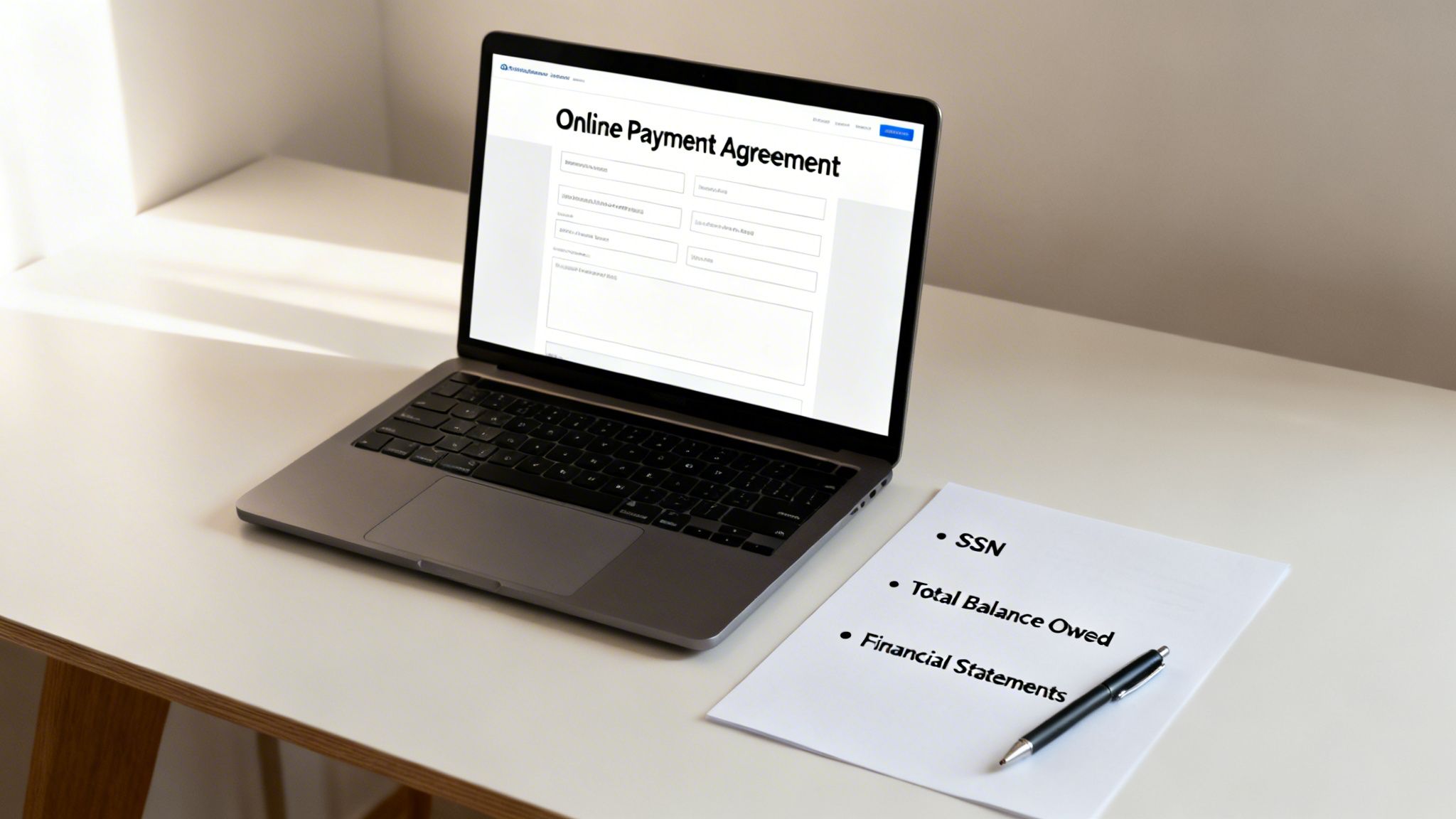
Method 1: The Online Payment Agreement (OPA) Tool
The IRS's Online Payment Agreement (OPA) tool is your most direct route to setting up a long-term installment agreement. If your total bill—including tax, penalties, and interest—is under $50,000, you can often get approved instantly without ever having to pick up the phone.
To get started, you’ll need an IRS Online Account. This involves an identity verification process, so be prepared with your personal information. Once you're in, the system guides you through the application, clearly showing your total debt and calculating different payment options for you.
Before you log in, it’s a good idea to gather these items:
- Your Social Security Number (SSN) or Individual Taxpayer Identification Number (ITIN)
- A copy of a recent tax bill showing your current balance
- The email and phone number from your last tax return
- Your bank routing and account numbers if you plan to set up direct debit
The OPA system is built for straightforward situations. It's the perfect choice for anyone who qualifies for a Streamlined or Guaranteed agreement, giving you an answer in just a few minutes.
Method 2: Filing Form 9465, Installment Agreement Request
If you'd rather stick to paper or your tax situation is a bit more involved, you can file Form 9465, Installment Agreement Request. This is the traditional way to apply, and you can either include it with your tax return or mail it in by itself.
This form is typically your go-to if:
- You owe more than $50,000.
- You need to propose a monthly payment that’s lower than what the IRS standard formula would require.
- You're applying for an installment plan for a business tax debt.
When filling out Form 9465, you have to propose a monthly payment amount and choose a payment date. Be honest with yourself here—proposing a high number you can’t actually afford is a fast track to defaulting on the agreement. After you send it in, the IRS will review your request and get back to you by mail, which usually takes 30 to 60 days, sometimes longer.
Important Note: If you owe more than $50,000, you'll almost certainly have to submit Form 433-F, Collection Information Statement, as well. This form is a deep dive into your entire financial picture—income, expenses, assets, and debts—and is used by the IRS to verify that your proposed payment is reasonable.
Method 3: Negotiating Directly with the IRS
Sometimes, the best move is to contact the IRS directly over the phone or respond to a collection notice you’ve received. This is especially true if a revenue officer has already been assigned to your case and is actively trying to collect.
Think of this less as a formal application and more as a direct negotiation. It’s essential for people who don’t quite fit the online tool’s criteria or need to explain unique financial hardships, like the fluctuating income that comes with self-employment. This is where having a tax professional in your corner can make a world of difference, as they can advocate for a payment plan that truly reflects your ability to pay.
No matter which path you take, once your plan is approved, you'll get a letter in the mail confirming all the terms. And remember, the IRS strongly prefers electronic payments. While you can mail checks, setting up a direct debit is the surest way to stay on track and avoid any accidental defaults.
What Happens if You Default on Your Payment Plan
Getting the IRS to agree to a payment plan can feel like a huge weight has been lifted off your shoulders. But don't get too comfortable—the agreement is just the beginning.
Think of it this way: getting the plan approved is like getting the keys to a new house. The real work is making the mortgage payment, on time, every single month. If you fail to hold up your end of the deal with the IRS, you’ll find yourself in default, and the consequences are serious.
A default isn't just about missing one payment. The IRS will pull the plug on your agreement for several reasons, and it's crucial to know what they are to keep yourself protected.
What Triggers a Default
The IRS isn’t very forgiving when it comes to the rules of an installment agreement. Break any of them, and your plan is terminated, instantly removing the shield that was protecting you from collections.
The most common reasons for default are straightforward:
- Missing a Monthly Payment: This is the big one. Even a single late or skipped payment can put your entire agreement in jeopardy.
- Failing to File New Tax Returns: Your responsibility to stay current doesn't go away. You must file all your tax returns on time for every year the payment plan is active.
- Owing New Taxes: If you file a new return and end up with a new tax bill that you don't pay off right away, it will cancel out your old agreement.
Basically, the IRS gave you a chance based on the condition that you would stay completely compliant going forward.
The Immediate Consequences of Defaulting
Once you default, the IRS moves fast. You'll receive a formal notice—usually a Letter CP523—informing you of their intent to terminate your installment agreement. From that moment on, the gloves come off, and aggressive collection activities can restart immediately.
As soon as your payment plan is terminated, it's as if it never existed. The IRS can immediately deploy the powerful collection tools that were on hold, including federal tax liens and levies on your assets.
This means the IRS is legally cleared to take actions like:
- Filing a Notice of Federal Tax Lien: This is a public claim against all your property, including your house and future assets. It wrecks your credit score and makes it nearly impossible to sell property or get a loan.
- Issuing a Levy: A levy isn't a warning; it's the actual seizure of your assets. The IRS can take money straight from your bank accounts or garnish a huge chunk of your wages, often without any further notice.
These actions can throw your finances into a tailspin overnight. The stability you worked so hard to get with the payment plan simply vanishes, and you're right back where you started, facing the full power of the IRS.
If your financial hardship is so severe that making any payment is impossible, you may need to look into other forms of relief. For some, it might be worth learning more about IRS Currently Not Collectible status, a program that temporarily pauses collections.
Still, the best strategy is always to prevent a default in the first place. If you see trouble on the horizon and think you might miss a payment, the most important thing you can do is contact the IRS before it happens to see if your plan can be modified.
When to Hire a Tax Attorney for Your IRS Payment Plan
Can you set up an IRS payment plan yourself? Absolutely. The IRS even provides online tools to make it happen for straightforward cases. But some tax problems are simply too big and carry too much risk to go it alone.
Calling a tax attorney isn't waving a white flag; it's bringing in a specialist to protect your financial future. When the stakes are high, knowing when to get professional help is the smartest move you can make.
Signs You Need Professional Help
The IRS system can feel like a labyrinth, especially when you owe a significant amount or your financial history is messy. Certain red flags should immediately tell you it’s time to stop DIY-ing and call an expert.
You should seriously consider hiring a tax attorney if you're in any of these situations:
- You owe more than $50,000. This is a critical number. Once your tax debt crosses this threshold, the IRS collection process gets far more aggressive. You'll likely face intense scrutiny of your finances and tougher negotiations that an attorney is equipped to handle.
- You have unfiled tax returns. You can't get a payment plan until you're current on all your filings. If you have years of unfiled returns, an attorney can help you reconstruct records, prepare the returns properly, and minimize additional penalties before you even approach the IRS for a deal.
- You're facing a tax audit. Juggling an audit and a large tax bill at the same time is a recipe for disaster. An attorney can represent you in the audit and negotiate the payment of the final tax liability as a single, coordinated strategy.
- Your case involves business or payroll taxes. This is a major red flag. The IRS pursues unpaid payroll taxes with extreme prejudice. They can hold business owners personally liable through the Trust Fund Recovery Penalty (TFRP), putting your home, savings, and other personal assets directly in their crosshairs.
Expert Insight: An experienced tax attorney does more than just negotiate your monthly payment. They become a shield between you and the IRS, stopping threatening calls and letters. Their real value is in building a comprehensive solution that protects your assets and finally puts your tax problems behind you for good.
A Real-World Example of Attorney Intervention
Imagine a small business owner in Detroit who falls behind on her payroll taxes. The IRS opens a Trust Fund Recovery Penalty investigation, threatening to hold her personally liable for the entire debt. She’s getting notices about liens on her home and levies on her personal bank account. The pressure is immense.
She hires a tax attorney, who immediately takes over all communication with the IRS Revenue Officer. The intimidating phone calls stop. The attorney digs into the business’s finances and builds a case proving the owner didn't have the legal "willfulness" required to be hit with the penalty.
The result? The TFRP is dropped, her personal assets are no longer at risk, and the attorney negotiates a manageable installment agreement for the business debt itself. That’s the kind of concrete protection and peace of mind that expert representation delivers.
Of course. Here is the rewritten section, designed to sound like it was written by an experienced human expert.
Frequently Asked Questions About IRS Payment Plans
When you're staring down a tax bill, a lot of questions pop up. It's completely normal. Here are some straightforward answers to the questions we hear most often from clients about setting up a payment plan with the IRS.
Can I Get a Payment Plan if I Haven’t Filed All My Returns?
This is a common stumbling block, and the IRS is very clear on this: No. Before the agency will even consider an installment agreement, you have to be fully caught up on all your past tax filings.
Think of it this way—the IRS won't agree to a payment plan for a debt amount that might change. If you have unfiled returns, your first and most important step is to get those prepared and submitted. Once you're current, the door to a payment plan officially opens.
Will the IRS Stop a Bank Levy if I Set Up a Payment Plan?
Absolutely. In most situations, getting an official installment agreement is the quickest way to halt aggressive collection actions like bank levies or wage garnishments.
Once your plan is formally approved, it acts like a shield. It tells the IRS that you have a proactive solution in place, effectively pausing their enforcement measures for that specific tax debt.
Key Takeaway: An approved payment plan is one of the most powerful tools for stopping immediate collection threats. It shifts the dynamic from enforcement to a structured, manageable repayment process.
How Quickly Can I Get an IRS Payment Plan Approved?
The approval time really comes down to how you apply.
- Online Payment Agreement (OPA): This is by far the fastest route. If you apply online and qualify for a Streamlined agreement (typically for debts under $50,000), you can get approved almost instantly. We're talking minutes.
- Mail (Form 9465): Going the paper route is much slower. Expect to wait anywhere from 30 to 60 days, and sometimes even longer, for the IRS to process your form and mail back a decision.
What Is the Longest Term for an IRS Payment Plan?
Generally, the IRS wants the debt cleared within 72 months, or six years. This is the standard maximum term for most arrangements, especially the common Streamlined Installment Agreements.
While it's sometimes possible to negotiate a longer-term plan for more complex financial situations, 72 months is the benchmark you should plan for. Of course, the faster you can pay it off, the more you'll save in penalties and interest that continue to add up.
