
Your Guide to the Fresh Start Program: the fresh start program for tax relief
When you're staring down a mountain of IRS debt, it can feel like the walls are closing in. But there's a pathway out. The Fresh Start Program isn't some rigid, one-size-fits-all plan; think of it more as a set of policies the IRS created to give struggling taxpayers a fair shot at getting back on solid ground.
What Is the IRS Fresh Start Program?
The constant fear of a bank levy, wage garnishment, or a lien on your property takes a massive toll, both financially and emotionally. The IRS Fresh Start Program was designed specifically to give individuals and small businesses a clear way forward out of that stressful cycle. It marks a real shift in how the IRS approaches collections—moving from pure enforcement to a more cooperative stance that actually recognizes financial hardship.
It’s less of a single program and more of a toolkit with different options, each built for a specific kind of situation. Instead of just demanding a full payment you can't afford, the initiative offers flexibility. The whole point is to help you resolve your tax debt in a way that matches what you can actually pay, stopping a financial problem from turning into a catastrophe.
This decision tree helps visualize the point where exploring these solutions becomes absolutely critical.
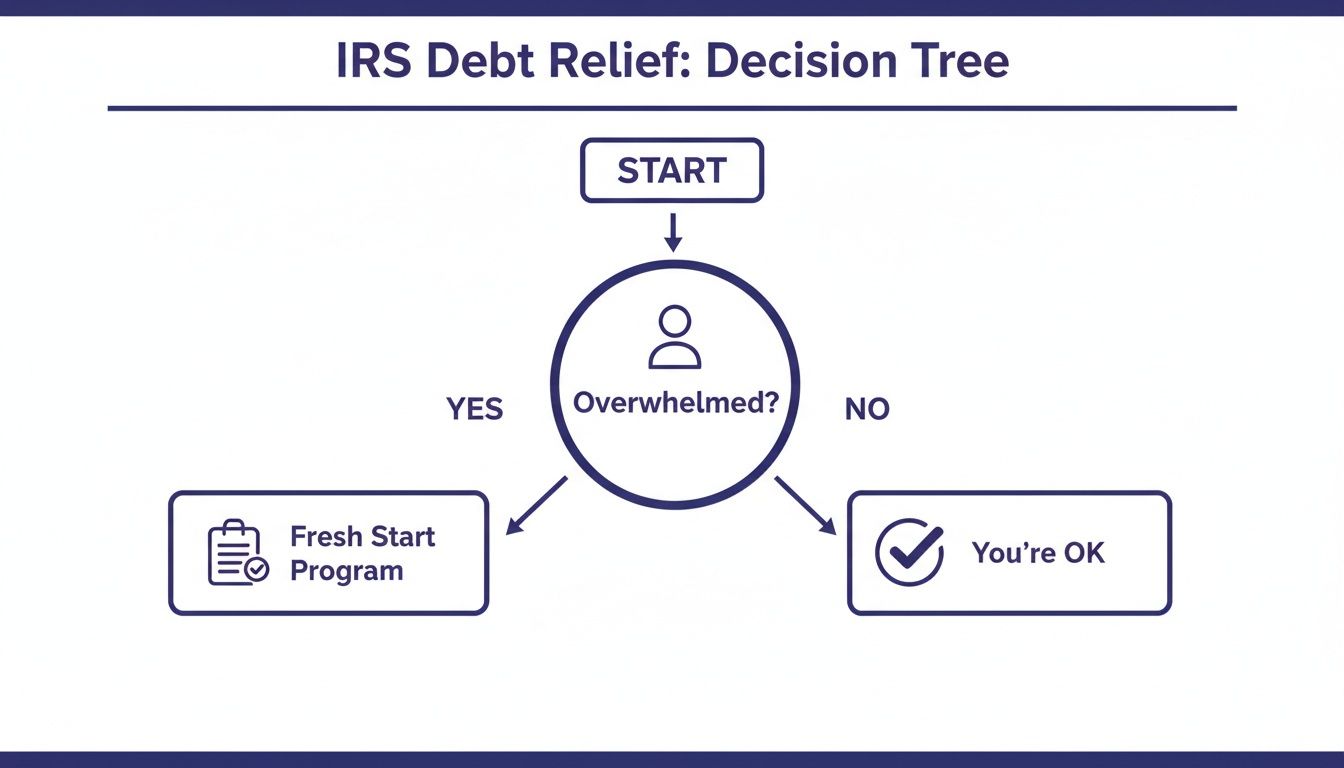
As you can see, that feeling of being completely overwhelmed is the main trigger. It’s the sign that it’s time to stop worrying and start looking at concrete options.
Key Relief Options in the Fresh Start Program
The table below gives you a quick snapshot of the main tools available through the Fresh Start initiative. Each one serves a different purpose, so finding the right fit for your circumstances is the first step toward a resolution.
| Relief Option | Primary Purpose | Ideal for Taxpayers Who… |
|---|---|---|
| Offer in Compromise (OIC) | Settle tax debt for less than the full amount owed. | Genuinely cannot afford to pay their entire tax bill due to significant financial hardship. |
| Installment Agreement (IA) | Pay off the full tax debt over time through monthly payments. | Can't pay in a lump sum but have the steady income to make manageable monthly payments. |
| Penalty Abatement | Remove penalties from a tax bill. | Have a valid reason for failing to file or pay on time, like a serious illness or bad advice. |
| Tax Lien Withdrawal | Remove a public Notice of Federal Tax Lien. | Have entered a payment plan and need the lien removed to secure credit for a major purchase. |
While each path has its own set of rules and requirements, they all lead to the same destination: getting you back in good standing with the IRS.
The Four Pillars of Relief
The program's real power comes from these different avenues for getting help. Let's break down what each one actually does.
Offer in Compromise (OIC): This is probably the most well-known option. An OIC allows qualified taxpayers to resolve their tax liability with the IRS for a lower amount than what they originally owed. It’s a powerful tool, but it’s reserved for those who can prove they truly don’t have the ability to pay the full debt.
Installment Agreements (IA): If you can afford to pay your debt over time, an Installment Agreement creates a structured monthly payment plan. The Fresh Start initiative made this much more accessible, especially for debts under $50,000, by simplifying the application process.
Penalty Abatement: This is exactly what it sounds like—a request to have tax penalties removed. The IRS might grant this for a specific reason (reasonable cause), such as a death in the family or reliance on incorrect advice from a tax professional. There's also a First-Time Abatement option for taxpayers with a clean compliance history.
Tax Lien Withdrawal: A federal tax lien can destroy your credit. Under certain conditions, like setting up a Direct Debit Installment Agreement, the IRS may agree to withdraw a filed Notice of Federal Tax Lien, making it much easier to get a loan for a home or car.
The Fresh Start Program isn’t about tax evasion. It’s about creating a realistic way for people to meet their obligations without having their financial lives ruined in the process. It's a recognition that helping taxpayers recover is better for everyone, including the government.
Taking advantage of these tools requires careful planning and a thorough understanding of the IRS’s rules. For a deeper dive into the specifics, you can learn more about Fresh Start tax relief in our other guides. Each option demands full compliance and accurate paperwork, but the result—financial peace of mind—is more than worth the effort.
How the Fresh Start Program Changed Everything for Taxpayers
To really get why the Fresh Start Program is such a big deal, you have to remember what life was like for taxpayers in trouble before it existed. For decades, the IRS's playbook was simple and severe: aggressive collection. If you fell behind, it wasn’t long before they filed a Notice of Federal Tax Lien (NFTL).
This wasn't just a letter in the mail; it was a public record declaring the government's claim against everything you owned. Imagine walking into a bank for a mortgage or a car loan with a federal lien stamped on your credit report. It was a non-starter. This single action could set off a financial implosion, making it almost impossible for people and businesses to get back on their feet. The system was built to punish, not to find a practical solution.
A New Way of Thinking at the IRS
The financial crisis of the late 2000s exposed a huge flaw in this heavy-handed approach. With millions of Americans suddenly struggling, the old enforcement methods weren't just harsh—they were backfiring. The IRS came to a crucial realization: you can’t get blood from a stone. A taxpayer who loses their business or home because of aggressive collections is a taxpayer who can never pay what they owe.
This understanding prompted a massive shift in IRS policy. Rolled out in 2011, the Fresh Start initiative was a direct answer to the economic reality of the time. It was the IRS officially acknowledging that helping taxpayers regain their financial footing is better for everyone, including the U.S. Treasury.
The core philosophy of the Fresh Start Program is simple: a financially healthy taxpayer is one who can actually pay their taxes. It’s a pragmatic pivot from an adversarial stance to a more cooperative one.
This wasn't just a friendly suggestion from the top; it was a set of concrete rule changes that gave struggling taxpayers real, tangible relief. The program wasn't just another "deal"—it fundamentally rewired how the IRS handles collections for people facing legitimate hardship.
The Power of Raising the Lien Threshold
One of the most impactful changes was increasing the debt amount that automatically triggered a tax lien filing. Before Fresh Start, a tax debt as low as $5,000 could bring down the hammer. The program immediately doubled that to $10,000.
This one adjustment created a massive ripple effect. By raising the bar, the IRS instantly saved hundreds of thousands of taxpayers from having their credit torpedoed over relatively small debts. It provided a vital financial cushion, giving them the breathing room to work out a solution without watching their financial world collapse. The numbers speak for themselves.
The initiative, launched in the wake of the Great Recession, eventually led to policies where liens might not be filed for debts up to $25,000 in certain situations. The result? IRS Data Book statistics show that Notices of Federal Tax Lien filings plummeted by nearly 76% between 2010 and 2023, dropping from over 1 million per year to less than 250,000. You can dig deeper into the facts and figures behind the Fresh Start Initiative on TaxFortress.com.
Creating Clearer Paths to Resolution
Beyond just holding back on liens, the initiative opened up access to other critical resolution tools. It made it far easier to qualify for programs that were once out of reach for the average person.
Key improvements included:
- Simpler Installment Agreements: The debt limit for getting a streamlined installment agreement was raised, making it much easier for people with significant but manageable tax bills to get on a payment plan.
- More Attainable OICs: The Offer in Compromise (OIC) program became more flexible. The IRS started using more realistic figures when calculating a taxpayer's reasonable living expenses and ability to pay.
This one-two punch of delayed enforcement and expanded resolution options is what truly gives the Fresh Start Program its power. It replaced an old, often destructive model with a structured, more humane system for getting right with the IRS.
Settle Your Debt with an Offer in Compromise

When you're facing a tax debt so large that you can't imagine ever paying it off, an Offer in Compromise, or OIC, can feel like a lifeline. It's one of the most powerful options available through the Fresh Start Program because it allows you to formally settle your entire tax bill with the IRS for less than you actually owe.
This isn't just the IRS giving you a discount out of kindness. It's a pragmatic business decision on their part. Think of it like a credit card company negotiating a massive balance. If you can prove you simply don't have the income or assets to ever clear the full amount, they might accept a smaller, final payment rather than get nothing at all. An OIC works the same way—it's a legally binding agreement that, once you've fulfilled your end of the deal, wipes the slate clean.
Proving Your Case to the IRS
Successfully getting an OIC comes down to one core idea: doubt as to collectibility. This is the formal term for convincing the IRS that, based on your complete financial picture, they are highly unlikely to ever collect the full tax debt from you. It means opening up your finances for intense review.
The IRS uses a specific formula to determine your Reasonable Collection Potential (RCP). This is their official calculation of what they believe they could realistically get from you. The RCP looks at two main things:
- The net value of your assets (equity in your home, cars, bank accounts, etc.).
- Your disposable income over a set number of months into the future.
If your RCP is far lower than your total tax bill, you have the grounds for an OIC. This isn't about finding a loophole; it’s about presenting a thoroughly documented, honest argument about your financial reality.
The Role of Form 433 and the Application Process
The heart of any OIC application is Form 433-A (for individuals) or 433-B (for businesses). This is an exhaustive financial statement where you must list every detail about your income, expenses, assets, and debts. Be warned: the IRS will verify everything you submit against their own records, so absolute accuracy is non-negotiable.
When the IRS launched the Fresh Start Initiative back in 2011, it made some key updates that opened the OIC program to more people. The rules were adjusted to allow for more realistic living expenses, like car payments and student loans, which helped paint a truer picture of a person's financial hardship. While OIC acceptance rates have historically hovered around 38%, these changes made it possible for more taxpayers in genuine need to find relief. Our detailed guide on what an Offer in Compromise is breaks down the mechanics even further.
An Offer in Compromise is fundamentally a financial negotiation. You are presenting a detailed argument, backed by evidence, that the settlement offer you are making is the most the IRS can ever expect to receive.
The process kicks off when you submit Form 656 (the official OIC document), your completed Form 433, and a $205 non-refundable application fee (unless you meet low-income waiver requirements). You'll also need to make an initial payment toward your offer. Once your application is in, the IRS typically pauses most collection activities while a revenue officer reviews your case, which can take several months.
During this entire time, you must stay completely compliant. That means filing all your tax returns on time and making all your current tax payments. Any misstep here will get your offer thrown out automatically.
Manage Payments with Installment Agreements and Penalty Abatement
While an Offer in Compromise can feel like the ultimate goal for someone with tax debt, the reality is it’s a tough path reserved for those in truly dire financial straits. But that doesn't mean you're out of options.
The Fresh Start Program created other powerful tools for people who can pay their tax liability over time but simply can’t write a massive check today. Two of the most effective are Installment Agreements and Penalty Abatement. These options don't erase the original tax you owe, but they tackle the problem from a different angle by making the total debt far more manageable.
The Power of a Streamlined Installment Agreement
An Installment Agreement (IA) is a formal payment plan you set up with the IRS. It’s a straightforward solution for taxpayers who have the income to clear their debt eventually but need a structured, predictable way to do it.
The Fresh Start initiative made getting one of these agreements significantly easier, especially with the creation of the Streamlined Installment Agreement. This was a game-changer for many taxpayers.
Here’s why it works so well:
- Higher Debt Ceiling: Your total bill—including tax, penalties, and interest—can be up to $50,000.
- Less Paperwork: For many people who qualify, there’s no need to complete a complex Collection Information Statement (Form 433-F).
- Longer Repayment Horizon: You get up to 72 months (that’s six years) to pay the debt in full.
This streamlined process helps you get a plan in place quickly, stopping the immediate threat of aggressive collection tactics like a wage garnishment or a levy on your bank account.
Getting Penalties Removed with Abatement
IRS penalties can feel like salt in the wound. They can inflate a manageable tax bill into a mountain of debt that feels impossible to climb. Penalty Abatement is the official process for asking the IRS to remove those penalties.
While the process isn't new, the spirit of the Fresh Start Program encourages relief for taxpayers who have a legitimate reason for their compliance issues. Most successful requests are built on one of two arguments.
Reasonable Cause
This is the most common path to penalty relief, but it requires a strong case. You have to prove that you acted with "ordinary business care and prudence" but were still unable to file or pay on time because of circumstances completely outside your control.
A "Reasonable Cause" argument is not a simple excuse. It requires a detailed, compelling narrative supported by documentation that proves your inability to comply was not due to willful neglect.
In our experience, valid arguments often involve situations like:
- A debilitating illness or the death of the taxpayer or a close family member.
- An unavoidable, extended absence from home or work.
- The destruction of your home, business, or critical records in a fire, flood, or other disaster.
- Relying on incorrect advice you received from a competent tax professional.
First-Time Penalty Abatement
If you have a solid track record with the IRS, you may be in luck. The First-Time Abatement (FTA) policy is an administrative waiver that recognizes your past good-faith efforts to stay compliant.
To qualify for this one-time "get out of jail free" card, you must meet three conditions:
- You've filed all your required tax returns (or filed a proper extension).
- You've already paid the tax due or have arranged to pay it (like through an Installment Agreement).
- You have a clean slate, with no penalties for the three tax years prior to the one in question.
Whether you're arguing reasonable cause or seeking a first-time waiver, a well-prepared request is everything. For more details on the specific forms and arguments involved, you can check out our guide on Form 843 and penalty abatement. Your success depends on presenting a clear, persuasive, and well-documented case to the IRS.
Common Mistakes That Can Derail Your Application
The IRS Fresh Start Program can be a lifeline, but it’s not a cakewalk. I’ve seen far too many applications get torpedoed by the same handful of simple, avoidable mistakes. One small oversight is all it takes for the IRS to issue an automatic rejection, sending you right back to square one.
Think of it this way: when you apply for a mortgage, the bank needs to see your entire financial story before they’ll even consider lending you money. The IRS is no different, only their standards are even more rigid. Knowing where the landmines are hidden is the first step to successfully navigating the process.
The most common—and frustrating—error is failing to get your house in order before you apply.
This isn’t just a good idea; it's a non-negotiable requirement for any relief under the Fresh Start Program.
The Absolute Must-Do: Filing All Your Returns
Let’s be crystal clear: the IRS will not even open your application for an Offer in Compromise or Installment Agreement until every single one of your required tax returns is filed. That includes any overdue returns from years past. The IRS simply cannot assess your financial reality or entertain a settlement if they don't have a complete picture of your tax history.
Many people fall into the trap of thinking they can sort out old, unfiled returns after they get a deal in place. That’s completely backward. From the IRS’s perspective, unfiled returns are a glaring sign of ongoing non-compliance, which immediately disqualifies you from a program meant to help people acting in good faith.
The IRS Fresh Start Program is a pathway forward, not a tool to ignore past obligations. Proving you are serious about getting right with the government starts with filing every single overdue return, no exceptions.
Making this mistake is like asking for a fresh start while refusing to let go of the very habits that created the problem. It’s a guaranteed rejection.
Staying Compliant During the Review Period
Once your application is in, you’re officially under the microscope. This review period can be long—an Offer in Compromise, for instance, can easily take six to twelve months. During that entire time, you must stay perfectly current with your tax obligations.
This means you absolutely have to:
- Make your quarterly estimated tax payments on time if you're self-employed.
- Check that your employer is withholding the correct amount of tax from each paycheck.
Falling behind on new taxes while the IRS is reviewing your old debt is one of the quickest ways to get your application tossed out. They need to see that you've fundamentally changed your financial behavior and can be trusted to stay compliant in the future.
Incomplete or Inaccurate Financial Disclosures
At the heart of every Fresh Start application is your financial statement—Form 433-A or 433-F. This is where you lay all your cards on the table, providing a forensic accounting of your income, expenses, assets, and liabilities. Any gaps or misrepresentations here can be fatal to your case.
The most frequent blunders we see on this form include:
- Understating Income: "Forgetting" to list income from a side gig or other irregular cash flow.
- Inflating Expenses: Claiming monthly expenses that the IRS deems excessive or unnecessary based on their national and local standards.
- Hiding Assets: Failing to disclose a secondary bank account, a boat, or other property.
The IRS has enormous power to verify your information through third-party data. They will cross-reference what you report, and they will find discrepancies. Being anything less than 100% transparent isn’t a strategy; it’s an invitation for rejection. Worse, if they suspect you're being intentionally deceptive, it could trigger a much more serious investigation. Treat Form 433 with the gravity it deserves—your entire case is built upon it.
How Professional Guidance Can Secure Your Fresh Start

Knowing that the Fresh Start Program exists is one thing. Actually using it to resolve a serious tax problem is a completely different ballgame. The gap between reading about an Offer in Compromise and having one approved by the IRS is often where professional representation makes all the difference.
Trying to face the IRS by yourself is a lot like trying to represent yourself in court. You might grasp the basic concepts, but you’re up against an opponent who handles thousands of these cases every single day. A single misstep on a form or a missed deadline can get your case thrown out, sending you right back to square one with less time and fewer options.
The Advantage of Having an Expert in Your Corner
A seasoned tax professional brings far more to the table than just filling out paperwork. They become your advocate, building and defending a case designed to get you the best possible outcome. They know how to anticipate the IRS's questions and counter their assumptions with documented proof.
This expertise is absolutely vital when dealing with the core components of the program.
- Offer in Compromise Filings: An expert knows exactly how to frame your financials on Form 433. They ensure your Reasonable Collection Potential is calculated correctly and presents your situation in the most accurate—and favorable—light.
- Installment Agreement Negotiations: A professional can often negotiate directly with an IRS revenue officer to secure manageable payment terms, heading off more aggressive actions like liens or levies before they even start.
- Penalty Abatement Cases: To get penalties waived, you need a compelling “Reasonable Cause” argument backed by solid evidence. A tax attorney understands what the IRS considers a legitimate reason and how to build a persuasive case for relief.
Professional guidance turns a stressful, high-stakes gamble into a well-planned strategy. It’s all about using inside knowledge of IRS procedures to protect your assets and secure a resolution you can actually live with.
A huge part of effective professional guidance is the ability to manage client expectations and improve client relations. Given the long timelines and complexities of tax cases, that kind of transparent communication is absolutely essential.
Taking the First Step Toward Resolution
You don't have to navigate the maze of the Fresh Start Program on your own. The potential pitfalls are real, but the right guidance can help you sidestep common mistakes, save an immense amount of stress, and ultimately protect your financial future.
At Defense Tax Partners, our team has spent years helping Michigan taxpayers find relief through these exact programs. We know the local enforcement environment, we understand the nuances of IRS procedures, and we know how to build a strong case based on the reality of your financial situation.
It all starts with a clear plan. Don’t let uncertainty or fear stop you from moving forward. Schedule a free, confidential consultation with our team today, and let's explore the best path to securing your fresh start.
Frequently Asked Questions About the Program
When you're facing a significant tax debt, it’s natural to have a lot of questions. The IRS Fresh Start Program offers several paths to relief, but knowing which one is right for you—and how to navigate the process—can feel overwhelming.
We’ve compiled answers to some of the most common questions our clients ask. Getting these details straight from the beginning helps set clear expectations and builds a much stronger foundation for your case.
Can I Qualify with Unfiled Tax Returns?
No, this is one of the most critical starting points. Before the IRS will even consider you for an Offer in Compromise or an installment plan, you have to be in full compliance. In their eyes, that means every required tax return from previous years must be on file.
Think of it this way: the IRS can't agree to a solution if they don't know the full extent of your tax liability. If you have unfiled returns, getting those prepared and submitted is your absolute first step. Trying to apply for relief before you're caught up is, unfortunately, a dead end.
How Long Does an Offer in Compromise Take?
Patience is a virtue when it comes to the Offer in Compromise (OIC) process. From the moment you submit your application, you should plan on a waiting period of 6 to 12 months for the IRS to complete its review and make a final decision. The timeline really depends on how complex your financial situation is and the current backlog at the IRS.
The good news is that during this review period, the IRS generally puts a pause on aggressive collection activities. This can provide a much-needed break from things like bank levies or wage garnishments while your offer is under consideration.
Keep in mind that if your finances involve business assets, trusts, or other complex holdings, the review could easily stretch beyond a year.
What Happens If the IRS Rejects My Application?
A rejection letter can feel like a major setback, but it’s not the end of your journey. If the IRS denies your OIC or another Fresh Start application, you have 30 days from the date on that letter to file an appeal. Your case then goes to the IRS Office of Appeals, which is an independent division within the agency.
This gives you a fresh set of eyes on your case. An appeal is your chance to clarify any misunderstandings from the initial review or provide additional arguments. And if the appeal doesn't succeed, you can immediately shift your focus to other resolution strategies, like a Streamlined Installment Agreement, to get your tax debt under control.
Does an Installment Agreement Stop a Bank Levy?
Yes, it absolutely does. Once you and the IRS formally agree to an Installment Agreement, it effectively stops most enforced collection actions. This means the IRS will halt future bank levies and wage garnishments as long as you stick to the approved payment plan.
It's important to understand, however, that an agreement doesn't necessarily prevent a federal tax lien. The IRS might still file a Notice of Federal Tax Lien to protect its claim on your property while you pay down the debt. While the Fresh Start initiative made lien filings less frequent for debts under $25,000, it’s still a possibility. The main takeaway is that an approved agreement immediately protects your liquid assets and income from seizure.
