
How to Negotiate with IRS: how to negotiate with irs for Michigan taxpayers
That official-looking envelope from the IRS in your mailbox is enough to make anyone’s heart skip a beat. But before you let panic set in, take a deep breath. Your first move isn’t to pick up the phone in a frenzy; it’s to calmly and methodically figure out exactly what the IRS is saying.
This initial assessment is everything. It transforms a scary, ambiguous letter into a set of facts you can actually work with and lays the groundwork for every step that follows.
Your First Move After Getting an IRS Notice
Reacting with emotion is the quickest way to make a mistake. Think of this first step as gathering intelligence. The more you understand about the notice itself, the stronger your position will be when it’s time to respond.
Most of the time, these letters aren't formal audits or immediate demands for payment. They're often automated notices generated by the IRS computer system because the numbers on your tax return don't quite match the information they received from third parties, like your employer or a financial institution.
Decoding the Language of IRS Notices
Every notice has a code, usually printed in the top-right corner. This isn't just a random number—it tells you exactly why the IRS is contacting you. For taxpayers in Michigan, a couple of common ones you might see are the CP2000 and the CP504.
A CP2000 notice is not a tax bill. It's a "Proposed Individual Income Tax Assessment." Essentially, the IRS is saying, "Our records show something different from your return, and we think this is how it should be corrected." For example, maybe you did some freelance graphic design work in Grand Rapids and forgot to include a 1099-NEC form on your return. The CP2000 is their way of pointing that out.
The CP504 notice, however, is a different beast entirely. This is a "Notice of Intent to Levy." It’s a much more serious letter that means the IRS has sent previous notices that have likely gone unanswered. They are now officially warning you of their intent to seize assets, which could mean taking funds from your bank account or garnishing your wages. Understanding the vast difference in urgency is critical.
Expert Insight: The notice number tells a story. A CP2000 is an invitation to have a conversation about a discrepancy. A CP504 is the final warning shot before the IRS begins enforced collection. Your strategy for each will be worlds apart.
Pinpointing the Crucial Information
Once you know the type of notice, you need to pull out three key pieces of information from the document:
- The Tax Year in Question: The notice will clearly state the tax period it relates to (e.g., "Tax Year Ending December 31, 2022"). This is crucial because it tells you exactly which year's records you need to pull.
- The Proposed Amount Owed: Look for the section breaking down the proposed additional tax, along with any penalties and interest that have already started to accrue. This is your starting point.
- The Response Deadline: This might be the single most important detail on the page. The IRS typically gives you 30 days to respond before their proposed changes become final or they escalate collection actions. Missing this deadline strips you of a lot of negotiating power.
Your Initial Triage Checklist
Before you do anything else, you need to triage the notice. This simple checklist helps you organize the chaos and turn that intimidating letter into a clear, actionable problem to solve.
IRS Notice Triage Checklist
A quick reference guide to assess your IRS notice and determine immediate next steps.
| Checklist Item | What It Means | Your Action |
|---|---|---|
| Notice Number (e.g., CP2000) | This is the reason the IRS is contacting you. | Identify the notice type so you understand its purpose and urgency. |
| Tax Period | The specific year the issue is about. | Focus your efforts. Pull all your financial records for that year only. |
| Proposed Balance Due | The amount the IRS believes you owe, including tax, penalties, and interest. | Start by verifying this. Does it look right based on your own records? |
| Response Deadline | The non-negotiable date by which you must reply. | Mark this date on your calendar immediately and plan backward from there. |
Let’s say you get a CP2000 proposing a $5,000 tax increase for 2023 with a response date of August 15th. With this table filled out, your mission becomes crystal clear: gather all your 2023 income documents and prepare your argument before that August deadline.
This initial analysis is the foundation of a successful negotiation. It takes you from a state of panic to a place of clarity, armed with the facts you need to choose the right path forward.
Finding Your IRS Resolution Pathway
Once you’ve sorted through the initial IRS notice and understand what you’re up against, it’s time to choose your strategy. This is where a lot of people go wrong. They pick the option that sounds best, not the one that actually fits their financial reality according to the IRS's rigid rules.
There’s no one-size-fits-all solution here. The right path—the one that will actually get approved—depends entirely on the numbers. Your goal is to get inside the IRS’s head and pick the program they’re most likely to greenlight. Wasting months on an application that was doomed from the start just means more stress, more penalties, and more interest piling up.
The three main resolution programs are the Installment Agreement (IA), the Offer in Compromise (OIC), and Currently Not Collectible (CNC) status.
This decision tree gives you a visual of how to think through the process right after opening that IRS envelope. It all starts with a clear-eyed assessment.
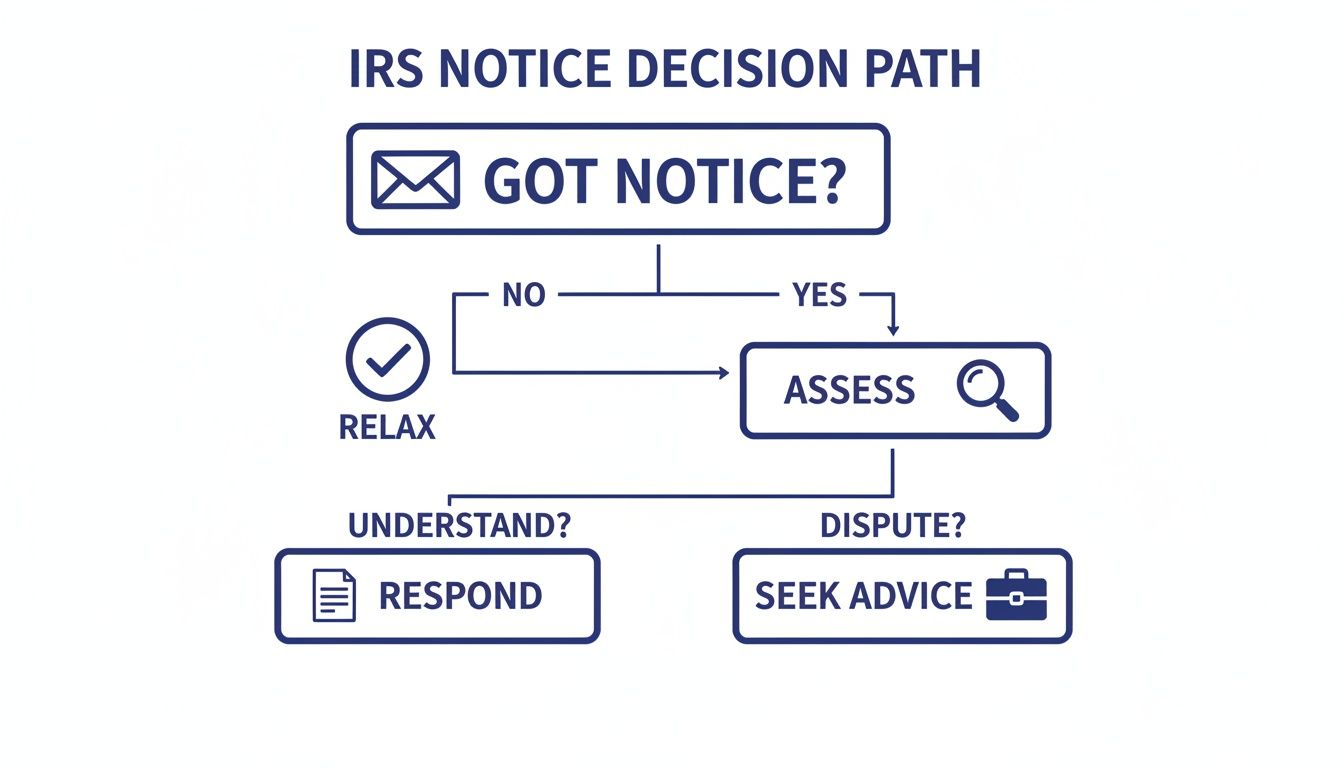
As the flowchart shows, that initial triage directly points you toward the most realistic resolution path for your situation.
Installment Agreement: The Most Direct Path
An Installment Agreement is the most common and straightforward resolution. Think of it as a payment plan. You agree to make monthly payments over time—typically up to 72 months—until the debt, including penalties and interest, is paid off completely.
This is the perfect fit for taxpayers who have a steady income and can cover their basic living expenses while also chipping away at their tax liability. A salaried professional in Lansing with a predictable paycheck is a classic candidate. The IRS sees a reliable income stream and is usually more than willing to approve a payment plan that fits the budget.
Offer in Compromise: A Financial Fresh Start
An Offer in Compromise (OIC) is a whole different ballgame. This program allows certain taxpayers to settle their tax debt for less than the full amount owed. Let's be clear: this isn't a casual negotiation. It’s a formal process for people in genuine financial distress who have no realistic way to ever pay back everything they owe.
To even have a chance, you have to prove to the IRS that they can’t collect the full amount from your income and assets. They use a strict formula called Reasonable Collection Potential (RCP) to figure this out. An OIC is often a viable option for someone with unpredictable income, like a self-employed contractor in Ann Arbor whose business has hit a rough patch, or someone who's been through a major life event like a disability or job loss.
Key Takeaway: An OIC is based on what you can pay, not what you want to pay. The IRS will put your entire financial life—assets, income, and expenses—under a microscope before they even consider a settlement.
It’s worth noting that OIC acceptance rates have dropped, making a meticulously prepared application more critical than ever.
Currently Not Collectible: A Temporary Reprieve
When things are truly dire, you might qualify for Currently Not Collectible (CNC) status. This doesn’t make the debt disappear. Instead, it puts a temporary pause on all IRS collection efforts because they’ve determined you can’t even afford your basic living expenses, let alone a tax bill.
CNC is designed for people facing severe hardship—unemployment, serious illness, or even homelessness. You have to show that your monthly income is less than your allowable living expenses, as defined by the IRS's own national and local standards. While you’re in CNC status, the debt is still on the books and continues to grow with interest and penalties, but the IRS will stop levies and wage garnishments. If this sounds like your situation, you can learn more about how IRS Currently Not Collectible status works and who qualifies.
The IRS doesn’t forget about you, though. They’ll check in periodically, usually every year or two, to see if your financial situation has improved.
Comparing Your Options
Choosing the right path forward demands an honest look at your finances. This table boils down the core differences to help you see where you might fit.
| Resolution Pathway | Who It's For | Key Consideration |
|---|---|---|
| Installment Agreement (IA) | Taxpayers with steady income who can pay the full debt over time. | A straightforward way to resolve debt without severe financial hardship. |
| Offer in Compromise (OIC) | Taxpayers in significant financial distress with no ability to pay the full debt. | Requires extensive financial disclosure and meets a strict IRS formula. |
| Currently Not Collectible (CNC) | Taxpayers facing extreme hardship who cannot afford basic living expenses. | A temporary pause on collections; the debt remains and grows. |
By analyzing your income, assets, and expenses through the same lens the IRS uses, you can pinpoint the most viable resolution. Making this strategic choice upfront is the single most important step in putting your tax problem behind you for good.
Crafting a Winning Offer in Compromise
An Offer in Compromise, or OIC, can feel like a lifeline. It’s a formal agreement with the IRS that allows you to settle your tax debt for a fraction of what you originally owed. But let's be clear: this isn't about asking for a favor. It’s about building a rock-solid financial case that proves you simply cannot pay the full amount, either now or in the foreseeable future.

Getting an OIC approved has become incredibly challenging. The IRS Offer in Compromise acceptance rate recently dropped to a mere 21%. Just a few years ago, that number was closer to 40%. This dramatic shift sends a clear message: your application must be perfect. There is simply no room for error.
This process isn't about what you think is a fair amount to pay. It’s a cold calculation based entirely on the IRS’s own internal formulas.
Understanding the Reasonable Collection Potential Formula
Everything hinges on one critical calculation: the Reasonable Collection Potential (RCP). This is the exact formula the IRS uses to figure out the absolute minimum they will accept to resolve your tax liability. If your offer doesn't meet or exceed their RCP number, it's dead on arrival.
The RCP formula has two primary parts:
- The Net Value of Your Assets: This isn’t what you think your house or car is worth. It’s the "quick-sale" value of everything you own—cash, investments, real estate equity, vehicles—minus any loans against them. Essentially, it’s what the IRS believes they could get if they forced a liquidation.
- Your Future Income Potential: The IRS takes your gross monthly income and subtracts a set of standardized, allowable living expenses. They don't care about your actual car payment or grocery bill; they use their own national and local standards. Whatever is left over is multiplied by either 12 (for lump-sum offers paid within 5 months) or 24 (for payment plans lasting up to 24 months).
Add those two numbers together—your asset value plus your future income—and you have your RCP. Your offer must be at least that amount.
The Essential Forms: 433-A (OIC) and 656
Your entire argument is presented through two main documents. They work together, and any discrepancies between them can doom your application from the start.
- Form 656, Offer in Compromise: This is the one-page formal proposal. It’s where you officially state your offer amount and the grounds for it, which for most people is "Doubt as to Collectibility."
- Form 433-A (OIC), Collection Information Statement: This is the beast. It's a comprehensive, detailed breakdown of your entire financial life—every asset, every source of income, and every expense. This is the form the IRS uses to calculate your RCP.
Think of it this way: Form 433-A is your evidence, and Form 656 is the conclusion you draw from that evidence. They have to tell the same story.
Expert Tip: A classic mistake is listing your actual monthly expenses on Form 433-A. You must use the IRS's approved living expense standards. If you list expenses higher than their allowed amounts without an extremely well-documented reason, the IRS will simply adjust them, inflating your calculated ability to pay and leading to a rejection.
Avoiding Critical Application Mistakes
With the acceptance rate so low, you can't afford a single misstep. An incomplete or poorly prepared OIC will be kicked back without a second thought. If you plan to tackle this on your own, you must first understand the complexities of an Offer in Compromise before you even fill out the first line.
Here are the most common traps people fall into:
- Using the Wrong Asset Values: You must list the "quick sale value," which is typically 80% of an asset's fair market value. Using the full market price will artificially inflate your RCP.
- Forgetting About Future Income: Taxpayers often get fixated on their assets and forget that the IRS is just as interested in what you can pay from your wages over the next 12 or 24 months.
- Submitting a "Hopeful" Offer: The single biggest reason for rejection is offering an arbitrary amount. Pulling a number out of thin air won't work. The offer must be a direct result of the RCP calculation.
- Missing the Fee and First Payment: Unless you qualify for a low-income exception, you must include a non-refundable $205 application fee and your first proposed payment along with your submission. If you don't, the IRS won't even look at it.
Ultimately, a successful OIC isn't really a negotiation. It's an exercise in meticulous compliance. The goal is to present your financial data so accurately and in accordance with their strict rules that the IRS examiner independently arrives at the same RCP that you did. When your numbers match theirs, you have a winning offer.
Side-Stepping the Common Traps in IRS Negotiations
Knowing how to negotiate with the IRS is as much about dodging the common mistakes as it is about making the right moves. I’ve seen countless well-intentioned people accidentally torpedo their own cases by making simple, avoidable errors. Understanding these pitfalls ahead of time is your best defense against a denied resolution, liens, and levies.
One of the most frequent—and fatal—missteps is submitting a "lowball" offer. This is what happens when someone decides what they want to pay, or what feels fair, and presents that number to the IRS. The problem is, the IRS doesn't operate on feelings; their process is driven by a rigid, data-based formula.
The Myth of the Lowball Offer
Trying to negotiate with a number based on wishful thinking is a fast track to rejection. The IRS calculates your ability to pay using a strict formula called the Reasonable Collection Potential (RCP). This isn't a negotiation starting point; it's a hard calculation that analyzes your assets, income, and expenses to determine the absolute minimum settlement they will even look at.
There’s often a massive gap between what a taxpayer hopes to pay and what the IRS calculates. In fact, it's not uncommon for the IRS's RCP calculation to be seven to ten times higher than what taxpayers propose in their rejected offers. This just goes to show how far apart expectations can be and why you absolutely must base your offer on their math, not your own.
The Danger of Inconsistent Information
When you submit financial forms like the 433-A for an Offer in Compromise, you’re painting a complete picture of your financial life. Every single number has to be accurate and, just as importantly, consistent. A classic blunder is providing information that contradicts other documents you've filed or what's available in public records.
For example, if you claim a very low income on your tax forms but your bank statements show large, unexplained deposits, an IRS agent will spot that discrepancy in a heartbeat. The same goes for undervaluing assets—if you claim your car is worth next to nothing, they will immediately cross-reference it with standard industry valuation guides.
Real-World Scenario: A small business owner in Detroit submitted an Offer in Compromise, claiming severe financial hardship. What they didn't disclose was a boat registered in their name with the state of Michigan. The IRS examiner found the asset with a simple public records search. That one inconsistency not only got the offer thrown out but also triggered a much deeper audit into their business finances.
Showing Up with Incomplete or Messy Records
Your negotiation is only as strong as the evidence you bring to the table. Walking into a discussion with an IRS agent unprepared or submitting an application with missing paperwork sends a clear signal: you aren't taking this seriously. This can instantly kill any goodwill and steer the case toward a negative outcome.
To avoid this, it's crucial to learn how to organize business receipts and other financial documents. A well-organized file projects credibility and makes the agent's job easier, which can only work in your favor.
Missing Deadlines and Ghosting the IRS
The IRS runs on a tight schedule. When a notice says you have 30 days to respond, that’s a hard deadline, not a suggestion. Missing it can lead to the IRS automatically approving their proposed tax increase or escalating collection actions, which can strip you of your appeal rights and any negotiating power you had.
Ignoring letters and calls is even worse. It’s a surefire way to make the situation deteriorate quickly. Proactive and timely communication shows the IRS you're willing to cooperate and find a solution. An unresponsive taxpayer, on the other hand, is seen as a collection risk, prompting the agency to fast-track aggressive tactics like wage garnishments and bank levies. And if you find yourself facing penalties, it's worth seeing if you can request a penalty abatement using Form 843.
Key Mistakes to Steer Clear Of
To protect yourself from these costly errors, think of this as your "what not to do" checklist as you prepare to deal with the IRS.
- Don't Guess on Your Offer: Never pull an offer amount out of thin air. You must do a thorough RCP calculation first.
- Don't Hide Assets: Work from the assumption that the IRS will find everything. Full, honest disclosure is your only real option.
- Don't Be Unprepared: Get all your financial documents, back tax returns, and supporting evidence organized before you ever make contact.
- Don't Miss a Deadline: Put every single date on your calendar and set reminders to respond well before the cutoff.
- Don't Go It Alone on Complex Cases: If you're dealing with significant debt, multiple unfiled years, or a business tax issue, trying to handle it yourself is one of the biggest pitfalls of all.
Avoiding these common traps can completely change the dynamic of your case. It shifts the interaction from a stressful, adversarial confrontation to a structured, fact-based negotiation where a positive outcome is genuinely possible.
When to Hire a Michigan Tax Attorney
Trying to handle an IRS issue on your own can feel empowering at first, but there's a definite tipping point where going it alone becomes a serious liability. Knowing when to switch from a DIY approach to calling in a professional is one of the most critical decisions you'll make. It’s not about admitting defeat; it's a strategic move to protect your financial future.

Certain situations dramatically raise the stakes, moving your case beyond a simple tax bill into territory where legal expertise isn't just helpful—it's essential. If you see any of these red flags, it's a clear signal to stop talking to the IRS and let a professional take over.
The IRS Threatens Enforced Collection
You can tell a lot from the language the IRS uses. When their letters shift from proposing a balance to threatening action, the game has changed entirely. The moment a Final Notice of Intent to Levy lands in your mailbox, it's time to call an attorney. No exceptions.
This notice is the IRS's final warning before they start seizing your assets. We're talking about clearing out your bank accounts, garnishing your wages, or even taking your property. Once that levy machine starts rolling, it is incredibly difficult to stop without immediate and skilled intervention.
A tax attorney can file for a Collection Due Process (CDP) hearing, which legally forces the IRS to halt the levy. This move instantly buys you precious time and shifts the conversation to a formal setting where your rights are the primary focus.
You're Facing a Complex Audit or Years of Unfiled Returns
An IRS audit is much more than a simple review of your receipts. A revenue agent will dig into every corner of your financial life, and one wrong move or poorly worded answer can have devastating consequences. You absolutely need an attorney if you're facing:
- A Field Audit: This is when an IRS agent schedules a visit to your home or business. It's an invasive, in-person examination that signals a very serious inquiry.
- Multiple Years of Unfiled Returns: Digging out from several years of unfiled taxes is a minefield. An attorney can manage the entire process of getting you back into compliance, working to minimize penalties and ensure the situation doesn't escalate toward a criminal investigation.
- Business or Payroll Tax Issues: The IRS is at its most aggressive when it comes to payroll tax debt. This is what's known as the Trust Fund Recovery Penalty, and because it involves money withheld from your employees' paychecks, the IRS can and will hold business owners personally liable.
In these situations, an attorney serves as a critical shield. They handle all communication with the IRS agent, preventing you from accidentally saying something that could be used against you.
Your Offer in Compromise Was Rejected
If you’ve already submitted an Offer in Compromise (OIC) and the IRS rejected it, you've hit a wall that requires professional help to get over. The OIC acceptance rate hovers around a dismal 21%, so rejections are common. Often, they happen because of a technical mistake on the application or a flawed calculation of your Reasonable Collection Potential (RCP).
An experienced tax attorney knows exactly how to dissect the rejection letter, pinpoint the IRS’s specific reasons for denial, and map out the smartest way forward. That might mean appealing the decision or building a brand-new, stronger offer that directly counters the IRS's objections. Trying to go it alone a second time after being rejected is a recipe for failure.
The Advantage of Local Michigan Expertise
When your tax problem involves both the feds and the state, a local Michigan attorney gives you a home-field advantage. A firm like Defense Tax Partners is deeply familiar with the inner workings of both the IRS and the Michigan Department of Treasury. They understand how the two agencies interact, know the local economic factors that can influence a negotiation, and are experts in the specific procedures for handling state-level tax liens and levies.
This dual expertise is priceless. For instance, resolving a federal tax lien is only half the battle if the State of Michigan has also slapped a lien on your property. A local attorney can build a comprehensive strategy to tackle both liabilities at once, protecting your assets in a way a generic, out-of-state firm might not even consider. Bringing in an attorney lifts the emotional weight from your shoulders, puts a legal expert between you and the IRS, and gives you the best shot at a real resolution.
Answering Your IRS Negotiation Questions
When you're staring down a stack of IRS notices, it's natural to have a million questions running through your mind. The whole process can feel like a black box, and you're probably wondering about timelines, penalties, and what happens if you just… don't respond. Let's clear up some of the most common concerns we hear from Michigan taxpayers trying to navigate a negotiation with the IRS.
Can I Really Negotiate IRS Penalties and Interest?
Yes, absolutely. Negotiating penalties is a very real possibility, and it's something we help clients do all the time. The most common route is called a Penalty Abatement. To get one, you need to show the IRS you had a "reasonable cause" for not filing or paying on time. This isn't just any excuse; it has to be something significant, like a serious illness, a house fire, or even bad advice from a tax professional.
If this is your first time in trouble with the IRS, you might be in luck. The agency's First-Time Abate policy can provide a one-time pass for a clean record.
Interest, on the other hand, is a tougher nut to crack. It's set by law and rarely waived on its own. The good news? If you successfully reduce the tax you owe or get your penalties removed, the interest tied to that amount automatically goes down, too.
How Long Does an Offer in Compromise Take?
If you're thinking about an Offer in Compromise (OIC), get ready to play the long game. This is not a quick fix. From the moment you submit the paperwork, you can expect the IRS to take anywhere from 6 to 9 months—and sometimes over a year—to review your case and give you a final answer.
The silver lining is that while your OIC is under review, most of their aggressive collection activities, like bank levies and wage garnishments, are put on hold. It gives you some critical breathing room. Just remember, if your offer is accepted, you have to walk the straight and narrow for the next five years, filing and paying every tax bill on time.
What Happens If I Just Ignore the IRS Notices?
I can't stress this enough: ignoring the IRS is the single worst thing you can do. The problem doesn't vanish; it snowballs. What starts as a simple letter will quickly escalate into something much more serious.
If you don't respond, the IRS will ramp up its efforts. Here’s what you can expect:
- Federal Tax Lien: The IRS will file a public claim against your property—your house, your car, everything. This lien is a bright red flag to any lender and can crush your credit score.
- Bank Levy: This is when they reach directly into your bank account and take what they're owed. They can drain your checking and savings accounts without any further warning.
- Wage Garnishment: The IRS can legally order your employer to send a chunk of every paycheck directly to them before you even see it.
These actions have consequences that go far beyond your tax bill. A federal tax lien, for example, is a public record that can have a lasting negative impact. If you're worried about this, it’s worth understanding how public records affect your credit report. The only way to stay in control of the situation and keep your options open is to face the problem head-on.
