
What Is Notice of Levy? A Guide for Michigan Taxpayers
A Notice of Levy from the IRS or the Michigan Department of Treasury is one of the most serious letters you can receive. It's the government's final, legal warning shot before it begins actively seizing your assets to pay a tax debt. This isn't just another bill; it’s an aggressive collection action that requires an immediate, strategic response.
What is a Notice of Levy, Really?
Getting a Notice of Levy marks a critical turning point in your financial life. It’s crucial to understand how it differs from a tax lien, as people often confuse the two.
A tax lien is a passive claim. It secures the government’s interest in your property, essentially putting a public "dibs" on your house or car to show everyone you owe a tax debt. A levy, on the other hand, is the actual, forceful seizure of that property.
To put it simply: a lien is a legal claim on your car, but a levy is the government showing up with a tow truck to take it away.
Before things get to this point, you’ve likely received a series of other notices. This official document means all prior attempts to collect the debt have failed. It's the government’s way of saying, "We're done asking." The consequences are direct and incredibly disruptive:
- Bank Levies: The government can freeze and take funds directly from your checking or savings accounts.
- Wage Garnishments: They can order your employer to send a portion of your paycheck directly to them before you ever see it.
- Asset Seizure: They can take physical property, including vehicles, real estate, and other valuable personal items.
The 30-Day Warning Window
The good news is that the IRS can't just show up unannounced. Federal law, specifically 26 USC §6330, requires the agency to notify you in writing of your right to a hearing first.
This notice must be sent at least 30 days before the first levy is issued. This gives you a critical—but very limited—window to take action. You can learn more about the legal details in our guide on what a tax levy is.
A Notice of Levy turns a tax problem from a passive debt into an active, immediate threat. It gives the government the power to take what is yours without having to go to court first.
Understanding what this notice means is the first step toward getting back in control. It's an urgent call to action, signaling that the time for waiting is over. While the situation is serious, it’s not hopeless. That 30-day period is your chance to request a hearing, which temporarily stops all collection activity, and start negotiating a solution to protect your financial future.
To make the distinction crystal clear, here's a quick comparison of a tax lien versus a tax levy.
Tax Lien vs. Tax Levy at a Glance
| Aspect | Tax Lien | Tax Levy |
|---|---|---|
| What it is | A legal claim against your property to secure a debt. | The actual seizure of your property to satisfy a debt. |
| Purpose | Protects the government's interest in your assets. | To collect the money you owe by taking your assets. |
| Impact | Appears on your credit report; complicates selling property. | Your bank accounts, wages, or physical property are taken. |
| Analogy | The bank putting a "dibs" sticker on your car. | The tow truck hauling your car away. |
Knowing the difference is vital. A lien clouds your financial future, but a levy actively dismantles your present financial life.
The Road to a Tax Levy: How It All Unfolds
A Notice of Levy from the IRS or the Michigan Department of Treasury never just appears out of the blue. Think of it as the final destination on a long road, and the government sends plenty of road signs along the way. Understanding this escalation path is key, because it’s filled with opportunities to get off the road before you reach the end.
It all starts with a tax assessment, which is simply the government officially recording your tax debt on its books. Shortly after, you’ll get the first bill in the mail—a formal Notice and Demand for Payment. If you don't pay that, a predictable series of reminder notices will follow, each one a bit more serious than the last.
Every letter is another chance to open a dialogue and sort things out before the government takes more drastic measures.
From Polite Reminders to a Final Warning
Ignoring those early notices is what really sets the wheels of forced collection in motion. The government’s goal is to collect the tax you owe, and if you won't pay voluntarily, they have the power to take it. This is where the process gets serious, fast.
Eventually, you'll receive the most critical letter of all: the Final Notice of Intent to Levy and Notice of Your Right to a Hearing. This isn't just another bill. It’s a formal, legally required warning shot, and it means business. The notice clearly states the government's plan to seize your property and, just as importantly, tells you that you have 30 days to formally appeal by requesting a Collection Due Process (CDP) hearing.
This Final Notice is your last clear chance to stop the levy before it happens. Requesting a CDP hearing within the 30-day deadline legally freezes all collection efforts, buying you precious time to negotiate a resolution while your appeal is considered.
This timeline gives you a bird's-eye view of how a simple tax claim escalates to a final notice that demands your immediate response.
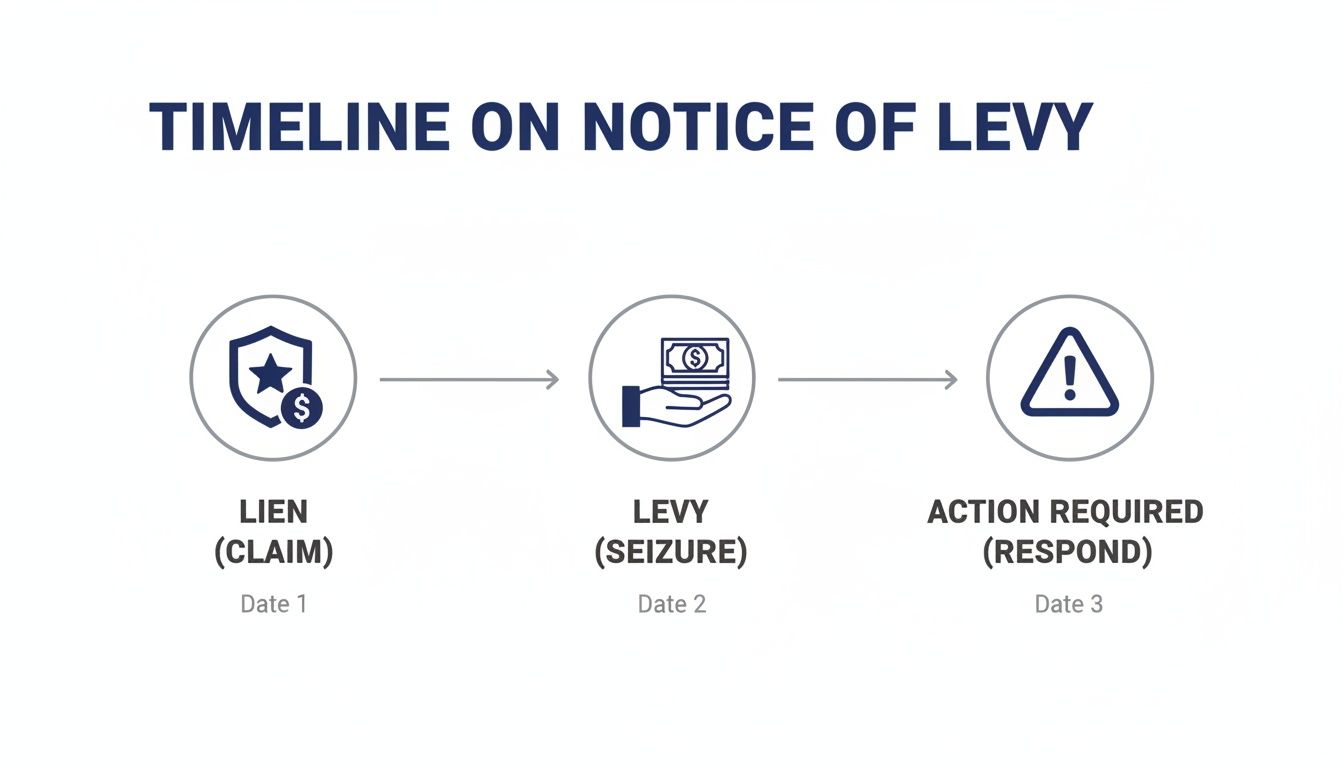
As you can see, a levy is the predictable end of a very documented process—it's not a random act.
The Critical 30-Day Window
The day you receive that Final Notice of Intent to Levy, a 30-day clock starts ticking. This window is your single most powerful defensive tool. If you let it close without responding, you give up your automatic right to a CDP hearing. On day 31, the IRS or the state of Michigan is legally free to start seizing your bank accounts, garnishing your wages, and taking your assets.
This is why understanding how long the IRS can collect back taxes is so critical—the whole system operates on strict legal timelines that have windows for you to act. Your response, or your silence, is what determines whether you stay in control of your financial future or hand that control over to the government. Acting fast within those 30 days is everything.
What a Levy Can Seize from Michigan Residents

When the government issues a levy, things get real, fast. The problem moves from being just paperwork to a genuine financial crisis. For folks here in Michigan, this means that both the IRS and the Michigan Department of Treasury have their sights set on specific assets. Knowing exactly what they can take is your first line of defense.
One of the most common and jarring actions is a bank levy. This isn't a slow drain; it's an immediate freeze. The government can legally take funds straight out of your checking, savings, or investment accounts, often without enough warning to move money for your rent, mortgage, or even groceries.
Your Paycheck and Personal Property
It's not just the money you have saved. A levy can also go after the money you earn through a wage garnishment. When this happens, your employer is legally ordered to send a large chunk of your earnings directly to the government. You never even see it in your paycheck, which can obviously devastate your household budget.
A levy’s power doesn't stop there. The government also has the right to seize and sell your physical property to cover your tax bill.
Assets commonly taken include:
- Vehicles like your car, truck, or boat
- Real estate, which can include your primary home, a vacation cottage, or rental properties
- Valuable personal property, such as jewelry, art, or family heirlooms
- Business assets, from accounts receivable to essential equipment
These aggressive actions show just how severely a levy can impact your ability to provide for your family, pay your bills, and keep your business running.
The Financial Impact of a Levy
A Notice of Levy isn't just another letter—it’s the legal key that unlocks serious collection powers. It’s what turns a tax lien into the actual seizure of your property. To give you an idea of its power, the IRS used levies to collect from over 1.2 million taxpayers in fiscal year 2023 alone. Of those, bank levies were the most common, making up 60% of all seizures and bringing in $1.8 billion. This authority comes directly from Internal Revenue Code §6331.
The notice itself will arrive by certified mail, clearly stating what you owe and giving you a 30-day window to appeal before the seizures can start.
A levy is designed to be disruptive. By freezing your financial resources, the government applies maximum pressure to force a resolution to your tax debt.
Even your future income is at risk. The IRS and Michigan Treasury can levy Social Security benefits, retirement accounts, stock dividends, rental income, and even sales commissions. While certain assets have some protection, very little is completely safe once a levy is underway. You can find more specifics by reading our guide on what happens during a bank levy. The speed and scope of a levy make it absolutely critical to act within that 30-day notice period to protect everything you've worked so hard to build.
Your First Steps After Receiving a Notice of Levy

The moment you open a Notice of Levy, the clock officially starts ticking. It’s a jarring experience, but this isn't a time for panic. It’s a time for immediate, decisive action. Your most powerful tool is the right to request what's known as a Collection Due Process (CDP) hearing.
Filing for this hearing within 30 days of the notice date is your absolute top priority. Think of it as hitting a legal pause button. This single action forces the IRS or state to freeze all collection activities—no bank levies, no wage garnishments—while your case is reviewed. This breathing room is invaluable, giving you a chance to regain control, challenge the levy, or work out a better solution.
Create Your Immediate Action Plan
To move from a panicked reaction to a strategic response, you need a methodical plan. The first 48 hours are critical. Start by finding the exact date on your notice; your 30-day deadline to file for that crucial CDP hearing hinges on it.
Next, start gathering every piece of tax-related mail you've received from the IRS or the Michigan Department of Treasury. These documents form the paper trail of your case, and every letter is a potential clue. Don't throw anything away, no matter how minor it seems.
Here’s your immediate checklist:
- Confirm the Notice Date: Find the date printed on the levy notice. Mark your calendar with the strict 30-day deadline to request your CDP hearing. If you miss it, you forfeit your automatic right to stop collections.
- Organize All Documentation: Pull together every notice, letter, and assessment you’ve gotten. Having a complete file helps a professional quickly grasp your case history and spot any procedural mistakes or defense angles.
- Consult a Tax Attorney Immediately: This isn't a DIY project. Navigating tax law is incredibly complex, and the stakes are high. An experienced tax attorney can make sure your CDP hearing request is filed correctly and on time, protecting your rights from the very start.
A CDP hearing is not just a formality; it is a critical legal proceeding. It's your official opportunity to negotiate alternatives like an installment agreement or an Offer in Compromise. It's also where you can prove that the levy would cause you significant financial hardship.
The Power of Professional Representation
Getting a qualified tax attorney involved is, without a doubt, the most important step you can take. They've been through this hundreds of times and understand the procedural dance required when dealing with a what is notice of levy situation. They can step in immediately and act as your shield, communicating directly with the IRS or state revenue officers so you don't have to.
Your attorney will handle the filings, negotiate with the tax authorities, and represent you at the CDP hearing. This professional intervention does more than just boost your chances of a good outcome—it ensures you don't accidentally miss a deadline or waive any of your rights. Taking these deliberate steps shifts the power dynamic, putting you back in a position of control.
Proven Strategies to Stop a Levy and Resolve Your Tax Debt
Getting a Notice of Levy is a serious wake-up call, but it's absolutely not the end of the road. Believe it or not, you still have options. The key is understanding how to use them to stop the collection machine and start working toward a real solution for the underlying tax debt.
Think of it this way: the IRS and the Michigan Department of Treasury would much rather have a taxpayer actively working to resolve their debt than to go through the messy process of seizing assets. Proposing a formal resolution is your most powerful first move.
Negotiating an Installment Agreement
One of the most straightforward and common solutions is an Installment Agreement (IA). It's exactly what it sounds like: a formal payment plan that lets you chip away at your tax debt with manageable monthly payments.
Simply entering into an IA shows you're making a good-faith effort to pay up. This alone is often enough to get the agency to call off an active levy. To get one, you'll need to be up-to-date on all your tax filings. They'll look at your financial picture to set a monthly payment you can genuinely afford without it causing you severe financial strain. It’s a structured way out of debt without the immediate fear of your bank account being emptied.
Settling for Less with an Offer in Compromise
For some people, the tax debt is so overwhelming that even a payment plan isn't realistic. In these cases of true financial hardship, an Offer in Compromise (OIC) can be a lifeline. An OIC lets you settle your tax liability for less—sometimes much less—than the full amount you owe.
This isn’t a simple back-and-forth negotiation, though. It’s an intensive application where you must prove to the IRS that the amount you're offering is the absolute most they could ever hope to collect. Expect to provide a mountain of paperwork detailing your income, expenses, assets, and overall ability to pay.
An OIC is essentially a plea to the government, asking them to accept that collecting the full debt is impossible. If they agree, you get a legitimate fresh start. But the standards are incredibly high, and getting one approved often requires an expert's help.
Proving Financial Hardship
What if you can't pay anything right now? If you're out of work, dealing with a serious illness, or facing another major crisis, you can ask for Currently Not Collectible (CNC) status. If the IRS grants it, they'll pause all collection efforts, including levies and garnishments.
CNC provides immediate breathing room, but it's a temporary fix. Your debt doesn't just vanish—interest and penalties keep piling on. The IRS will also check in on your financial situation periodically to see if your ability to pay has changed.
Other Powerful Relief Options
Beyond those main strategies, a few other specific defenses might fit your situation perfectly. For those in Michigan facing a state levy, it's crucial to know the local rules. You can learn more about how to stop wage garnishment in Michigan.
- Penalty Abatement: Did you have a good reason for filing or paying late, like a family emergency or a natural disaster? If you can prove "reasonable cause," you might get the penalties wiped off your bill.
- Innocent Spouse Relief: This is a vital protection if you're stuck with tax debt that your spouse (or ex-spouse) racked up without your knowledge. It can shield you from being held responsible for their tax mistakes.
Acting quickly and decisively is everything. Data shows that an astounding 85% of levies could be stopped if the taxpayer takes action within that initial 30-day window. Furthermore, a successful penalty abatement can slash a tax bill by 20-30%. You can dig deeper into these numbers and strategies in this helpful tax levy guide from TurboTax.
When you’re staring down a Notice of Levy from the IRS or the Michigan Department of Treasury, going it alone is a massive gamble. While other tax professionals can certainly help, only a tax attorney brings the critical shield of attorney-client privilege to the table.
This privilege means everything you discuss about your finances, your mistakes, and your fears stays completely confidential. You can be 100% honest without worrying that your own words will be turned against you by the very agency you're trying to negotiate with.
But it’s not just about confidentiality. The real power comes from having a local expert in your corner. A Michigan-based tax attorney knows the ins and outs of the Michigan Department of Treasury—their specific tactics, their internal policies, and even the people who work there. They’ve built relationships with local revenue officers and understand which arguments actually work at the state level. That's a home-field advantage a national chain or a CPA just can’t replicate.
More Than Just Advice—A Direct Defense
A levy isn't a problem that gets solved with good advice; it requires immediate, decisive action. This is where an experienced tax attorney transitions from advisor to your active defender, taking over the entire process so you don't have to.
This isn't a small thing. They handle the critical, time-sensitive tasks that can make or break your case:
- Filing an Immediate Halt to Collections: The moment they file a timely Collection Due Process (CDP) Hearing Request, the levy action is legally required to stop. This gives you breathing room and preserves your right to fight back.
- Negotiating from a Position of Strength: Your attorney speaks the same language as the revenue agents. They take over all communications, negotiating directly for practical solutions like an Installment Agreement or an Offer in Compromise.
- Enforcing Your Taxpayer Rights: They scrutinize every move the tax agency makes, ensuring your rights are protected and that the government isn't overstepping its legal authority.
Bringing in a tax attorney is a strategic decision to protect your financial future. They stop you from making costly mistakes under pressure, handle the aggressive negotiations, and build a defense aimed squarely at protecting your assets, your paycheck, and your sanity.
When a notice lands in your mailbox and you're left asking, "what is notice of levy," your first call should be to a legal professional who specializes in this fight. Their ability to step in immediately, stop the financial bleeding, and start building your defense is the surest way to turn a full-blown crisis into a manageable problem with a clear path forward.
Frequently Asked Questions About Tax Levies
Getting a tax levy notice from the IRS or the Michigan Department of Treasury can feel overwhelming, and it's normal to have a flood of questions. Let's tackle some of the most common and urgent concerns people have when they find themselves in this spot.
Can the IRS Take My Social Security or Retirement Funds?
Unfortunately, yes, but there are strict rules. The IRS can take up to 15% of your Social Security benefits through what’s known as the Federal Payment Levy Program. Your retirement accounts, like a 401(k) or an IRA, are also fair game, though the IRS usually doesn't go after these funds unless other options have been exhausted.
This is a scenario where professional help is invaluable. A tax attorney can step in to negotiate alternatives and protect the assets you're relying on for retirement or disability income.
How Long Does a Tax Levy Last?
The answer really depends on the type of levy. A bank levy is a one-time snapshot. It grabs whatever funds are in your account at the exact moment the bank receives the notice, and that’s it.
A wage garnishment, on the other hand, is a different beast entirely. This is a continuous levy, meaning it latches onto your paycheck and takes a cut every single pay period. It will keep doing so until the tax debt is paid in full, the levy is formally released, or you get an alternative agreement in place.
A one-time bank levy can be a shock, but a continuous wage garnishment can create a long-term financial crisis. Addressing it quickly is essential to protect your income.
What if I Cannot Afford to Pay My Tax Debt at All?
If paying your tax debt would prevent you from covering basic living expenses like rent and food, you have options. You might qualify for Currently Not Collectible (CNC) status, which essentially hits the pause button on all collection activities from the government.
For a more permanent fix, an Offer in Compromise (OIC) might be a possibility. This allows you to settle your entire tax liability for less than the full amount you owe. Both of these programs require a mountain of financial proof, and the process is far from simple. Working with an experienced tax attorney can make all the difference in successfully demonstrating your inability to pay.
