
What Is Form 8821? A Michigan Taxpayer’s Guide (2026)
That white envelope lands in the mailbox in Troy, Detroit, Lansing, or Grand Rapids, and the day changes fast.
Upon opening an IRS notice, individuals often immediately jump to the worst conclusion. They assume they owe more than they can pay, that the government is already taking action, or that they have to call the IRS alone and somehow explain a problem they don't fully understand yet.
In many cases, the first problem isn't the tax bill. It's lack of visibility.
A new client will often tell me the same thing in different words: “I know something is wrong, but I can't tell what the IRS is looking at.” That is exactly where Form 8821 becomes useful. If you're searching what is form 8821, the short answer is simple. It's the IRS authorization that lets a trusted third party inspect and receive your tax information without giving that person authority to act for you.
That matters when you're under stress and want help, but don't want to surrender control before you know what's happening.
That Official Envelope from the IRS What Happens Next
A Michigan taxpayer gets home from work, sorts the mail, and sees the return address from the Department of the Treasury. The notice may be about an audit, a balance due, missing returns, or a mismatch in reported income. Sometimes it follows a payroll tax problem for a small business. Sometimes it appears after a move, a divorce, or identity theft.

The first move usually shouldn't be guessing. It should be getting the file.
If you aren't sure what kind of notice you received, this guide to types of IRS letters can help you identify the issue before you respond.
Why this form is often the safest first step
Form 8821 is often the cleanest way to begin. It lets a tax professional see what the IRS sees. That includes the records behind the notice, the tax periods involved, and the account history that explains why the letter was issued.
You still keep decision-making authority.
That distinction gives many people immediate relief. You can authorize access to your records without authorizing anyone to negotiate, sign, or commit you to a position before you've discussed strategy.
Practical rule: When you don't yet know whether the problem is a simple transcript issue or a full representation matter, start by getting reliable access to the records.
What this looks like in real life
In Oakland County audit matters, the issue might be missing wage records or questions about deductions. In Detroit collection cases, the immediate concern may be whether the IRS has already moved from notices to enforced collection. For business owners, the actual problem may be payroll tax periods that no one reviewed carefully.
Form 8821 doesn't solve those problems by itself.
It does something just as important at the beginning. It replaces panic with facts. Once the records are available, you can separate a notice that needs clarification from one that needs active legal defense.
Granting Access Without Giving Away Control
The easiest way to understand Form 8821 is to think of it as view-only access.
If you've ever let someone log in to review financial information without giving them permission to move money, you're already familiar with the idea. Form 8821, Tax Information Authorization, allows designees to inspect confidential tax data like transcripts, filing status, and payment histories. According to the IRS, that access helps professionals work from the same record set the IRS is using, and it can cut resolution times by up to 40% in appropriate matters. The same IRS overview notes that audits have affected roughly 20,000 Michigan individual returns annually in recent years. See the IRS page about Form 8821 tax information authorization.
What the designee can receive
A properly completed Form 8821 can authorize access to information such as:
- Tax transcripts that summarize returns, account activity, and payment postings
- Filing status details that help verify how the IRS has coded the account
- Payment history that shows whether payments posted correctly
- Income records such as prior-year W-2 and 1099 information
- Account balance information tied to the periods listed on the form
That record set is what allows a professional to diagnose the issue accurately instead of relying on memory, partial notices, or old tax returns that may not match the IRS file.
What the designee cannot do
Many people find this confusing.
Form 8821 does not authorize the designee to represent you before the IRS. The designee can't negotiate a payment plan under this form alone. They can't argue an audit position, request collection relief as your representative, or sign agreements for you.
That limitation is a feature, not a flaw, when you're still in the information-gathering stage.
Form 8821 is a controlled transparency tool. It opens the file, not the steering wheel.
Why that matters in Michigan cases
Michigan taxpayers often have parallel concerns. They may be dealing with the IRS and also with the Michigan Department of Treasury. Or they may need to know whether a federal issue is about to affect wages, bank accounts, or business cash flow.
Before anyone decides whether to fight an audit, seek penalty relief, or move into a collection defense strategy, someone has to confirm the facts. Form 8821 does that efficiently. It gives a trusted professional the same source material the IRS is using, while leaving the taxpayer fully in charge of the next move.
Form 8821 vs Form 2848 A Critical Distinction
Most confusion about what is form 8821 comes from one comparison. People hear there is an “authorization form” and a “power of attorney form,” then assume the difference is minor.
It isn't.
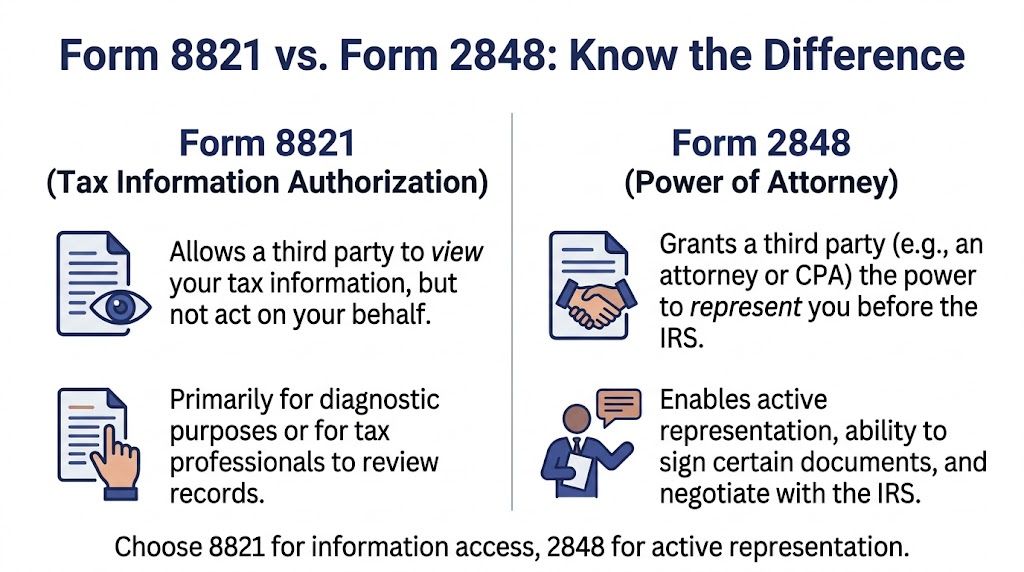
Form 8821 is for information access. Form 2848 is for representation. If you need a side-by-side look at when a representative can step in, this article on an IRS audit representative is useful context.
The clean distinction
Use Form 8821 when you want someone to inspect records and understand the problem.
Use Form 2848 when you want a qualified representative to speak to the IRS, negotiate, respond in an active case, or take procedural steps on your behalf.
That sounds simple, but real cases don't always stay in one lane.
Form 8821 vs Form 2848 at a Glance
| Capability | Form 8821 (Tax Info Authorization) | Form 2848 (Power of Attorney) |
| | | |
| Access IRS records | Yes | Yes |
| Receive confidential tax information | Yes | Yes |
| Review transcripts and notices for diagnosis | Yes | Yes |
| Speak to the IRS as your representative | No | Yes |
| Negotiate with the IRS | No | Yes |
| Sign certain documents within authorized scope | No | Yes |
| Best use | Early review, monitoring, record access | Audit defense, collections, active disputes |
Where the middle ground matters
Some Michigan cases begin as record-review matters and become representation matters later. That is especially true when a taxpayer first wants an attorney to inspect transcripts, compare them against filed returns, and determine whether the problem is a simple mismatch or a larger exposure.
The usual online explanation stops at “view versus act.” That misses an important strategic point. A discussion of understanding Form 8821 for tax information authorization highlights this underexplored middle ground. In practical terms, a taxpayer facing wage garnishment or a bank levy may need targeted action at one stage, but not broad representation at the start.
What works in practice
Three common patterns come up:
-
Initial diagnosis only
A taxpayer receives an audit notice for an Oakland County business return and wants a professional review before deciding how aggressively to respond. Form 8821 may be enough at the outset. -
Escalation to active defense
The transcript review shows collection activity, missing periods, or a dispute that requires direct contact with the IRS. At that point, Form 2848 becomes the right tool. -
Layered use in sensitive matters
In identity theft or complex compliance situations, information access may come first so the file can be reconstructed carefully. Representation authority may follow once there is a defined action plan.
If a professional needs to read the file, use 8821. If that professional needs to fight the case, 2848 is usually necessary.
What doesn't work
What doesn't work is signing the wrong form because it “sounds close enough.”
A taxpayer who thinks Form 8821 lets a lawyer stop a levy will be disappointed. A taxpayer who signs a broad power of attorney when only transcript review is needed may be giving more authority than necessary at the moment.
The form should match the stage of the case. That is the main distinction.
How to Correctly Complete and Submit Form 8821
Form 8821 is short, but mistakes on a short IRS form can still cost time.
The most common filing problems come from leaving the tax periods vague, naming the wrong designee, or submitting it too slowly when the case is urgent.

The key fields to get right
Start with the taxpayer section. The IRS wants identifying information to match its records. That usually means your name, address, and taxpayer identification number.
Then come the designee details. This is the person or firm authorized to inspect and receive the information.
After that, focus on the part many taxpayers underestimate: the exact tax matters and periods.
-
Tax type matters
If the issue involves an individual return, that may mean income tax. For a business, it could involve payroll tax or another listed matter. -
Periods matter just as much
“All years” is not a safe assumption. The IRS expects specificity. If your problem involves certain years or quarters, those periods need to be identified correctly. -
Scope matters
The form can be used to narrow access to the matters in dispute.
Why specificity matters
A notice might mention one year, while the account history shows carryover problems from prior years. A business payroll issue may involve a set of quarters, not a full calendar year. If the periods are listed incorrectly, the IRS may not release what your professional needs.
That leads to wasted time and duplicate filings.
How the IRS records the authorization
Once properly submitted, Form 8821 is recorded in the IRS's Centralized Authorization File, often called the CAF. That system is what allows the IRS to recognize the designee when requesting authorized information.
For urgent matters, filing method matters a lot. The IRS instructions state that over 90% of digital submissions can be recorded in CAF almost immediately, while paper submissions can take 2 to 4 weeks. The IRS instructions for Form 8821 processing and submission make clear why that speed matters in collection cases.
When a wage garnishment threat is active, paper filing is often too slow to be the best first option.
Best submission approach in urgent cases
For a taxpayer dealing with a Detroit wage issue, a sudden lien problem, or a time-sensitive audit deadline, digital submission is often the practical choice because it speeds recognition of the authorization.
A simple working order looks like this:
- Complete the taxpayer and designee information accurately
- List the exact tax matters and periods
- Review the signature carefully
- Submit through the fastest appropriate IRS channel for the case
- Confirm that the authorization has been recognized before relying on it
A practical checklist before sending it
| Item to confirm | Why it matters |
| | |
| Taxpayer information matches IRS records | Prevents rejection or delay |
| Designee is listed correctly | Ensures the right person receives access |
| Tax matters are specific | Avoids incomplete disclosure |
| Tax periods are correct | Prevents missing years or quarters |
| Signature is current and complete | Keeps the authorization usable |
| Submission method matches urgency | Reduces avoidable delay |
For many clients, this is the point where the process starts to feel manageable. The issue isn't “talking to the IRS somehow.” It's getting the authorization on file correctly so the right records can be reviewed without delay.
Common Pitfalls That Can Invalidate Your Form
The most dangerous Form 8821 mistakes are the quiet ones.
The IRS doesn't always reject a flawed filing in a way that feels dramatic. Sometimes the problem shows up later, when your professional tries to pull transcripts, receives incomplete information, or discovers the authorization was stale.
The 120 day trap
One rule deserves special attention. The IRS requires Form 8821 to be received within 120 days of the taxpayer's signature. That timing issue is a well-known compliance trap discussed in this reference to the Form 8821 filing deadline requirement.
This becomes a real problem when someone waits to hire help.
A taxpayer may receive an audit notice, spend weeks trying to sort it out alone, then decide to bring in counsel. By then, the original signing date may leave very little room to get the form to the IRS and recognized.
A signed form sitting on someone's desk doesn't protect you. The IRS has to receive it in time.
Other mistakes that create delays
Several recurring errors can make the form ineffective or less useful than expected:
-
Wrong tax periods
If an audit involves one year but the actual issue spans multiple years, a narrow listing can block access to key records. -
Incorrect taxpayer information
Even small mismatches can slow processing. -
Missing signature
An unsigned authorization won't do the job. -
Using Form 8821 for the wrong objective
If the case requires actual advocacy, this form alone won't get you there.
What taxpayers often assume, and why it backfires
People often assume any authorization form is better than none. That isn't always true.
A flawed Form 8821 can create false confidence. You may think your professional has what they need, while the IRS record still doesn't permit full access to the relevant file. In an active audit or collection case, that kind of delay can change strategy and timing.
A better approach
Treat Form 8821 as a technical filing, not a casual permission slip.
Check the dates. Confirm the periods. Match the form to the actual problem. If the case is already moving, don't leave the submission method to chance.
Those are small details until they stop a case from moving.
Revoking or Changing a Tax Information Authorization
One reason Form 8821 works well for cautious taxpayers is that it doesn't lock you into a permanent relationship.
If the matter is resolved, if you change firms, or if you only wanted temporary transcript access, you can end or replace the authorization.
How revocation usually works
In practice, there are two common paths:
-
File a new Form 8821 for the same tax matters and periods
When done properly, a new filing can replace the earlier authorization for those same matters. -
Send a written revocation to the IRS
This is useful when you want the IRS record to reflect that access has been withdrawn.
The important point is control. The taxpayer decides who gets access, for what matters, and for how long that access should remain useful.
When changing the authorization makes sense
Common examples include:
- a case has closed and ongoing access is no longer needed
- a business changes outside tax professionals
- the original authorization covered the wrong periods
- the matter has escalated and broader representation is now required under a different form
What to keep in mind
If you're changing designees during an active problem, don't assume the transition will take care of itself.
Make sure the replacement filing is aligned with the exact tax periods and issue type involved. If the case has become an audit defense, levy matter, or negotiation, the better question may no longer be whether to update Form 8821. It may be whether the case now calls for a power of attorney instead.
The good news is simple. You remain in charge of your private tax information the entire time.
When to Call a Michigan Tax Attorney for Your IRS Problem
Form 8821 is a useful first step. It is not the final step when the IRS is already applying pressure.
There is a point where access to records is no longer enough. You need someone who can analyze the file, define the legal risk, and take action.

Situations that justify a call now
You should speak with a Michigan tax attorney promptly if any of these are happening:
-
You received a lien or levy notice
Those cases can move from warning to enforcement quickly. -
Your employer received a wage garnishment order
Once wages are involved, speed matters. -
Your Oakland County business is under audit
Business audits often branch into recordkeeping, payroll, and prior-period issues. -
You have both IRS and Michigan Department of Treasury problems
Federal and state exposure often require coordinated handling. -
You suspect identity theft or fraudulent filing activity
Those cases require record correction, not just record review.
Why the attorney role is different
A tax attorney doesn't just gather information. The attorney evaluates whether the IRS position is accurate, whether the timeline can be challenged, whether penalties should be contested, and whether the case requires negotiation, appeal, or a protective response.
That is a different job from transcript access.
If you're already facing audit pressure or collection action, this discussion of IRS tax audit representation will help you see when a case has moved beyond information gathering.
A good first filing can prevent confusion. It can't replace legal judgment once the IRS is actively asserting a claim.
A practical Michigan perspective
In this state, taxpayers often aren't dealing with abstract tax questions. They're trying to protect a paycheck in Detroit, preserve a business in Oakland County, clear up an old compliance issue in Lansing, or avoid a problem that could affect financing, licensing, or day-to-day operations.
That's where experienced counsel matters.
If you're dealing with an IRS notice, a garnishment threat, a lien issue, or a parallel Michigan Treasury problem, Defense Tax Partners offers free consultations for Michigan taxpayers who need a clear plan. The right next step may be Form 8821. It may be immediate representation. The important thing is finding out before the case gets harder to control.
