
IRS Tax Audit Representation: A Michigan Guide
The envelope usually arrives on an ordinary day. You open it at the kitchen table or in your office between meetings, see the IRS letterhead, and your mind jumps straight to the worst-case scenario. Many taxpayers don't know whether they should call the number on the notice, send documents immediately, or brace for a visit from an agent.
That uncertainty is where mistakes begin.
IRS tax audit representation means putting a qualified professional between you and the examination process so the audit is handled deliberately, not emotionally. For Michigan taxpayers, that often means dealing with two separate risks at once. The federal audit itself, and the possibility that a state issue follows if the Michigan Department of Treasury decides to review the same return or a related one. National audit guides rarely spend enough time on that second problem. They should.
A careful response can narrow the issues, protect your rights, and keep a federal examination from turning into a broader tax controversy. A rushed response can do the opposite.
You Received an IRS Audit Letter Now What
The first thing to know is simple. A real IRS audit starts by mail. If someone calls, emails, or messages you claiming you're under audit, treat it as a scam and slow down before you do anything else.

What audit representation does
Many taxpayers think representation means someone argues with the IRS after things go badly. In practice, it starts much earlier.
A representative reviews the notice, identifies the tax year and issues under review, protects response deadlines, and controls what information goes to the agency. That matters because the first response often shapes the rest of the audit.
Practical rule: The IRS notice is not a demand to explain your whole financial life. It's a request tied to specific years and specific issues. Responding beyond that can create new problems.
Representation also changes the tone of the case. Instead of anxious phone calls and incomplete document dumps, the file becomes organized, chronological, and easier to defend.
Why the stakes can still be high
A lot of taxpayers have heard that audits are rare. That's true overall, but it's only part of the story.
IRS audit rates are historically low at 0.20% for individuals, yet the rate rises sharply for higher-income taxpayers. Taxpayers earning $1 million to $5 million face a 1.6% audit rate, those earning $5 million to $10 million face 3.1%, and taxpayers above $10 million face 8.4%. In FY 2024, the IRS recommended over $29 billion in additional taxes from audits (IRS audit statistics overview).
For Michigan business owners, investors, physicians, executives, and taxpayers with pass-through income, that's the practical takeaway. Your return may not look like the average return. Complexity draws more attention than a simple W-2 filing.
If you're trying to understand the immediate consequences, this overview of what happens if the IRS audits you is a useful starting point.
What to do in the first 48 hours
Start with a short checklist.
Read the notice carefully
Confirm the tax year, the items being examined, and the response deadline.Pull your filed return
You need the exact version that was submitted, not a reconstructed memory of it.Stop informal contact
Don't call the examiner just to "clear things up" unless you understand the issues first.Preserve records
Gather statements, receipts, accounting records, mileage logs, and anything tied to the questioned items.Assess whether this is really simple
A narrow credit-verification issue is different from a business audit, a high-income examination, or anything involving multiple entities.
What doesn't work
Some responses make audits harder fast.
- Panic mailing documents in bulk without explanation
- Guessing at facts during a phone call
- Ignoring a deadline because you need time to "get organized"
- Treating an office or field audit like a routine customer service matter
- Assuming the Michigan side won't care if the IRS makes an adjustment
If the return involves business deductions, partnership activity, S corporation income, real estate, payroll issues, or large swings in income, a measured strategy is better than a fast one. The point of representation isn't to create drama. It's to reduce it.
Navigating the Audit Process with a Representative
Most audits feel overwhelming because the taxpayer sees them as one large unknown. They aren't. They follow a sequence, and a representative's job is to control each stage before the next one starts.
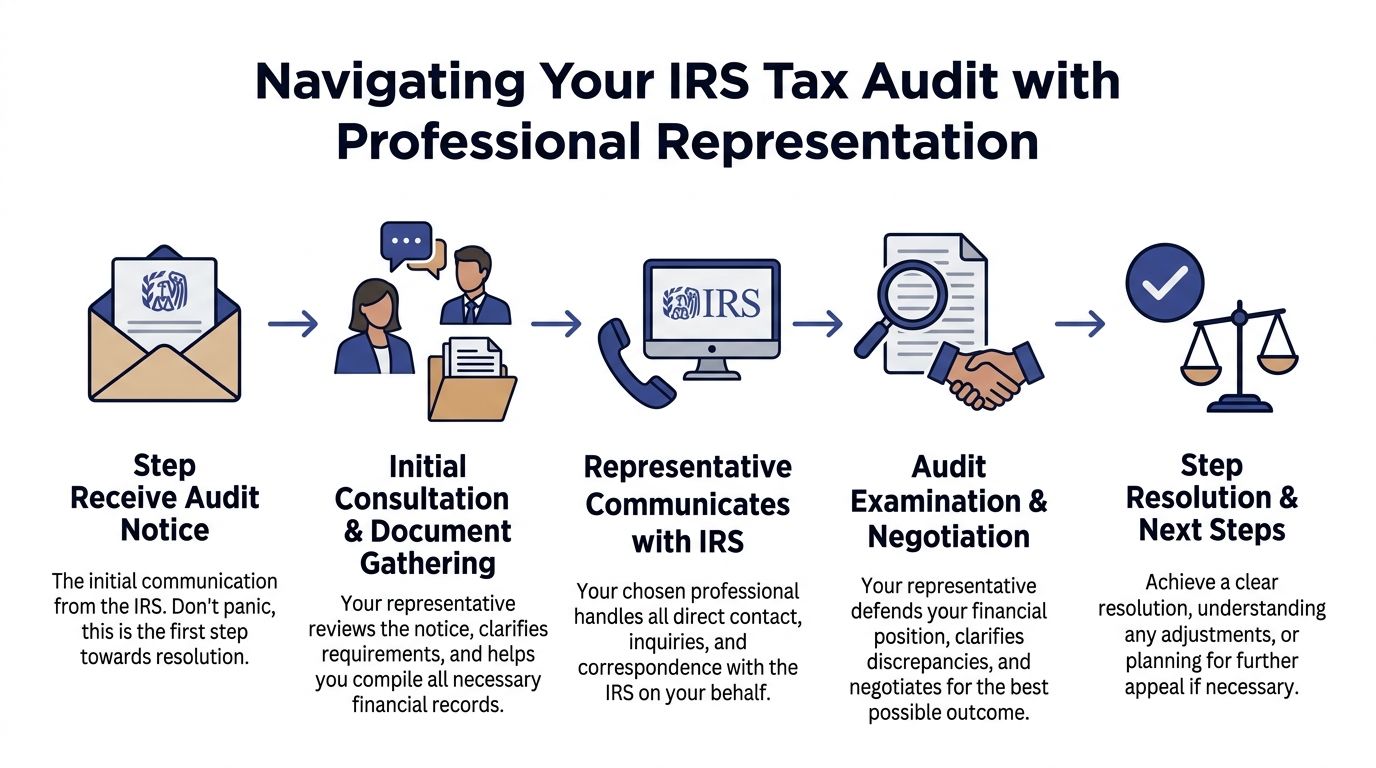
Step one is notice triage
The first review is more than reading the letter. It means figuring out what kind of audit you face and how much risk sits behind it.
A correspondence audit usually centers on specific documents. An office audit is broader and usually requires more preparation. A field audit is the one that deserves the most discipline because it can expand quickly if it's not managed carefully.
The representative looks for four things immediately:
Scope of review
Which issues are listed, and which years are open on the notice.Deadline pressure
Missing the first response date can put you on defense before the facts are organized.Document burden
Some notices ask for narrow proof. Others signal a broader examination of books and records.Expansion risk
A small issue can become a larger one if the response reveals unrelated weaknesses.
Form 2848 changes the communication channel
One of the most important early steps is signing Form 2848, Power of Attorney.
Once that authorization is in place, the representative can manage communications and document requests directly with the IRS. That keeps the taxpayer from answering questions casually, making admissions by accident, or sending records without context.
The IRS process begins with a formal mailed notice, and phone or email contacts are scams. After representation is secured through Form 2848, the representative handles communications and document requests such as Form 4564. Unrepresented taxpayers often concede 2 to 3 times more in adjustments (complete guide to IRS audit representation).
That last point matches what experienced practitioners see. Self-represented taxpayers often try too hard to be cooperative. Cooperation helps only when it's paired with control.
The goal isn't to hide information. The goal is to provide the right information, in the right format, at the right time.
The document phase is where cases are won or lost
The IRS usually asks for proof, not broad explanations. Good representation starts by matching each requested item to a document, or to a reconstruction strategy if the original record is missing.
A working audit file often includes:
- Income records such as W-2s, 1099s, K-1s, and sales summaries
- Bank support including account statements and deposit detail
- Expense proof like receipts, invoices, and vendor statements
- Business substantiation including contracts, ledgers, payroll records, and bookkeeping exports
- Use logs for mileage, travel, or property use when those items matter
If records are incomplete, the answer isn't to give up or invent details. It's to rebuild the file conservatively from secondary evidence and explain what exists.
Different audit types need different handling
Correspondence audits
These are usually the most manageable because they are document-driven. The danger is that taxpayers underestimate them.
A good written response is focused. It addresses the specific line items under examination, labels supporting records clearly, and avoids commentary on issues the IRS didn't raise.
Common mistakes include sending originals, burying key proof in a large unsorted packet, or adding explanations that invite follow-up questions.
Office audits
Office audits require more discipline because there is interaction with an examiner.
Preparation usually involves reviewing the return line by line, rehearsing likely questions, and deciding which issues the representative can address without the taxpayer attending. In many cases, the representative can appear and narrow live questioning.
That matters when the return includes business operations, related entities, shareholder issues, or deductions that need framing before they are discussed.
Field audits
Field audits require the most control. If the IRS wants to come to your business or home, the location itself becomes part of the case.
In many matters, it's better for meetings and document production to happen through the representative's office rather than at the taxpayer's place of business. That can limit distractions, reduce offhand comments from staff, and prevent an agent from casually observing unrelated issues.
From practice: Field audits often turn on process as much as substance. Who speaks, where the meeting happens, and how records are produced can shape the entire examination.
What a representative does during the examination
This part is often misunderstood. Representation is not just mailing forms and waiting for the IRS to decide.
A good representative will:
- analyze the notice and any Information Document Request
- identify strong issues and weak ones before the IRS does
- organize records around the return, not around how the client stores them
- respond in stages when that serves the client better than one large production
- challenge unsupported assumptions or scope creep
- prepare for the closing discussion and any next-step review
Some issues should be defended aggressively. Others should be resolved efficiently so the case doesn't widen.
That judgment matters. For example, fighting every minor point can frustrate an examiner and distract from the issues that control the result. On the other hand, conceding too early can lock in adjustments that were negotiable or unsupported.
If the IRS proposes changes
Not every audit ends with full agreement, and it shouldn't if the proposed changes are wrong.
Possible outcomes include:
| Outcome | What it means in practice |
|---|---|
| No change | The IRS accepts the return as filed on the examined issues |
| Agreed change | The taxpayer accepts some or all adjustments and moves to payment or resolution planning |
| Disagreed case | The taxpayer contests the findings through a manager conference, appeals, or another formal review path |
Experienced representation matters most in this situation. The file has already been built. The question becomes how to present disagreement without damaging credibility.
What works better than most taxpayers expect
Audits usually go better when the response is narrower, cleaner, and better documented than the taxpayer's first instinct.
That means:
- Lead with records instead of emotion
- Answer the notice instead of your anxiety
- Control meetings rather than improvising them
- Correct weak positions early when that prevents a broader fight
- Plan for Michigan exposure if a federal change could ripple into a state problem
The process is still serious. But it becomes manageable once someone is steering it.
Michigan Enforcement Your Local Tax Playbook
Michigan taxpayers often make one costly assumption. They think an IRS audit is a federal problem only.
It isn't.
A federal change can trigger a state problem, especially where business income, payroll issues, sales tax exposure, or adjusted federal income flows through to a Michigan filing position. That's why irs tax audit representation for a Michigan resident has to account for both agencies, even when only one has contacted you so far.

Federal and state audits don't behave the same way
The IRS tends to work through a defined examination structure with formal notices, document requests, and layered review options. Michigan Department of Treasury matters often feel more administrative at first, then more aggressive once an assessment is on the books.
That difference affects strategy.
With the IRS, the early objective is often to contain scope and preserve defenses during examination. With Michigan, the early objective is often to prevent a proposed balance from hardening into a collection problem before the record is fully developed.
Where Michigan taxpayers get caught off guard
Three patterns show up often in practice.
Income changes that carry over
If the IRS adjusts federal income, the Michigan return may need to be amended or defended in parallel. Taxpayers sometimes focus so heavily on the federal side that they miss the state reporting consequences.
Business audits with a state tail
A business owner may survive the IRS portion only to face questions about withholding, sales tax, or other state-administered obligations. The records overlap, but the agencies care about different details.
Collections move faster than expected
The IRS audit itself may still be under discussion while Michigan collection notices begin arriving on another issue entirely. That's one reason local coordination matters.
For many readers, lien and levy anxiety is part of the broader tax problem. This explanation of an IRS notice of levy helps distinguish audit concerns from active collection pressure.
Michigan cases often require two calendars in your head at once. One for the federal examination, and one for state deadlines that don't pause just because you're busy with the IRS.
A practical Michigan playbook
A localized audit strategy usually looks like this:
Map the overlap early
Identify whether the IRS issue could affect your Michigan individual, business, sales, or payroll filings.Separate audit from collection
Some taxpayers need an examination defense on one front and collection protection on another.Keep one consistent factual record
You can't explain the same transaction one way to the IRS and another way to Michigan without creating credibility problems.Watch entity-level consequences
Owners often focus on the personal return while the more dangerous issue sits in the business records.Use local knowledge where it matters
A representative familiar with Michigan enforcement patterns can spot practical risks that a national-only shop may miss.
Why local context matters in Detroit, Lansing, and Grand Rapids
Tax problems don't land in a vacuum. A Detroit business with payroll stress, a Lansing professional with an income allocation issue, and a Grand Rapids company dealing with multi-layer records don't need generic audit advice. They need a plan that accounts for how state and federal issues travel together.
That doesn't mean every IRS audit becomes a Michigan dispute. It means every Michigan taxpayer should ask whether it could.
Choosing Your Tax Audit Representative
Not every audit needs the same kind of help. Some are document-heavy and narrow. Others carry legal exposure, collection risk, or collateral state consequences. The right representative depends on the return, the issues, and what could happen if the case widens.
The main options
You generally have three categories of professional representation available for an IRS audit.
Tax attorneys
Tax attorneys are often the best fit when the audit involves legal interpretation, privilege concerns, multiple entities, high-income issues, prior noncompliance, or the possibility of a state follow-on problem.
A lawyer's role is not limited to preparing numbers. It includes controlling risk, preserving legal positions, negotiating disputed adjustments, and planning for appeals or collections if the matter doesn't end cleanly.
CPAs
CPAs are often strong on accounting records, return mechanics, reconciliations, and substantiation projects. In a straightforward audit centered on books and documents, a capable CPA can be a practical choice.
The trade-off is that some cases stop being accounting problems and become legal controversy matters. When that happens, the skill set needed changes.
Enrolled Agents
Enrolled Agents focus on federal tax practice and can represent taxpayers before the IRS. They can be effective in many routine and mid-level audit situations, especially when the core dispute is procedural or document-based.
The main question is whether your case is staying routine.
The issue most taxpayers ask about too late
Attorney-client privilege matters most when the facts are messy.
If the audit touches unreported income, commingled accounts, payroll problems, prior filing gaps, nominee issues, or statements you don't want misunderstood, legal privilege becomes more than a technical concept. It affects how safely you can prepare the case.
That doesn't mean everyone needs a lawyer. It means taxpayers should think about risk before choosing solely on price.
A representative isn't just filling a seat at the audit. You're choosing who will shape the facts, the tone, and the options if the case turns contentious.
If you want a broader overview of roles and qualifications, this guide on choosing an IRS audit representative is a useful companion.
Comparing common fee structures for tax representation
| Fee Model | How It Works | Best For | Potential Downside |
|---|---|---|---|
| Flat fee | One set amount covers a defined scope of work | Narrow audits with a predictable issue list | If the audit expands, the original scope may not cover new work |
| Hourly billing | You pay for time spent on review, calls, meetings, and responses | Unpredictable or evolving examinations | Total cost can become hard to forecast |
| Hybrid model | A base fee covers initial stages, with hourly or staged fees for added complexity | Matters that may stay simple or may escalate | Clients need to read the engagement terms carefully |
| Phase-based billing | Separate fees apply to audit response, appeals, and collection work if needed | Cases with a clear chance of moving into dispute or resolution stages | The full cost isn't visible at the start |
What to ask before you hire anyone
Use direct questions.
Who will handle the file
In some firms, the person you meet isn't the person managing the audit.How do you handle Michigan overlap
This is essential for local taxpayers with business or pass-through issues.What happens if the audit expands
You need to know the response plan before it happens.How do you communicate
Some clients want regular updates. Others want contact only when action is required.What records do you need first
A good answer should be specific, not vague.
For taxpayers comparing firms online, it can also help to understand how legal practices present their services and credentials. This article on digital marketing for law firms is useful because it shows why some websites feel polished long before you've learned who will work your case.
A Michigan taxpayer looking at serious audit risk should weigh experience, communication style, legal protection, and state-federal coordination together. On that spectrum, a tax law firm such as Defense Tax Partners may fit cases involving audits, liens, levies, state exposure, and settlement planning, while a CPA or EA may fit a more limited factual examination.
Real-World Scenarios and Success Stories
Audit representation makes more sense when you see how the issues play out in ordinary lives. The names and details below are anonymized, but the patterns are real.
Oakland County executive with a complex return
An Oakland County taxpayer came in after receiving a notice tied to a return that included W-2 income, investment activity, and pass-through items from a closely held business.
The initial instinct was to respond fast and send everything. That would have been a mistake. The better move was to isolate the issues listed in the notice, reconcile the return to the supporting records, and hold back unrelated material that would only invite new questions.
The file had a few weak spots, but they weren't fatal. Once the records were organized around the return and the explanations were tightened, the examination became narrower and more manageable than it looked at the start.
Detroit small business owner with overlapping tax pressure
A Detroit business owner first called about an audit concern but quickly revealed a second problem. The company also had mounting anxiety about payroll records and older notices that hadn't been addressed.
This is common. Clients often describe one tax problem when they have three.
The strategy was to keep the audit response disciplined while separately stabilizing the broader tax posture. That prevented the client from making admissions in one matter that would have complicated another. It also helped the business keep operating while the records were rebuilt into a format the agencies could review.
The best audit strategy sometimes starts with identifying the problem the client didn't realize was part of the case.
Married couple dealing with joint return exposure
A married couple came in with an audit notice tied to a joint return. One spouse had handled the finances. The other had signed the return without fully understanding the underlying records.
The emotional dynamic mattered as much as the documents. These cases can turn into blame contests quickly, which makes preparation harder and communication worse.
A better approach was to separate the factual review from the marital stress. Once the records were sorted and each spouse's role was understood, the representation focused on accuracy first and liability allocation second. That kind of structure often gives the client clearer options than trying to argue everything at once.
What these examples have in common
The facts were different, but the pattern was the same.
- the first notice created more fear than clarity
- the file improved once the issues were narrowed
- records mattered, but so did sequencing
- local tax consequences had to be considered early
- calm strategy worked better than quick reaction
Audits rarely improve because the taxpayer tries harder. They improve when the case becomes organized, limited, and defensible.
Frequently Asked Questions About IRS Audits
Can an audit ever help me instead of hurt me
Sometimes, yes.
A representative may uncover missed deductions, reporting errors, or credit issues while reviewing the return and underlying records. Many taxpayers think only in terms of defending against an added balance. In practice, a careful review can also reveal items that were overlooked when the return was filed.
That possibility shouldn't create false optimism. The audit is still an examination. But taxpayers shouldn't assume every audit ends only one way.
What if I can't find all my receipts
Missing records don't automatically destroy the case.
Original proof is best, but many audits can still be defended with secondary evidence such as account statements, invoices, bookkeeping records, and other documents that support the same transaction. The key is to rebuild the file conservatively rather than guessing.
Should I talk to the IRS myself first
Usually, no. At least not before you understand the issues.
Early calls often feel harmless. They aren't. Taxpayers volunteer facts, estimate numbers, and answer questions outside the notice because they want to seem cooperative. That's one of the most common ways a manageable case gets harder.
If you're going to speak, speak from a prepared record. If you aren't prepared yet, wait.
What happens if I ignore the notice
Ignoring it is one of the few choices that reliably makes things worse.
If you don't respond, the IRS can move forward based on the information it has, disallow unsupported items, and issue proposed changes without your side of the record being developed properly. By the time many people finally act, they've lost useful options.
Do I need a lawyer for every audit
No.
A narrow, document-driven issue may be manageable with limited professional help, and in some lower-income cases a Low-Income Taxpayer Clinic may be an option for eligible taxpayers seeking free or low-cost assistance. The IRS notes that these clinics are independent from the agency and can help with audits, appeals, and court matters for qualifying individuals. Taxpayers can locate one through the IRS at 800-829-3676, as described in the IRS guidance on the right to retain representation.
For complex Michigan matters, though, the better question isn't "Can someone represent me?" It's "Who can manage the federal audit and the state consequences if this grows?"
Can Michigan get involved even if the letter came from the IRS
Yes. That's one of the most overlooked risks for local taxpayers.
A federal adjustment can affect a Michigan return, and a business audit can raise separate state issues even when the original notice came only from the IRS. That's why local planning matters early, not after the federal case is over.
If you've received an audit notice and you're not sure whether the issue is narrow or likely to expand, get the notice reviewed before you respond. A careful first move often protects more than the return under examination. It can protect your business records, your state filing position, and your room to negotiate later.
