
What Is an IRS Audit and How Do You Survive One in 2026
Let's be clear: no one is happy to receive a letter from the IRS. That single envelope can cause a lot of anxiety, but it's important to understand what an audit really is. Think of it less as an accusation and more like a detailed financial fact-check. The IRS is simply verifying that the numbers on your tax return accurately reflect your financial reality.
Demystifying the IRS Audit

An audit is the primary tool the IRS uses to close the "tax gap"—the massive difference between the total taxes legally owed to the government and what it actually collects. It's a quality control measure.
This isn't just business as usual, though. Thanks to significant new funding from the Inflation Reduction Act of 2022, the IRS has been seriously ramping up its enforcement efforts. They have more staff and better technology, allowing them to scrutinize returns far more closely than in previous years.
Why Audits Are on the Rise
This renewed push is already delivering big results. In fiscal year 2024 alone, the IRS conducted over 505,000 tax return audits. Those audits led to recommendations for more than $29.0 billion in additional taxes. It's a clear signal that the agency is getting more aggressive.
To put this trend in perspective, the table below highlights the agency's goals. The IRS is making it clear that audits are a growing priority, especially for certain taxpayers.
IRS Audit Enforcement at a Glance 2024-2026
| Metric | Figure / Target |
|---|---|
| Audits Closed (FY 2024) | 505,000 |
| Additional Tax Recommended (FY 2024) | $29.0 Billion |
| Target Audit Rate (Income >$10M) by 2026 | 16.5% |
| Previous Audit Rate (Income >$10M) in 2019 | 11.0% |
This data shows a deliberate and strategic increase in enforcement. You can read more about the IRS plan to increase audits on businesses and high-income individuals on their official site.
The agency's focus is sharpening, particularly on complex financial situations.
The target is to audit 16.5% of these high-income earners by tax year 2026, a sharp increase from the 11% rate in 2019. This signals a clear strategic shift towards more aggressive examination of complex financial situations.
So, what does this mean for you? While the odds of an audit for the average taxpayer are still relatively low, they are certainly not zero. This increased scrutiny means that flawless record-keeping and a solid understanding of the audit process are more important than ever. Knowing what an IRS audit is—and why it might happen—is your first and best line of defense.
The Three Types of IRS Audits You Could Face

When the IRS decides to take a closer look at your tax return, the process can unfold in a few very different ways. Forget the stereotype of agents showing up at your door—that’s actually quite rare. Most audits are far less dramatic.
Knowing which type of audit you're facing is the first step in understanding what’s at stake and how to respond. The IRS chooses the audit type based on the specific questions they have about your return.
The Correspondence Audit
By far the most common audit is the correspondence audit. As the name suggests, it’s handled entirely through the mail. You can think of it as the IRS asking for clarification on a specific point.
These audits are usually triggered by a simple mismatch. For example, the income you reported might not line up with the W-2s or 1099s your employer or clients submitted. You’ll receive a notice, often a CP2000, asking you to mail in documents to prove a deduction or verify an income source. If you respond quickly and provide the right paperwork, the matter is often closed right then and there.
The Office Audit
If the issues are a bit more tangled, the IRS might escalate things to an office audit. This means you’ll be asked to come into a local IRS office and meet with an auditor face-to-face.
An office audit digs deeper than a simple mail inquiry and often focuses on areas like:
- Itemized deductions that seem unusually high for your income
- Expenses claimed for a small business or rental property
- Unreported income from a side gig
The auditor will ask you to bring specific records, and they’ll go through them with you in person. This is their chance to ask follow-up questions and get a clearer picture of your financial situation.
It's worth remembering that many of these inquiries start with technology. In Fiscal Year 2024, the IRS closed over 1.2 million Automated Underreporter (AUR) cases using software to spot discrepancies, in addition to its traditional audits. You can see more of these enforcement stats in the IRS's latest compliance report.
The Field Audit
The most intensive and serious audit is the field audit. This is the one people tend to dread, where an IRS revenue agent conducts the examination at your place of business, your home, or your accountant's office.
Field audits are reserved for the most complex tax situations, like those involving large businesses, intricate partnerships, or individuals with substantial investment portfolios. The scope is broad, and the agent has the authority to examine your records for multiple years. Because of the high stakes, it’s critical to understand what a field audit involves and get professional representation on your side from day one.
Common Red Flags That Trigger an IRS Audit
While a small number of tax returns are chosen for an audit completely at random, most are flagged for a very specific reason. The IRS doesn't just pull names out of a hat; it uses a powerful, confidential scoring system called the Discriminant Information Function (DIF).
Think of your DIF score as a "probability score" for an audit. The system analyzes your return and compares it against a baseline of what's considered "normal" for taxpayers in your income bracket. A high score doesn't automatically mean you've done anything wrong—it just signals that your return stands out from the crowd, making it much more likely that a human auditor will be assigned to take a closer look.
So, what kinds of things make the system raise an eyebrow? Knowing the most common triggers is your first and best defense. It helps you file a smarter return and prepare for potential questions before they're even asked.
Unusually High Deductions
One of the quickest ways to get your return flagged is by claiming deductions that seem out of proportion with your income. For instance, if you report an income of $80,000 but claim $40,000 in charitable donations, the system will almost certainly flag it for review. This same logic applies across the board, from huge medical expense deductions to hefty business write-offs.
The system is all about spotting outliers. A great way to check yourself is to ask, "Does this deduction look reasonable for someone with my job and my income?" If it feels like a stretch to you, you can bet the IRS will feel the same way.
At its core, the issue is a mathematical one. The IRS has an incredible amount of data on what "normal" looks like. When your return deviates too far from that norm, it sends up an alert. It’s not an accusation of wrongdoing, but it is an invitation to prove your numbers are legitimate.
Issues with Business and Vehicle Expenses
If you’re a small business owner or self-employed, you’re already under a bit more scrutiny. This is especially true for deductions where personal and business use can easily overlap.
A few specific claims are notorious for drawing attention:
- Claiming 100% Business Use of a Vehicle: The IRS is deeply skeptical when someone claims a vehicle was used only for business, with zero personal trips. To even attempt to defend this, you need flawless, contemporaneous mileage logs documenting every single mile.
- Reporting Consistent Business Losses: A real business is expected to make money eventually. If your Schedule C shows significant losses year after year, the IRS might start to suspect you're just writing off a hobby. This could lead them to reclassify it and disallow all those past losses.
- Failing to Report All Income: With so many people earning money through the gig economy, freelance work, and even cryptocurrency, it's never been easier for the IRS to find unreported income. Platforms are required to send the IRS forms like the 1099-K and 1099-B, essentially giving them a road map to your earnings. Forgetting to report this income is one of the surest paths to an audit.
For business owners here in Michigan, the interplay between federal, state, and local tax obligations can sometimes create discrepancies that catch the IRS's eye. This makes meticulous bookkeeping not just good practice, but an essential part of your defense.
How to Prepare When You Get an Audit Notice
That thick envelope from the IRS has arrived. Your heart probably just skipped a beat, but the first thing to do is take a breath. Don't panic. An audit notice isn't an accusation of guilt; it’s a formal request for clarification, and how you respond from this moment on matters immensely.
A calm, organized approach is your best friend here. Before you start digging through shoeboxes of receipts, you need to understand your fundamental protections.
Know Your Rights and Assemble Your Records
The IRS has published a Taxpayer Bill of Rights, and it’s not just a formality. It grants you very real and powerful protections. The most important one is the right to representation. This means you don't have to speak to the IRS yourself. You can hire a tax attorney or another qualified professional to handle every phone call, letter, and meeting for you.
With that in mind, it’s time to get organized. The auditor has asked for specific information for a reason. Your job is to provide only that information. Don't send a jumbled mess of paperwork hoping they'll figure it out. Create a clean, orderly file with exactly what they've requested.
Commonly requested documents include:
- Receipts and Invoices: To back up any business expenses or large deductions in question.
- Bank and Credit Card Statements: These help the IRS trace and verify your reported income and spending.
- Mileage Logs: If you claimed business use of a vehicle, you need detailed, contemporaneous logs. A simple guess won't cut it.
- Legal Documents: This could be anything from business formation papers and contracts to closing statements from a real estate sale.
Here’s the most critical piece of advice I give my clients: Never volunteer information. Only provide the exact documents the IRS asks for. Handing over extra records can inadvertently open up new lines of inquiry and dramatically expand the scope of the audit.
Understand the Timeline and Get Help
Timing is everything. The IRS doesn't have an unlimited window to scrutinize your past returns. This is governed by a statute of limitations.
For most tax returns, the IRS generally has three years from the date you filed to initiate an audit. However, that window extends to six years if you've substantially underreported your gross income by more than 25%. In serious cases, like tax fraud or if you never filed a return at all, there is no time limit. You can learn more about how audit risk evolves over time on bigideasforsmallbusiness.com.
So, what gets a return flagged in the first place? It's often not a person, but an algorithm.
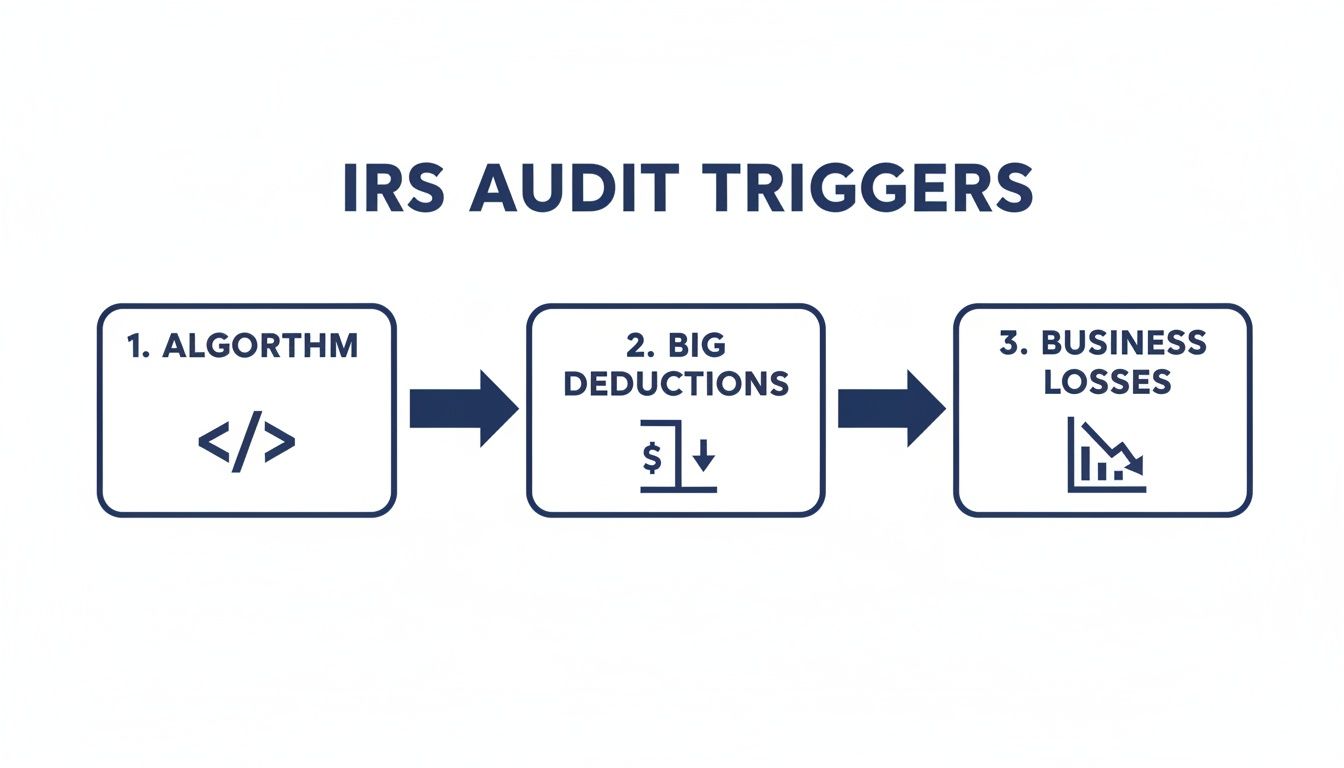
As the chart shows, a return first goes through the IRS’s automated system. Things like unusually large deductions compared to your income, or a history of significant business losses, can raise a red flag.
Once that notice is in your hand, the smartest move is to let an experienced professional take the lead. A tax attorney will ensure your rights are protected, strategically review every document before it goes to the auditor, and handle all communications to resolve the matter as favorably as possible.
Understanding Audit Outcomes and Your Options
Once the IRS auditor finishes their review, the waiting game is over. You'll receive a formal report with their findings, but that doesn't automatically mean you'll be writing a check. In my experience, there are really only three ways an audit can end.
Knowing these three potential outcomes is crucial, because how you respond will set the course for everything that happens next.
The Three Potential Audit Results
When all is said and done, the auditor’s final report will land in one of these categories:
- No Change: This is the best news you can get. It means the IRS agrees with your tax return exactly as you filed it. You don't owe any additional tax, and your case is officially closed. Time to breathe a sigh of relief.
- Agreed: In this scenario, the auditor found issues and proposed changes to your tax bill. You’ve reviewed them and agree with the assessment. You'll sign a form to make it official, pay the amount owed (plus any interest and penalties), and the audit is finished.
- Disagreed: You’ve seen the auditor's report and you simply don’t agree with their conclusions or the extra tax they say you owe. This isn't a dead end—it's just the beginning of the next chapter: the appeals process.
What Happens When You Disagree
If you disagree with the audit findings, you have a fundamental right to appeal the decision. This isn’t about arguing with the same person again; it’s about taking your case to a higher, independent authority within the IRS. You can request a conference with an IRS Appeals Officer, a professional trained specifically to resolve tax disputes and avoid taking matters to court.
An appeal is not a second audit. The Appeals Office has a different mission: to settle cases based on the "hazards of litigation." They weigh the odds of who would likely win—you or the IRS—if the case went to court and often work toward a fair compromise.
Should you and the Appeals Office fail to find common ground, you still have one final move. You can petition to have your case heard in U.S. Tax Court.
Even after an audit concludes with a tax bill, there are powerful tools we can use to manage the financial impact. We can pursue Penalty Abatement, which is a request to have penalties removed due to a reasonable cause, like a first-time error or relying on bad advice. Another route is an Offer in Compromise (OIC), where we can negotiate to settle your tax debt for less than you owe, though this is only available in very specific financial hardship situations. You can learn more about how these resolutions factor into the overall timeline in our article on how long an IRS audit takes. And remember, the strongest defense starts with meticulous organization; using a tax statement parser can be a lifesaver for accurately gathering and sorting your financial data from the very beginning.
Why a Tax Attorney Is Your Best Ally in an Audit
When that official IRS envelope lands in your mailbox, your first instinct is probably to call the CPA who prepared your tax return. While that's an understandable reaction, it’s crucial to recognize that an audit is far more than an accounting problem—it’s a legal proceeding.
This is precisely where a tax attorney becomes indispensable.
The Power of Attorney-Client Privilege
The single most critical advantage a tax attorney offers is attorney-client privilege. It's a legal shield that makes your conversations completely confidential. The IRS cannot compel your attorney to disclose what you've discussed.
A CPA, on the other hand, does not have this same legal protection. In certain situations, they could be required to testify about their conversations with you, potentially turning a trusted advisor into a witness for the IRS.
A Strategist and a Defender in Your Corner
The differences don't stop there. If your audit leads to a dispute that can't be settled through the IRS appeals process, only a licensed attorney can represent you in U.S. Tax Court. A CPA simply can't take the fight to that level.
Think of a tax attorney as your frontline defense. They immediately step in to manage all communications with the IRS, which can be incredibly stressful and intimidating. This prevents you from making an innocent mistake or accidentally saying something that expands the scope of the audit.
An experienced lawyer builds a protective wall around you. They will meticulously review every single document before it goes to the auditor, ensuring you only provide what is legally required—and nothing more.
The Advantage of Local Michigan Expertise
For Michigan taxpayers, a local attorney brings a level of insight that can be a game-changer. They understand our state's unique economic landscape, from local business trends in Detroit to the specific financial profiles common in high-net-worth examinations in Oakland County.
This local knowledge provides a layer of context that a national firm might overlook, connecting the dots between your state filings and your federal audit.
Ultimately, professional legal representation is what separates a controlled, strategic response from a risky, uncertain ordeal. An attorney doesn't just help you answer the auditor's questions; they take full command of the process to protect your rights, your assets, and your financial future.
You can learn more about choosing the right professional in our guide to selecting an IRS audit representative.
Frequently Asked Questions About IRS Audits
Even with a clear roadmap, you're bound to have specific questions pop up. Let's tackle some of the most common concerns we hear from taxpayers who are staring down a potential review.
How Long Does an IRS Audit Usually Take?
This is the million-dollar question, and the honest answer is: it depends entirely on the type of audit. There’s no single, set timeline.
A simple correspondence audit, where you’re just mailing in a few documents to clear up a small discrepancy, might be over in as little as three to six months.
Things get longer with an in-person office audit. Because it involves scheduling meetings and more back-and-forth with an agent, you can expect the process to take anywhere from several months to a full year. The most complex type, a field audit, where agents come to your home or business, often lasts for a year or even longer. They are doing a much deeper dive into your books, and that simply takes time.
Can I Handle an IRS Audit by Myself?
Legally, yes, you can represent yourself. But from an experienced standpoint, it's an incredibly risky move. Think of it this way: you’re stepping into a negotiation with someone who handles these disputes every single day. IRS auditors are highly trained professionals.
It's far too easy to say something you think is helpful but actually opens up a new line of questioning, expanding the audit's scope. You might also agree to something you shouldn't or misunderstand a request, leading to a much worse outcome than necessary.
A tax attorney or qualified representative acts as a crucial buffer. We know the procedural playbook, your rights are protected by attorney-client privilege, and we know exactly what information to provide—and how to frame it—to build the strongest case for you.
What Happens if I Ignore an Audit Notice?
Ignoring a letter from the IRS is the one thing you should never do. It doesn't make the problem disappear; it just removes you from the equation. The auditor will simply close the case without your input.
When this happens, they make their decision based only on the information they have, which almost always leads to a "guilty" verdict. You'll receive a notice for a massive proposed tax bill, piled high with steep penalties and interest.
That bill isn't a suggestion—it's a legally enforceable debt. The IRS can then move to aggressive collection actions, including:
- Bank Levies to seize money directly from your checking or savings accounts.
- Wage Garnishments to take a chunk out of every paycheck.
- Federal Tax Liens filed against your property, which devastates your credit score and makes it hard to sell or refinance.
No matter how intimidating the notice seems, the first step is always to respond.
