
Your Guide to Schedule D Instructions
If you've sold investments this year—whether it's stocks, a rental property, or even cryptocurrency—you're going to get acquainted with IRS Schedule D. This is the form where all your capital gains and losses come together to be tallied.
Think of Schedule D as the summary report for your investment activity. It's the final step in a process that often begins with another form, Form 8949, where you list out each individual transaction. Schedule D consolidates those details to give the IRS the bottom line.
Your Starting Point for Reporting Capital Gains

The single most important job of Schedule D is to calculate your net capital gain or loss for the year. But before you can get to that final number, the form forces you to make a critical distinction based on how long you held each asset.
This isn't just a matter of bookkeeping. The holding period directly determines how your profits are taxed, and the difference can be substantial. Everything you do on this form flows from this one fundamental concept.
Short-Term vs. Long-Term Gains Explained
So, what's the magic number? One year. The holding period is the key that unlocks either favorable tax treatment or a much higher bill. Let's break it down.
- Short-Term Capital Gains are profits from assets you owned for one year or less. The IRS taxes these gains at your ordinary income tax rate—the same rate that applies to your salary. For many, this can be as high as 37%.
- Long-Term Capital Gains apply to assets held for more than one year. These gains are rewarded with lower tax rates, which are 0%, 15%, or 20% depending on your income level.
The difference is stark. Imagine you sell a stock after holding it for 11 months. That profit is taxed just like your regular paycheck. If you had simply waited another 31 days, you could have easily cut the tax on that gain in half.
To help clarify these crucial differences, here’s a simple table breaking down the two types of gains.
Short-Term vs Long-Term Capital Gains At a Glance
| Attribute | Short-Term Capital Gains | Long-Term Capital Gains |
|---|---|---|
| Holding Period | One year or less | More than one year |
| 2026 Federal Tax Rates | Taxed as ordinary income (10%–37%) | Preferential rates (0%, 15%, or 20%) |
| Primary Reporting Form | Form 8949, Part I | Form 8949, Part II |
| Summary Form | Schedule D, Part I | Schedule D, Part II |
As you can see, the path your transaction takes through your tax return is determined entirely by its holding period. This simple distinction has major financial consequences.
Key Takeaway: I can't stress this enough: your holding period is the most important factor in capital gains taxes. A difference of just a few days can mean thousands of dollars saved or lost.
Why Getting It Right Matters More Than Ever
Reporting capital gains isn't new; it's been a part of the U.S. tax system for generations. But as investing becomes more common, the IRS is paying closer attention. By 2023, more than 25 million individual tax returns included a Schedule D, a huge jump reflecting how many Americans are now in the market.
This surge, especially in high-net-worth areas like Michigan's Oakland County, brings heightened IRS scrutiny. I've seen it firsthand—errors or omissions on Schedule D are a red flag and a common reason for an audit. The penalties for mistakes can be steep. You can even review historical versions of the form by checking the prior-year forms and instructions available from the IRS.
Mastering these rules isn't just about staying compliant. It's a core component of smart financial planning. By understanding the system, you can make more informed decisions about when to sell and how to structure your investments. Learning about proven capital gains tax strategies is an excellent next step to turn this knowledge into real-world savings.
The Real Story Behind Form 8949 and Schedule D
One of the most common hangups for taxpayers dealing with investment income is the interplay between Form 8949 and Schedule D. It’s a frequent point of confusion, but the relationship is straightforward once you grasp it.
Think of Form 8949 as your detailed logbook. It’s where you list every single capital asset transaction one by one. Schedule D, on the other hand, is the summary sheet where you report the totals from Form 8949. They work together—Form 8949 provides the line-by-line proof for the figures you ultimately report on Schedule D.
Getting this right is your first line of defense against an IRS notice. The IRS cross-references the data on your return with the Form 1099-B your broker sends them, and any mismatch is an easy flag for their automated systems.
When You Absolutely Must Use Form 8949
In many cases, you have no choice but to file Form 8949. This is typically required whenever the information on your Form 1099-B from your brokerage is either incomplete or incorrect.
You’ll need to roll up your sleeves and get into the details on Form 8949 if you run into these common situations:
- Incorrect Cost Basis: Your 1099-B shows the wrong original purchase price. This happens more than you'd think.
- Missing Cost Basis: The broker may not know your basis, especially for assets you inherited or received as a gift. You must establish and report the correct basis on Form 8949.
- Wash Sale Adjustments: Your 1099-B may not properly account for a disallowed loss from a wash sale. Form 8949 is where you make that official adjustment.
- Other Adjustments: Any other nuanced adjustments, like those for market discounts or acquisition premiums, must also be documented here.
From our experience, about 75% of the initial Schedule D audit flags we handle for high-net-worth clients in Oakland County come from basis adjustments that weren't properly documented on Form 8949. This is especially true for inherited assets where a stepped-up basis was incorrectly reported.
A discrepancy between what your broker reports and what you report is a direct route to a CP2000 notice proposing more tax. If you find yourself in that position, understanding what happens if you get audited becomes your immediate priority.
The Exception: When You Can Report Totals Directly on Schedule D
Now for the good news. There's a significant exception that allows certain taxpayers to bypass Form 8949 entirely, saving a ton of time.
You can report your summary totals directly on Schedule D, but only if every single transaction meets a strict set of criteria. The transaction details must be on a Form 1099-B, that form must show that your basis was reported to the IRS, and there can be absolutely no adjustments needed to the basis, the type of gain or loss, or the holding period.
If all your sales and dispositions fit this description, you can summarize them directly on Schedule D (Line 1a for short-term and Line 8a for long-term). This is a huge timesaver for active traders. But be careful—even one transaction that doesn't meet these rules means you have to use Form 8949 for that specific sale.
When you do have to prepare Form 8949, especially with many transactions, knowing how to extract tables from a PDF can be a lifesaver for pulling data from your annual broker statements.
A Little History, a Lot of Modern Impact
The system we have today evolved from efforts like the 1997 Taxpayer Relief Act, which pushed for better cost basis reporting. As stock ownership became more widespread, this helped curb the underreporting of capital gains.
Today, the rules continue to adapt. The official Schedule D instructions on IRS.gov now include very specific provisions, like the qualified extended duty exclusion for military members selling a home. This single rule benefits roughly 200,000 active-duty personnel each year, showing just how much your personal circumstances can affect your tax filing.
A Practical Walkthrough of Filling Out Schedule D
Alright, let's get down to the brass tacks of filling out Schedule D. Theory is one thing, but translating your actual investment activity into the lines and boxes the IRS demands is where people often get stuck. We'll go through the form line by line, using a couple of real-world examples to show you exactly how it’s done.
We'll tackle this the same way the form does: first the short-term transactions in Part I, then the long-term ones in Part II, and finally, putting it all together in the Part III summary.
Before we dive in, this flowchart is incredibly helpful. It shows you exactly when you need to fill out Form 8949 first based on what your broker reported on Form 1099-B.
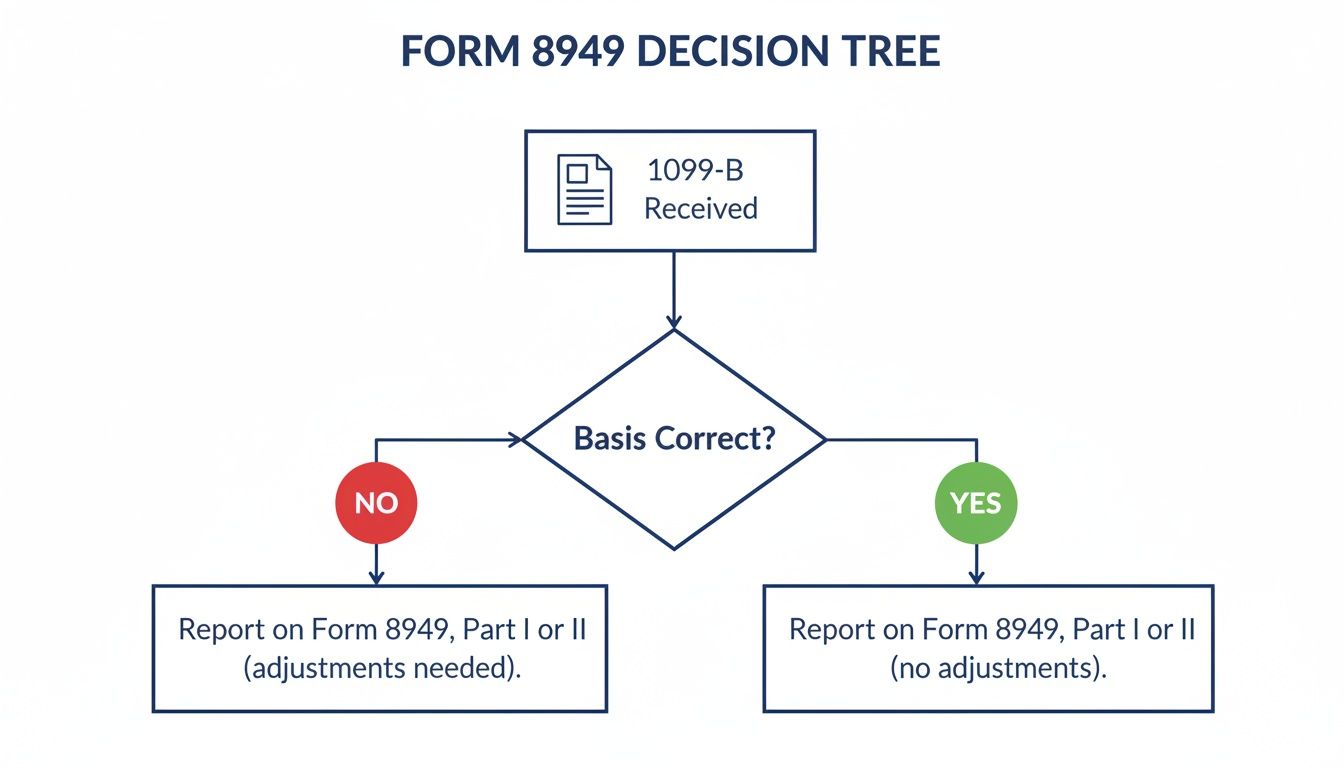
The main point? If your Form 1099-B has any missing information or discrepancies—especially with the cost basis—you can’t skip Form 8949. You have to file it.
Part I: Short-Term Capital Gains and Losses
Part I is exclusively for assets you held for one year or less. The numbers you put here are pulled directly from Part I of your Form 8949.
Let's imagine a pretty common scenario. You bought 100 shares of XYZ Corp. for $10,000 on March 1, 2025. The stock did well, so you sold all 100 shares for $15,000 on December 15, 2025. You held it for about nine months, making it a short-term trade.
In this simple case, your broker reported the cost basis correctly to the IRS, and you had no adjustments to make. Technically, you might be able to skip Form 8949. But for the sake of clarity, let's say you detailed it on Form 8949, Part I, checking Box A.
Here's what that entry would look like:
- Description: 100 shares of XYZ Corp.
- Date Acquired: 03/01/2025
- Date Sold: 12/15/2025
- Proceeds (Sales Price): $15,000
- Cost Basis: $10,000
- Gain or (Loss): $5,000
That $5,000 short-term gain is what matters. You'll take the totals from Form 8949, Part I, and carry them over to the corresponding lines in Schedule D, Part I. After you've listed all your short-term transactions, the total on Line 7, your Net short-term capital gain or (loss), moves down to the summary in Part III.
Part II: Long-Term Capital Gains and Losses
Part II mirrors the process of Part I, but it's for assets you’ve owned for more than one year. This is where you can take advantage of those more favorable long-term capital gains tax rates.
Let's look at a more involved example. Say you sold a rental property in Lansing, Michigan, that you owned for five years. You originally paid $200,000 and sold it for $300,000. Over those five years, you correctly claimed $40,000 in depreciation deductions.
A transaction like this absolutely requires Form 8949 because you have to adjust your cost basis for the depreciation you've taken.
Here’s how the math works:
- Original Cost: $200,000
- Depreciation Taken: ($40,000)
- Adjusted Cost Basis: $160,000
Now, you calculate your gain by subtracting that adjusted basis from your sale price: $300,000 (Proceeds) – $160,000 (Adjusted Basis) = $140,000 (Gain).
This $140,000 long-term gain first goes on Form 8949, Part II. From there, the totals are transferred to Schedule D, Part II. The final figure on Line 15, your Net long-term capital gain or (loss), is ready for the summary section.
A Quick Tip: Found a mistake on an old return, like using the wrong cost basis? Don't just let it be. Take a look at our guide on how to amend a tax return to fix the error. You might even be due a refund for overpaid taxes.
Part III: Summary of Gains and Losses
Part III is the grand finale—it's where your short-term and long-term results meet. This section determines the final impact your investment activities will have on your tax bill.
- Line 16: This is a straightforward calculation. You combine your net short-term gain or loss (from Line 7) with your net long-term gain or loss (from Line 15).
- Line 21: Pay close attention here if you have a net capital loss. You're allowed to deduct up to $3,000 of that loss against your other income, like wages from your job.
- Line 22: What if your net loss is more than $3,000? You don't lose that extra amount. This line is where you calculate your capital loss carryover, which you can use to offset gains or income in future tax years. It’s a powerful tool for tax planning.
Once you’ve completed Part III, the final gain or loss from Schedule D gets carried over to your main Form 1040, directly affecting your taxable income for the year. Following these steps carefully helps ensure you file an accurate return and don't leave any money on the table.
Costly Schedule D Mistakes We See Every Day
When it comes to taxes, Schedule D is where small mistakes can have huge consequences. After handling countless tax returns for clients across Michigan, I've seen the same handful of errors pop up over and over again. These aren't just minor typos; they're fundamental misunderstandings that often lead to audits, painful penalties, and unexpected tax bills.
This isn't just a list of rules from the IRS manual. This is a field guide to the most common—and costly—pitfalls we see in our practice, along with real stories of how they impact people and how you can steer clear of them.
Miscalculating Cost Basis on Special Assets
One of the most frequent errors we end up correcting involves the cost basis for assets that weren't simply bought on the open market. This is especially true for gifted and inherited property, where the rules are unique and frankly, a bit confusing.
For instance, we had a client from Ann Arbor who inherited a stock portfolio from her parents. She assumed her cost basis was what her parents originally paid for the shares decades ago. When she sold the stock, she reported an enormous capital gain and braced for the tax hit.
What she didn't realize was the stepped-up basis rule. For inherited property, the basis is "stepped up" to the fair market value on the date of the original owner's death. Once we amended her return with the correct, much higher basis, her taxable gain shrank by over $150,000, resulting in a substantial refund.
Key Insight: The rules here are night and day. If you receive a gift, your basis is generally the same as the person who gave it to you. But if you inherit property, your basis is its value on the date of death. Getting this wrong is a surefire way to either overpay your taxes or underpay and risk penalties.
Fumbling the Wash Sale Rule
Active traders, even casual ones using apps like Robinhood, constantly get tripped up by the wash sale rule. The rule exists to stop you from selling a stock at a loss to get a tax break, only to buy it right back and stay in the investment.
The IRS defines a wash sale with a few key elements:
- You sell a security at a loss.
- You buy a "substantially identical" security within 30 days before or after that sale (creating a 61-day window).
- If both conditions are met, the IRS won't let you deduct that loss on your current tax return.
That loss isn't lost forever, though. It's deferred by getting added to the cost basis of the new shares you bought. We recently worked with a Detroit-based client who was an active crypto trader. He was selling Bitcoin for a loss and buying it back a week later, doing this dozens of times. He claimed every single loss on his Schedule D, creating a large net capital loss he thought would wipe out other gains.
The IRS audit was not far behind. They disallowed all of his wash sale losses, which left him with a $45,000 tax bill, plus interest and penalties. He was floored; he had no idea the wash sale rule could even apply to crypto, which is a very common and costly misconception.
Forgetting to Use Capital Loss Carryovers
Think of your capital losses as a valuable tool, but they only work if you remember to use them. The IRS allows you to deduct up to $3,000 in net capital losses against other income (like your salary) each year. If your loss is bigger than that, you can "carry over" the rest to future tax years.
It's shocking how many people simply forget to do this. We took on a small business owner in Grand Rapids who suffered a $50,000 capital loss on a bad investment back in 2021. For the next two years, he filed his taxes without carrying that loss forward on his Schedule D. He just plain forgot about it.
When we reviewed his prior returns, the unused loss jumped right out at us. We were able to go back and amend those returns, applying the $3,000 annual deduction he was entitled to. That simple fix saved him thousands. Always, always check last year's Schedule D for a capital loss carryover on Line 21. If you don't, you're literally leaving money on the table.
How Schedule D Affects Your Michigan State Taxes

It’s easy to feel a sense of relief after wrestling with your federal tax return and Schedule D. But if you’re a Michigan resident, you’re not quite done. The figures you just finalized on your federal forms have a direct impact on your Michigan state tax return, the MI-1040, and understanding that link is crucial.
Everything starts with your federal Adjusted Gross Income (AGI). This number, pulled directly from your federal Form 1040, is the baseline for calculating your Michigan taxes. Because your net capital gains or losses from Schedule D are already baked into your federal AGI, they automatically flow through to the income Michigan taxes.
How Michigan Taxes Capital Gains
Here's where many people get tripped up. The federal government gives you a tax break for holding investments long-term, but Michigan doesn't play by the same rules.
Michigan has a flat income tax rate. For the 2023 tax year, that rate was 4.25%.
This means all of your net capital gains—whether short-term or long-term—are taxed at that same flat rate. The special 0%, 15%, or 20% federal rates for long-term gains simply don't apply at the state level. A long-term gain that might get favorable treatment on your federal return is hit with the full 4.25% state tax.
This is a critical distinction, especially for retirees living on investment income or for employees in places like Ann Arbor or Grand Rapids who are exercising long-held stock options. That tax benefit you earned by holding an asset for over a year vanishes when you file your MI-1040.
For a closer look at how your federal AGI is calculated before any state adjustments come into play, you can calculate your adjusted gross income in our detailed article.
Real-World Example: Let's say you realized a $20,000 long-term capital gain. Federally, if you're in the 15% bracket, you owe $3,000. On top of that, Michigan will take another $850 ($20,000 x 4.25%), no matter how long you held the asset.
Federal Deductions That Don't Carry Over
Another common mistake is assuming every federal deduction also applies to your Michigan return. While your federal AGI is the starting point, Michigan law requires you to add back certain deductions you just took.
The most important one for investors is the capital loss deduction. On your federal return, you can deduct up to $3,000 in net capital losses against your ordinary income (like your salary).
Michigan does not allow this deduction. If you took that $3,000 loss on your federal return, you must add it back to your income on your Michigan return.
- On your Federal 1040: You have a ($5,000) net capital loss and deduct ($3,000) from your income.
- On your Michigan MI-1040: You have to add that $3,000 deduction back on Schedule 1, line 12.
So, what happens to that loss? You can't use it to reduce your Michigan income from a job or pension this year. However, the state does let you carry the loss forward to offset future capital gains on Michigan tax returns. It's a key difference that can lead to a surprise tax bill if you're not prepared for it.
When to Call a Michigan Tax Professional
While filing with straightforward stock sales is often manageable, some situations are clear red flags that you need an expert in your corner. Don't try to go it alone if you're dealing with anything complex.
You should seriously consider consulting a tax attorney if you're facing any of these scenarios:
- A Large or Complex Asset Sale: The sale of a business, a large piece of real estate, or inherited property comes with tax implications that standard software can't handle.
- Significant Capital Losses: If you have substantial capital losses, an expert can help you create a strategy for carrying them over correctly for both federal and state purposes, ensuring you get the maximum benefit in future years.
- An Audit Notice: If you receive a letter from the IRS or the Michigan Department of Treasury about your capital gains, your first call should be to a professional. This isn't a DIY project; getting expert representation is the best way to protect yourself.
Tackling Your Toughest Schedule D Questions
Even after you've nailed down the basics of Schedule D, a few common but tricky situations always seem to pop up. These aren't obscure edge cases; they are the real-world scenarios that trip up investors every single year. Getting them wrong can easily lead to an audit notice or a painful tax bill.
Let’s walk through some of the questions I hear most often from clients to make sure your return is spot-on.
How Do I Report My Crypto and NFT Sales?
This is easily one of the biggest points of confusion today. Let's be perfectly clear: the IRS sees your virtual currencies and non-fungible tokens (NFTs) as property, just like a stock or a piece of real estate. They are not treated like cash.
That single rule changes everything. It means every time you sell, trade, or even use your crypto to buy something—a coffee, a car, or another digital asset—you’ve just triggered a taxable event. Traded some Ethereum for Bitcoin? That’s a sale. Flipped an NFT for a profit? That's a capital gain.
For every single one of these transactions, you have to calculate your gain or loss. This means you absolutely must track:
- Your Cost Basis: What you originally paid for the asset, including any fees.
- Your Proceeds: The fair market value (in U.S. dollars) of what you got in return when you sold or traded it.
- The Transaction Dates: This is critical for determining whether your gain is short-term or long-term.
Every one of these transactions gets listed on Form 8949, Sales and Other Dispositions of Capital Assets, before the totals flow to your Schedule D. Don't be tempted to skip this—the IRS now receives reporting from major crypto exchanges, and they are actively looking for mismatches.
What Exactly Is a Wash Sale?
The wash sale rule is a classic trap, especially for active traders. It’s the IRS’s way of stopping you from claiming a tax loss on a stock you haven't truly given up on.
A wash sale happens when you sell a security at a loss and then buy a "substantially identical" one within a 61-day period—that’s 30 days before the sale and 30 days after. If you do this, you can't claim that loss on your current tax return.
The good news is the loss isn’t lost forever. The disallowed amount is simply added to the cost basis of the new shares you bought. This just pushes the tax benefit down the road until you finally sell the new position.
Think of it this way: You sell 100 shares of XYZ Corp for a $1,000 loss. A week later, you decide you still like the company and buy 100 shares back. The wash sale rule kicks in, and you can’t deduct that $1,000 loss this year. Instead, the $1,000 is added to the cost basis of your new shares, which will reduce your taxable gain (or increase your loss) when you eventually sell them for good.
Do I Report the Sale of My Main Home?
For most people, selling their primary home is a happy occasion that doesn't involve the IRS at all. Thanks to the Home Sale Exclusion, you can often pocket the entire profit tax-free.
The exclusion lets you avoid tax on a huge chunk of your gain:
- Up to $250,000 of gain if you're a single filer.
- Up to $500,000 of gain if you're married filing jointly.
To qualify, you must have owned and lived in the house as your main home for at least two of the five years right before the sale. If your profit is under your exclusion amount, you usually don't have to report the sale on your tax return. Simple as that.
But—and this is a big "but"—there are a few key times when you must report the sale on Schedule D, even if you don't owe any tax:
- Your gain is too big. If your profit is more than your exclusion amount, the extra gain is taxable and has to be reported.
- You receive a Form 1099-S. This form reports real estate proceeds. If you get one, you have to put the sale on your return to show the IRS why you're correctly excluding the gain.
- You decide not to claim the exclusion. This is rare, but some strategic tax plans call for it.
- You didn't meet the "use" test for the whole property. If you rented out a room or had a home office, you might have to report the portion of the gain that applies to the business-use part of your home.
