
How to Amend a Tax Return A Guide for Michigan Filers
So, you've filed your taxes, breathed a sigh of relief, and then it hits you: you made a mistake. It’s a sinking feeling many of us have experienced, but the good news is that most errors are fixable. The key is knowing when you need to formally amend your return versus when you can let it slide.
Filing an amended return involves submitting a specific form, the Form 1040-X, Amended U.S. Individual Income Tax Return. This is your tool for correcting significant errors or reporting changes that impact your tax liability after you’ve already filed. It's not just about filling out a form; it's about clearly explaining the "what" and "why" of the changes to calculate any new refund or additional tax you might owe.
Knowing When to Amend Your Tax Return

Let's be honest, realizing you messed up on your taxes is stressful. Your first instinct might be to rush and fix it, but not every little slip-up requires you to file a whole new form. Understanding the difference between a minor issue and a major error will save you a ton of time and unnecessary paperwork. The IRS often catches and corrects small things on its own.
Common Reasons to File an Amended Return
You absolutely need to file a Form 1040-X if you discover a mistake that changes your bottom-line tax calculation. Think of it this way: if the information alters your income, deductions, or credits, an amendment is in order.
Here are some real-world scenarios where you’d need to amend:
- A late or corrected form arrives. Your employer sends a W-2c (Corrected Wage and Tax Statement) after you've already filed, or you get a corrected 1099 from a bank that changes your interest income.
- You discover a missed tax break. You realize you were eligible for a major credit, like the American Opportunity Credit for your child's college tuition, or forgot to deduct thousands in medical expenses.
- You chose the wrong filing status. A married couple filed separately but later realizes that filing jointly would have saved them a significant amount of money. You can make this change as long as you're within the time limit.
- You forgot to report some income. You find a 1099-MISC from a freelance gig that got buried in a pile of mail. Ignoring it isn't an option.
These kinds of changes directly affect your Adjusted Gross Income (AGI) or the tax credits you qualify for, making your original tax calculation incorrect. An amendment officially sets the record straight. Properly documenting these changes is also a defensive measure—understanding what happens if you get audited makes it clear why accuracy is so important.
A critical piece of advice: When you fill out Form 1040-X, be crystal clear in your explanation for the change. The IRS isn't looking for a novel, but a vague or missing reason will almost certainly lead to processing delays or follow-up questions.
When You Should Not File an Amendment
On the flip side, don't rush to file a 1040-X for minor flubs. The IRS has automated systems that are surprisingly good at catching and fixing small mistakes without any action on your part.
You can probably skip the amendment process for things like:
- Simple math errors. If you added or subtracted incorrectly, the IRS computer will almost certainly catch it. They'll correct the math and send you a notice explaining the change to your refund or balance due.
- Missing forms or schedules. Did you forget to attach your W-2? The IRS will usually just send you a letter (a CP notice) asking for the missing document. You can simply mail it in response—no amendment needed.
Amend or Not Amend Key Scenarios
Deciding whether to file can feel like a judgment call. This table breaks down some common situations to help you make the right choice.
| Scenario | Action Required | Reasoning |
|---|---|---|
| You made a simple addition error of $100. | Do Not Amend | The IRS will automatically correct minor math errors and adjust your refund or amount owed accordingly. |
| You received a corrected W-2 with $5,000 in additional income. | Amend | This is a substantial change to your income that directly impacts your tax liability. |
| You forgot to attach Schedule A for your itemized deductions. | Do Not Amend | Wait for the IRS to send a notice (CP notice) requesting the missing form, then mail it to them. |
| You realized you qualify for the Child Tax Credit you didn't claim. | Amend | This is a valuable credit that will result in a refund, and the IRS won't know you qualify unless you file. |
| You used the wrong street address or misspelled your name. | Do Not Amend | The IRS will likely correct this based on your Social Security number. You can update it on your next year's return. |
Ultimately, amending is for substantive changes that affect your tax liability. For clerical errors or missing attachments, it’s often better to wait for the IRS to contact you first.
Getting Your Paperwork in Order for a Smooth Amendment
Filing an amended return is less about filling out a new form and more about correcting the record. To do that successfully, you need proof. The strength of your amendment rests entirely on the quality and completeness of your documents. Going into this process without the right paperwork is a recipe for delays, questions from the IRS, and maybe even another amendment down the road.
Before you touch Form 1040-X, take the time to gather everything you need. This isn't just a suggestion; it's the most critical step to ensure your amended tax return is accurate, easy to defend if questioned, and processed without a hitch by both the IRS and the Michigan Department of Treasury.
The Essential Document Checklist
Let's start with the basics. Having these documents in front of you prevents guesswork and ensures you're pulling the correct numbers from your original filing.
Here’s what you absolutely must have:
- A copy of your original federal return (Form 1040). This is your baseline. You’ll need to reference the exact figures you first reported.
- A copy of your original Michigan return (Form MI-1040). Since Michigan's tax calculation starts with your federal Adjusted Gross Income (AGI), any change there almost always means you need to amend your state return, too.
- The new or corrected tax forms. This is the document that kicked this whole process off. It could be a W-2c (Corrected Wage and Tax Statement), a revised 1099-DIV from a mutual fund, or maybe a K-1 that arrived late.
- Any letters or notices from the IRS or Michigan Treasury. If you're amending in response to a notice (like a CP2000), keep it handy. It has crucial reference information and explains the exact issue they've flagged.
I always tell my clients to think of their original tax return as the "before" photo. All your new documents and supporting records create the "after" photo. Form 1040-X is just the story explaining what changed and why.
Backing Up Your New Claims with Evidence
If you’re amending to claim a deduction or credit you missed the first time around, the responsibility is on you to prove it. You can't just say you had more business expenses; you need the receipts and records to back that claim up. If the IRS asks for proof and you can't provide it, they'll deny the claim flat out.
For example, let's say you realize you forgot to deduct thousands of miles you drove for your side business. To properly add that deduction, you'd need:
- A detailed mileage log with dates, the business purpose of each trip, and start/end odometer readings.
- Receipts for vehicle expenses like gas, maintenance, and insurance if you're using the actual expense method instead of the standard mileage rate.
The same goes for something like the Child and Dependent Care Credit. You'll need the daycare provider's name, address, and Taxpayer ID Number, plus proof of what you paid them. Having this information organized from the start makes the whole how to amend a tax return process infinitely less painful and dramatically improves your odds of getting it approved without any questions.
A Closer Look at Federal Form 1040-X
At first glance, Form 1040-X—the one you'll use to amend your federal tax return—can look a bit complicated. But once you understand its logic, it's actually quite straightforward. The entire form is built around a simple three-column system designed to give the IRS a clear "before and after" picture of your tax situation.
The goal is to show them exactly what was on your original return, what the new numbers are, and how you got there. This side-by-side comparison makes it easy for an agent to pinpoint the changes, which is key to getting your amendment processed without unnecessary delays.
The process often involves pulling together your original return and any new documents that triggered the need for an amendment.
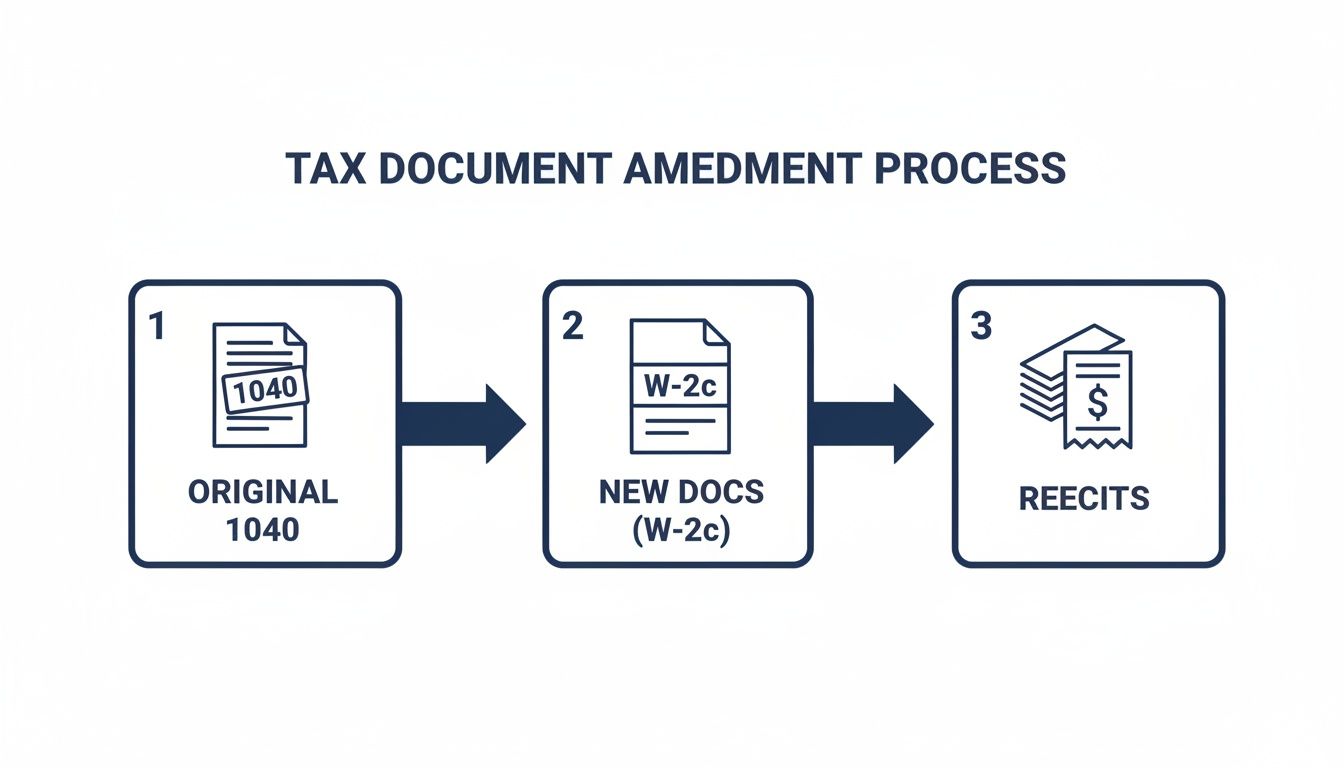
As you can see, you'll need to reference your original 1040 Form Template to accurately transfer the initial figures onto your 1040-X.
Understanding the Three-Column Layout
The core of Form 1040-X is all about its three main columns. Getting these right is everything.
Column A: Original Amount or As Previously Adjusted. This is your starting point. You'll copy the figures from your original tax return directly into this column. If your return was already adjusted by the IRS or a previous amendment, you'll use those updated numbers instead.
Column B: Net Change. This is where the action happens. Here, you enter the difference—whether it's an increase or decrease—between your original figure in Column A and your new, correct figure. If a specific line item didn't change, you just leave this column blank for that line.
Column C: Corrected Amount. This column shows the final, correct numbers. It's the result of what’s in Column A plus or minus the adjustment you made in Column B. This is what your tax return should have looked like all along.
The single biggest mistake I see people make is putting the new total in Column B instead of just the change. Column B is for the difference only. Messing this up will throw off all the calculations on the form.
Anatomy of Form 1040-X Line by Line
To really understand how the columns work together, it helps to see them laid out. Think of it as telling a story with numbers, where each column plays a specific role.
| Line Item (e.g., Adjusted Gross Income) | Column A (Original Amount) | Column B (Net Change) | Column C (Corrected Amount) |
|---|---|---|---|
| Adjusted Gross Income (AGI) | Report the AGI from your first return. | Show the increase or decrease to AGI. | The new, correct AGI goes here. |
| Itemized/Standard Deduction | Enter the deduction you originally took. | If your deduction changed, note it here. | The final, corrected deduction amount. |
| Taxable Income | The original taxable income you reported. | The net change to your taxable income. | Your new, updated taxable income. |
| Total Tax Liability | The total tax from your original filing. | The increase or decrease in your tax. | The final, correct total tax liability. |
This table illustrates the flow: Start with the original figure, apply the change, and arrive at the corrected amount. It's a simple formula that ensures the IRS can follow your work.
Walking Through a Real-World Scenario: The Forgotten 1099-NEC
Let's make this practical. Imagine you already filed your taxes, but then a Form 1099-NEC for $5,000 shows up in the mail for a freelance gig you did last year. This is a classic reason to amend.
First, you'd need to prepare a new Schedule C to report that $5,000 in business income and a new Schedule SE to figure out the self-employment tax you now owe. With those new schedules in hand, you can transfer the changes to your Form 1040-X.
Here's a simplified example of how the key lines on your 1040-X might change:
- Adjusted Gross Income: Your original AGI in Column A would increase by $5,000 in Column B.
- Self-Employment Tax: This was likely $0 in Column A. You'd add the new tax (around $707) in Column B.
- Total Tax: Your total tax liability in Column A would increase in Column B by the sum of the income tax and the new self-employment tax.
You must attach the new Schedule C and Schedule SE to your 1040-X. Without them, the IRS has no way of knowing where your new numbers came from, which will certainly trigger a letter asking for more information.
Don't Skip the Explanation in Part III
Part III of Form 1040-X is a simple text box, but it’s one of the most important parts of the form. This is your one chance to explain why you're amending your return in plain English. A clear, direct explanation can mean the difference between a quick approval and a long, drawn-out review.
Avoid being vague. Instead of just writing "Forgot to include income," be specific.
Here’s an example of a strong explanation:
"Amending this return to include $5,000 in nonemployee compensation from XYZ Corp. This income was reported on a Form 1099-NEC received after the original filing deadline. Attached are the supporting Schedule C and Schedule SE to report this income and the related self-employment tax."
This short paragraph tells the IRS reviewer everything they need to know: what changed, by how much, why it changed, and what documents you've included to prove it.
Assembling Your Final Amendment Packet
Once you've filled out the form and double-checked all your numbers, it's time to put your packet together. A common mistake is to attach a copy of the entire original 1040 return—don't do this! The IRS already has it.
You only need to attach the new or corrected forms and schedules that support the changes on your 1040-X.
For our 1099-NEC example, your submission would include:
- The signed Form 1040-X on top.
- Your new Schedule C, showing the $5,000 income.
- Your new Schedule SE, with the self-employment tax calculation.
- A copy of that late-arriving 1099-NEC form.
Organizing your documents this way presents a clear, easy-to-follow case for the IRS agent, which is exactly what you want. Given that the IRS processed nearly 165 million individual returns in a recent season, clarity and accuracy are your best friends. Making an agent's job easier is the fastest way to get your amendment approved and put the issue behind you.
Tackling Your Michigan Amended Return: Form MI-1040X-12

Once you’ve wrestled with the federal Form 1040-X and gotten it right, you're not quite at the finish line. Any change to your federal return almost always means you need to amend your Michigan return, too. That’s where Form MI-1040X-12 comes in.
This isn't an optional step. Michigan’s income tax is directly linked to your federal Adjusted Gross Income (AGI), so when your AGI changes, your state tax liability will follow suit. The Michigan Department of Treasury expects to hear from you, and ignoring it can lead to state-level penalties and interest. This creates a whole new tax headache right after you've solved the federal one.
How Your Federal and State Amendments Connect
Think of your federal 1040-X as the foundation for your Michigan MI-1040X-12. The most important number you'll carry over is your corrected federal AGI, found in Column C of the federal form. This figure is the new starting point for calculating your Michigan tax.
But it's rarely a simple copy-and-paste job. You have to re-evaluate any state-specific items that might have been affected by the change.
A few common Michigan adjustments to look out for include:
- Homestead Property Tax Credit: If your income went up or down, it could easily change your eligibility for this credit or the amount you qualify for.
- Home Heating Credit: Just like the homestead credit, this is tied to your income and may need to be completely recalculated.
- Michigan Standard Deduction: A shift in your filing status or number of dependents on the federal return will directly change your Michigan deduction.
Key Takeaway: Much like the federal form, the MI-1040X-12 requires a clear explanation for the amendment. You must also attach a complete copy of your filed Form 1040-X. The Treasury needs to see exactly where your new numbers are coming from.
Deadlines and Where to Mail Your Return
Timing is everything. Michigan has a specific window for filing an amended return, and it’s tied directly to your federal filing. You generally have 120 days to file your MI-1040X-12 after you’ve finalized the change with the IRS.
Missing this deadline can cause real problems, often leading to avoidable penalties. If you're dealing with issues from past years, our guide on how to file back tax returns can be a valuable resource for getting back on track.
Once your paperwork is complete and you’ve gathered all your documents (especially that federal 1040-X), it's time to mail it. Where you send it depends on whether you're getting money back or sending money in.
For refunds or if there's no tax change:
Michigan Department of Treasury
Lansing, MI 48956If you owe more tax:
Michigan Department of Treasury
Lansing, MI 48929
Pro tip: Always check the Michigan Treasury's website for the latest mailing addresses before you seal the envelope. Sending it to the wrong place is a surefire way to cause major processing delays.
A Michigan Amendment in Practice
Let's walk through a real-world example. Imagine the Jacksons, a Michigan couple, filed with an AGI of $90,000. Weeks later, a corrected 1099-R arrived, showing an extra $10,000 in retirement income they missed. Their new, correct AGI is $100,000.
- Federal First: They begin by preparing and filing Form 1040-X to report the $10,000 increase in AGI to the IRS.
- On to the State: Next, they grab Form MI-1040X-12. The first thing they do is enter the new $100,000 AGI from their federal amendment.
- State-Specific Adjustments: That $10,000 income bump unfortunately reduces the Homestead Property Tax Credit they originally claimed. They have to recalculate the credit with their new, higher income and report the correct, smaller credit on the MI-1040X-12.
- The Final Package: They assemble their packet: the completed MI-1040X-12, a full copy of the federal 1040-X, and a copy of that corrected 1099-R. They mail it all to the proper "payment due" address in Lansing, along with a check for the extra state tax they now owe.
By following these steps, the Jacksons ensure both their federal and state tax accounts are accurate, preventing any surprise notices down the road.
Understanding Filing Deadlines and Processing Times
When it comes to amending a tax return, timing is everything. The IRS gives you a specific window to make corrections, and if you miss it, you could lose out on a refund you’re rightfully owed. This is what we call the statute of limitations, and it’s a hard and fast deadline.
The Three-Year Rule: Your Main Deadline for Refunds
The most important timeline to remember is the “three-year rule.” In most cases, you have three years from the date you originally filed your return to submit a Form 1040-X and claim a credit or refund.
Here’s a practical tip: if you filed early, say in February, the IRS considers your filing date to be the official April due date for that year.
Let's say you filed your 2023 tax return on March 1, 2024. The clock for the statute of limitations would start on April 15, 2024, giving you until April 15, 2027, to amend that return.
The Two-Year Rule for Paying Off a Tax Bill
There's another key deadline that often trips people up: the “two-year rule.” You can also file an amendment within two years from the date you actually paid the tax, if that date is later than the three-year deadline.
This usually comes into play when you filed on time but paid the tax bill much later. For instance, you filed your 2023 return in April 2024 but couldn't pay the balance until June 1, 2025. In this scenario, you’d have until June 1, 2027, to file an amendment for a refund of that specific payment. The IRS lets you use whichever deadline gives you more time.
A common mistake I see is people thinking they can amend a return indefinitely. The statute of limitations is firm. Once that window slams shut, you generally can’t get a refund, even if you find a major error. Acting quickly is key.
How Long Does It Take? Setting Realistic Expectations
Once you've sent in your amended return, it’s time to be patient. Very patient. Processing a Form 1040-X is a much more manual, hands-on process for the IRS than an original e-filed return.
Right now, you should be prepared to wait 20 weeks or more for the IRS to process it. You can check its progress using the "Where's My Amended Return?" tool on the IRS website, but don’t panic if you see nothing at first. It often takes up to three weeks just for your 1040-X to show up in their system.
The 2025 tax filing season really underscored these delays. IRS data showed that for amended returns needing a deeper look, only 52.3% were finished within the standard 45-day window. If you're curious, you can learn more about these IRS processing challenges and timelines.
This long wait has real financial implications. If you're expecting a refund, don't bank on that money arriving anytime soon. And if you owe more tax, remember that interest and penalties are still ticking away, calculated from the original tax due date, not the date you amend.
Why You Need to Track Your Amended Return
Keeping an eye on your amended return isn't just about watching for a check in the mail. It's your way of making sure your file doesn't get lost in the shuffle. If months pass with no updates, it could be a sign of a problem, like a missing signature or a document that never made it.
Here’s what I advise all my clients to do after filing an amendment:
- Keep a full copy. Don't just save the forms—save the entire packet you mailed, including your signature and date.
- Send it certified mail. For a few extra dollars, using certified mail with a return receipt gives you undeniable proof the IRS received your filing. It's cheap insurance.
- Check the online tool. Start looking up your return on the "Where's My Amended Return?" page about three weeks after you mail it.
- Keep a simple log. Jot down the dates you checked online and keep any notices you receive from the IRS in a dedicated folder.
Staying organized helps you manage your own expectations and gives you the information you need if you have to follow up on a stalled return.
When You Need a Tax Attorney for Your Amended Return
Knowing how to file an amended return is one thing. Knowing when not to do it yourself is another entirely.
While plenty of amendments are simple fixes, certain situations can quickly spiral into serious financial or legal trouble. These are the red flags that tell you it's time to stop and call in a professional instead of trying to navigate the complexities alone. Attempting to handle a high-stakes amendment on your own can easily turn a correctable mistake into a full-blown crisis.
When an Amendment Becomes High Stakes
Sometimes, what seems like a minor correction on paper is actually a major event in the eyes of the IRS. If your amendment involves any of the following, you've moved beyond simple paperwork and into a situation that requires a legal expert.
- You're amending multiple years of returns. Filing several 1040-X forms at once can look like a pattern of non-compliance to the IRS, significantly increasing your odds of a deeper investigation or audit.
- The errors could be mistaken for fraud. If the mistake involves a large amount of unreported income or aggressive deductions, you need an attorney to frame the correction carefully. The goal is to fix the error without inviting accusations of intentional tax evasion.
- A lot of money is on the line. Whether you owe a substantial new balance or are claiming a large refund, the IRS gives these returns a much closer look.
Legal arguments are also critical when you're filing for innocent spouse relief or formally requesting penalty abatement. A tax professional knows how to build the nuanced case required for these situations.
Think twice before responding to an IRS notice on your own. If a CP2000 notice (Proposed Changes to Your Return) or any other official inquiry lands in your mailbox, an attorney can help you craft a precise response that solves the problem without accidentally creating new ones.
Protecting Your Rights During Complex Tax Issues
The IRS isn't an agency you want to deal with unprepared, especially when you're admitting to an error. The system is overloaded and unforgiving. In early 2025, the IRS itself reported 33.5 million suspended returns that were stuck waiting for review. Within that pile, 2.9 million were flagged for potential identity theft. These numbers, detailed in these findings on IRS processing challenges and delays, show just how easily a return can get lost in bureaucratic limbo.
An experienced tax attorney serves as your official representative, creating a critical buffer between you and the tax agencies. They handle all communication with the IRS and the Michigan Department of Treasury, making sure every document and statement is strategic and serves your best interests.
This representation becomes absolutely essential if your amended return triggers an audit, lien, or other aggressive collection action. Ultimately, an attorney’s job is to secure the best possible outcome—whether that’s negotiating a lower tax bill, getting penalties waived, or just making sure your amended return is processed without further complications. If you're facing a complex tax problem in Michigan, you can learn more about how a local tax attorney can provide expert representation.
Answering Your Top Questions on Amending Tax Returns
Even after walking through the steps, you probably still have a few questions. That's completely normal. Let's tackle some of the most common things people ask when they're getting ready to file an amended return.
Can I E-File My Amended Return?
For years, the answer was a hard no—everything had to be mailed. Thankfully, that's changed. You can now e-file Form 1040-X for recent tax years using most major tax software. It’s a huge time-saver.
But don't assume it's always an option. If you're amending a return from several years ago or dealing with some unusual forms, you might still need to print it out and mail it the old-fashioned way. The best advice? Check your tax software’s instructions or the IRS website before you start to see if your specific situation is eligible for e-filing.
What Happens If I Owe More Tax?
Discovering you owe more money is never fun, but the worst thing you can do is wait to pay it. If your amended return shows a balance due, pay it immediately when you file your Form 1040-X.
Why the urgency? The IRS calculates interest and penalties from the original due date of the return (usually April 15th), not from the day you file the amendment. The longer you wait, the more it will cost you.
You’ve got a few easy ways to pay:
- IRS Direct Pay is a secure and simple way to pay straight from your bank account.
- The Electronic Federal Tax Payment System (EFTPS) is another reliable online service from the Treasury.
- If you're mailing your return, you can include a check or money order made payable to the "U.S. Treasury."
How Can I Check the Status of My Amended Return?
Once you’ve filed, the waiting game begins. The IRS provides a dedicated tool called “Where's My Amended Return?” that lets you track its progress. You’ll just need your Social Security number, date of birth, and zip code.
A quick heads-up on timing: It can take up to three weeks from the day you mail your return for it to even show up in their system. From there, total processing can easily take 20 weeks or longer. Try to be patient and avoid calling the IRS for an update until at least that much time has passed.
