
How to Complete an Offer in Compromise Form 656 Guide
A lot of people find Form 656 only after the problem has already become disruptive.
Their paycheck is short. Their bank account is frozen. A federal tax lien is blocking a refinance. In Michigan, that pressure often gets worse because people are dealing with both the IRS and the Michigan Department of Treasury at the same time, and they assume one settlement fixes both. It doesn't.
Offer in compromise form 656 can be powerful, but it's also one of the most misunderstood forms in IRS collections. It isn't a hardship letter with a number attached. It's a structured application that has to match your financial reality, your filing history, and the IRS's collection formula. If the package is incomplete, inconsistent, or unrealistically low, the IRS will usually reject it or return it without serious consideration.
Recognizing When an Offer in Compromise Form 656 is Right for You
A common Michigan fact pattern looks like this. A taxpayer in Macomb, Oakland, or Kent County falls behind after a business slowdown, divorce, medical issue, or job interruption. They ignore IRS notices because they can't pay in full. Then the IRS levies a bank account or starts wage garnishment, and the question changes from "How do I catch up?" to "How do I stop this from getting worse?"

In that moment, some people should pursue an installment agreement. Others should ask for currently not collectible status. A smaller group should look at offer in compromise form 656 because they don't have a realistic path to paying the full balance before the IRS can collect.
The program is selective. In 2019, only 54,225 taxpayers submitted IRS Form 656 applications from a pool of 20 million owing $539 billion, and just 17,890 were accepted, a 33% acceptance rate, according to Jackson Hewitt's discussion of IRS offer in compromise data. That tells you two things. The form is not for everyone, and sloppy filings don't survive review.
Situations where Form 656 deserves a serious look
Some patterns come up repeatedly:
- Levy pressure with no repayment capacity: Your wages or bank account are exposed, and even a long payment plan won't fit your actual budget.
- Asset-heavy on paper, cash-poor in practice: You may own property or equipment but still lack disposable income to service the full debt.
- Old liabilities with compounding penalties and interest: The balance keeps growing while your financial position does not.
- Joint tax debt after separation: One spouse wants to resolve the matter, the other won't cooperate, and the debt is still active.
Practical rule: If you can pay the IRS over time without losing basic living stability, Form 656 often isn't your best first move.
When it usually doesn't work
An offer is often the wrong tool when the taxpayer is hoping for a discount. The IRS wants detailed financial disclosure and compares your offer against what it believes it can collect. If your income supports monthly payments, or your asset equity is strong, an installment agreement is usually the more realistic route.
Michigan taxpayers also make a strategic mistake by waiting too long. By the time they seek help, payroll has already been hit or account balances have been swept. Early action gives you more room to choose the right collection alternative instead of reacting to the harshest one.
For a broader Michigan-focused overview of the program, this explanation of what is an offer in compromise is a useful starting point.
Ensuring You Qualify and Michigan-Specific Eligibility Details
Before you fill in a single line on Form 656, run an eligibility audit on yourself. Most rejected offers fail long before the IRS reaches the math. They fail because the taxpayer wasn't eligible to submit.
Start with the IRS gatekeeping issues
The IRS expects basic compliance first. If that foundation is missing, the offer won't get traction.
Use this checklist:
- All required returns filed: If old returns are missing, fix that first.
- Current tax obligations handled: Estimated payments and required deposits need to be current where applicable.
- No open bankruptcy case: An active bankruptcy usually blocks this route.
- Correct liability identified: Individual debt, business debt, and mixed liabilities can't be casually blended.
These points matter because Form 656 is an application to compromise an existing collectible debt, not a substitute for filing compliance.
For a more detailed rundown of threshold issues, Michigan taxpayers can review how to qualify for offer in compromise.
Michigan realities that national guides often skip
National how-to articles usually talk as if every taxpayer is dealing with one agency and one stream of notices. Michigan residents often aren't.
You may have:
- an IRS income tax debt,
- a Michigan income tax assessment,
- a business sales tax issue at the state level,
- or all of them at once.
Form 656 addresses the federal side. It does not settle Michigan Treasury balances. That matters because cash flow that looks manageable on a federal worksheet may not be manageable in real life if the state is also collecting.
Another local issue is housing and transportation proof. In Michigan, taxpayers often drive long distances for work, medical care, or business operations. If your actual transportation costs exceed what the IRS informally expects, you need records that show the expense is necessary, not optional.
Watch the joint filing trap
Married taxpayers create some of the most preventable mistakes in this process.
If both spouses owe only joint liabilities and both are participating, the filing path is more straightforward. Problems start when one spouse won't sign, one spouse has separate liabilities, or the couple is separated and the finances are no longer pooled in a clean way.
That can lead to:
- separate federal analysis for each spouse,
- separate financial disclosures,
- separate decisions about innocent spouse relief,
- and closer scrutiny of household income, transfers, and asset ownership.
If one spouse refuses to participate, don't guess your way through the filing structure. That's where good offers get rejected for technical reasons rather than financial ones.
A practical pre-filing screen
Before you spend time gathering records, answer these questions:
| Question | Why it matters |
|---|---|
| Are all returns filed? | Unfiled returns can stop the process before review begins. |
| Are you current on required payments? | The IRS expects present compliance before compromise. |
| Is this an individual, business, or mixed case? | Form count and supporting documents depend on the liability type. |
| Is a spouse involved? | Joint and separate liabilities need to be mapped carefully. |
| Can you document hardship or limited collection potential? | The offer has to match provable facts, not just a lower number. |
If any answer is unclear, slow down and fix that before drafting the offer amount. The taxpayers who do best with Form 656 usually treat eligibility like a legal threshold, not an administrative detail.
Gathering Forms and Documentation for Your Submission
The IRS doesn't evaluate Form 656 in isolation. It evaluates a packet.
That packet has to tell one consistent story about your income, assets, debts, expenses, and ability to fund the offer. If one document says you have little cash but your bank statements show regular transfers to savings, the IRS will focus on the inconsistency first and your hardship second.
The core forms you need
Most individual taxpayers need more than Form 656 itself.
Gather these first:
- Form 656: This is the actual offer in compromise form 656.
- Form 433-A (OIC): Used for individuals and many self-employed taxpayers.
- Form 433-B (OIC): Used if the offer involves a business entity.
- Supporting schedules or attachments: Needed when the tax periods, liability types, or explanations don't fit neatly on the form.
If you're not sure how the financial statement ties into the offer, this Michigan-focused overview of Form 433-A OIC helps frame the relationship between the forms.
The records that usually make or break the file
The IRS wants proof, not estimates. Start building the file from original statements and bills rather than spreadsheets you made yourself.
A practical packet often includes:
- Income proof: Pay stubs, benefit statements, or business profit-and-loss records.
- Bank records: Recent statements for all open accounts.
- Asset records: Mortgage statements, vehicle loan statements, investment statements, and retirement account records.
- Expense proof: Rent, mortgage, utilities, insurance, child care, medical bills, and court-ordered obligations.
- Debt records: Credit card balances, personal loans, and secured debt statements where relevant to equity analysis.
Bank statements deserve special attention because they often reveal recurring transfers, subscriptions, cash withdrawals, loan proceeds, and deposits that taxpayers forget to explain. If you want a practical primer on what a bank statement shows, that breakdown is useful before you submit anything to the IRS.
Michigan-specific records people often overlook
Michigan taxpayers with property, seasonal income, or closely held businesses tend to under-document items the IRS cares about.
Pay close attention to these:
- Real estate valuation support: If you're claiming limited equity in a home, vacant parcel, or rental property, support that with a credible valuation source and current loan payoff information.
- Vehicle condition evidence: High mileage, collision history, or commercial wear should be documented if it affects value.
- Medical necessity expenses: If your actual medical costs exceed standard allowances, include bills and records that tie those costs to ongoing care.
- Business cash flow support: If you own a small company, provide records that show whether cash belongs to the business, to you personally, or is already committed to operating costs.
If your spouse won't cooperate
Many do-it-yourself packets prove inadequate in this situation.
When one spouse refuses to join the offer, you may need a separate filing structure and separate supporting records. Don't assume the IRS will accept a simple explanation that "we're separated" or "my spouse handles that account." If household income affects ability to pay, the IRS will want a full picture.
Separate-spouse cases usually require tighter documentation, not less. The IRS wants to know who owns what, who pays what, and whether assets have been shifted.
A clean package isn't just complete. It is internally consistent, easy to review, and supported by records that match every important number on the forms.
Calculating Your Reasonable Collection Potential Precisely
A Michigan taxpayer can have $60,000 in IRS debt, offer $8,000 because that is all the cash available, and still get nowhere if the numbers on Form 433-A show more collection value than the offer reflects.
That is the hard part of an offer in compromise. The IRS does not start with what feels manageable. It starts with your reasonable collection potential, or RCP, and measures what it believes it can collect from your assets and future income. A useful overview of that framework appears in Verni Tax Law's explanation of the RCP process.
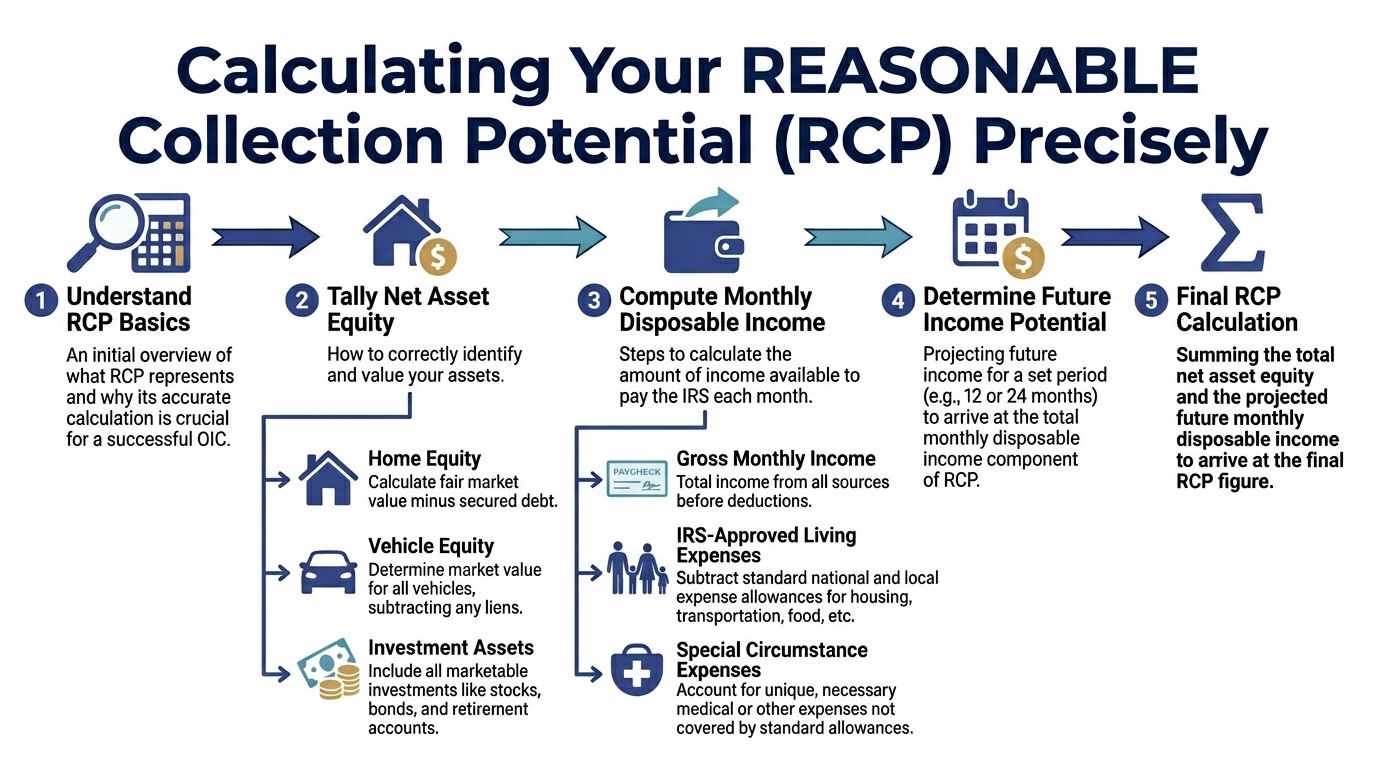
RCP has two parts.
One is net realizable equity in assets. The other is future disposable income after the IRS applies its allowed expense standards. If either side is understated, the offer amount is usually too low from the start.
| RCP component | What goes into it |
|---|---|
| Net asset value | Equity in real estate, vehicles, bank balances, investments, and other assets after allowed debt offsets |
| Future income potential | Monthly disposable income multiplied by the payment-term factor tied to the offer type |
Start with assets, but value them the way the IRS will
Home equity, vehicles, bank accounts, retirement funds, tools, brokerage accounts, and business interests all belong in the analysis. Use supportable values. Zillow screenshots can help as a rough check, but county equalization records, payoff statements, dealer trade figures, account statements, and current loan balances usually carry more weight.
Michigan cases often get messy here for two reasons. First, property values can move faster than taxpayers expect, especially in parts of Oakland, Washtenaw, and Kent County. Second, jointly titled assets create confusion. A married couple may assume a house is "really my spouse's" because one spouse pays the mortgage, but title, equity, and household benefit still matter in the IRS analysis.
If you are filing without your spouse, do not guess at your share. Show how ownership is divided and who is entitled to the equity.
Income is broader than a paycheck
The IRS looks at the full household picture. Wages are only part of it.
Include self-employment income, pension payments, Social Security, rental income, side work, regular transfers from family, and business distributions. In Michigan, I often see seasonal swings with construction, landscaping, hospitality, and auto-related work. If your income rises for part of the year, an average based on only your slow months will not hold up for long.
Joint-filing households run into another trap here. Even if only one spouse owes the tax, the IRS may still examine shared income and shared expenses to decide how much of the household's cash flow is available. That does not mean every dollar of a nonliable spouse's income automatically counts toward the offer. It does mean you need a defensible allocation, supported by actual bills and account history.
Allowable expenses are where many offers go off course
Taxpayers usually build RCP from their real budget. The IRS builds it from its standards, then decides whether your actual expenses should replace those standards in limited categories.
That difference matters. Credit card payments, voluntary support to adult children, retirement savings, private school tuition, and unsecured personal loans often do not reduce disposable income for offer purposes. On the other hand, documented out-of-pocket medical costs, court-ordered obligations, and certain work-related expenses can matter if you prove them properly.
Michigan taxpayers should be careful with expenses that are common here but still questioned by the IRS. Long commuting costs may be reasonable in Metro Detroit or for tradespeople covering multiple counties. Winter utility bills may exceed a national budget assumption. Small business owners may need to explain why cash in the operating account is not freely available for personal tax debt. Those points can be won, but only if the records are specific and consistent.
The IRS is not asking whether you usually spend the money. It is asking whether collection standards allow the expense and whether the documents support it.
Payment terms change the math
Your payment option affects the future-income side of RCP. A lump-sum offer usually produces a lower minimum offer than a periodic payment offer because the IRS applies a shorter future-income factor. That trade-off is practical, not just mathematical. Lower total settlement value may require a larger upfront payment, which some taxpayers cannot make without borrowing or liquidating an asset.
So the question is not which option looks cheaper month to month. The primary question is which option gives you a credible offer amount that you can fund.
A clean calculation follows a clear order
Value each asset with support.
Use current statements, payoff figures, and realistic market value.Calculate net equity.
Subtract secured debt only where the debt is valid and attached to the asset.Determine average monthly income.
Include all regular sources and explain seasonality if it applies.Apply allowable expense standards carefully.
Do not assume every recurring bill reduces RCP.Multiply disposable income by the correct payment factor.
The offer structure changes the minimum defensible number.
Errors that hurt Michigan filers
A few mistakes come up repeatedly in practice:
- Using county tax assessment numbers as if they settle home value. They often do not.
- Ignoring joint bank access. If your name is on the account, the IRS will ask about it.
- Blending business and personal cash. That creates inflated income in one place and unsupported expenses in another.
- Leaving out irregular but recurring income. Overtime, side jobs, and family support tend to surface in bank statements.
- Choosing periodic payments for affordability without recalculating the higher offer floor.
A precise RCP calculation does not guarantee acceptance. It does give the offer a defensible foundation. If the math is off, the IRS usually finds the weakness before it reaches any sympathetic part of your story.
Completing Key Sections of Offer in Compromise Form 656
A Michigan couple can have the numbers right and still lose weeks because Form 656 was filled out loosely. I see that pattern often with joint filers. One spouse lists all back taxes together, the other assumes a shared payment plan solves everything, and the IRS sends the file back because the liabilities, signatures, or funding explanation do not match the financial disclosures.
Form 656 is short. It is not forgiving.
The sections that cause the most trouble are the liability listing, the payment election, the source-of-funds explanation, and the signature blocks. Errors in those areas do not just look sloppy. They suggest the offer was assembled before the taxpayer understood what was being offered.
Section 2 and identifying the exact liabilities
Section 2 needs exact tax periods and the correct liability type. General descriptions such as "old income taxes" or "business taxes" are not enough. If the IRS account transcript shows different periods than the form, the offer can be delayed, returned, or treated as incomplete.
That issue shows up more often with Michigan taxpayers who have mixed exposure. A person may owe individual income tax, trust fund recovery penalties tied to a business, or payroll tax liabilities from a closed company. Those are not interchangeable. Form 656 must match the liability category the IRS is trying to collect.
Joint filers need extra care here. Married taxpayers often assume all federal tax debt can be wrapped into one offer because they filed jointly for some years. That assumption causes problems. One spouse may have separate liabilities from earlier years, self-employment tax issues, or business assessments that do not belong on the same line as the joint income tax years.
Section 4 and choosing the right payment terms
Section 4 is where taxpayers lock themselves into the structure of the offer. The two standard choices are lump sum cash and periodic payment. The form instructions explain the mechanics. A lump sum offer requires 20 percent with the submission and the rest is paid in five or fewer months after acceptance. A periodic payment offer requires the first proposed installment with the submission, then payments continue over a longer period.
The choice has real consequences.
A lump sum offer can produce a lower acceptable number because of how future income is treated. It also requires access to cash fast. A periodic offer may feel more manageable at first, but it often raises the floor of what the IRS will consider acceptable. During review, periodic offers also require ongoing payments, which creates pressure for taxpayers already stretched thin.
I tell clients to answer one question before checking the box: where will the money come from, and how quickly can you get it without creating a new financial problem? Borrowing from family can work. Selling an extra vehicle can work. Draining an account that was never disclosed will create a different problem.
Section 6 and the source of funds
Section 6 deserves more attention than it gets. The IRS asks where the offer funds are coming from because the answer can reveal whether more collection potential exists than the application shows.
Vague answers hurt credibility fast.
Bad responses usually look like this:
- Personal funds
- Family help
- Cash on hand
- Loan if needed
Those statements do not tell the IRS anything useful. A better answer identifies the source and matches the paperwork. If the initial payment will come from a sister's loan, say that and be prepared to show the transfer. If the money is coming from an existing savings account, the bank statements should reflect that balance. If an asset will be sold, that asset needs to appear consistently on the financial statement, with a realistic value and any debt against it explained.
National how-to guides often fall short for Michigan readers in this regard. They tell you to disclose the source, but they do not warn you about local fact patterns that trigger questions. I see this with jointly titled hunting property up north, inherited vacant lots, side business equipment stored at home, and family-owned vehicles driven by adult children. If those assets exist anywhere in the file, the source-of-funds story has to fit them.
An offer can be numerically reasonable and still fail if the funding explanation suggests hidden equity, undisclosed help, or inconsistent ownership.
Joint filer signatures and spouse traps
Joint offers deserve careful handling because the form can look simple while the liability picture is not. If both spouses are offering on joint liabilities, both signatures usually need to line up with the rest of the packet. If one spouse is included on some years but not others, the structure may require separate treatment instead of one blended filing.
Michigan couples run into this after separations, informal business arrangements, or inherited property issues. One spouse may still be on title to a home in Oakland County, while the other controls the bank account used for household bills. One may have payroll tax exposure from a Detroit-area business, while the other only owes on joint 1040 years. Form 656 has to reflect that reality. The IRS will not clean it up for you.
A missing spouse signature is easy to spot. The harder problem is a technically signed form built on the wrong assumption that marriage equals one tax case.
Common form-level mistakes
Several errors come up repeatedly in practice:
- Incomplete tax periods. One year is omitted, or a quarter is listed incorrectly.
- Wrong payment election. The taxpayer picks periodic payments for comfort without realizing the offer amount must be recalculated under that structure.
- Thin funding disclosure. The money source is described in a way that cannot be traced.
- Signature problems. A spouse, fiduciary, or authorized business signer is missing.
- Conflicts with the financial statement. Form 656 says one thing, but Form 433-A (OIC), bank records, or asset schedules say another.
The cleanest approach is procedural. Finish the financial disclosures first. Confirm the liability list from IRS records. Decide the payment structure based on actual funding, not preference. Then complete Form 656 from that file.
That order prevents a common mistake: writing the story first and trying to make the numbers catch up later.
Submitting Your Offer and Tracking the IRS Review Process
Once the packet is complete, treat submission like evidence handling.
You want a record of exactly what was sent, when it was sent, how it was paid, and how delivery was confirmed. If the IRS later says a fee was missing or a form wasn't included, your file should let you answer that immediately.
Build the submission package carefully
Verified guidance on OIC submission says one Form 656 is required per liability category, and each requires a $205 fee and initial payment unless low-income certification applies, with practitioner data indicating that errors here account for roughly 80% of OIC rejections, according to the SCL Tax Law application guide.
That means your assembly process matters as much as the substance.
Use a practical order:
- Signed Form 656
- Signed Form 433-A (OIC) or 433-B (OIC)
- Supporting income documents
- Asset and debt documentation
- Expense proof
- Application fee and required initial payment documentation
- Copies of everything for your own records
Send it in a way you can prove
Mailing by certified mail is still the safest paper-route habit for many taxpayers because it creates a delivery trail. Use the address listed in the current Form 656 booklet for your state and keep the mailing receipt, tracking proof, and a full copy of the package.
If you make any payment electronically, print and save the confirmation. Don't rely on memory or screenshots that might disappear later.
The IRS reviews a lot of incomplete packets. Your job is to make your file easy to identify, easy to trace, and hard to dispute.
What happens after submission
Review is not instant. The IRS first screens the package for completeness and basic eligibility. Then, if it passes that threshold, the file moves into financial review.
During that stage, the IRS may:
- ask for updated statements,
- challenge expense categories,
- question asset values,
- or propose a higher number.
If you chose periodic payments, keep a close eye on required payments during review. Missing them can create avoidable problems.
Keep your own status log
Don't rely on memory once the file is in IRS hands. Maintain a simple log with:
| Item | What to track |
|---|---|
| Mailing record | Date sent, address used, tracking number |
| Payment record | Fee payment, initial payment, method, confirmation |
| IRS notices | Date received, response deadline, issue raised |
| Follow-up contacts | Phone calls, names, request summaries |
| Updated documents | What you sent later and when |
That log becomes essential if the IRS asks for more information or claims something was not received.
Responding to IRS follow-up
When the IRS requests more records, answer directly and only after checking your original submission. Many taxpayers create new inconsistencies because they rush to respond and send updated documents that don't match prior disclosures.
If your finances changed after filing, explain the change plainly and support it. If the IRS challenges an expense, respond with records tied to necessity and consistency.
The review process rewards organization. It punishes drift, silence, and half-explained updates.
Avoiding Common Pitfalls and Knowing When to Consult with Experts
Most Form 656 failures are preventable.
The usual problems are underreported assets, inflated expenses, mismatched forms, incomplete spouse disclosures, and failure to stay compliant after acceptance. The IRS can rescind an accepted offer if the taxpayer doesn't remain compliant for the required period, so approval is not the end of the discipline.
The mistakes that cause the most damage
A short list covers most of them:
- Offering a number before calculating RCP: The IRS checks the math before it considers your hardship narrative.
- Treating joint debt casually: Spouse participation, separate liabilities, and household income issues need deliberate handling.
- Leaving out inconvenient records: Missing accounts or transfers create credibility problems fast.
- Confusing federal and Michigan resolutions: Settling with the IRS doesn't automatically solve state tax enforcement.
- Submitting without a strategy for review: The process doesn't end when the envelope goes out.
The joint issue deserves special emphasis. IRS data shows only 25% to 30% acceptance for contested joint offers and highlights the complexity of spouse-refusal scenarios, with separate Forms 656 and specific innocent spouse strategies often needed, as reflected in the IRS Form 656-B materials.irs.gov/pub/irs-pdf/f656b.pdf).
When outside help makes sense
Some cases are manageable if the facts are simple. Others aren't.
Get professional help when:
- one spouse won't cooperate,
- business and personal liabilities overlap,
- you own multiple properties or closely held entities,
- identity theft has affected IRS records,
- or the IRS has already challenged your numbers.
At that point, you're no longer just filling out forms. You're building a defensible collection case. Firms such as Defense Tax Partners assist with preparing Form 656, the related 433 financial statements, and the supporting submission packet when the file is too technical to handle casually.
If you're dealing with IRS levies, wage garnishment, joint tax debt, or a rejected offer in compromise form 656 in Michigan, get the facts in order before you file. The strongest offers are the ones that are accurate, documented, and structured for the liability you have.
