
Your Guide to the IRS Notice of Deficiency
No piece of mail from the IRS gets the heart pounding quite like a Notice of Deficiency. But before you panic, it's crucial to understand what this document is—and what it isn't. It's not a tax bill. Not yet, anyway.
Think of it as the IRS's final warning shot. It's their formal declaration that they believe you owe more tax, and it officially starts a countdown. You have a strict, non-negotiable 90-day window to challenge their position in U.S. Tax Court without having to pay the disputed amount first.
What a Notice of Deficiency Actually Means

Getting that thick envelope in the mail is nerve-wracking. The language inside is dense and intimidating, filled with legal terms like "deficiency." The key is to take a deep breath and see the notice for what it is: the last step before the IRS can legally make you pay. It’s less like a bill and more like a final proposal that comes with a very firm deadline.
This notice almost always comes after an audit or some other review of your tax return. Essentially, the IRS is saying, "We've looked at your numbers, and we think they're wrong. Here's what we believe you actually owe, and why."
The Legal Power of the “90-Day Letter”
In the world of tax law, this document is a heavyweight. Officially called a Notice of Deficiency, most tax professionals refer to it as the "90-Day Letter." Its power comes directly from the Internal Revenue Code, which requires the IRS to send this statutory notice before it can assess and collect additional tax from you.
The IRS must send it via certified or registered mail to your last known address. This is a critical legal protection for taxpayers. It provides a 90-day period (or 150 days if you're living abroad) to file a petition with the U.S. Tax Court.
The Notice of Deficiency is, quite literally, your "ticket to Tax Court." It’s a legal hurdle the IRS must clear. If they don't issue it properly, they generally can't assess the tax or force you to pay.
How to Decode the Message
Making sense of a Notice of Deficiency requires careful reading, a bit like applying contract interpretation principles to understand every clause. The notice will clearly state:
- The tax year in question.
- The exact amount of the proposed tax deficiency.
- An explanation of how the IRS arrived at that number.
- Any penalties they are also proposing.
This summary table gives you a quick rundown of what's most important when you receive a Notice of Deficiency.
Notice of Deficiency At a Glance
| Element | What It Means for You | Your Critical Action |
|---|---|---|
| The Deficiency Amount | This is the proposed additional tax the IRS thinks you owe. It's not final. | Review the IRS's calculations to see if you agree or disagree with their adjustments. |
| The 90-Day Deadline | You have exactly 90 days from the date on the notice to petition the U.S. Tax Court. | Mark your calendar! This deadline is absolute and cannot be extended. |
| Your "Ticket to Tax Court" | This is your one chance to challenge the IRS in court before paying. | If you disagree, you must file a petition with the Tax Court before the deadline. |
| The Consequences of Inaction | If you do nothing, the IRS will automatically assess the tax and begin collection. | Decide on a course of action—don't just ignore the notice. |
This table highlights the immediate takeaways, but the core message is simple: your next move is time-sensitive and will determine how your tax dispute unfolds.
Why the 90-Day Clock Is Your Most Critical Deadline

A Notice of Deficiency isn't just another letter from the IRS—it’s the official start of a legal countdown. This single document gives you the right to sue the IRS in U.S. Tax Court without having to pay the tax they claim you owe first. That 90-day deadline isn’t a friendly suggestion; it’s a non-negotiable, legally binding cutoff.
Think of it like this: the notice hands you a key to the Tax Court's door, but the key has an expiration date. You have exactly 90 days to use it. The moment day 91 arrives, that key dissolves, and the door locks for good.
If you let that clock run out, the IRS can and will treat its proposed tax as a final, assessed debt. From that point on, they are legally free to begin forced collection actions, giving them access to some incredibly powerful tools to get their money.
What Happens If You Miss the Deadline?
Ignoring or fumbling the 90-day deadline triggers severe and immediate consequences. Once that window closes, the IRS collection machine roars to life. They can legally:
- File a Federal Tax Lien: This is a public claim against all your property—your house, your car, your financial assets. It wrecks your credit and makes selling property or getting a loan nearly impossible until the debt is paid.
- Issue a Bank Levy: Without any further court order, the IRS can command your bank to freeze your accounts and send the money directly to them. It’s a jarring experience to find your checking and savings accounts emptied overnight.
- Garnish Your Wages: The IRS can order your employer to send a large chunk of your paycheck straight to the government. This happens before you even see the money, making it incredibly difficult to manage your regular monthly bills.
Missing the deadline means you forfeit your most valuable right: challenging the IRS before you pay. Your only remaining path to dispute the tax itself is to pay the full amount they demand and then file a lawsuit for a refund—a far more expensive and challenging uphill battle.
Overcoming the "Presumption of Correctness"
When you do file a timely petition in Tax Court, you’ll immediately face a legal hurdle called the "presumption of correctness." In simple terms, the judge starts with the assumption that the IRS's numbers in the Notice of Deficiency are right. The burden of proof is entirely on you to prove they are wrong.
While this sounds daunting, it's a standard part of the process and a hill that can absolutely be climbed with the right evidence and strategy. To dismantle this presumption, you need to build a case with credible proof that chips away at the IRS's position. This often involves:
- Solid Documentation: This is your best weapon. Receipts, mileage logs, bank statements, and other records that back up your deductions or income are essential.
- Witness Testimony: In certain situations, having other people testify to support your claims can be very powerful.
- Sharp Legal Arguments: You may need to show that the IRS agent simply got the tax law wrong or misapplied it to your specific set of facts.
Your goal is to methodically prove, point by point, that the IRS's assessment is based on flawed information or incorrect legal reasoning.
How IRS Rules and Procedures Can Work in Your Favor
While the burden of proof is on you, the IRS isn’t free to do whatever it wants. They are bound by their own strict, internal rulebook—the Internal Revenue Manual (IRM)—when creating and sending a notice of deficiency. For example, IRM 4.8.9 requires IRS staff to double-check the math for deficiencies and certain penalties to ensure accuracy before a notice goes out the door.
Every so often, the IRS makes a mistake. An agent might send the notice to the wrong address, miscalculate the tax, or fail to follow the proper approval protocols. These procedural errors are rare—the IRS only rescinds a notice for major errors in about 0.5% of cases—but finding one can be a game-changer. A significant procedural flaw could give you powerful leverage or, in some cases, even invalidate the notice entirely. This is where having a professional who knows tax procedure inside and out becomes invaluable.
Telling the 90-Day Letter Apart from Other IRS Mail
The IRS mails out millions of letters every year, so that thick envelope in your mailbox can spark instant panic. But it's crucial to understand that not all IRS mail is created equal. Mistaking a routine inquiry for the far more serious Notice of Deficiency can mean missing critical deadlines and forfeiting your rights.
Think of it this way: most IRS letters are like a yellow light. They’re a heads-up, signaling that you need to pay attention and probably respond. A Notice of Deficiency, on the other hand, is a hard red light. It means stop everything. A legal clock has just started ticking, and you have to act immediately.
Is It a 90-Day Letter or Something Else?
So, how can you be sure you're holding the real thing? The true Notice of Deficiency—often arriving as IRS Form 3219—is your official "ticket to Tax Court," and it uses very specific language that sets it apart from everything else.
Here’s exactly what to look for:
- The title "Statutory Notice of Deficiency" will be printed right at the top.
- It will explicitly state that you have 90 days (or 150 days if you live outside the U.S.) to file a petition with the United States Tax Court. This is the key phrase.
- The letter will arrive via certified mail. The IRS does this to have legal proof that you received it.
If the letter in your hand doesn't mention petitioning the Tax Court within that 90-day window, you're likely dealing with a different, less time-sensitive document. These notices still demand a response, but they don't start that non-negotiable countdown. Of course, these letters don't appear in a vacuum; they're usually the result of an ongoing audit. If you're facing one, you can learn more about what happens if you get audited in our comprehensive guide.
Common Notices Mistaken for a 90-Day Letter
I've seen countless clients panic over a preliminary letter, thinking their time was up. It’s a common mistake, but knowing the difference is the first step in building a smart defense.
A Notice of Deficiency is the IRS's final administrative ruling before they can assess the tax. All other notices are just proposals that come before this final step, giving you a chance to argue your case without going to court.
To clear up the confusion, let’s compare the critical 90-day letter with other common IRS mail you might receive.
Notice of Deficiency vs. Other Common IRS Notices
| Notice Type | Primary Purpose | Your Next Step | Legal Weight |
|---|---|---|---|
| Notice of Deficiency | This is the IRS's final proposed assessment and your official "ticket to Tax Court." | You have 90 days to petition the U.S. Tax Court. This is a hard deadline. | Very High: Legally required before the IRS can assess and collect the tax. |
| CP2000 Notice | Proposes changes to your tax return based on a mismatch with third-party info (e.g., a 1099). | Respond by the due date with an explanation or agreement. You can often resolve this directly. | Medium: This is a proposal, not a final bill. You have time to dispute it before a deficiency notice is issued. |
| 30-Day Letter | This letter comes after an audit and explains the proposed changes, giving you 30 days to appeal internally. | You can agree, provide more info, or request a conference with the IRS Appeals Office. | Medium: It offers a chance to settle before the IRS issues the formal Notice of Deficiency. |
| Math Error Notice | Corrects a mathematical or clerical error on your return and adjusts your tax. | You have 60 days to ask the IRS to reverse (abate) the change. | Low to Medium: It allows a quick fix but has a shorter window to respond before the change becomes permanent. |
Being able to spot which notice you’ve received is absolutely the most important first step. A CP2000 or a 30-Day Letter opens the door for negotiation. Only the Notice of Deficiency opens the door to the U.S. Tax Court—and starts that unyielding 90-day countdown.
Your Three Strategic Response Options
Getting a Notice of Deficiency can feel like the IRS just pushed all its chips to the center of the table. It’s an intimidating move, but it doesn't mean they’ve already won. Your power lies in understanding the game and making a smart, calculated response.
You essentially have three core strategies. Each one carries its own set of risks, rewards, and legal realities. Think of this as a critical decision point. One path leads directly to court, another involves paying first and fighting later, and the third focuses on negotiation. Let’s break down what each path looks like.
Option 1: Petition the U.S. Tax Court
This is often your strongest play if you genuinely dispute the IRS's assessment. By filing a petition with the U.S. Tax Court within that critical 90-day window, you are formally challenging their determination and asking a judge to intervene.
Filing this petition does two crucial things right away. First, it puts an immediate legal freeze on IRS collections for that specific tax year. They can’t touch your bank accounts, garnish your wages, or place a lien on your property while the case is active.
Second, and just as important, it moves your case into a new arena ripe for settlement. The fact is, over 90% of Tax Court cases settle before ever seeing a trial. Filing the petition gets your case in front of the IRS Appeals Office or IRS Counsel, officials who have the authority to resolve disputes based on the "hazards of litigation"—in other words, the risk that either side could lose in court. This is where real negotiation happens.
Option 2: Pay the Tax and Sue for a Refund
Sometimes, paying the disputed tax upfront is the right strategic move. In this scenario, you pay the full amount the IRS claims you owe, file an official claim for a refund, and if they deny it (or don't respond within six months), you can then sue for your money back.
So, why would anyone choose this path?
- Stop the Bleeding: Paying the tax immediately stops interest and failure-to-pay penalties from piling up, which can save you a significant amount of money if you ultimately lose.
- Choose Your Battlefield: A refund suit gives you more options for where to fight. You can file in your local U.S. District Court or the U.S. Court of Federal Claims, which might be a strategic advantage if the legal precedent in those courts is more favorable to your case.
The downside here is obvious: you have to be able to pay the entire disputed tax, penalty, and interest bill first. That's a huge hurdle for most people. This path is often more complex and costly, and it’s typically a last resort if you've missed your 90-day deadline to petition the Tax Court.
A Notice of Deficiency is your ticket to challenge the IRS without paying first. Once that 90-day window slams shut, your only way to get a judge to hear your case is to pay the full debt and sue for a refund—a much steeper hill to climb.
Option 3: Agree and Negotiate Payment
If, after reviewing the notice, you realize the IRS is right, the goal shifts from fighting the assessment to managing the debt. Conceding the tax doesn't mean you have to liquidate your savings tomorrow. The IRS has several established programs for taxpayers who simply can't pay everything at once.
This strategy involves reaching out to the IRS to work out a collection alternative. Your main options include:
- Installment Agreement: This is a formal payment plan that lets you pay off the debt in manageable monthly chunks, often over a period of up to 72 months.
- Offer in Compromise (OIC): For those facing true financial hardship, an OIC may allow you to settle your tax debt for a lower amount than what you originally owed. You can learn more about how this works in our guide on what an Offer in Compromise is.
- Currently Not Collectible (CNC) Status: If you can demonstrate that paying the tax would prevent you from covering basic living expenses, the IRS might place your account in CNC status, temporarily pausing collections.
This is the practical choice when the facts aren't in your favor. It avoids a costly legal fight and instead focuses on finding a realistic financial solution.
Your Action Plan: What to Do the Moment You Open the Letter
Getting a Notice of Deficiency can feel like hitting a brick wall. It’s intimidating, but having a clear plan can transform that anxiety into a confident, proactive strategy. The absolute worst thing you can do is nothing. Those first few moments after opening that certified letter are crucial—they set the tone for the entire dispute.
Here’s a step-by-step roadmap I've developed over years of helping Michigan taxpayers navigate this exact situation.
First Things First: Breathe, and Mark Your Calendar
My first piece of advice is always the same: stay calm, but act fast. The IRS sends this letter by certified mail to create a legal paper trail proving you received it. Ignoring it won't make the problem vanish; it just surrenders your rights and gives the IRS the green light for forced collections once the clock runs out.
Before you do anything else, grab a calendar. Find the date printed on the notice and count forward exactly 90 days. Circle that date. This is your absolute, non-negotiable deadline to petition the U.S. Tax Court. Every move you make from here on out will revolve around that critical date.
Step 2: Assemble Your Evidence
With your deadline firmly in mind, it's time to gather your financial history for the tax year in question. The IRS is claiming there's a problem, and your records are your only ammunition to prove otherwise. You need to pull together every single document related to that year's tax return.
This includes things like:
- Proof of Income: Every W-2, 1099, and K-1 you received.
- Deduction Substantiation: All the receipts, invoices, canceled checks, bank statements, and mileage logs that back up the expenses you claimed.
- Asset and Investment History: Brokerage statements, closing documents for property sales, and any records of cryptocurrency trades.
- Prior IRS Communications: Any earlier letters or audit reports you have from the IRS about this specific tax year.
Get everything organized by category. This groundwork is the foundation of any strong defense, whether you plan to dispute a tax assessment on your own or bring in a professional.
Step 3: Put the Notice Under a Microscope
Now, it’s time to carefully dissect the notice itself. The IRS is a huge organization, and believe me, they make mistakes. Start by checking the basics—is your name, Social Security number, and the tax year correct?
Then, zero in on the "Explanation of Items" section. This is where the IRS lays out exactly what they changed and why. Do their adjustments actually make sense? Did they deny a deduction for which you have perfect documentation? Did they attribute income to you that you never actually received? Spotting a clear error on their part can give you significant leverage.
Step 4: Don't Forget About the State of Michigan
A federal tax problem almost never stays just a federal problem. Here in Michigan, our state tax return begins with your federal Adjusted Gross Income (AGI). So, any change the IRS makes to your AGI will almost certainly create a ripple effect, triggering a similar adjustment and a separate tax bill from the Michigan Department of Treasury.
This is why a successful challenge at the federal level is so important—it stops that domino effect before it starts. For any Michigan taxpayer, a coordinated strategy that accounts for both federal and state tax implications is absolutely essential.
Step 5: Weigh Your Options and Get an Expert Opinion
Once you have your documents organized and you understand the notice, you've reached a critical decision point. This is where you map out your strategy.
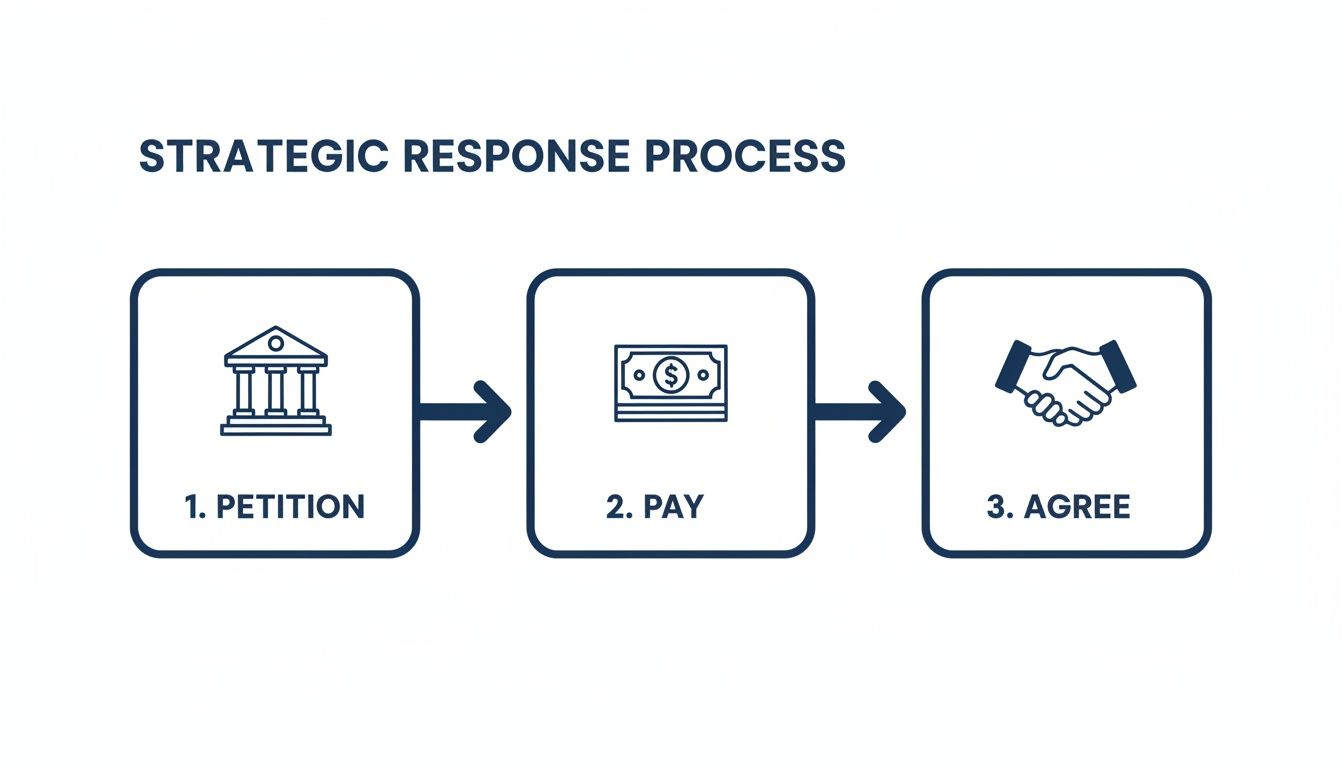
This flowchart illustrates the three main paths you can take: petitioning the Tax Court, paying the amount and suing for a refund, or negotiating an agreement. The Notice of Deficiency is the lynchpin of the entire IRS process, often triggered by red flags like unreported crypto gains—which have seen a 300% audit increase since 2020—or poorly documented business expenses.
This is the perfect time to bring in a professional. An experienced tax attorney can assess the strength of your case, review your evidence, and provide a candid opinion on the best path forward. Whether that means filing a Tax Court petition, negotiating a settlement, or pursuing another option, you need that expert guidance. Whatever you do, don't wait until day 89 to make the call.
Common Questions About the Notice of Deficiency
Receiving a notice of deficiency is understandably nerve-wracking. Once you get past the initial shock, a flood of questions usually follows. The formal language and tight deadlines can feel overwhelming, but you're not alone in feeling that way.
Let's walk through some of the most pressing concerns we hear from clients, breaking down the answers into plain English so you know exactly where you stand.
What Happens If I Miss the 90-Day Deadline?
This is the big one, and there’s no way to sugarcoat it: the consequences are severe. If you let that 90-day window close without filing a Tax Court petition, you forfeit your right to challenge the tax bill before you have to pay it.
On day 91, the IRS can legally assess the tax, turning a "proposed" amount into a real, collectible debt. At that point, the IRS collection machine can fire up with some powerful tools:
- Federal Tax Liens: A public claim against your property (your house, your car, your investments) that cripples your credit score and makes selling assets a nightmare.
- Bank Levies: The IRS can instruct your bank to freeze your accounts and send the money directly to them.
- Wage Garnishment: Your employer will be ordered to divert a portion of your paycheck to the IRS before you even see it.
Your only recourse after missing the deadline is to pay the entire bill first, then file a formal claim for a refund. If the IRS denies that claim, you can sue them for your money back in a different federal court. This "pay-to-play" strategy is incredibly difficult and expensive. The 90-day deadline isn't just a suggestion; it’s your most important legal right in the entire process.
Can I Still Negotiate If I File a Tax Court Petition?
Yes, and not only can you negotiate, but filing the petition is often the very thing that unlocks the most meaningful negotiations. The vast majority of Tax Court cases—well over 90%—are settled before ever going to trial.
Filing the petition doesn't lock you into a courtroom battle. Instead, it moves your case to a different part of the IRS. You’re no longer dealing with the Examination Division that conducted the audit; your case is now handled by the IRS Appeals Office or IRS Counsel.
Think of it like this: The audit division is the sales clerk who has to stick to the list price. Filing a petition is like asking to speak to the store manager. The manager (IRS Appeals) has the authority to look at the situation, evaluate the risks of a long fight, and make a deal.
This new venue gives your tax professional real leverage. They are now dealing with a division whose entire purpose is to resolve disputes and assess the "hazards of litigation"—the risk that the IRS might lose in court. This opens the door for a skilled negotiator to point out weaknesses in the IRS's position and work toward a fair settlement, often including reduced taxes and waived penalties.
Does This Notice Mean the IRS Thinks I Committed Fraud?
For most people, the answer is no. A standard notice of deficiency is a civil tax matter, not a criminal one. It usually means the IRS auditor disagreed with something on your return, like deductions you couldn't fully prove or income that was left off by mistake. It’s a dispute over numbers, not a suggestion of criminal intent.
However, you need to scan the notice for one specific, very serious red flag: a civil fraud penalty. Governed by Internal Revenue Code § 6663, this isn't just any penalty. Its inclusion means the IRS examiner believes they have "clear and convincing evidence" that you intentionally tried to evade taxes.
This penalty is a massive 75% of the tax amount attributed to fraud. If you see this on your notice, the entire dynamic of your case changes. The stakes are dramatically higher. This is the point where you must stop and immediately seek out an experienced tax attorney. Handling a case with fraud allegations on your own is an exceptionally risky gamble.
How Does This Federal Issue Affect My Michigan State Taxes?
A federal tax issue is rarely just a federal issue, and that’s especially true in Michigan. Your federal and state tax returns are directly linked. The starting point for your Michigan MI-1040 is a number pulled straight from your federal return: your Adjusted Gross Income (AGI).
This creates a clear domino effect. If the IRS changes your federal AGI—by disallowing business expenses, for example—that change flows directly to your Michigan return. The Michigan Department of Treasury will eventually get a report from the IRS about the adjustment and will issue its own bill for the additional state tax you now owe, plus its own set of interest and penalties.
That’s why mounting a strong defense against the federal notice of deficiency is so vital. By fighting the proposed changes at the federal level, you’re not just saving on federal tax; you're also preventing a second tax problem from popping up at the state level. A smart defense always considers both federal and state implications from the very beginning.
