
Understand injured spouse vs innocent spouse: Key Relief Differences
The biggest mistake I see taxpayers make is confusing injured spouse relief with innocent spouse relief. On the surface, they sound similar, but they solve two completely different problems.
Think of it this way: injured spouse relief is about getting your money back. Innocent spouse relief is about not having to pay money you don't believe you owe.
Your Guide to Joint Tax Return Relief Options
When you file a joint tax return, you and your spouse are telling the IRS you're a single financial unit. This creates a legal concept called "joint and several liability." In plain English, it means the IRS can come after either one of you for the entire tax bill, no matter who earned the income or made the mistake.
For most couples, this isn't an issue. But what happens when your spouse has old debts you knew nothing about? Or what if they hid income from you, and now the IRS is knocking? That's when joint liability becomes a nightmare.
Thankfully, the IRS has two specific relief programs designed for these exact situations. Choosing the right one is absolutely critical to fixing the problem.

What's the Core Purpose of Each Relief?
Let's get straight to the point. Injured spouse relief is for when your joint tax refund gets snatched by the government to pay for your spouse's separate, pre-existing debts—things like overdue child support, defaulted student loans, or old tax bills from before you were married. You're "injured" because your portion of the refund was taken for a debt that wasn't yours.
Innocent spouse relief, on the other hand, is your defense against a tax bill created by your spouse's actions on the joint return itself. This applies when your spouse underreported income, fabricated deductions, or made other serious errors without your knowledge, leaving you on the hook for the resulting tax, penalties, and interest. The IRS provides detailed guidance on the requirements for spousal tax relief for those facing this situation.
Here's a quick way to diagnose your situation:
- Is your tax refund missing? If you were expecting a refund but it was intercepted to cover your spouse's debt, you're almost certainly looking at an injured spouse claim.
- Did you get a scary notice from the IRS demanding more money? If an audit uncovered errors on your joint return and now there's a new tax deficiency, you need to explore innocent spouse relief.
Getting this first step right is everything. This simple table breaks down the fundamental differences.
| Feature | Injured Spouse Relief | Innocent Spouse Relief |
|---|---|---|
| Primary Goal | Recoup your share of a seized tax refund | Avoid liability for an unfair tax debt |
| Triggering Event | Refund offset for a spouse's separate debt | IRS audit or notice of tax deficiency |
| Spouse's Debt | Pre-existing and legally separate | Created by errors on the joint return |
| Relevant IRS Form | Form 8379 | Form 8857 |
Injured Spouse vs. Innocent Spouse Relief: What’s the Difference?
When you file a joint tax return, the IRS generally views both spouses as equally responsible for the tax bill. But what happens when one spouse's past debts or current mistakes create a financial mess for the other? This is where the IRS provides two very different forms of relief: injured spouse and innocent spouse.
Choosing the right path is critical. Getting it wrong means delays, rejections, and unnecessary stress. The core difference really boils down to this: one is about getting your refund back, while the other is about avoiding a new, unexpected tax bill.
Core Problem and Objective
The first thing to figure out is why you need relief. The answer to that question will point you in the right direction.
An injured spouse claim is all about a refund being taken away. You filed a joint return, were owed a refund, and the IRS intercepted it to pay a separate, legally enforceable debt that belongs only to your spouse. This could be anything from their old student loans or back child support to a state tax debt they incurred before you were even married. Your goal is simply to get your portion of that seized refund back.
Innocent spouse relief, on the other hand, deals with a problem on the tax return itself. You discover there's a significant tax deficiency—a surprise bill from the IRS—because your spouse either didn't report all of their income or claimed deductions and credits they weren't entitled to. Your objective here isn't to recover a refund, but to legally shield yourself from having to pay this new tax debt.
Key Takeaway: Think of it like this: Injured spouse relief is a refund recovery tool for a past debt. Innocent spouse relief is a liability shield against a new debt created on the return itself.
Required IRS Forms and Documentation
The IRS uses completely different paperwork for these requests. Sending in the wrong form is a non-starter; it will be rejected, and you’ll have to start over.
- For Injured Spouse Relief: You'll file Form 8379, Injured Spouse Allocation. This form is essentially a worksheet where you allocate all the income, tax withholding, and credits between you and your spouse to prove exactly what portion of the refund is yours.
- For Innocent Spouse Relief: The required form is Form 8857, Request for Innocent Spouse Relief. This is a much more detailed application. You'll need to explain why you didn't know about the tax error and make a case for why it would be unfair to hold you responsible for it.
The supporting documents also differ. For Form 8379, you primarily need W-2s and 1099s to prove the income allocation. For Form 8857, the evidence is more substantial, often including financial records, proof of your level of involvement in household finances, and details about the circumstances surrounding the error.
Timing and Filing Deadlines
The deadlines for these claims are strict and very different. Missing them can close the door on your opportunity for relief.
For an injured spouse claim using Form 8379, you generally have three years from the original return's due date or two years from the date you paid the tax, whichever is later. The smartest move, however, is to file Form 8379 with your joint tax return if you know your spouse has a debt that could trigger a refund offset.
The timeline for innocent spouse relief is tighter and starts from a different point. You must typically file Form 8857 within two years from the date the IRS first begins collection activities against you for that tax debt. This could be a notice of intent to levy or a lien filing. If you miss this two-year window, you may lose your chance for traditional innocent spouse relief, leaving only the more difficult-to-obtain equitable relief as an option.
Key Differences Between Injured Spouse and Innocent Spouse Relief
This table breaks down the crucial distinctions to help you quickly identify which path applies to your situation.
| Criteria | Injured Spouse Relief | Innocent Spouse Relief |
|---|---|---|
| Problem Solved | Your portion of a joint refund was seized to pay your spouse's separate, pre-existing debt. | A joint tax return has an understated tax liability due to errors or omissions made by your spouse. |
| Primary Goal | To recover your share of the intercepted tax refund. | To be legally absolved of responsibility for the additional tax, penalties, and interest. |
| Required IRS Form | Form 8379 (Injured Spouse Allocation) | Form 8857 (Request for Innocent Spouse Relief) |
| Filing Deadline | Generally, within 3 years of the original return's due date. | Generally, within 2 years from the first IRS collection action against you for the specific tax debt. |
Understanding these fundamental differences is the first and most important step. It ensures you're filing the right claim, with the right evidence, and within the strict deadlines set by the IRS.
Determining Your Eligibility for Injured Spouse Relief
So, you think you might qualify for injured spouse relief? Let's break down what that really means. This type of relief isn't for correcting a mistake on your tax return; it's about protecting your portion of a refund from being snatched up to cover your spouse's separate, past-due debts. It's how you draw a line in the sand with the IRS and say, "This part is mine."
The entire process boils down to proving exactly what you contributed to the tax overpayment. To do this right, you have to accurately analyze financial reports tied to your joint return. This is how you'll correctly allocate income and tax payments on Form 8379.
This decision tree gives you a quick visual on that first, crucial choice between injured spouse and innocent spouse relief. It all starts with one question: was your refund taken, or was your tax bill wrong?
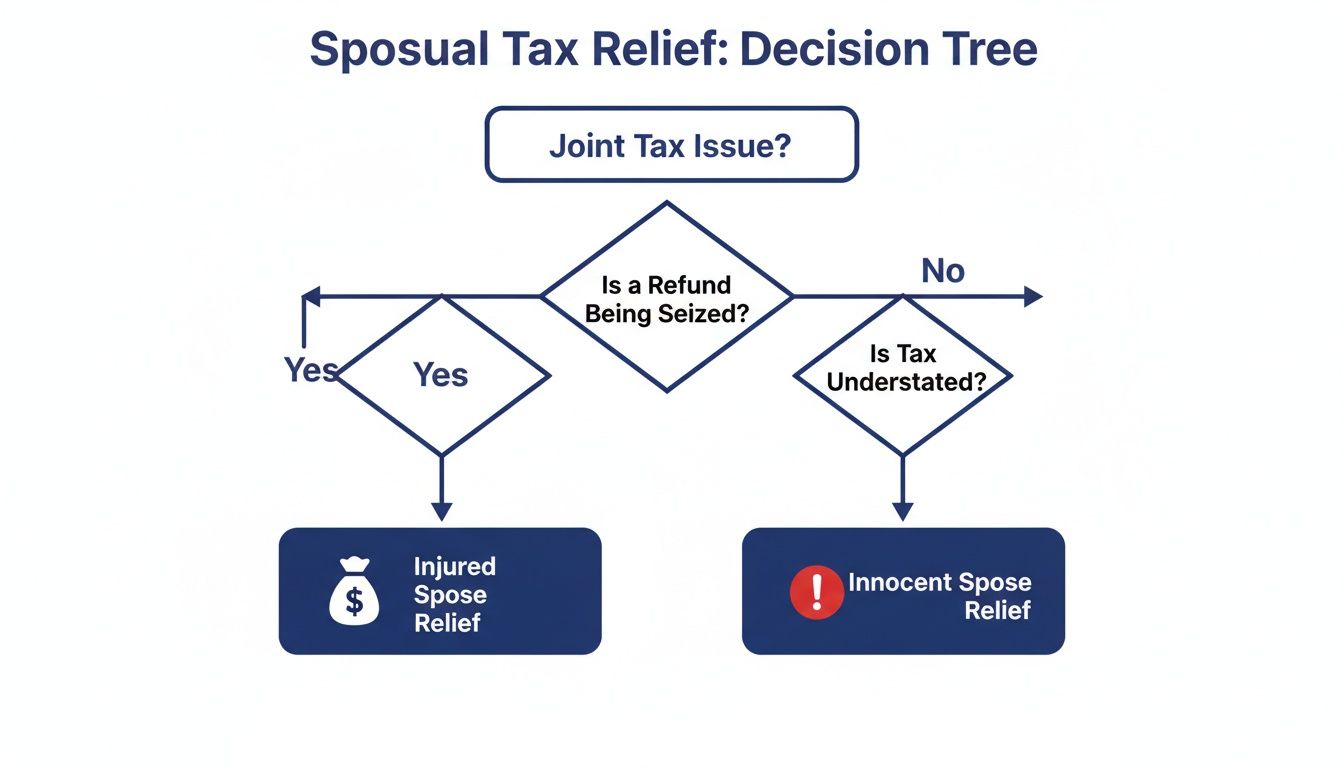
As you can see, the nature of your tax problem—a seized refund versus an understated tax liability—points you down two completely different paths from the very beginning.
The Three Core Requirements for an Injured Spouse Claim
To file a successful injured spouse claim, you must be able to give a firm "yes" to all three of these questions. If you answer "no" to even one, this isn't the right solution for you.
- Did you file a joint tax return? This is the baseline. This relief only applies to couples who filed jointly, as that’s what creates the single, shared refund that can be seized.
- Did you have reportable income and make tax payments? You have to show that you personally contributed to the tax overpayment that created the refund. This could be through federal income tax withheld from your paycheck (shown on a Form W-2) or by making your own estimated tax payments.
- Was your joint refund seized to pay your spouse's separate debt? The IRS must have taken some or all of your refund to pay a legally enforceable debt that belongs only to your spouse, not to you.
What kind of debts are we talking about? Typically, it's things like:
- Federal tax debt from before you were married
- Overdue child support or spousal support (alimony)
- Federal student loans that are in default
- State income tax bills
Strategic Filing of Form 8379
Once you've confirmed you're eligible, your next move is to fill out and submit Form 8379, Injured Spouse Allocation. You have two ways to file it, and your choice can make a big difference in how quickly you get your money back.
The best strategy is to be proactive. File Form 8379 with your original joint tax return. If you already know your spouse has a debt that could trigger a refund offset, attaching this form from the start signals the IRS to properly divide the refund before it's ever touched. This can stop the offset in its tracks.
The other option is to file Form 8379 by itself after the IRS has already notified you that your refund was seized. This is a more reactive approach, but it still works. Just be prepared to wait. It often takes the IRS much longer—several weeks or even months—to process a standalone form, which means a longer delay in getting your share of the refund.
The Three Flavors of Innocent Spouse Relief
Unlike an injured spouse claim, which is a fairly straightforward process, innocent spouse relief isn't a single solution. Think of it as an umbrella covering three distinct paths to protection, each with its own set of rules. It’s crucial to understand these differences, because getting denied for one doesn't necessarily mean you won't qualify for another.
The right path for you will hinge on the unique details of your situation—your marital status, what you knew about the tax error (and when you knew it), and whether it’s simply unfair for the IRS to hold you responsible for the debt. Choosing correctly from the start can make all the difference.

Traditional Innocent Spouse Relief
This is the classic form of relief and what most people think of first. Qualifying means meeting several strict conditions, but the toughest nut to crack is almost always the "knowledge test."
You have to prove that when you put your signature on that joint return, you did not know, and had no reason to know, that there was an understatement of tax. This is a very high bar to clear. The IRS will dig into things like your level of education, how involved you were in the family finances, and whether you ever raised questions about strange-looking items on the return.
Beyond that, the IRS must agree that holding you liable for the tax deficiency would be fundamentally unfair. For instance, if your spouse secretly opened a business bank account you never knew existed, your case is much stronger. If you’re unsure how these rules apply to you, you can learn more about innocent spouse relief in our detailed guide.
Separation of Liability Relief
This option works differently. Instead of trying to wipe out the tax debt completely, it divides it up. Under separation of liability, the IRS allocates the tax understatement between you and your spouse (or ex-spouse), and you’re only on the hook for your portion.
To even be considered, you must first meet one of these marital status requirements when you request relief:
- You are divorced or legally separated from the spouse named on the joint return.
- You are widowed.
- You haven't lived in the same household as your spouse for the entire 12-month period leading up to the date you file for relief.
The catch? This relief is off the table if you had actual knowledge of the item that caused the tax problem when you signed the return. If you knew your spouse was fudging business deductions but you signed anyway, you'll almost certainly be denied.
Key Differentiator: Traditional relief asks if you had no reason to know about the error. Separation of Liability is stricter, demanding proof you had no actual knowledge of it. This small difference in wording is where many of these cases are won or lost.
Equitable Relief
So, what happens if you can't qualify for the first two? That’s where equitable relief comes in as a critical safety net. It’s the most flexible option, giving the IRS the power to grant relief if, after reviewing all the facts, it would simply be inequitable (unfair) to hold you liable for the debt.
This is often the last hope for someone who may have had some inkling of the problem but was in a difficult or coercive situation. The IRS considers a whole host of factors here, such as:
- Your current marital status.
- Whether you would face severe economic hardship if relief isn't granted.
- Any history of spousal abuse or financial control.
- Whether you received a significant benefit from the unpaid tax.
- Your current physical and mental health.
The need for these options became glaringly obvious right after the modern framework for innocent spouse relief was put in place. According to historical IRS data, claims jumped from 46,619 in fiscal year 1999 to 54,402 by fiscal year 2000, and have since leveled out at a steady 50,000 claims per year. This consistent volume, which you can read about on the Taxpayer Advocate Service website, shows just how many people find themselves in this tough spot every single year, highlighting why these relief provisions are so essential.
Applying Tax Relief to Real-World Scenarios
Tax rules can feel abstract and overwhelming. But when you look at them through the lens of real-life situations, they start to make a lot more sense. The difference between injured and innocent spouse relief isn’t about memorizing IRS definitions; it’s about seeing how those definitions play out in people's lives. Let's walk through a couple of common scenarios that Michigan residents might encounter.
By exploring these examples, you can learn to spot the key details in your own situation and figure out which path is right for you.
Case Study One: The Seized Refund in Ann Arbor
Sarah, a registered nurse in Ann Arbor, and her husband Mark, a carpenter, filed their taxes jointly. They were expecting a nice refund of $4,200, mostly coming from the taxes Sarah had withheld from her hospital paychecks all year.
Instead of a check, they got a letter from the IRS. Their entire $4,200 refund had been seized to pay off an old state tax debt from Mark's failed business—a business that closed down years before he even met Sarah. She had absolutely nothing to do with it, and now her part of the refund is gone. She feels wronged, or "injured," because her money was used to pay a debt that isn't hers.
This is the textbook definition of an injured spouse claim. The issue isn't a mistake on their current tax return. The problem is that their legitimate refund was intercepted to cover one spouse's separate, pre-existing debt.
Decision Rationale: Sarah needs to file Form 8379, Injured Spouse Allocation. The goal here is to separate her income and withholdings from Mark's to get her portion of the refund back. Since the debt is solely Mark's and predates their joint filing, this is the correct form to use.
Case Study Two: The Hidden Income in Traverse City
David and Mary, retirees in Traverse City, filed their joint return as they always did, reporting their pension and social security. Two years later, a frightening letter from the IRS arrives—a CP2000 notice proposing $9,500 in additional tax, plus hefty penalties and interest.
It turns out David had been doing freelance consulting work on the side and never told Mary about it. He failed to report $35,000 in income. David always handled the finances and assured Mary everything was in order. She had no clue about the extra work and never saw a dime of the money, as David had it sent to a separate bank account. Now, she's on the hook for a huge tax bill on income she didn't even know existed.
This situation is a clear fit for innocent spouse relief. Mary is being held responsible for a tax understatement on a joint return that she signed in good faith, believing it was accurate.
Decision Rationale: Mary's next step is to file Form 8857, Request for Innocent Spouse Relief. She will need to prove that she didn't know—and had no reason to know—about the unreported income. The key is to show that it would be fundamentally unfair to hold her liable for David's secret actions.
Sometimes, tax debts are so large that even innocent spouse relief isn't enough to solve the problem. If you're facing a tax liability you simply can't afford to pay, it's worth seeing what other options are out there. For more on this, you might be interested in our guide on what an Offer in Compromise is and how it can help you settle tax debt for a fraction of what you owe.
When to Consult a Michigan Tax Relief Attorney
Trying to handle an injured or innocent spouse claim on your own might feel like a straightforward task, but the reality is that the stakes are incredibly high. A small oversight or a simple mistake on the forms can get your claim denied, leaving you on the hook for a huge tax bill or costing you a refund you desperately need. The key is knowing when to stop the DIY approach and call in a professional to protect your financial future.
There are a few situations that should be immediate red flags. If you find yourself in any of these scenarios, it’s a clear sign that your case is too complex to handle alone and it's time to talk to an attorney.
Key Indicators That You Need a Lawyer
The line between an injured spouse vs innocent spouse claim can get blurry, and the process becomes much more challenging under certain conditions. You should strongly consider getting legal help if you’re dealing with any of the following:
- A Large Tax Debt: The bigger the tax bill, the more closely the IRS is going to look at your claim. An attorney knows how to build a rock-solid case from the start, presenting the strongest evidence to support your position.
- An Ongoing IRS Audit: If the IRS is already auditing you, filing for spousal relief just adds another complicated layer to the process. A tax attorney can take over all communications with the IRS, making sure your rights are protected during both the audit and the relief claim.
- A Previously Denied Claim: After a denial, you only have a short window to appeal. Trying to navigate the U.S. Tax Court appeals process alone is nearly impossible. You need an attorney to build a convincing legal argument to get that decision overturned.
- Complex Financial Situations: If your case involves things like a family business, hidden assets, or a spouse who was intentionally deceptive about finances, a standard claim won't be enough. These situations require a thorough investigation.
A tax attorney does much more than fill out forms. They become your advocate, crafting a strategy, negotiating directly with the IRS for you, and representing you in court if an appeal is necessary.
The Strategic Advantage of a Local Michigan Firm
Working with a local Michigan tax law firm gives you a home-field advantage. Our attorneys not only have a deep understanding of federal IRS rules but are also dialed into Michigan's specific tax enforcement priorities and state-level relief options. This dual expertise is critical when your tax problems span both federal and state tax agencies.
An experienced lawyer will dig into the details of your situation, handle all the back-and-forth with the government to avoid costly mistakes, and frame your claim with powerful legal arguments. It's also helpful to recognize the kind of support structures that successful law firms and attorneys have in place to manage complex cases.
Ultimately, calling a professional isn't giving up; it's making a smart, strategic decision to get the best possible result. For local help throughout the state, check out our guide to Michigan-based tax attorney locations.
Frequently Asked Questions About Spousal Tax Relief
Even after you grasp the basics, the world of spousal tax relief can be confusing. When you’re in the middle of a stressful tax situation, it's natural to have questions. Let's walk through some of the most common ones that come up when people are trying to figure out the injured spouse vs. innocent spouse puzzle.
Can I File for Both at the Same Time?
No, you have to pick one. These two types of relief are mutually exclusive because they're designed to solve completely different problems.
Think of it this way: one addresses an old debt, and the other deals with a new tax problem.
- Injured Spouse Relief (Form 8379): This is your tool when the IRS seizes your portion of a joint tax refund to pay for a debt that belongs solely to your spouse—a debt from before you even filed the joint return.
- Innocent Spouse Relief (Form 8857): This is what you seek when you discover your joint tax return has an error, like unreported income or an incorrect deduction, that your spouse is responsible for, creating a new tax bill you didn't know about.
You can't apply for both for the same tax year because your situation will only fit one of these scenarios. If you're unsure which path to take, a tax professional can diagnose your situation and point you in the right direction.
What Happens if My Innocent Spouse Claim Is Denied?
Getting a denial letter from the IRS for your innocent spouse claim isn't necessarily the final word. You have the right to appeal their decision, but you have to act fast.
You can challenge the denial by filing a petition with the U.S. Tax Court. The catch? The deadline is ironclad. You typically have only 90 days from the date on the IRS denial notice to file your petition. If you miss that window, you may lose your right to appeal forever.
Take Action: The moment you receive a denial, the clock starts ticking. This is a critical time to consult a tax attorney who can review the IRS's decision, assess the strength of your case, and navigate the formal Tax Court process on your behalf.
Does Michigan Have Its Own Spousal Relief Programs?
Yes, it does. Michigan’s spousal relief programs largely mirror the federal rules. So, if you owe back taxes to both the IRS and the Michigan Department of Treasury, you need to file for relief with each agency separately.
Getting approved for federal relief can definitely bolster your case with the state. However, you can't assume one will automatically take care of the other. You must address both. If you ignore the state liability, the Michigan Department of Treasury can pursue its own collection actions, like garnishing your wages or levying your bank account, regardless of what happens with the IRS.
