
Identity verification letter from irs: What to do next to protect your refund
That moment your heart skips a beat—seeing an official envelope from the IRS in your mailbox. Before you panic, take a breath. If it's an identity verification letter, like a 5071C or 4883C, it means the IRS has simply hit the pause button on your tax return.
This isn't an audit or a sign you're in trouble. It’s a security measure, a checkpoint designed to protect you and your refund from the ever-present threat of tax fraud. The key is to act quickly to get your refund back on track.
Why the IRS Sent You This Letter
Think of this letter less as a problem and more as a precaution. The IRS’s automated fraud detection systems flagged something on your return that didn’t quite line up with their records, prompting a manual review to confirm it was really you who filed.
Their main objective is to prevent criminals from using stolen Social Security numbers to file fake tax returns and steal legitimate refunds. It's similar to your bank calling to verify an unusual purchase on your credit card. The IRS is just doing its due diligence with your tax refund.
Common Triggers for a Verification Letter
While the IRS keeps its exact fraud detection methods under wraps, I’ve seen enough of these cases to know the common triggers. Most of them are completely innocent life changes.
Your return might get a second look if:
- You've moved recently and filed from a new address.
- Your income changed dramatically from last year (either up or down).
- You claimed a new dependent for the first time.
- You have a history of being a victim of identity theft.
This isn't a rare occurrence. During the 2024 filing season alone, the IRS put a hold on over 1.9 million tax returns for identity verification. That’s nearly two million taxpayers left waiting, all because of this single step. You can read more about how identity verification delays tax refunds.
Your prompt response is the single most important factor here. What starts as a minor delay can easily stretch into a weeks-long wait if you ignore the letter. The faster you verify, the faster the IRS releases your refund.
At the end of the day, this letter is a crucial tool in the fight against tax fraud. It might feel like an inconvenient roadblock, but its purpose is to make sure your refund lands safely in your bank account, not a scammer's.
Decoding the Most Common IRS Verification Letters
Getting a letter from the IRS about identity verification can be unsettling, and to make matters worse, they aren't all the same. Each notice points to a specific way the IRS wants you to prove you're you. Figuring out which letter you've received is the critical first step to getting this sorted out and, most importantly, getting your tax refund released.
Think of it like your bank flagging a strange transaction. They might text you, email you, or call you. The IRS does something similar. The specific letter you get is their chosen way of reaching out, usually based on their internal risk assessment of your situation.
Letter 5071C: Your Path to Online Verification
Here in Michigan, the Letter 5071C is the one we see most often. This letter is essentially the IRS's way of saying, "We need you to verify yourself online." It means their system has flagged something, but they're comfortable letting you clear it up through their secure web portal.
The 5071C will have a unique reference number and will point you to their official Identity and Tax Return Verification Service website. This is, by far, the quickest and easiest way to resolve the hold on your refund. You'll typically be routed through ID.me, an official IRS partner, to complete a short video verification process.
A common scenario? Someone files their taxes from a new computer or while traveling. That simple change in IP address can be just enough to trigger the system, prompting a Letter 5071C as a routine security check.
Letter 4883C: When a Phone Call Is Required
If you get a Letter 4883C in the mail, forget about going online. This one means you have to pick up the phone and call the IRS Taxpayer Protection Program (TPP) hotline. The IRS sends this when their system decides a direct conversation is the best way to clear things up.
Don't panic—this doesn't automatically mean your situation is more serious. It could be triggered by something as simple as a data mismatch that a human agent can quickly fix with a few questions. For instance, if you recently got married and changed your name, but the Social Security Administration's records haven't caught up, a phone call allows an IRS agent to manually verify your documents.
Pro Tip: The phone number on your Letter 4883C is a dedicated, secure line specifically for identity verification. Don't call the main IRS support number. You'll just get stuck in a maze of transfers and long hold times. Stick to the number they provided.
Letter 5747C: The In-Person Verification Mandate
The Letter 5747C is the one nobody wants to see. It’s the least common but requires the most effort: scheduling a face-to-face appointment at a local IRS Taxpayer Assistance Center (TAC). This letter is usually reserved for cases where the IRS has pretty significant concerns or if other verification methods have already failed.
This is a mandatory, in-person meeting. You can't resolve it over the phone or online. It’s the final security checkpoint where the IRS needs to see your original identification documents with their own eyes.
What might trigger a 5747C?
- A return was filed from an address already flagged for fraudulent activity.
- The taxpayer has been a confirmed victim of identity theft in a prior year.
- The information on the current tax return is wildly different from all previous years on file.
To help you quickly tell these letters apart, here's a simple breakdown.
Comparing IRS Identity Verification Letters
This table offers a quick reference for understanding the key differences between these common IRS notices, what they mean, and what you need to do next.
| IRS Letter | Primary Verification Method | What It Means | Typical Next Step |
|---|---|---|---|
| 5071C | Online | The IRS flagged a potential issue but is comfortable with a secure online verification. This is the most common and fastest method. | Use the reference number on the letter to log into the IRS ID Verify website, often using ID.me. |
| 4883C | Phone Call | An online check isn't sufficient. The IRS needs to speak with you directly to ask specific questions and verify information. | Call the dedicated Taxpayer Protection Program (TPP) hotline number provided in your letter. |
| 5747C | In-Person | The IRS has significant concerns and requires a mandatory, face-to-face appointment to inspect original documents. | Call to schedule an appointment at a local IRS Taxpayer Assistance Center (TAC) as instructed. |
Seeing these letters can be stressful, but they are a standard part of the IRS's fraud prevention efforts. Following the instructions for the specific letter you received is the surest way to resolve the issue.
While you're working through the verification process, it's also a good time to double-check that your original tax return was accurate. If you realize you made a mistake after filing, you'll need to take action. You can learn more about how to amend a tax return in our detailed guide. Fixing any errors now can save you from bigger headaches down the road.
When an identity verification letter from the IRS shows up in your mailbox, it's easy to feel a knot in your stomach. But don't panic. This simply means the IRS has flagged your return for a closer look to make sure you are the one who actually filed it. Your refund is on hold, but resolving this is usually a matter of following the specific steps outlined in the notice you received.
The type of letter you get—whether it's a 5071C, 4883C, or 5747C—determines the exact path you'll need to take.
This flow chart gives you a bird's-eye view of the three main ways the IRS handles this, each with its own set of requirements.
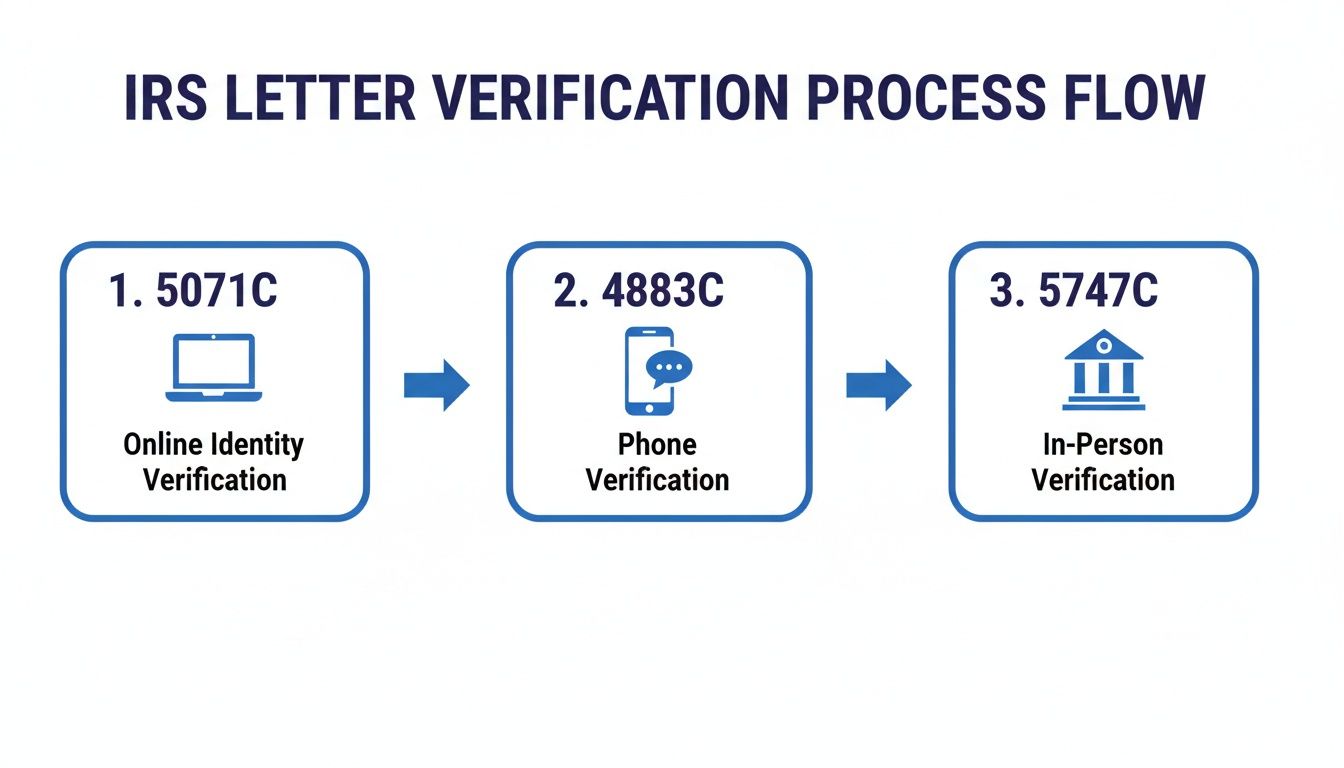
As you can see, the IRS will direct you to verify yourself online, over the phone, or in person. Each route requires different documents and a specific course of action to prove you're the legitimate taxpayer. Let’s walk through what to do for each scenario.
Tackling the Online Process for Letter 5071C
If a Letter 5071C landed on your doorstep, consider yourself lucky—you have the most convenient option. The IRS wants you to use its secure online portal, and if you have your documents ready, you can often knock this out in less than 30 minutes.
First, find the letter itself. It contains a unique control number you can't proceed without. The verification is usually managed through ID.me, a trusted technology partner the IRS uses to confirm identities securely.
Here's what the ID.me process generally involves:
- Creating an Account: You'll start by setting up an account with your email and a strong password.
- Uploading Documents: The system will ask you to take and upload photos of a government-issued ID, like your Michigan driver's license or a U.S. passport.
- Jumping on a Video Call: The final step is a brief, live video chat with an ID.me agent. You’ll just need to hold your ID up to the camera so they can see it’s really you.
Once ID.me gives the green light, they notify the IRS, which then releases the hold on your tax return.
Getting Ready for a Phone Call with Letter 4883C
Receiving a Letter 4883C means the IRS needs to speak with you directly. You'll have to call the Taxpayer Protection Program (TPP) hotline number printed right on the letter. Make sure you call that specific number—not the general IRS helpline, or you’ll end up in a frustrating loop of transfers and long waits.
Before you even think about dialing, get all your documents in a neat pile. The IRS agent will fire off a series of questions to confirm your identity, and fumbling for paperwork will only prolong the call.
Real-World Tip: From my experience, the best time to call the TPP hotline is right when they open, usually early in the morning. Wait times can easily stretch past an hour during tax season. I've found that calling first thing on a Tuesday or Wednesday often gets you through much faster.
The agent will likely ask you to verify details from both the current year's return and the prior year's. Be ready to confirm your Adjusted Gross Income (AGI), the exact refund amount you claimed, or specific numbers from your W-2s.
Scheduling an In-Person Visit for Letter 5747C
The Letter 5747C is the least common but requires the most effort. It means you must make an in-person appointment at an IRS Taxpayer Assistance Center (TAC). For those of us in Michigan, that might be an office in Detroit, Lansing, or Grand Rapids. You can't just show up; an appointment is mandatory.
Call the number on your letter to get your visit on the calendar. The IRS representative on the phone will tell you exactly which documents to bring. And this is critical: they must be original documents or certified copies. Photocopies will be rejected on the spot.
Your Go-To Verification Checklist
No matter which letter you received, being prepared is half the battle. Having these documents handy will make the entire process smoother and quicker.
Key Documents for Any Verification Method:
- The IRS Letter: Your 5071C, 4883C, or 5747C is non-negotiable. It has your case numbers.
- Social Security Number (SSN): Have your SSN ready, along with the SSNs of your spouse and any dependents on the return.
- Photo ID: A valid, unexpired government-issued ID is a must (e.g., driver’s license, passport, state ID card).
- The Tax Return in Question: Keep a copy of the Form 1040 for the year mentioned in the letter.
- Last Year's Tax Return: The IRS often uses this to cross-reference information.
- Your Income Documents: Gather all the W-2s, 1099s, and other forms you used to file your return.
By pulling these items together beforehand, you can confidently answer whatever questions come your way. This is the final hurdle to getting your tax return processed and that refund into your bank account.
What Happens After You Verify Your Identity
You’ve gone through the verification process, submitted everything, and proved you are who you say you are. It’s natural to feel relieved, but it's important to know this is just one step toward getting your tax return fully processed. The finish line is in sight, but what happens next can go a couple of different ways.
For most people, it's now a waiting game. Once the IRS accepts your verification, they lift the security hold on your account. From there, the agency says it can take up to nine weeks to finish processing your return and send out your refund.
While nine weeks is the official timeline, my experience with Michigan taxpayers shows it can vary. Some get their refunds much faster, while others are left waiting the full nine weeks or even a bit longer, especially during the height of tax season. Your best bet now is to keep tabs on your status using the official IRS tools.
Checking Your Refund Status
After you've verified your identity, the "Where's My Refund?" tool on the IRS website will be your go-to resource. I'd give it at least a few days after you complete the verification before you start checking, as the system needs time to catch up and show the hold has been removed.
To check your status, you'll need three pieces of information handy:
- Your Social Security Number or ITIN
- Your exact filing status (e.g., Single, Married Filing Jointly)
- The precise refund amount you claimed on your tax return
The tool tracks your return through three stages: Return Received, Refund Approved, and Refund Sent. If more than nine weeks go by with no update, it's time to call the IRS directly. A long delay could signal another problem with your return that needs your attention.
When Verification Confirms Identity Theft
Unfortunately, there are times when the verification process uncovers something much more serious. You might discover during a phone call or in-person appointment that someone has already filed a fraudulent tax return using your Social Security number.
This isn't just a simple delay anymore; it's a confirmed case of identity theft. Your focus immediately has to shift from getting your refund to securing your account and sorting out the fraudulent filing.
The IRS will not fix this for you automatically. You have to take specific, proactive steps to report the fraud and protect yourself from further harm. This is where things get a lot more complicated.
You will need to file Form 14039, the Identity Theft Affidavit. This is the official form that tells the IRS you didn't file the fraudulent return and are the rightful taxpayer. It’s the first crucial step in what can be a long recovery process.
Once you’re a confirmed victim, the IRS will also issue you an Identity Protection PIN (IP PIN). This is a six-digit number mailed to you each year, and you absolutely must use it to file your federal tax returns from now on. It’s like two-factor authentication for your taxes—no one can file with your SSN unless they also have that PIN.
Navigating the fallout from tax identity theft is stressful and overwhelming. The paperwork is complex and the timelines are often frustratingly long. This is a critical point where getting professional help can make all the difference. If you're dealing with confirmed fraud, having an experienced representative in your corner is invaluable. You can learn more about the benefits of an IRS audit representative who can handle the IRS communications and fight for your interests, ensuring everything is filed correctly so your case doesn't get lost in the shuffle.
When an IRS Letter Signals Deeper Identity Theft Issues

Sometimes, that letter from the IRS isn't just a routine check. It’s the first thread you pull that unravels a much bigger problem: a criminal has already filed a bogus tax return in your name, hoping to steal your refund. Suddenly, a simple delay turns into a complex and incredibly frustrating battle to reclaim your identity.
When this happens, you’re no longer just verifying who you are. Your mission is now twofold: prove the other tax return is fraudulent while simultaneously trying to get your own legitimate return processed. Settle in, because this isn’t a quick fix that a single phone call or online form can resolve.
The Long and Winding Road to Resolution
Fixing your IRS records after tax identity theft is a marathon, not a sprint. The process demands meticulous documentation, persistent follow-up, and an enormous amount of patience. It’s a completely different world from the straightforward, nine-week timeline for a simple verification.
Recent data paints a pretty grim picture of just how long this can take. The IRS now takes an average of 623 days to fully resolve identity theft victim assistance cases. That’s a staggering increase from the old standard, largely driven by backlogs that swelled during the pandemic. You can find more details on IRS identity theft case resolution times to see what you might be up against.
This extended timeline isn't just an inconvenience; it can have serious financial consequences. While your case is stuck in limbo, you could face cascading issues, from delayed refunds for subsequent years to erroneous collection notices for taxes you don't actually owe.
Unresolved tax identity theft creates a domino effect. Imagine a Michigan taxpayer trying to secure a mortgage or student loan, only to be denied because their IRS records show a tax debt that isn't even theirs. This is precisely why tackling the root problem head-on is so critical.
Red Flags: When It's Time for Professional Help
While you can often handle a standard verification letter on your own, certain signs scream that the problem has escalated beyond a DIY fix. If you see any of the following red flags, it's a clear signal you need a tax professional who specializes in these tangled messes.
- You receive multiple IRS notices for different tax years. One letter is one thing. A collection of notices spanning several years suggests a persistent, ongoing breach of your account.
- The IRS tells you a refund has already been issued. This is the smoking gun—direct confirmation that a fraudulent return was processed ahead of yours.
- You get a collections notice for a tax debt you don't recognize. This means the bogus return created a balance due, and the IRS now thinks you owe them money.
- You receive an unexpected W-2 or 1099 for a job you never had. This is a major warning that someone is using your Social Security number for employment fraud, which inevitably spills over into your tax life.
When these issues pop up, trying to navigate the IRS bureaucracy alone is like trying to find your way out of a maze blindfolded. A tax attorney can cut through the red tape, communicate directly with the IRS on your behalf, and ensure all the necessary paperwork, like the Form 14039 Identity Theft Affidavit, is filed perfectly.
Dealing with the IRS over a fraudulent return can feel a lot like trying to fix an incorrect tax bill. The core principles of gathering solid evidence and presenting a clear, logical case are crucial. If you're facing wrongful collections, our guide on how to dispute a tax assessment might give you a better grasp of the formal process. Protecting your financial standing starts with knowing how to challenge bad information effectively.
Common Questions About IRS Identity Verification
Getting a letter from the IRS can be nerve-wracking, and a notice asking you to verify your identity can really ramp up the stress. I've worked with countless Michigan taxpayers who've been in this exact spot. Let's cut through the confusion and get straight to the answers you need.
I Threw Away My IRS Letter. What Should I Do Now?
It’s surprisingly easy to do—an important-looking envelope gets mixed in with junk mail, and suddenly it’s gone. If you’ve lost or tossed your identity verification letter, take a breath. You can still fix this, but you have to do it by phone.
The online verification tool is off the table because it requires the 14-digit control number printed only on that letter.
Your only option is to call the IRS's Taxpayer Protection Program (TPP) hotline. When you get an agent on the line, you'll have to explain what happened and go through a verbal verification process. Trust me, they've heard this story before.
Before you dial, get your paperwork in order. You’ll make the call go much smoother if you have everything in front of you:
- The tax return that triggered the letter (Form 1040)
- The tax return from the prior year
- All your supporting documents, like W-2s and 1099s
- Your Social Security number and the SSNs of any dependents
The agent will ask very specific questions based on these documents. Be patient—hold times can be long, but this is the only way to resolve it without the letter.
How Can I Tell If an Identity Verification Letter Is a Scam?
With tax scams on the rise, being cautious is smart. Scammers are clever, but they have tell-tale signs. The most important thing to remember is how the real IRS will not contact you. They will never initiate contact by email, text message, or social media to ask for personal or financial information.
A legitimate letter, like a 5071C or 4883C, will only direct you to do one of three things: visit the secure IRS.gov website, call an official TPP phone number, or schedule an in-person appointment.
Expert Tip: Red flags should go up immediately if any communication demands payment via gift card or wire transfer, threatens you with arrest, or asks for your credit card number over the phone. If a letter feels off, don't use the phone number printed on it. Instead, go directly to the official IRS website, look up the TPP hotline number yourself, and call that to confirm.
Will I Get an Identity Verification Letter Every Year?
Thankfully, no. This isn't something you should expect to deal with every tax season. An identity verification letter is a one-off measure tied to a specific red flag on a single tax return. Once you complete the verification process, you're done for that year.
The major exception is if you've been a confirmed victim of tax-related identity theft. In that case, the IRS will enroll you in its Identity Protection PIN (IP PIN) program for added security.
This is a six-digit number that the IRS will mail you each year in a special notice. You must enter this PIN when you file your federal return. If you e-file without it, the return will be rejected. If you file on paper, expect significant processing delays.
If you keep getting verification letters year after year but haven't been issued an IP PIN, that's a sign of a bigger problem. It could mean there's a recurring issue with your IRS account that isn't being properly resolved. At that point, it’s a good idea to bring in a professional to get to the bottom of it.
