
How Long for an Amended Tax Return in 2026? A Complete Guide
So, you’ve filed an amended tax return and now you’re playing the waiting game. The big question on your mind is, naturally, how long is this going to take?
Let’s get right to it. The official IRS line for 2026 is that processing an amended return can take up to 20 weeks. But as any seasoned tax professional will tell you, that's just a benchmark. The reality on the ground can be quite different.
Understanding the Two-Track System: Original vs. Amended Returns
The key to understanding the long wait is knowing that your amended return, filed on Form 1040-X, is on a completely different track than your original filing.
Think of your first e-filed return as hopping on an automated express train. It zips through the IRS's digital systems, and you often see a refund in as little as 21 days. An amended return, however, is like pulling the emergency brake and asking for a manual inspection. It gets pulled off the main line entirely.
Every amended return requires a real person—an IRS agent—to physically retrieve your original return, lay it side-by-side with your new Form 1040-X, and meticulously review every single change you made. This hands-on, manual process is precisely why the timeline stretches from days into months. For Michigan taxpayers from Detroit to the Upper Peninsula, knowing this upfront can save a lot of frustration.
A Tale of Two Timelines
The difference in processing speed isn't just a slight delay; it's a fundamental shift in how the government handles your paperwork. One is automated and fast, the other is manual and slow.
This timeline gives you a stark visual of just how different the two paths really are.
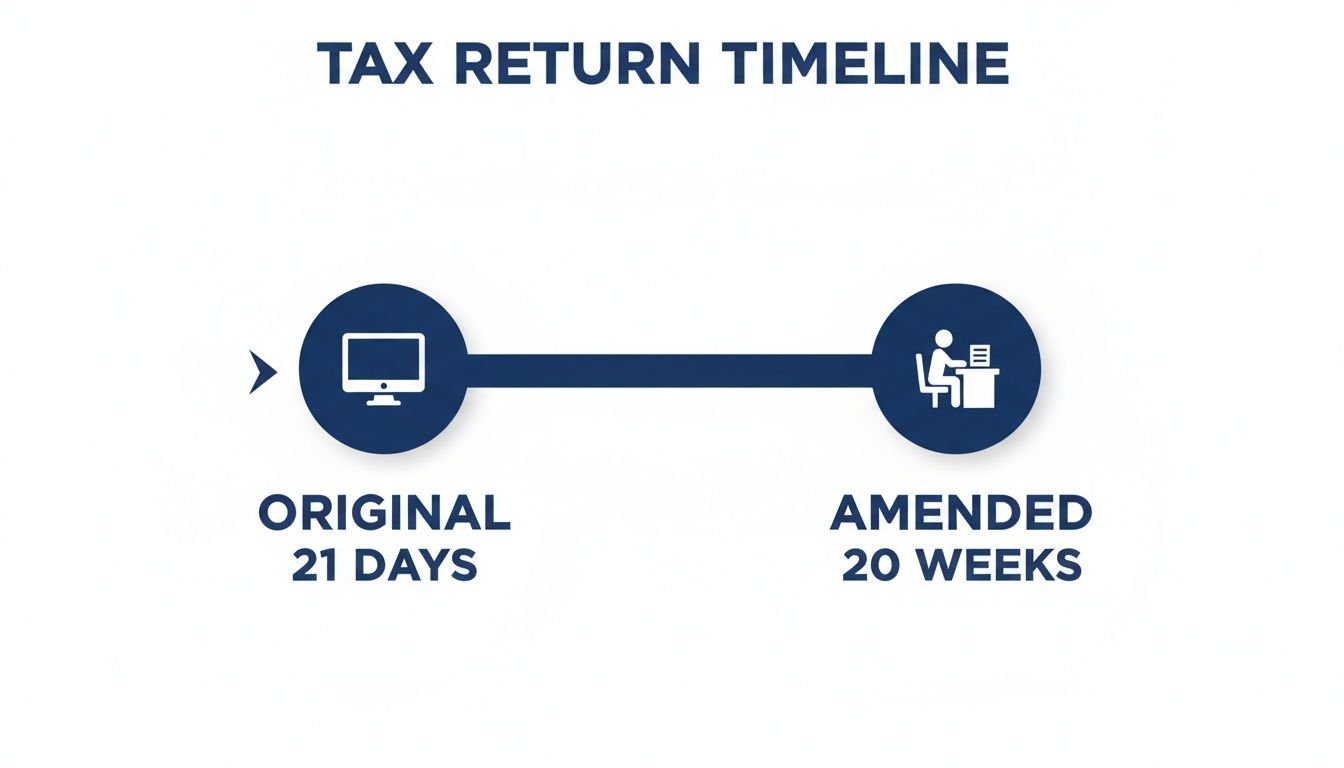
As you can see, we’re measuring the wait for an amended return in months, not days. The sheer volume of work the IRS faces is a major factor here. By early March of the 2026 tax season, the agency had already processed over 60.8 million individual returns. With a backlog of nearly 2 million unresolved cases and 164 million total returns expected, their resources are stretched incredibly thin.
This is why a simple paper-filed amendment can get stuck in the queue for so long. For our clients here in Michigan, especially those already dealing with state tax issues or an IRS audit, this is why we stress getting the return right the first time.
The Bottom Line: An amended return isn't just a quick fix. It's a formal request for a human-led case review, and that’s the root cause of the 20-week standard processing time.
Estimated Processing Times for Amended Tax Returns in 2026
To give you a clearer picture, here’s a quick breakdown of what you can generally expect for both federal and Michigan-specific amended returns in 2026.
| Filing Method | Authority | Standard Timeline | Potential Timeline with Delays |
|---|---|---|---|
| E-File | IRS | Up to 20 weeks | 6-12+ months |
| Mail (Paper) | IRS | 20+ weeks | 8-12+ months |
| E-File | Michigan Dept. of Treasury | 4-6 weeks | 3-6 months |
| Mail (Paper) | Michigan Dept. of Treasury | 8-12 weeks | 4-8 months |
Keep in mind, these are just estimates. Factors like errors on the form, missing documents, or the complexity of your correction can extend these timelines significantly.
Now that you understand why it takes so long, the next step is to know what’s happening behind the scenes during that wait. If you need a refresher on the actual filing process itself, our guide on how to amend a tax return is a great place to start.
Why Do Amended Returns Take So Long? It's All About the Manual Review
Unlike an original tax return that can fly through the IRS's automated systems, every single amended return is pulled from the fast lane and handed over for a personal review by an IRS agent. This is the single biggest reason for the long wait times. You're not just fixing a typo; you're asking the government to re-evaluate a piece of your financial history, and that requires a human touch.
Think of it like this: When a car manufacturer finds a flaw, they can't just mail you a new part. A trained mechanic has to bring your specific car into the shop, look at the original assembly, and carefully replace the faulty component to make sure the entire system runs smoothly again. That's exactly what an IRS agent does with your tax return.

The Hands-On Process
When you file a Form 1040-X, you set a very specific, manual process in motion. An IRS employee has to retrieve your original return, place it side-by-side with your new amendment, and meticulously compare the two. They are looking line-by-line to understand precisely what changed and why.
This careful comparison is crucial for them to verify your changes and accurately recalculate your tax. Because this process relies on people, not just algorithms, the timeline is measured in months, not days.
What Triggers a Deeper Dive?
While every amendment gets a manual review, certain changes are like red flags that signal an agent to slow down and dig even deeper. If your amendment involves any of the following, you can almost certainly expect a longer wait.
Common triggers that add weeks or months to the process include:
- Changing Your Filing Status: Moving from "Single" to "Married Filing Jointly" (or the reverse) is a massive change. It affects tax brackets, deductions, and credits, requiring a complete re-evaluation.
- Adding or Removing Dependents: The IRS doesn't just take your word for it. They will take the time to verify that a newly claimed dependent truly meets all the complex eligibility tests.
- Correcting Complex Income Sources: Did you forget some capital gains, freelance income, or investment earnings? Amending these requires the agent to scrutinize all the supporting documents you provide.
- Claiming a Large, New Credit: Suddenly claiming a major credit you missed before—like the American Opportunity Tax Credit for tuition—will cause the agent to pause and thoroughly confirm you were eligible for it.
When you amend a return, you're not just fixing a number; you're asking an IRS agent to read two different versions of your financial story and confirm the new one is the true one.
This detailed, hands-on review is how the IRS prevents errors and fights fraud. It's a necessary step to keep the system fair, but it's also a primary cause of the backlog. Sometimes, these changes can even look like a potential case of identity theft, which triggers its own serious verification protocols. If you've received a notice about this, our guide on how to handle an IRS identity verification letter can help.
While the IRS gives a standard 20-week timeline for amended returns, I've seen that number swing wildly in both directions. Think of it less as a hard deadline and more as a starting estimate.
The good news is that you have a surprising amount of influence over the final processing time. The choices you make when preparing and filing your Form 1040-X can either put you in the fast lane or leave you stuck in a bureaucratic traffic jam.
What Speeds Up an Amended Return?
The secret to a faster review is simple: make the IRS agent's job as easy as possible. When they open your file, you want them to immediately understand what you changed and why, with all the proof right there.
Here's what I always tell my clients to do:
- E-File, No Exceptions: Ever since the IRS started accepting electronic 1040-X forms, it's become the single best way to cut down your wait time. Filing on paper adds weeks just for mail transit and manual data entry before an agent even sees it.
- Choose Direct Deposit: If you're expecting money back, this is a no-brainer. A paper check can add another week or two to the process after your return is finally approved. Direct deposit gets the funds into your account in just a few days.
- Write a Crystal-Clear Explanation: The form gives you space to explain the changes. Be specific. Don't just write "forgot income." Instead, try: "Amending to include a W-2 from ABC Company, which was received after the original return was filed."
- Include Every Supporting Document: Think like the agent. If you’re adding a deduction, they'll want to see the receipt. If you're correcting income, they need the W-2 or 1099. Missing paperwork is a guaranteed delay, as they have to stop everything and send you a formal request for it.
What Slows an Amended Return Down?
On the other hand, a few common missteps can bring your amendment's journey to a crawl, easily pushing you past the 20-week mark.
A Real-World Example: I recently worked with a small business owner in Lansing who realized they’d missed several thousand dollars in legitimate business mileage and home office deductions. We e-filed the 1040-X, attached a clean spreadsheet detailing every missed deduction, and wrote a precise explanation. The result? Their refund arrived in just under 16 weeks—a full month ahead of the average.
Their meticulous approach meant the IRS never had to pause and ask for more information, which is where so many amended returns get stuck.
Filing on paper is by far the biggest delay. While you can track the latest IRS data in the 2026 Filing Season Statistics, the pattern is clear: paper-filed amendments get buried in backlogs. This is a source of major stress for Michigan taxpayers, whether they're in Oakland County or the U.P.
Other common speed bumps include:
- Forgetting to sign and date your paper form.
- Making simple math errors on the 1040-X.
- Mailing a paper return to the wrong IRS service center.
- Claiming an exceptionally large or unusual refund, which will always get a second look and more intensive review.
By keeping these factors in mind, you can navigate the process more smoothly and set a much more realistic timeline for yourself.
How to Track Your Federal and Michigan Amended Return Status
After you’ve filed an amended tax return, the waiting game begins. It can be a source of major anxiety, leaving you to wonder if the IRS or the Michigan Department of Treasury even received your paperwork.
Fortunately, you don't have to guess. Both agencies provide tools that let you check in on your amendment's progress. Knowing where your return is in the queue provides peace of mind and helps you manage expectations for the long road ahead. For many people, just seeing that initial "Received" status is a huge relief.
Checking on Your Federal Amended Return
The IRS has a specific online portal for this purpose called “Where’s My Amended Return?” It's your primary window into the federal review process. Before you visit the site, you'll want to have a few key pieces of information handy.
To look up your status, you'll need:
- Your Social Security Number (SSN) or Individual Taxpayer Identification Number (ITIN)
- Your date of birth
- Your ZIP code
The tool itself is fairly simple. Here's what you can expect the page to look like.
One of the most important things to remember is patience. If you mailed a paper Form 1040-X, it can take up to three weeks before it even registers in the online system. Electronically filed amendments show up much faster, but the overall processing timeline is still quite long.
The tracker will show one of three possible statuses:
- Received: This confirms the IRS has your Form 1040-X and it's in the processing queue.
- Adjusted: The IRS has reviewed your amendment and made an update to your account. This could mean a refund is on its way, you now have a balance due, or no change was made.
- Completed: The process is officially over. The IRS has sent you a formal notice in the mail detailing the final outcome.
Don't panic if your return's status seems stuck. It's completely normal for an amendment to sit in the 'Received' stage for the vast majority of the 20-week processing window. This is due to the manual review required for every amended return.
How to Check Your Michigan Amended Return Status
If your federal changes impacted your Adjusted Gross Income (AGI), you were also required to file a Michigan Amended Income Tax Return (Form MI-1040X). Tracking this is a separate process from the federal one.
You have two main options for checking your Michigan amendment:
- Online: The Michigan Department of Treasury website has a "Check My Income Tax Info" tool. While it may not provide as much step-by-step detail as the IRS portal, it will confirm that your return was received and is being processed.
- By Phone: You can also call the Treasury's main customer service number. Make sure you have your SSN and a copy of your MI-1040X with you, as the representative will need this information to access your file.
It's easy to focus on the federal amendment, but keeping an eye on your state filing is just as crucial to avoid future notices or penalties. For a deeper dive into what the different status messages mean, check out our guide to understanding your tax amendment status. Staying on top of both your federal and state amendments is the smartest way to get through this process smoothly.
What to Expect When Your Amended Return Is Finally Processed
After months of waiting, the day comes when the status on the IRS "Where's My Amended Return?" tool finally changes. You'll see "Adjusted" or "Completed," and you know an official notice is headed your way. This is the moment of truth, and it can go one of three ways.
Knowing what these outcomes look like—and what they mean for you—is the last step in this long journey. Whether you’re due a refund, find out you owe more, or learn that nothing has changed, having a clear head helps.

Outcome 1: You're Getting a Bigger Refund
This is the best-case scenario, of course. If your changes lowered your tax bill, the IRS will send you a refund for the overpayment. As a small bonus, the IRS also pays you interest on that money, calculated from the original tax-filing deadline until the day they send the payment.
Once your refund is approved, understanding direct deposit processing times can give you a better idea of when the cash will arrive. If you used direct deposit for your original return, the money should appear in your account within a few business days. Otherwise, a paper check will be mailed to your address, which usually adds another week or two.
Outcome 2: You Have a New Balance Due
Sometimes, correcting a return reveals that you actually underpaid. If this is your situation, you’ll get a notice explaining the additional tax you owe, plus any penalties and interest that have accumulated. Interest starts ticking from the original filing deadline, so it's always smart to pay this balance as soon as you can.
The IRS provides several payment methods, from bank transfers to debit/credit cards. If the amount is more than you can handle at once, don't panic. You can often set up a payment plan.
A Michigan Case Study: An Oakland County couple we worked with amended their return after realizing they'd misreported income from a side business. They discovered they owed an extra $7,000. By getting in front of the issue, we helped them contact the IRS, explain the situation, and set up a manageable installment agreement that fit their budget. This completely avoided the stress of a formal collections process.
Outcome 3: Your Tax Liability Hasn't Changed
The third possibility is that after reviewing your amendment, the IRS determines that no change was needed. This can happen if the correction you made didn’t actually alter your final tax figure or if the agency simply disagrees with your proposed change.
In this case, you’ll receive a letter explaining their reasoning. Read this notice carefully. If you're confident the IRS made a mistake in their assessment, you do have the right to appeal their decision.
A look at the 2026 tax season stats gives some perspective on the delays. While the IRS processed 60.8 million cumulative returns by early March and refunded $160.8 billion, amendments are a much lower priority. With 164 million total filings and a backlog of 2 million other cases, amended returns simply have to wait their turn. As you can see by diving into the complete filing season statistics from the IRS, the system is under incredible strain.
When to Escalate Your Case to a Michigan Tax Professional
Patience is a virtue, especially with the IRS, but there comes a point where you need to switch from waiting to acting. If you’re starting to feel like your amended return has fallen into a bureaucratic black hole, you’re probably right. Knowing when to raise the red flag can save you a world of time, money, and stress.
The standard 20-week processing window for a federal amendment is a good benchmark. If you've blown past that timeline and the "Where's My Amended Return?" tool is still stuck on "Received," it’s a strong signal your case is stalled. This is particularly true if your calls to the IRS aren't getting you any clear answers.

Clear Signals to Call for Help
Don't wait indefinitely. Some situations are complicated right out of the gate, and bringing in a professional isn't just a good idea—it's essential. In these cases, the question of how long for an amended tax return to process takes a backseat to making sure it’s handled correctly from the start.
It's time to get a pro involved if you run into any of these issues:
- Excessive Delays: Your IRS amendment has been sitting for over 20 weeks with no update, or your Michigan amendment is well beyond the typical 8-12 week timeline for paper filings.
- Unexplained Rejection: You get a notice that your amendment was rejected by the IRS or Michigan Treasury, but the explanation is confusing, vague, or just seems plain wrong.
- A Large Refund Is at Stake: The bigger the refund, the more scrutiny your amendment will get. A tax professional can help you build an ironclad case to prevent a denial or audit.
- Complex Tax Issues: Your correction involves tricky areas like innocent spouse relief, reporting foreign income, or complex business depreciation schedules. These are definitely not do-it-yourself territory.
When the IRS rejects an amendment without clear cause or a large refund hangs in the balance, a tax professional can directly challenge the decision, present a stronger case, and navigate the appeals process on your behalf.
The Advantage of Local Michigan Expertise
When you’re dealing with both the IRS and the Michigan Department of Treasury, a local expert is your best asset. A firm like Defense Tax Partners, with deep roots in Michigan, truly understands the unique financial pressures people face here, from Detroit to Grand Rapids. That local perspective is critical when negotiating a payment plan or building a defense.
A Michigan-based tax attorney knows the state's specific rules and enforcement patterns inside and out. They can interpret the notices from Lansing and speak the same language as the Treasury agents reviewing your MI-1040X. Put simply, they can cut through the red tape much faster than you can on your own.
Whether you need to structure a fair settlement or defend against an audit triggered by your amendment, professional representation gives you a vital layer of protection. If that amended return has turned into a major source of financial anxiety, your best move is to take decisive action and get an expert in your corner.
Common Questions About Amending Tax Returns
Once you get the hang of the amendment process, a few practical questions almost always come up. Let's walk through some of the most common ones we hear from Michigan taxpayers to make sure you have all the final details ironed out.
Can I E-File an Amended Return for a Prior Year?
Thankfully, yes—for recent years. For the current tax year, 2026, the IRS allows you to electronically file an amended Form 1040-X for the 2023, 2024, and 2025 tax years. This is a huge step up from the old paper-only system, as e-filing gets your return logged in much faster.
For any tax year before 2023, you're back to the old-school method: print, sign, and mail the paper form. We strongly advise e-filing whenever possible. It's not just faster; it also cuts down on the risk of postal service delays or someone at the IRS making a typo while keying in your information.
What if I Find Another Mistake After Filing an Amendment?
If you spot another error after you've already sent in a Form 1040-X, the single most important thing you can do is wait. Do not file a second amended return while the first one is still being processed.
Think of it this way: sending another amendment is like changing your dinner order after the first one is already in the kitchen. It creates confusion, can lead to mistakes, and slows everything down. Wait until you get an official notice confirming your first amendment has been completed. Only then should you prepare and file a second Form 1040-X to address the other mistake.
Patience is your best friend here. Filing a second amendment too early won't speed things up; it will complicate your case and likely double your wait time.
Does Amending My Federal Return Affect My Michigan Return?
In nearly every case, the answer is yes. Your Michigan tax obligation is directly linked to your federal Adjusted Gross Income (AGI). So, if the correction you made on your federal Form 1040-X changed your AGI, you're required to amend your Michigan return, too.
For this, you'll need to file a Michigan Amended Income Tax Return (Form MI-1040X). If you skip this step, you can expect a notice from the Michigan Department of Treasury down the line, which will likely come with added penalties and interest on any tax you should have paid.
Will Filing an Amended Return Increase My Audit Risk?
It's a valid concern, but the risk really depends on what you're changing. If you're just fixing a typo in your address or adding a W-2 you forgot, it's highly unlikely to raise any red flags. The IRS processes simple corrections like these all day long.
However, certain amendments are more likely to get a second look. These usually involve significant changes, such as:
- Claiming substantial new deductions or credits you missed the first time.
- Drastically lowering your previously reported income.
- Changing your filing status to one that offers a much bigger tax break (e.g., from Single to Head of Household).
The best way to protect yourself is to make sure your amendment is 100% accurate and that you have solid documentation for every single change. A well-supported amendment signals to the IRS that you're just trying to get it right, not pull a fast one.
