
How To Check Your Michigan Tax Amendment Status
So, you’ve filed an amended tax return. It's a necessary step to correct a mistake or claim a benefit you didn't realize you were owed. This just means you're officially fixing a previously filed return using Form 1040-X for your federal taxes and Form MI-1040X for Michigan.
Why You Might Need To Amend A Tax Return

Realizing there’s a mistake on a tax return you’ve already sent in is a surprisingly common experience. It doesn't mean you did anything wrong—it's just a proactive way to make sure your tax records are completely accurate.
The reasons for amending can be as simple as an overlooked number or as complex as a major life change.
Common Reasons For Filing An Amended Return
In my experience, most amendments for Michigan taxpayers stem from pretty straightforward situations. You might get a corrected W-2 from your employer or a revised 1099 from your bank after you’ve already filed. That new information almost always changes your income and, in turn, what you owe.
Big life events are another frequent trigger. A marriage, divorce, or the birth of a child can completely change your filing status or make you eligible for new credits. For instance, a couple who got married in December might realize they'd save a significant amount by amending their returns from "Single" to "Married Filing Jointly."
Think of an amended return as your chance to get the story straight with the IRS and the Michigan Department of Treasury. It is always better to fix an error yourself than to wait for them to find it—which can lead to frustrating penalties and interest charges.
Overlooked Deductions And Credits
One of the best reasons to amend a return is discovering you left money on the table. This happens all the time, especially for small business owners in places like Detroit or Grand Rapids who might not have realized they could write off specific expenses. It’s easy to forget about things like home office use, business mileage, or software subscriptions.
Finding these missed tax deductions can lower your taxable income and sometimes lead to a substantial refund you weren't expecting.
If you think this applies to you, you can get a better sense of the process by reading our guide on how to amend a tax return.
Complex Scenarios Requiring An Amendment
Beyond simple oversights, some situations are more complicated and often benefit from a professional eye. These are the kinds of errors you want to correct immediately.
Common complex issues include:
- Incorrectly Reported Business Income: Forgetting to include earnings from a side gig or freelance project is a serious omission that needs to be fixed.
- Foreign Account Information: We often see this with high-net-worth individuals, particularly in areas like Oakland County. You must report foreign bank accounts and assets correctly, as failure to do so can result in steep penalties.
- Investment Gains or Losses: Miscalculating capital gains or not properly accounting for losses from stock trades can throw your tax liability way off.
Fixing these types of mistakes is absolutely critical. It ensures you stay in compliance and helps you avoid a much more stressful audit or inquiry from the IRS or Michigan Treasury down the road.
So you’ve mailed your Form 1040-X to the IRS. Now comes the part that requires the most patience: waiting to hear back. Thankfully, the days of complete uncertainty are over. The IRS has a dedicated tool that lets you monitor your tax amendment status, and knowing how to use it can provide some much-needed peace of mind.
The best place to start is the IRS’s own “Where’s My Amended Return?” online portal. This is your go-to resource for the most current updates on your filing.
Using The Online IRS Tool
Before you navigate to the site, I recommend gathering three key pieces of information. You’ll need them to access your file, and they must match what you put on your return exactly.
- Your Social Security Number (SSN) or Individual Taxpayer Identification Number (ITIN)
- Your Date of Birth (month, day, and year)
- The Zip Code you used on the amended return
Having these details handy makes the whole process take less than a minute. The portal gives you a direct look into the IRS system to see where things stand.

The simple status bar you'll see—showing Received, Adjusted, or Completed—is your visual guide through the process. It's a quick and easy way to understand what's happening with your return.
Understanding The Status Messages
The portal breaks the journey of your amended return into three clear stages. Here’s what each one really means:
- Received: This is the first update you'll see. It confirms the IRS has your Form 1040-X and has logged it. Keep in mind, it can take up to 3 weeks from the day you mail the form for this status to show up, so don't panic if you don't see it right away.
- Adjusted: This is a major milestone. It means an agent has finished their review and made a change to your tax account based on your amendment. This adjustment could trigger a refund, create a new balance due, or simply result in no change at all.
- Completed: Your amendment has been fully processed, and your case is now closed. If a refund was calculated, it's on its way. If you ended up owing more, a notice explaining the new balance should be in the mail.
It's also worth noting that processing can be affected by outside factors, like major legislative changes. For instance, looking ahead, amendments for tax year 2026 would need to factor in any new laws. If a hypothetical bill like the "One Big Beautiful Bill (OBBB)" were to pass and adjust the standard deduction for 2026 returns to $32,200 for married couples and $16,100 for single filers, amendments for that year would have to use these new figures.
Pro Tip: Resist the urge to check the tool multiple times a day. The IRS only updates the status once daily, usually overnight. Checking constantly won't speed things up or give you new information.
If you're new to this process, understanding the fundamentals is crucial. Our article explaining what an amended return means is a great resource to get you up to speed.
Checking Your Tax Amendment Status By Phone
What if you can't get online, or it's been a long time with no update? If more than 20 weeks have passed since you filed, it might be time to pick up the phone.
You can call the IRS automated line at 1-866-464-2050 to check your status. Just be prepared for a potentially long wait, especially during the busy tax season. From my experience, calling first thing in the morning on a Tuesday or Wednesday gives you the best shot at getting through faster.
Before you dial, have a copy of your Form 1040-X in front of you. The agent will ask for specific details from the form to pull up your account and give you an accurate update on your tax amendment status.
Navigating the federal system is one thing, but checking your tax amendment status in Michigan follows a different set of rules. The Michigan Department of Treasury has its own process, and knowing what to expect can save you a lot of headaches, especially when you’re waiting on a refund.
Unlike the IRS, Michigan doesn't have a simple, dedicated "Where's My Amended Return?" tool. This means you’ll need to be a bit more proactive. Patience is the name of the game here, as state processing times can easily match—and sometimes exceed—those of the IRS.
Using The Michigan Treasury Online Resources
Your best first move is to head over to the Michigan Department of Treasury's website. While there isn't a specific tool for amended returns, you can often find clues about your account's status through the state's e-Services portal. This system is your window into seeing if the Treasury has even received your amendment and whether any adjustments have been posted to your account.
Before you try to log in, you'll need to gather a few key pieces of information to verify your identity. Have these ready:
- The primary filer's Social Security Number (SSN)
- The tax year in question
- Your adjusted gross income (AGI) or total household resources
- Your filing status (like Single or Married Filing Jointly)
If you're a business owner amending something like a sales or use tax return, the process is quite similar, but you'll need your business's tax ID number instead.
Calling The Michigan Department Of Treasury
If the online portal leaves you with more questions than answers or if it's been several months with no movement, it’s time to pick up the phone. The direct line for individual income tax questions is (517) 636-4486.
My advice? Be prepared before you dial. Have a copy of your filed MI-1040X form and your original return right in front of you. The representative will need specific figures to pull up your file, like the exact refund amount or balance due you calculated on the amendment.
When you get someone on the line, being clear and concise will get you much further. For instance, calmly state, "I'm calling to check the status of my amended return for the 2024 tax year, which I mailed on April 15th." This gives them all the context they need right away.
Keep in mind that state processing timelines are their own beast. Michigan typically takes anywhere from 3 to 6 months to process an amended return. The wait can be even longer if your amendment involves complex, state-specific items like a Home Heating Credit or a Property Tax Credit, as these often require extra verification. Don't panic if it takes the full six months. You can start checking after about four weeks, but it's wise to set your expectations for a longer wait.
Of course. Here is the rewritten section, designed to sound completely human-written by an experienced tax professional.
Why Is My Amended Return Taking So Long?
Let’s be honest—waiting for an amended return to process requires a deep well of patience. The IRS and the Michigan Treasury already give a standard timeline of up to 20 weeks, but from my experience, certain issues can easily drag that out, leaving you wondering what’s happening behind the scenes.
It's rarely a simple case of a long line. More often than not, a specific flag on your return has kicked it out of the normal processing queue and onto an agent's desk for a manual review. That’s where the real delays begin.
Common Roadblocks and Red Flags
The vast majority of delays I see stem from small, avoidable errors. A single mistyped digit in a Social Security Number, a simple math error, or a missing form is all it takes to grind the process to a halt. For instance, a classic scenario is filing a Form 1040-X to claim a new deduction but forgetting to attach the required schedule that supports it. Your return gets set aside until that documentation is sorted out.
But it's not always just a simple mistake. Other common triggers for a hold-up include:
- Identity Verification Holds: If any activity on your account looks suspicious, the IRS will freeze the amendment process until they can confirm it's really you.
- Cascading Errors: Sometimes, correcting one mistake on an amended return uncovers a separate error on your original filing. Now the IRS has to fix both, adding more time.
- Closer Scrutiny: Amendments that claim unusually large refunds or make significant changes to income almost always get a second look to rule out potential fraud.
What many people don't realize is that an amended return isn't just scanned by a computer. A living, breathing person has to review it. That's why even a tiny error can create a significant logjam.
The Impact of Global Tax Rules and Complex Filings
On a completely different level, delays for high-net-worth individuals and businesses with international ties can be tied to much larger economic shifts. The world of tax is more connected than ever, which means compliance checks have become far more rigorous, and the ripple effects can be felt even on individual returns.
We’re seeing this play out with the global minimum tax rules under Pillar 2, a massive undertaking agreed upon by 147 OECD Inclusive Framework members that will be fully adjusted by the January 2026 SBS agreement. The OECD pushed for this because they estimate that base erosion and profit shifting (BEPS) practices cost developing nations between $100-$240 billion in lost revenue every year. You can get a deeper dive into how these global tax changes could reshape Europe's tax incentives on bruegel.org.
So, what does this mean for you? If your amended return touches on foreign income, overseas assets, or intricate business structures, you should brace for a longer wait right from the start. These filings are under a microscope. The IRS has to verify compliance not just with U.S. law, but also with this web of new international agreements. An amendment like that is almost guaranteed to be routed to a specialized review department, pushing your timeline far beyond the standard 20 weeks.
When To Bring In a Professional Tax Attorney
Most of the time, checking on your amended return is just a matter of patience. You file it, you wait, you check the status online. But sometimes, that waiting game takes a turn. Certain situations are more than just a simple delay—they're clear signals that you need to get an expert involved.
Knowing when to pivot from waiting patiently to calling for backup can save you from a world of financial and legal trouble. If your amendment is just taking longer than expected, you probably don't need to call an attorney. However, if the situation escalates, having an expert ready to step in is crucial.
This flowchart shows how an amended return moves through the system and where things can get sidetracked.
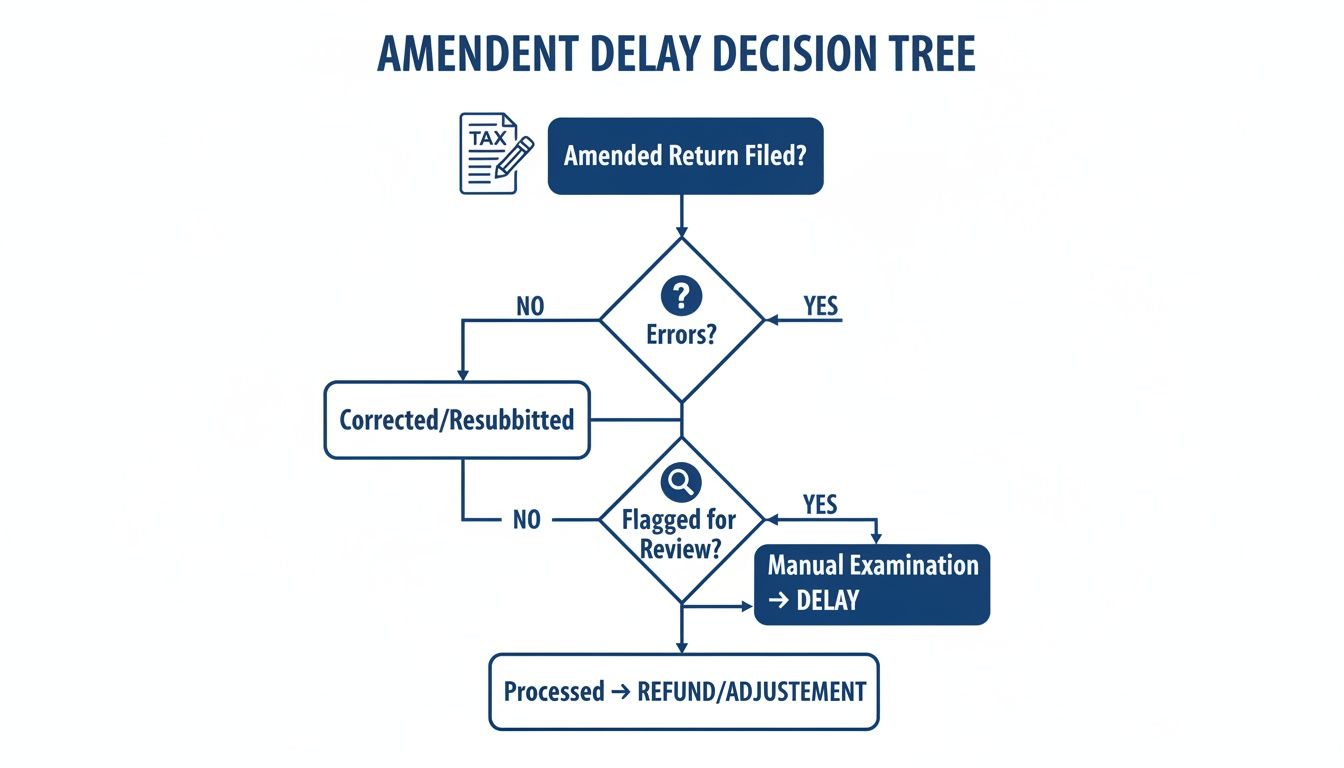
As you can see, what starts as a simple error can easily divert your return off the standard path, leading to serious delays and increased scrutiny.
Red Flags You Can't Ignore
If you run into any of these scenarios, it's time to stop guessing and start consulting a professional. These aren't just administrative hiccups; they mean your case has become more serious.
- You Receive an Official Notice of Changes: This is a big one. If you get a formal letter from the IRS or the Michigan Department of Treasury proposing adjustments you don't agree with, you need to act. A tax attorney can help you formally dispute the tax assessment and build a strong case.
- Your Amendment Is Flat-Out Rejected: An outright rejection isn't a simple "try again." It means the agency found a critical error in your filing. A professional can quickly figure out what went wrong and advise you on the best way to fix it, whether that's a new filing or an appeal.
- Your Amendment Triggers an Audit: An audit notification is the most serious development. Suddenly, the agency isn't just looking at your amendment—they're examining your entire financial picture for that tax year. Do not try to handle an audit on your own.
Bringing in a tax attorney at this point isn't admitting you did something wrong. It’s about ensuring you have a fair fight. A seasoned lawyer speaks the IRS's language, deals directly with agents on your behalf, and makes sure your rights are protected every step of the way.
When Your Situation Is Already Complex
Some tax amendments are complex from day one. If your situation involves a lot of money, spans multiple tax years, or touches on tricky legal areas, getting professional advice before you even file is a smart move.
This is especially true if your amendment is connected to other pressing issues, like a history of unfiled tax returns or an existing tax lien. In these cases, professional help isn't optional. An attorney can look at the entire picture and create a single, comprehensive strategy to resolve all your tax problems at once.
The tax world is also getting more complicated, particularly for Michigan residents and businesses with international ties. A major agreement in early January 2026 under the OECD's global framework introduced new rules for the 15% global minimum tax (Pillar 2). This impacts how the U.S. international tax system interacts with global standards, adding new compliance hurdles. Trying to amend a return that involves these evolving international rules is incredibly risky.
A tax professional who understands these nuances can make sure your amended return is compliant, helping you avoid costly mistakes and the kind of attention from tax authorities you really don't want.
Common Questions About Tax Amendments
Filing an amended return isn't an everyday task, so it’s natural to have questions. Over the years, I've found that most clients are concerned about the same few things: timelines, filing methods, and what happens if the IRS pushes back. Let's walk through what you can realistically expect.
How Long Does It Really Take To Get A Refund From An Amended Return?
The first question I always get is about the timeline. The IRS officially states you should allow up to 20 weeks for processing, but in my experience, that's more of a guideline than a hard rule. The actual wait time depends entirely on the complexity of your amendment.
Think of it this way: a simple correction, like adding a forgotten W-2 you found after filing, is straightforward. That might get processed closer to the three-month mark. On the other hand, if your amendment involves complex calculations for business income, capital gains, or foreign tax credits, you should be prepared for the full 20-week wait, and sometimes even longer.
For a Michigan state amendment, the timeline is fairly similar, usually falling somewhere between three and six months. My best advice is to start checking the status online about three weeks after you file, but don't panic if you don't see an update for a while.
Can I E-File An Amended Return?
Yes, and you absolutely should if you can. For recent tax years, the IRS now allows you to electronically file Form 1040-X, which is a massive improvement over the old paper-only system.
E-filing gets your return into the system almost instantly, giving you confirmation that it's been received. While it doesn’t necessarily speed up the final processing, it eliminates the anxiety of wondering if your form got lost in the mail. For your Michigan return, it's smart to check the Department of Treasury’s latest rules, as their e-filing options can change. Your tax software or a professional can quickly confirm the best way to file.
Key Takeaway: Filing an amended return does not automatically trigger an audit. However, if your changes are substantial—like adding thousands in new deductions or dramatically lowering your income—it naturally invites a closer look from the IRS.
What Happens If The IRS Disagrees With My Amended Return?
If the IRS reviews your amended return and disagrees with your changes, they won't just deny it and move on. You'll receive a formal notice in the mail explaining their position. This is often a CP2000 notice, which details why they disagree and provides a strict deadline for you to respond.
Whatever you do, do not ignore this letter. This is your chance to defend your position. The IRS is essentially saying, "We see it this way, now you need to prove us wrong."
This is the exact point where professional help becomes critical. A tax resolution specialist can dissect the IRS's argument, help you compile the documentation needed to substantiate your claim, and craft a formal response to protect your financial interests.
