
Understanding does irs garnish wages in Michigan? A Practical Guide
Yes, the IRS can take money directly from your paycheck. But what they do is technically called a wage levy, and it's a far more powerful tool than the "garnishment" most people are familiar with.
While private creditors have to go through the court system to get permission, the IRS doesn't. Congress has granted them the legal authority to seize your wages directly from your employer, making it one of their most effective and intimidating collection methods.
What an IRS Wage Levy Really Means for Your Paycheck
When most of us think of wage garnishment, we picture a lengthy court battle where a judge has to sign off on a creditor taking a slice of our pay. That's not how it works when Uncle Sam is the one you owe. The IRS operates under a completely different set of rules.
An IRS wage levy is a legally binding order sent straight to your employer. It’s not a one-time thing; it’s continuous. This notice, called a Publication 1494, forces your employer to withhold a significant portion of your income from every single paycheck and send it to the government. This continues until the tax debt is paid in full or you negotiate another solution.
This is a critical distinction for taxpayers in Michigan and across the country. The IRS can move quickly and decisively, which is why it's so important to deal with tax problems head-on before they escalate to this point.
IRS Levy vs. Court-Ordered Garnishment: Not the Same Thing
To truly grasp how serious an IRS levy is, it helps to see it side-by-side with a standard court-ordered garnishment that a credit card company or medical provider might use.
The biggest difference comes down to one thing: authority.
- A private creditor has to sue you, win in court, and get a judge’s order to garnish your wages.
- The IRS, on the other hand, can issue a levy on its own after sending you the required legal notices.
This means the IRS can act much faster and with far fewer hurdles. Once their internal notification process is complete, they can move to seize your wages.
An IRS wage levy isn't a suggestion—it's a legal seizure of your property. Your employer is legally required to comply. If they don't, they can face penalties themselves.
The amount the IRS can take is also much more aggressive. State and federal laws typically cap consumer garnishments at 25% of your disposable income. The IRS calculation is different and often harsher. They leave you with a small, legally exempt amount based on your filing status and number of dependents, and they take everything else. For many people, this leaves barely enough to cover basic living expenses.
To make this crystal clear, let's break down the key differences in a table.
IRS Levy vs Court-Ordered Garnishment
This table highlights why an IRS action is so much more severe than what most creditors can do.
| Feature | IRS Wage Levy | Standard Wage Garnishment |
|---|---|---|
| Court Order Required? | No. The IRS has administrative authority. | Yes. A creditor must sue and win a judgment. |
| Amount Seized | Everything above a small, legally exempt amount. | Typically capped at 25% of disposable earnings. |
| Who Initiates It? | The IRS directly issues the levy to the employer. | A court issues the garnishment order. |
| Duration | Continuous until the debt is paid or resolved. | Varies by state law, but often has time limits. |
| Employer's Role | Legally required to comply immediately. | Legally required to comply with a court order. |
As you can see, the IRS levy process is designed for maximum effect with minimal obstacles, putting taxpayers in a very vulnerable position once a levy is issued.
Understanding the IRS Wage Levy Process
The idea of the IRS reaching into your paycheck can be terrifying. But here’s the reality: an IRS wage levy isn't a surprise ambush. It's the final step in a long, well-documented collection process. In fact, the IRS is legally required to follow a very specific set of rules and send you multiple warnings before they can take a dime.
Think of it as a series of escalating alerts. Understanding this timeline is your best defense. When you know what the official notices look like and what they mean, you can see a levy coming from a mile away and take steps to head it off. The system is actually designed to give you several chances to resolve your tax debt before things get that serious.
This timeline illustrates the journey from the first bill to the final outcome of a levy.
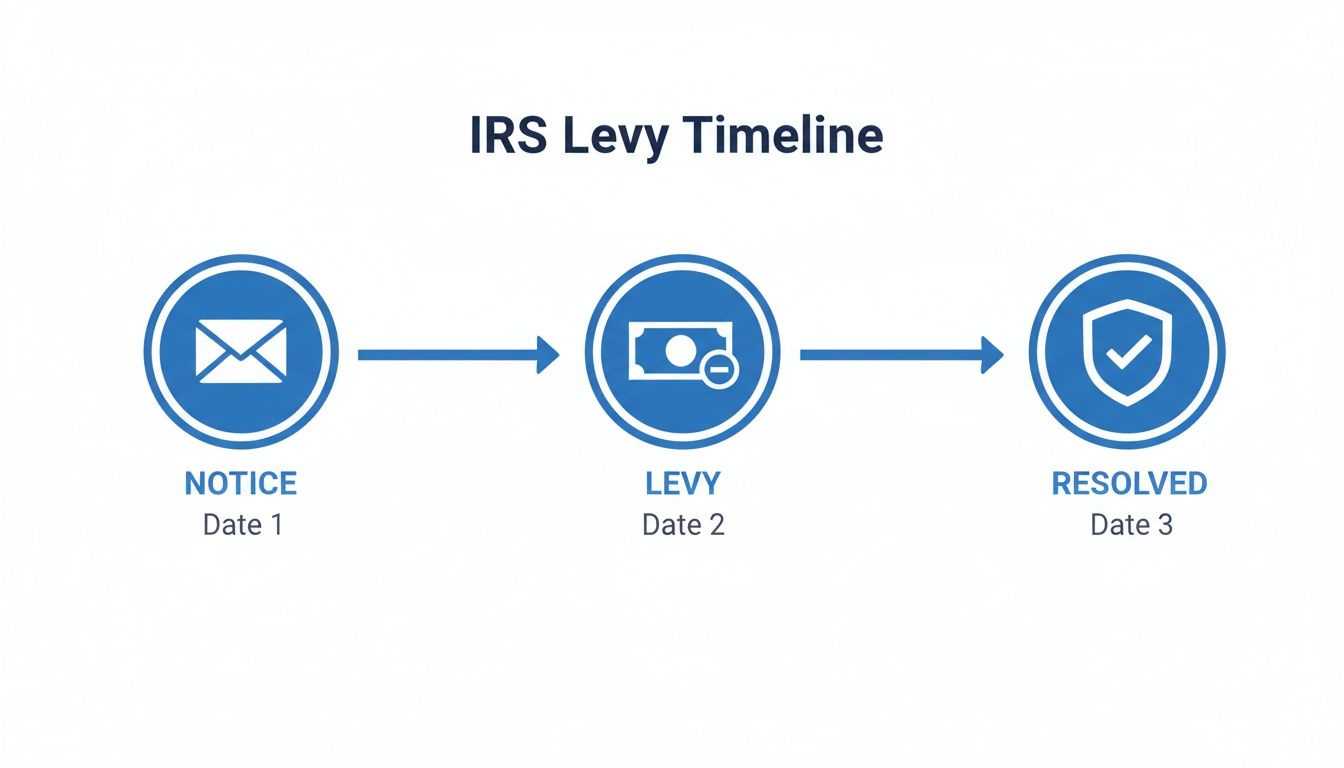
As you can see, this isn't a sudden event. It's a progression with clear warning signs, each one giving you an opportunity to act.
The Initial Bill and Subsequent Notices
It all starts with a letter, usually a Notice CP14. This is the first official bill you’ll get from the IRS, laying out what you owe and asking you to pay. If you don't respond, you won’t just hear silence. The IRS will begin sending a series of follow-up notices.
Each letter that arrives will get a little more serious. These are not just reminders; they're clear signals that the IRS is escalating its collection efforts. If you continue to ignore them, you're paving the way for more forceful actions.
The Final Notice Before Levy: The Critical Warning
After those initial attempts don't resolve the issue, the IRS will send out its most important warning. This is your last chance to get ahead of the problem before they issue a levy. The document is officially called the 'Final Notice of Intent to Levy and Notice of Your Right to a Hearing' and typically comes in the form of a Letter 1058 or LT11.
This final notice isn't just another piece of mail—it's a legal requirement. The IRS cannot legally take your wages until it has sent you this specific document and informed you of your right to appeal.
When this letter arrives, a critical countdown begins. You have exactly 30 days from the date on the notice to either pay the debt or formally dispute the levy. Ignoring this final warning is what gives the IRS the legal authority to contact your employer and start taking a portion of your wages. To dive deeper into the legal details of this action, you can learn more about what a tax levy is in our comprehensive guide.
Your 30-Day Window to Respond
That 30-day period is the most powerful tool you have to protect your income. During this window, you have the legal right to request a Collection Due Process (CDP) hearing. Simply filing a timely CDP request puts an immediate, automatic hold on the levy process while your case is reviewed.
This pause buys you invaluable time to work out a solution with the IRS. Some of the most common options to explore during this period include:
- Requesting an Installment Agreement: A structured monthly payment plan based on what you can afford.
- Submitting an Offer in Compromise: A formal proposal to settle your entire tax debt for less than you owe.
- Applying for Currently Not Collectible Status: If you can prove you're experiencing severe financial hardship, the IRS might temporarily stop all collection activities.
If you let these 30 days pass without taking action, you effectively give up your right to that automatic pause. Once the window closes, the IRS has the green light to move forward, and stopping the levy becomes a much more difficult, uphill battle.
Calculating What the IRS Can Take From Your Paycheck
When facing an IRS levy, the most terrifying question is usually the simplest: "How much will I have left to live on?" Unlike a typical creditor garnishment that takes a predictable percentage of your pay, the IRS calculation is far more aggressive and deeply personal. What they seize is tied directly to your specific life circumstances.
The IRS doesn't just take a flat rate. Instead, they figure out a legally exempt amount that you’re allowed to keep from each paycheck. Everything—and I mean everything—else goes straight to them. This exempt amount is designed to be the bare minimum for survival, and for many people, it's a shockingly low number.

This harsh reality reflects a broader trend. Wage garnishment has become surprisingly common, with studies showing that about 1 in 100 private-sector workers are having their pay garnished at any given time. The average seizure takes around 10% of gross earnings, a significant blow to any budget. You can learn more about the widespread impact of wage garnishment in the U.S. and how it affects financial stability.
The Formula for Exemption
So, how does this actually work? To figure out what you get to keep, your employer turns to a document called IRS Publication 1494. This publication contains tables that determine your exempt income based on three key factors:
- Your Filing Status: Are you single, married filing jointly, or head of household?
- Your Pay Frequency: Do you get paid weekly, bi-weekly, semi-monthly, or monthly?
- Your Number of Dependents: How many personal exemptions did you claim on your tax return?
Your employer finds your specific situation in the table, and that number is what you take home. The rest of your net pay—after standard deductions like taxes and Social Security—is sent directly to the IRS.
Think of it this way: The IRS calculation isn't about what feels fair; it's about what the law requires. The exempt amount is a floor, not a ceiling, and it often leaves families struggling to cover basic expenses like rent, utilities, and groceries.
Real-World Examples of an IRS Wage Levy
Abstract numbers don't really paint the picture. Let’s look at how this plays out for two different taxpayers to see the real-world impact. (Note: These are simplified examples for illustration; actual amounts will vary based on current IRS tables.)
Example 1: The Single Individual
- Taxpayer: Alex, a single individual with no dependents.
- Paycheck: Alex is paid bi-weekly and takes home $1,500 after taxes.
- Exempt Amount: Based on the IRS tables for a single person paid bi-weekly, Alex’s exempt amount might be around $500.
- Result: The IRS would levy a staggering $1,000 from each paycheck, leaving Alex with just $500 every two weeks to live on.
Example 2: The Married Couple with Children
- Taxpayer: Maria, who is married filing jointly with two dependent children.
- Paycheck: Maria is also paid bi-weekly, with a take-home pay of $2,200.
- Exempt Amount: Because of her filing status and dependents, Maria's exempt amount is higher, perhaps around $1,200.
- Result: Even with the higher exemption, the IRS would still levy $1,000 from each of Maria's paychecks.
Even though Maria’s situation provides a larger exemption, the levy is still substantial enough to devastate a family budget. These examples show that an IRS levy isn't a minor inconvenience. It’s an incredibly powerful collection tool that can consume the majority of your income, making it nearly impossible to manage daily finances. This is precisely why it's so critical to get ahead of it by seeking a resolution like an Installment Agreement or an Offer in Compromise before a levy ever hits.
Your Legal Rights and Options to Stop a Wage Levy
Receiving a notice that the IRS intends to take money directly from your paycheck can feel like the ground has vanished beneath your feet. It’s an intimidating, stressful moment, but it's crucial to understand this: it is not the end of the story. You have legal rights and several powerful paths to stop the levy, protect your income, and get your tax situation under control. The absolute key is to act quickly.

The moment you receive that “Final Notice of Intent to Levy,” a critical 30-day clock starts ticking. This is, without a doubt, your single best opportunity to stop the levy before it even begins. Doing nothing is not an option; how you respond in this window is your best defense.
The Power of a Collection Due Process Hearing
Your most immediate and effective tool is the Collection Due Process (CDP) hearing. By filing Form 12153 to request a CDP hearing within 30 days of your final notice, you put an immediate, automatic freeze on all collection activity. This means the IRS is legally barred from garnishing your wages while your appeal is being considered.
This move buys you priceless time. More importantly, it takes your case out of the hands of an automated collections system and places it with an independent IRS Appeals Officer. This gives you a formal chance to negotiate a resolution and explore alternatives to the levy.
Set Up a Manageable Installment Agreement
For many people, the most direct way to get a wage levy released is by setting up an Installment Agreement (IA). This is simply a formal plan to pay your tax debt over time with monthly payments you can actually afford. As soon as the IA is approved and you make the first payment, the IRS must instruct your employer to stop the wage levy.
It’s a lot like arranging a payment plan for a big purchase. Rather than letting the situation escalate, you agree to a payment structure that fits your budget. The IRS generally prefers this solution because it guarantees them a steady stream of payments without pushing you into financial ruin.
Settle for Less with an Offer in Compromise
But what if you owe so much that you could never realistically pay it all back? For situations like this, an Offer in Compromise (OIC) can be a game-changer. An OIC is a formal agreement with the IRS to settle your tax liability for a lower amount than you originally owed.
To qualify, you have to prove to the IRS that paying the full debt would cause significant economic hardship. The application process is tough and requires a deep dive into your income, expenses, assets, and ability to pay.
An Offer in Compromise isn't a simple back-and-forth negotiation. It's a complex legal argument where the IRS weighs whether accepting a smaller sum is ultimately in the government's best interest. A successful OIC offers a true fresh start, but getting one approved demands meticulous preparation.
Prove Financial Hardship with Currently Not Collectible Status
If your financial situation has become so dire that you can’t even cover basic living expenses, you might qualify for Currently Not Collectible (CNC) status. This status doesn't make the debt disappear, but it provides immediate and critical relief. When your account is flagged as CNC, the IRS agrees to halt all collection efforts, including wage levies, for the time being.
Achieving this requires providing detailed financial information that proves you have no ability to pay. The IRS will review your case down the road to see if your finances have improved. For anyone grappling with job loss or a major drop in income, learning how to qualify for IRS Currently Not Collectible status can be the lifeline you need.
How to Request a Levy Release
Even if a wage levy has already started, it’s not too late to fight back. You can request a levy release by showing that it's creating an immediate economic hardship—meaning the levy is preventing you from paying for essential needs like housing, food, or medical care.
To do this, you or your tax attorney must contact the IRS, provide clear proof of your financial hardship, and work toward one of the resolutions discussed above. It’s certainly more challenging to stop a levy once it’s in motion, which is why responding to that first notice is so important.
To make sense of these options, this table breaks down the main strategies for stopping an IRS wage levy.
Options to Stop an IRS Wage Levy
| Solution | Best For… | Key Requirement | Potential Outcome |
|---|---|---|---|
| Installment Agreement | People who can afford steady monthly payments over time. | A realistic payment proposal and being current on all tax filings. | Levy is released; debt is paid down in manageable chunks. |
| Offer in Compromise | Those who genuinely cannot pay their full tax debt due to hardship. | Proof of limited income, assets, and overall ability to pay. | The tax debt is settled for a fraction of the original amount. |
| Currently Not Collectible | Individuals facing severe and immediate financial distress. | Documented proof of inability to afford basic living expenses. | The IRS pauses all collection activities, including levies, temporarily. |
| CDP Hearing Request | Anyone who receives a 'Final Notice of Intent to Levy'. | Filing Form 12153 within the strict 30-day deadline. | All IRS collection is automatically frozen while you negotiate. |
Each path has its own requirements and is suited for different circumstances. Understanding which one is right for you is the first step toward resolving the issue and getting your full paycheck back.
Understanding Tax Garnishments in Michigan
When you're dealing with back taxes in Michigan, it feels like you're being pulled in two directions at once. You have to contend with both the IRS at the federal level and the Michigan Department of Treasury on the state side, and each has its own rulebook for taking money from your paycheck.
The Michigan Department of Treasury has the power to garnish your wages for unpaid state taxes, and here's the kicker: they often don't need a court order to do it. You’ll receive an Income Withholding Order, which is the official trigger for paycheck deductions. The state is required to mail you a Demand Notice at least 20 days before the garnishment begins, giving you a short window to act.
On the other hand, an IRS wage levy—which is the federal equivalent of a garnishment—also bypasses the court system. This process starts only after the IRS has sent you a Final Notice of Intent to Levy, which is followed by a crucial 30-day period where you have the right to appeal.
Michigan's State Notice Requirements
Before the Michigan Treasury can touch your wages, they must send that Demand Notice. This document lays out exactly how much you owe and what your options are for resolving the debt.
You have a brief 20-day window from the date on that notice to respond or request a formal hearing. If you spot any mistakes on the notice, pointing them out immediately can sometimes halt the entire process. Filing a Written Objection is a key step that forces the Treasury to pause and review your case to justify whether the garnishment can legally proceed.
"When a state garnishment order arrives, time is not on your side. Responding swiftly is the single most important thing you can do to protect your wages." – Michigan Tax Attorney
How Exemption Rules Protect Your Income
Both state and federal laws recognize that you need to be left with enough money to live on. They just calculate it differently.
Michigan's Income Withholding Act protects a portion of your disposable earnings. Generally, the state can’t take the greater of $75 per week or 25% of your disposable income. These exemptions are designed to help you cover essential living costs like rent, food, and utilities, even while the garnishment is active.
The IRS, however, uses a different calculation based on your filing status and number of dependents, which is detailed in IRS Publication 1494.
| Feature | State (Michigan) Exemption | Federal (IRS) Exemption |
|---|---|---|
| Exempt Amount | The greater of $75 per week or 25% of disposable earnings | Calculated using IRS Publication 1494 tables |
| Notice Period | 20 days before garnishment begins | 30-day appeal window after the final notice |
Working with a local Michigan tax firm can be a game-changer here. An experienced local attorney understands the state Treasury’s internal practices, knows the timing quirks, and can negotiate directly with both state and federal agents on your behalf.
Here are the immediate steps to take if you receive a Michigan Demand Notice:
- Carefully review the Demand Notice for accuracy, paying close attention to the deadlines.
- Calculate your exempt wages to see if the state's figures are correct.
- File a formal objection or request a hearing within that critical 20-day period.
- Begin exploring options like a payment plan or "currently not collectible" status with the Treasury.
For a deeper dive into these notices, check out our guide on Notice of Levy procedures for Michigan taxpayers.
What Happens When You're Facing Dual Garnishments?
Getting hit with garnishment threats from both the IRS and the state of Michigan can feel overwhelming, like you're trying to patch two holes in a sinking boat at the same time.
You’ll likely need to fight on two separate fronts: requesting a Collection Due Process (CDP) hearing to challenge the IRS levy and filing a state hearing request to contest the Michigan Treasury's action. Each agency has its own unique timeline, paperwork, and procedures.
To get through this, you need a coordinated strategy. It often makes sense to prioritize the federal levy appeal to stop the more powerful IRS first, while simultaneously addressing the state's Demand Notice.
- Track every deadline. Missing a response window for either agency can have serious consequences.
- Get your financials in order. You'll need pay stubs, bank statements, and household bills to support exemption claims and prove financial hardship in both cases.
- Unify your defense. Working with a local attorney can streamline communication and ensure your arguments are consistent across both appeals.
"Coordinating your federal and state responses isn't just about efficiency—it can dramatically cut down processing times and minimize the disruption to your income." – Defense Tax Partners Attorney
Why Local Expertise Truly Matters
When you’re up against the Michigan Treasury, having a local team in your corner makes a world of difference. At Defense Tax Partners, our Michigan-based professionals are constantly monitoring state garnishment trends and have built relationships with agents at the Treasury.
- We build strategies tailored specifically to Michigan's tax laws and statutes.
- We can often negotiate directly with state agents to find a resolution.
Bringing in local counsel early on is the best way to stop a levy before your wages are ever seized. This proactive approach has saved our clients thousands of dollars and an immense amount of stress.
Your Next Steps for Support
The key to protecting your income is to act quickly. Start by reviewing any and all notices you've received and documenting every phone call and letter.
- Contact Defense Tax Partners for a consultation.
- Set calendar reminders for every single deadline.
Securing experienced local counsel gives you the confidence to navigate Michigan’s unique garnishment rules and effectively protect the money you work so hard to earn.
When to Hire a Tax Attorney for a Wage Garnishment
Most people can handle a small tax mistake on their own. But when you’re staring down an IRS wage levy, that’s a different story entirely. Going it alone against the IRS collections division is a high-stakes gamble with your paycheck, and it's a bet most people can't afford to lose. Knowing when to bring in a professional is the single most important decision you can make to protect your income and find a real solution to your tax problem.
If you’ve received a notice about an impending IRS wage levy, that’s your cue. It’s time to call in an expert. An experienced tax attorney can step in immediately, contact the IRS for you, and often get a levy stopped much faster than you ever could on your own.
Clear Signs You Need Professional Help
Think seriously about hiring a tax attorney if your situation includes any of these red flags:
The Debt Is Substantial: When the amount you owe is significant, the IRS won’t back down easily. A tax attorney can open doors to negotiation strategies and settlement options that just aren't on the table for the average person.
You Have Multiple Unfiled Returns: The IRS won't even discuss a payment plan or settlement until you're fully caught up on filing. An attorney and their team can help you get all your past-due returns prepared and filed correctly, which is the first step to getting back in good standing.
You Want to Pursue an Offer in Compromise (OIC): An OIC allows you to settle your tax debt for less than you owe, but it's a formal legal negotiation, not a simple request. The IRS rejects most OIC applications, and having professional guidance is critical to building a successful case.
You Are Facing Action from Both the IRS and the State: If you're getting collection notices from both the IRS and the Michigan Department of Treasury, things can get complicated fast. An attorney can manage the fight on both fronts, making sure one resolution doesn't create a new problem with the other.
The Broader Context of Wage Seizures
It helps to know that IRS levies are part of a much larger picture. Wage garnishment is a widespread issue across the country. In fact, one major payroll study from 2014 showed that about 7.6 percent of all American workers had their wages garnished for some reason.
While child support was the leading cause, tax levies were right behind, affecting 1.5 percent of all employees. That's millions of people. This data confirms that the government is not shy about using this tool to collect what it's owed. You can find more details in this research on the prevalence and impact of wage garnishments.
The moment a tax professional gets involved, the entire dynamic with the IRS shifts. Revenue officers know they’re no longer dealing with an intimidated taxpayer; they’re dealing with someone who knows the rules, understands your rights, and can hold them accountable. This alone leads to more productive conversations and quicker results.
Hiring an attorney isn't an expense—it's an investment in getting your financial life back on track. It creates a clear path forward, protects you from aggressive collection tactics, and puts you in the best position to resolve the debt for good. A no-cost consultation can provide the clarity and confidence you need to take that first step.
Frequently Asked Questions About IRS Wage Garnishment
Facing down the IRS can be incredibly stressful, and when they threaten your paycheck, that stress multiplies. It's only natural to have a flood of urgent questions. Let's cut through the noise and get you some clear, straightforward answers to the most common concerns people have about IRS wage levies.
Can the IRS Take My Entire Paycheck?
No, the IRS can’t take your entire paycheck. But what they can take is often far more than what a typical creditor could.
With a standard garnishment for something like a credit card debt, there’s usually a cap, often around 25% of your disposable income. The IRS doesn’t play by those same rules. Instead, they leave you with a small, legally exempt amount based on your filing status and dependents, as laid out in IRS Publication 1494. Everything else goes straight to them. For most people, this leaves very little to cover basic living costs, which is why you have to act fast.
How Long Does an IRS Wage Levy Last?
An IRS wage levy isn't a one-and-done deal—it's continuous. Once your employer gets that notice, they are legally obligated to take money from every single paycheck you get from that day forward.
This process keeps going until one of three things happens:
- The tax debt is paid off completely.
- You reach a formal agreement with the IRS to resolve the debt (like an Installment Agreement or an Offer in Compromise), and they officially release the levy.
- The collection statute of limitations on your tax debt expires, which is typically 10 years after the tax was assessed.
Will I Get a Warning Before the IRS Garnishes My Wages?
Yes, absolutely. The law requires the IRS to send you several notices before they can touch your wages. The process leads up to one critical document: the Final Notice of Intent to Levy and Notice of Your Right to a Hearing.
This final notice is your last official warning. It triggers a crucial 30-day window where you can formally appeal the levy and try to work out a different solution. If you ignore it, you’re essentially giving the IRS the go-ahead to contact your employer.
Can I Stop a Wage Garnishment That Has Already Started?
Yes, it's possible to stop a levy even after it's started, but it demands immediate action. You (or your tax attorney) must get in touch with the IRS and show them that the levy is causing you what they call a "significant economic hardship." This means proving you can no longer afford necessities like food, rent, or medical care because of the levy.
The most reliable way to get a levy released is by entering into a formal resolution. This could mean setting up a payment plan or showing you qualify for another program. Having an experienced tax professional in your corner can make all the difference here; they know how to navigate the IRS bureaucracy, get to the right people, and secure a release much faster than most people can on their own.
