
What Happens If You Owe Back Taxes? A Michigan Guide
The notice usually arrives on an ordinary day. You grab the mail, sort through the junk, and then you see it. An envelope from the IRS or the Michigan Department of Treasury. Your stomach drops because you already know what it is, or you suspect it.
If that's where you are right now, stop making this worse by avoiding it.
Back taxes rarely start as a catastrophe. They become one when people freeze, ignore notices, miss deadlines, and let both the federal government and the State of Michigan move ahead without resistance. That is the core reality behind what happens if you owe back taxes. The debt grows. Collection pressure increases. Your options narrow if you wait.
The good news is simpler than expected. Tax debt is serious, but it is usually manageable with a plan. The government follows a process. If you understand that process and step in early, you can often protect your paycheck, your bank account, your property, and your business.
That Official Envelope You Have Been Dreading
A lot of Michigan clients walk in with the same look on their face. They haven't slept well in weeks. They kept the letter in a drawer. They opened one notice, then ignored the next three.
That reaction is human. It is also dangerous.
The first thing I tell people is this: a tax notice is not the end of the world, but it is a deadline attached to a problem that gets more expensive and more aggressive if you leave it alone. Whether you're a wage earner in Lansing, a contractor in Grand Rapids, or a business owner in Detroit, the mistake is the same. You hope silence buys time. It doesn't.
What that envelope usually means
Most notices are the government saying one of four things:
- You filed and still owe. The return is in, the balance is assessed, and collection has started.
- You didn't file. Now the IRS or Michigan wants the missing return and the money that should have gone with it.
- They changed your return. An audit, mismatch, or adjustment created a balance you weren't expecting.
- Your old debt is moving into collections. The account has aged enough that routine notices are giving way to stronger action.
If you're not even sure whether you owe, start there. Pull the facts before you panic. This guide on how to check if you owe back taxes is a practical first step.
You don't need to guess. You need the exact balance, the tax years involved, and which agency is already moving against you.
The right mindset
You are not dealing with a moral failing. You are dealing with a legal and financial problem. Those get solved by documents, deadlines, and strategy.
My advice is blunt. Open every notice. Keep every envelope. Stop talking yourself into waiting until "next month" when things feel better. Tax agencies are built to keep moving whether your finances improve or not.
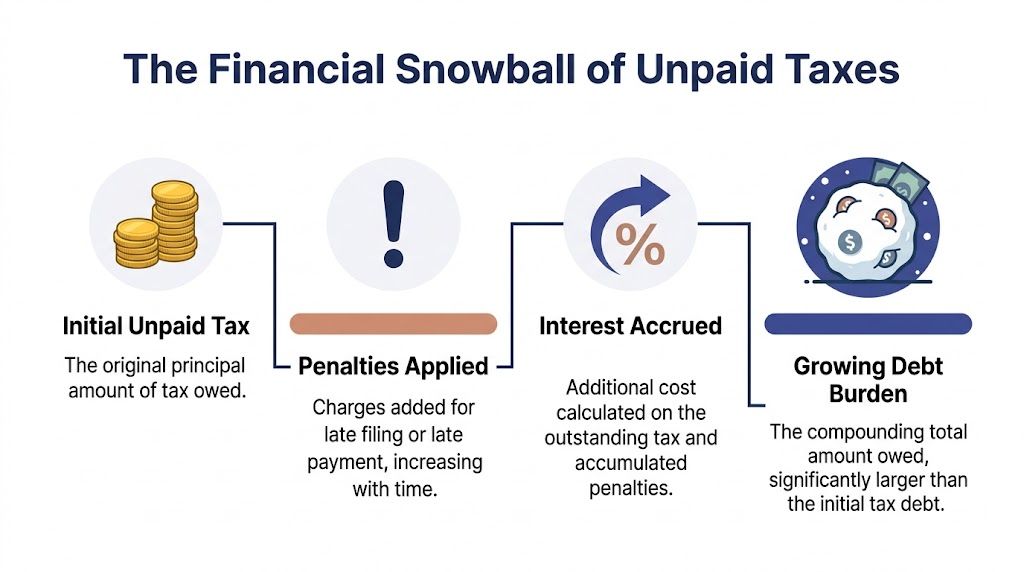
The Financial Snowball of Unpaid Taxes
A tax bill does not sit still. It grows while you are trying to catch your breath, and it can grow on two tracks at once if both the IRS and Michigan Treasury are involved.
That is how a manageable balance turns into a collection problem.
Penalties hit first
The first increase usually comes from penalties. On the federal side, the IRS can add a failure-to-pay penalty of 0.5% per month, up to 25% of the unpaid balance, and interest accrues daily. CBS News also reported that the IRS collected $77.6 billion in fiscal year 2024 from unpaid assessments, which is a reminder that old tax debt does not just fade away (CBS News on what happens if you owe taxes).
If you did not file, the cost rises faster. The failure-to-file penalty is much steeper than the penalty for filing and paying late. That is why my first instruction is simple. File the return, even if you cannot pay the full amount yet.
Interest keeps adding pressure
Interest is what makes delay expensive.
Taxpayers often focus on the number printed on the first notice. That number is already outdated by the time you decide to deal with it. Interest keeps accruing. Penalties can keep stacking. If you wait six months because cash is tight, the debt is larger, not just older.
For a Lansing wage earner, that may mean a balance that no longer fits comfortably into a monthly budget. For a self-employed contractor in Grand Rapids, it can mean a payment plan that now requires deeper financial disclosure. For a higher-income household in Oakland County, the larger issue is often strategy. The longer you wait, the fewer clean options you have and the more attention the account can draw.
The real cost of waiting
Unpaid taxes usually create three problems at the same time:
The balance grows
Penalties and daily interest increase the amount you must resolve.
Resolution gets harder
Larger balances often bring closer financial review, stricter payment terms, and less room for error.
You risk parallel enforcement
The IRS may be collecting federally while Michigan Treasury is collecting at the state level.
That last point matters because taxpayers often assume they can handle the IRS first and deal with Michigan later. In practice, that assumption causes trouble. Michigan Treasury does not have to wait for the IRS to finish. The state can pursue its own balance on its own timeline.
Michigan can turn one debt into two active cases
This situation often blindsides Michigan taxpayers. Federal and state tax agencies are separate creditors with separate powers.
If you owe both, you may be dealing with two notice streams, two balances, two sets of deadlines, and two collection strategies. A Detroit business owner can be fighting an IRS income tax problem while also dealing with Michigan sales tax or withholding exposure. A wage earner can be trying to stop federal penalties while the state is already pressing on collections.
That split matters because your response has to be coordinated. If you put every dollar toward the IRS and ignore Treasury, you may solve the wrong half of the problem.
What to do now
Start here, in this order:
- File every missing return. Unfiled years block many relief options with both the IRS and Michigan.
- Confirm who you owe and for which years. Do not guess. Separate federal debt from Michigan debt.
- Make a payment if you can. Even a partial payment can reduce how much future charges build on.
- Choose a resolution track quickly. That may be an installment agreement, penalty relief, currently not collectible status, or a settlement path.
- Coordinate the plan. If both agencies are active, treat this as one strategy problem, not two unrelated bills.
Clients want to wait until they feel financially ready. That instinct is expensive. Action stops the drift. Strategy contains the damage.
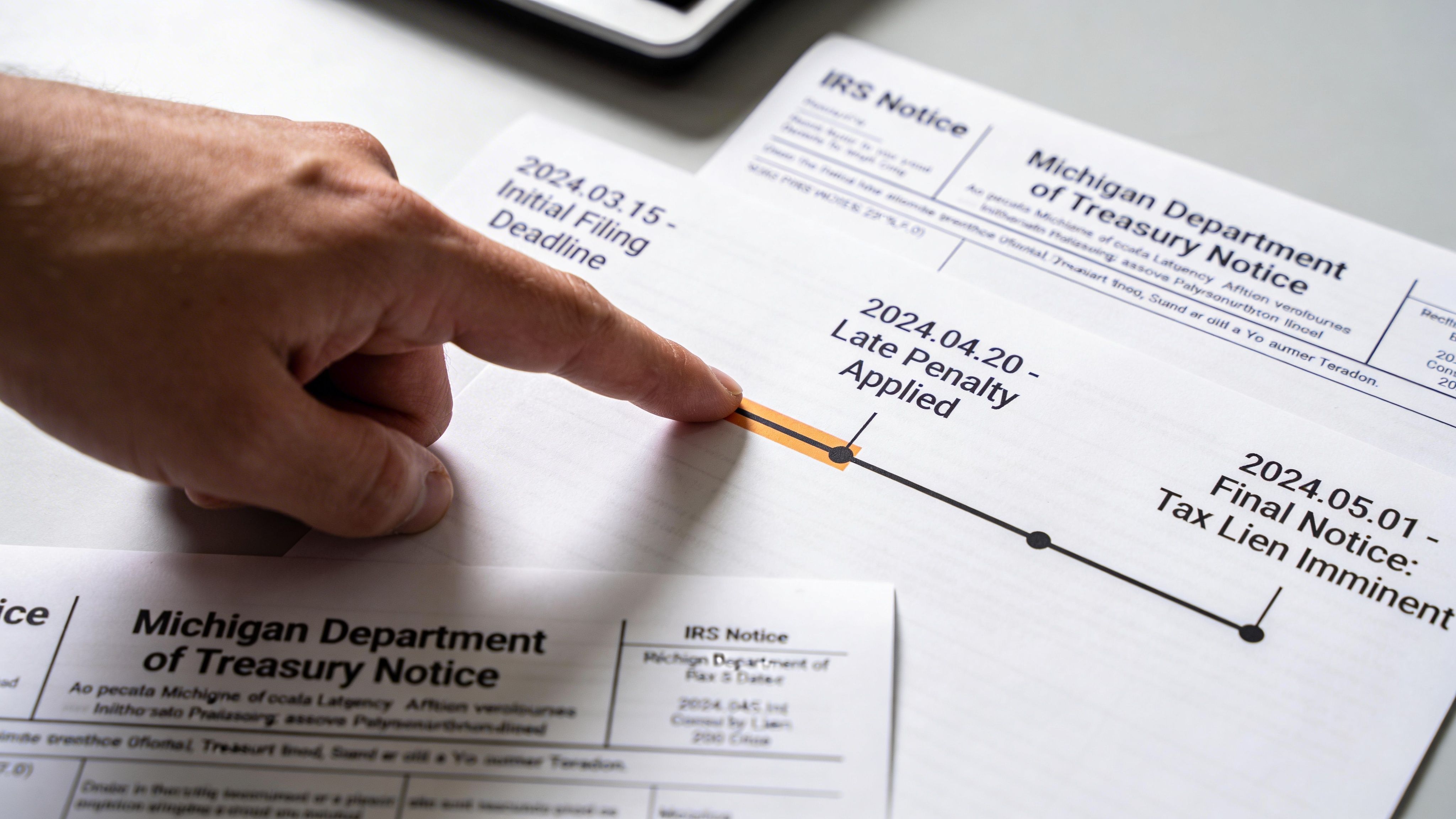
The Escalation Timeline from Notice to Enforcement
You open the mailbox in Lansing, Troy, or Grand Rapids and find another tax notice. You tell yourself it can wait until payday. Then a second letter arrives from a different agency. Now you are not dealing with one debt. You are dealing with two governments, two deadlines, and two paths to enforcement.
Stage one starts the clock
The first notice is your chance to control the case while the cost is still lower and the options are broader.
At this stage, you verify the balance, check whether the return was processed correctly, fix missing filings, and decide whether to dispute the debt or set up payment. A wage earner in Lansing may only need to correct a withholding issue or get onto a payment plan quickly. An Oakland County high-income taxpayer may need a much tighter review of assessments, estimated payments, and asset exposure before responding. Either way, delay is a mistake.
Stage two puts your case into the collection system
If you do nothing, the account moves from billing to collections. That shift matters.
On the IRS side, unresolved balances often move into an automated collection track built to push accounts toward enforced action. Michigan Treasury also follows its own collection path, and it does not wait for the IRS to finish first. If both are active, the pressure on cash flow can build fast, especially for business owners with payroll or sales tax issues.
Computers move these files. People review them later. Your silence works against you.
The final notice changes the risk
There is a point in every tax case where the question stops being whether the agencies are serious. The question becomes whether you are still in time to stop them.
Once a final notice is issued, levy action is close. That is when paychecks, bank accounts, and receivables move from possible targets to likely targets. If you own real estate or have business assets, you also need to be thinking about lien exposure and how to address it. If that is already on the table, read about options for removing a tax lien in Michigan.
The collection deadline exists, but waiting it out is a bad plan
Federal tax debts do not last forever. The IRS generally has a collection window tied to the assessment date, and certain events can suspend that period. Michigan collection timelines and enforcement tools follow their own rules.
Do not build your strategy around expiration.
That approach fails for a simple reason. The IRS and Michigan Treasury can take collection action long before any deadline runs out. They can also keep the case painful for years through notices, offsets, liens, levies, and payment pressure. For a well-paid employee, that can mean repeated wage disruption. For a business owner, it can mean a constant threat to operations and financing. For a high-net-worth taxpayer, it can mean avoidable exposure of property, accounts, and future transactions.
Federal and Michigan enforcement do not arrive in the same form
Here is how the pressure usually develops:
| Agency | Early Stage | Escalation Point | What You should do |
|---|---|---|---|
| IRS | Balance due notices and requests for payment | Final notice, levy warning, lien filing risk | Verify the assessment, get compliant, and choose a formal resolution before enforcement starts |
| Michigan Department of Treasury | Billing notices, state balance demands, business tax collection contact | Wage action, bank action, refund interception, business collection pressure | Confirm what tax type is involved and respond based on Michigan procedure, not federal assumptions |
| Both agencies | Separate notice streams for the same taxpayer | Overlapping enforcement that strains cash flow and payroll | Coordinate one plan for both debts instead of reacting letter by letter |
Cases that need immediate action
I treat these as priority cases from day one:
- You received a final notice from the IRS or Michigan Treasury
- Your paycheck, bank account, or business receipts are at risk
- You owe payroll tax or sales tax
- You have unfiled returns for multiple years
- You are getting notices from both the IRS and Michigan at the same time
If any of those apply, stop researching and act. Pull the notices, identify the shortest deadline, and put a resolution in front of the right agency before enforcement starts. That is how you keep a tax problem from turning into a wage crisis, a bank account freeze, or a business interruption.
Dissecting the Consequences Liens Levies and Garnishments
Tax agencies have several tools, but three do the most damage in everyday life. Liens, levies, and garnishments change how you borrow, how you get paid, and how you keep your money in the bank.

A lien is a public claim against your property
The IRS typically files a Notice of Federal Tax Lien for debts exceeding $10,000, and that filing can cause FICO scores to drop by over 100 points. It becomes a public record and can damage credit for years. The same source notes that after a final notice, the Automated Collection System can issue a continuous wage garnishment that seizes part of every paycheck (Dilucci on liens and wage garnishment consequences).
A lien doesn't mean the government has taken your house that day. It means the government has claimed a legal interest in your property. That claim follows you into refinancing, sales, and other transactions.
What a lien does in real life
- It interferes with refinancing. Lenders don't like a federal tax lien in the chain.
- It complicates selling property. The government's claim has to be addressed.
- It damages borrowing power. Public records and weakened credit affect future deals.
- It pressures business operations. Vendors, banks, and partners may hesitate when tax issues surface.
If you're dealing with an existing lien, this guide on how to remove tax liens lays out the mechanics.
A levy takes property or money
A levy is not a warning. It is a seizure.
The government can levy a bank account, take funds up to the debt amount, and leave you dealing with the fallout after the fact. For many people, the first sign is that a debit card stops working or a bank representative says the account is frozen.
That moment can destabilize everything at once. Mortgage payment. Payroll. Utilities. Childcare. A levy turns a tax problem into a household crisis.
A bank levy is where many taxpayers realize the problem was never "just paperwork."
Wage garnishment hits every pay cycle
A levy on wages is especially punishing because it is ongoing. It isn't one bad week. It is a continuing drain on each paycheck until the matter is resolved or the agency releases it.
For salaried employees in Lansing, teachers, nurses, engineers, state workers, and private-sector employees, wage garnishment creates shame and panic because it becomes visible to payroll departments. For employers, payroll compliance becomes part of the issue. For the taxpayer, monthly budgeting collapses fast.
Why businesses face a harsher version
Businesses often suffer the fastest and most visible damage from tax enforcement. The reasons are practical:
- Operating accounts are vulnerable. A levy can hit the account that pays rent, payroll, and suppliers.
- Payroll and sales tax issues draw more scrutiny. Agencies treat trust-fund type problems seriously.
- Owners get pulled in personally. Business tax issues can spill into individual financial exposure.
- Michigan and the IRS can both apply pressure. That overlap can freeze decision-making if no one takes charge.
The hidden consequence is lost flexibility
The biggest damage from liens and levies isn't only the money taken. It's the loss of options.
Once your credit is damaged, your account is frozen, or your wages are being garnished, every future decision gets harder. You borrow at worse terms if you can borrow at all. You miss opportunities to sell or refinance. You start making short-term decisions because the tax problem has taken control of your cash flow.
That is why I tell clients to focus less on outrage and more on timing. By the time a lien or levy appears, emotion doesn't help. Fast, organized response does.
Your Path to Resolution Available Tax Relief Options
There is no single tax relief solution that fits everybody. A Lansing employee with a stable paycheck needs a different plan than a Detroit business owner with payroll issues or an Oakland County executive trying to protect major assets during an audit.
The right question is not "What program sounds best?" The right question is "Which option matches the facts of this file?"
The major paths
The 10-year CSED can be suspended by certain resolution actions. Currently Not Collectible status stops levies while interest still accrues, and an Offer in Compromise is accepted in only 25% to 40% of cases, which is why careful preparation matters (IRS guidance on finality and collection options).
That single point should change how you think about relief. Programs exist, but they are not magic forms. You need the right fit and the right record.
Comparing Federal and Michigan Tax Resolution Options
| Resolution Method | Best For… | Key Requirement | Potential Outcome |
|---|---|---|---|
| Installment Agreement | Taxpayers who can pay over time | Current filings and a workable payment structure | Stops the case from drifting toward enforced collection if maintained |
| Offer in Compromise | People who cannot realistically pay the full balance | Strong proof of limited reasonable collection potential | Settles for less than full balance if accepted |
| Penalty Abatement | Taxpayers with good facts for relief | Reasonable cause or qualifying history | Reduces added charges tied to the original debt |
| Currently Not Collectible | Taxpayers in financial hardship | Proof that collection would prevent basic living expenses | Levies stop, but the debt remains active |
| Innocent Spouse Relief | Joint filers with unfair liability exposure | Facts showing lack of responsibility for the tax problem | Can shift or reduce liability for one spouse |
| Bankruptcy analysis | People with broader debt stress beyond taxes | Case-specific legal review of the tax years and debt type | May help in limited situations, but it is not a blanket fix |
What each option is really for
Installment agreements
These work best for people who owe a manageable amount relative to income and can stay current going forward. They are practical, but only if the monthly payment is realistic. An agreement that looks good on paper and defaults six months later doesn't solve anything.
There is also a tactical benefit. Under the rules cited earlier, proactive resolution through an installment agreement can reduce the failure-to-pay penalty to 0.25% per month rather than 0.5% per month, which is another reason delay is expensive.
Offers in Compromise
An OIC is not a discount coupon. It is a settlement based on what the government believes it can collect.
If your file supports an offer, it can be powerful. If it doesn't, submitting one just to "see what happens" can waste time and expose weaknesses in your financial presentation. For a fuller explanation, this article on what is an Offer in Compromise is worth reading before you file anything.
Penalty abatement
This is often overlooked. People fixate on the tax and forget that penalties can be attacked separately in the right circumstances. Medical events, record disruptions, serious hardship, and other reasonable-cause facts can matter. So can a clean prior compliance history.
Currently Not Collectible status
CNC is breathing room, not forgiveness. It is appropriate when collection would prevent a taxpayer from covering basic living expenses. If approved, it can stop levies, but the balance remains and the case can be reviewed later.
My view: CNC is useful when you need time to stabilize, not when you're trying to pretend the debt disappeared.
Innocent spouse relief
This matters more than many married taxpayers realize. If one spouse drove the tax problem and the other had limited knowledge or involvement, relief may be available. It can be critical in divorce, separation, or asset-protection planning.
Bankruptcy review
Some tax debts interact with bankruptcy law in ways that surprise people. It is never the first assumption I make, but it is often worth a real legal review. If you want a plain-English overview, this resource on bankruptcy and income taxes is a useful starting point.
Where professional help fits
You can handle some matters yourself. You should not assume you should.
A firm like Defense Tax Partners can step in where the problem involves parallel IRS and Michigan collection, unfiled returns, audits, levy releases, penalty arguments, or a disputed financial picture. That work is less about filling in forms and more about controlling the sequence, the documents, and the negotiation.
How This Plays Out in Michigan Real-World Scenarios
Tax debt feels abstract until you attach it to a person with a paycheck, a business account, or a house they are trying to protect. In Michigan, local facts matter because federal and state enforcement can squeeze the same taxpayer from different angles.
The Lansing wage earner
A salaried employee in Lansing often starts with a simple problem. Withholding was off. A side gig generated untaxed income. A divorce changed filing status. The return got filed, but the balance wasn't paid.
At first, this person thinks they can catch up later. Then notices pile up. Danger shows up when collection pressure starts threatening wages. For this taxpayer, the right move is usually speed and stability. Get compliant, stop the account from sliding into harsher enforcement, and structure a payment arrangement or hardship request that preserves cash flow.
The mistake is trying to negotiate emotionally. Payroll doesn't care that you were "about to deal with it." Tax agencies respond to paperwork.
The Detroit small business owner
A business owner in Detroit has a different problem. Sales tax issues, payroll tax trouble, or uneven cash flow can pull both the IRS and Michigan Treasury into the same file. Once that happens, the operating account is the pressure point.
The legal problem quickly becomes an operational problem. Can payroll run? Can suppliers get paid? Can the owner keep the doors open while sorting out old liabilities and filing gaps?
For this taxpayer, the strategy often starts with triage. Fix the filing posture. Separate trust-fund style issues from ordinary income tax debt. Identify which agency is closest to actual levy action. Then build a structure the business can survive.
The Oakland County high-net-worth taxpayer
Oakland County cases often look calmer on the surface and more dangerous underneath. The client may have substantial income, real estate, investment accounts, or a closely held business. They may also be in or around an audit. That combination gives the government a strong position.
For high-net-worth individuals in areas like Oakland County, Michigan's aggressive levy rates are reported as 15% higher on businesses since 2024, and those state actions can combine with federal liens to freeze high-value assets. The same source notes that Offers in Compromise are approved nationally in only 25% to 40% of cases, which is why local attorney negotiation can matter when presenting true financial capacity and asset exposure (H&R Block on owing back taxes and Michigan enforcement context).
Casual tax prep becomes insufficient. Asset equity, liquidity, timing of sales, joint liabilities, and audit posture all interact. A rushed or sloppy disclosure can do lasting damage.
Wealth does not make tax collection less serious. It gives the government more places to look.
The common thread
These three taxpayers need different strategies, but they share one rule. The earlier you act, the more control you keep.
- Wage earners need to protect income.
- Business owners need to protect operations.
- High-net-worth taxpayers need to protect structure, privacy, and assets.
The legal tools differ. The principle doesn't. Move before the agencies make the next decision for you.
Take Control of Your Tax Debt Today
If you owe back taxes, the worst move is still the most common one. People wait. They hope the next notice won't come. They convince themselves they'll deal with it after a bonus, after summer, after the business improves, after the divorce is final.
That is how manageable tax debt turns into liens, levies, garnishments, frozen accounts, and years of financial drag.
A better approach is straightforward. Get the facts. File what is missing. Identify whether the IRS, Michigan Treasury, or both are active. Choose the right resolution path based on your actual finances, not wishful thinking. Then stay compliant so the problem doesn't reappear.
Once the immediate fire is under control, it also helps to rebuild the broader money habits that keep tax trouble from returning. A practical guide to personal finance planning can help you think through cash flow, reserves, and long-term budgeting after the tax issue is resolved.
If you're in Michigan and this problem is already affecting your sleep, your paycheck, your business, or your property, treat it like the legal matter it is. Act now. A prompt, organized response gives you the best chance to stop collections and protect what you have.
Need help with an IRS or Michigan tax debt issue? Talk to a Michigan tax attorney as soon as possible. The goal is simple. Stop the spiral, protect your assets, and put a workable plan in place before the government takes the next step.
