
Abatement IRS Penalties: How to Get Relief
The envelope from the IRS usually sits unopened longer than people admit. You know it is bad news. You assume the number is fixed. You worry one late return or one missed payment has turned into a problem that will keep growing.
In many cases, the penalty is real. But the amount on the notice is not always the final amount you have to live with.
That is where abatement IRS penalties becomes more than a search term. It is a process. If you handle it correctly, you may remove part of the balance, stop the account from getting worse, and put yourself in a better position if you also need a payment plan, audit defense, or collection relief.
Michigan taxpayers often make the same mistake. They treat the penalty notice like a verdict instead of an opening move. The IRS has relief channels, but the IRS does not always volunteer the best one for your facts. You have to identify the right path, document it, and ask in the right way.
Understanding Your IRS Penalty Notice and Abatement Options
A Michigan taxpayer opens a CP14 after work, sees penalties and interest stacked on top of tax due, and assumes the number is fixed. That assumption costs people money. An IRS notice is a billing document, but it is also a roadmap. If you read it correctly, it tells you what period is at issue, what penalty code the IRS applied, and whether you have a realistic opening for relief.
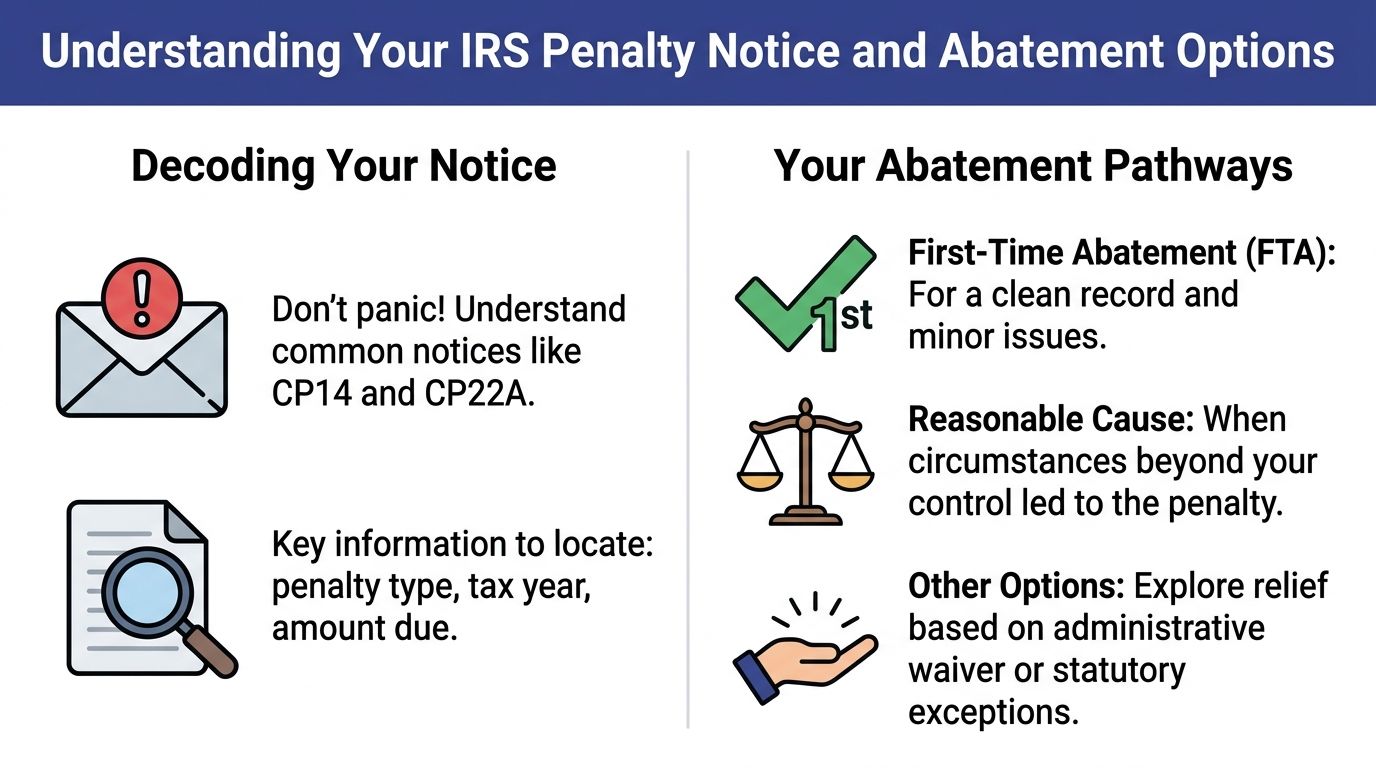
The first job is classification. Before calling the IRS, identify the penalty type, the tax year, and whether the problem started with a late return, a late payment, or an adjustment the IRS made after processing. A taxpayer in Grand Rapids with an unfiled return has a very different abatement path from a small business owner in Detroit who filed on time but missed payroll deposits.
What the notice is usually telling you
Most IRS penalty notices fall into a few recurring categories:
- Failure to file. This usually applies when a return was submitted after the deadline and tax was still due.
- Failure to pay. This usually applies when the return was filed, but the balance was not paid on time.
- Accuracy-related penalty. This often appears after an IRS adjustment and is tied to negligence, substantial understatement, or similar findings.
More than one penalty can appear on the same notice. That matters because each penalty has its own relief standards, and the best argument for one may be useless for another.
Check the notice number carefully. CP14 often signals an initial balance due. CP22A usually reflects changes the IRS made to the return. If the notice follows an audit, amended return, substitute for return assessment, or payroll issue, the strategy changes fast. In practice, the best abatement requests start with the account transcript, not with a rushed phone call.
Your main abatement paths
Most penalty cases fit into three lanes:
| Path | Best use | What usually matters most |
|---|---|---|
| First-Time Abatement | One isolated compliance problem after a clean history | Prior compliance, current filings, payment status |
| Reasonable cause | A serious event kept you from complying despite ordinary business care | Documents, timing, credibility |
| Statutory exception or administrative waiver | A narrow rule or IRS action created a specific basis for relief | Matching the facts to the exact rule |
First-Time Abatement is often the fastest route where the taxpayer has a good filing history.
Reasonable cause is fact-driven. The IRS wants a clear timeline, supporting records, and a believable explanation showing you tried to comply and were blocked by circumstances you could not control.
Statutory exceptions are less common, but they matter in the right case. I look for them when the notice timing is odd, the taxpayer relied on written IRS advice, or the assessment followed a procedural problem.
Read the notice before you argue the notice
Many taxpayers start with fairness. The IRS starts with procedure. That mismatch leads to avoidable denials.
A stronger approach is simple. Match the facts to the relief category first. Then gather the records that prove it. If your file is incomplete because prior returns were never finished, address that problem before making an abatement pitch. Taxpayers who still need to catch up should start with a clear process for filing back tax returns before seeking penalty relief.
Good documentation also saves time. Pull the IRS notice, the return for that year, proof of mailing or e-filing, payment confirmations, medical or insurance records if health issues were involved, and any correspondence with your preparer or the IRS. If your records are scattered, this ultimate tax return checklist is a useful way to organize the file before you contact the agency.
What Michigan taxpayers should notice first
Federal penalties rarely exist in isolation. In Michigan cases, I often see an IRS notice sitting beside unfiled Michigan returns, missed estimates, payroll tax exposure, or an old collection issue that has been dormant until now.
That broader context affects timing. If the IRS account is still accruing penalties because returns are missing or current compliance is broken, fix those items first. If a levy threat, revenue officer contact, or business payroll issue is involved, the abatement request may need to wait until collections are stabilized. That is the trade-off. Filing a penalty request too early can weaken it. Filing too late can let the account get harder to control.
The notice is the starting point. The challenge involves deciding which path fits, what proof supports it, and whether the case is simple enough to handle yourself.
The First-Time Abatement Playbook for a Quick Win
A common Michigan fact pattern looks like this. A taxpayer in Grand Rapids or Troy opens an IRS notice for failure-to-file or failure-to-pay penalties, assumes a long hardship explanation is coming, and misses the faster option. In many clean cases, First-Time Abatement is the quickest path because the fight is about eligibility, not storytelling.

FTA applies to a narrow group of penalties:
- Failure-to-file penalties
- Failure-to-pay penalties
- Failure-to-deposit penalties
It does not apply to everything. Accuracy-related penalties, estimated tax penalties, and many audit-driven penalties usually require a different strategy. The IRS also does not cap FTA relief by dollar amount, which is why I treat it as the first box to check in a penalty case with an otherwise clean record, as noted in Tax Lawyers Group’s overview of the IRS penalty abatement process.
The three screens the IRS usually applies
Before calling or writing the IRS, confirm these points:
Prior compliance history
The prior three tax years generally need to be free of significant penalties.Current filing compliance
All required returns should be filed, or properly extended.Current payment status
If the balance is not paid in full, the account should be in an approved payment arrangement or otherwise current enough for the request to be considered. Many self-filed requests often fail at this stage.
Check the transcript before you ask for anything
Do not rely on what you remember from prior years. Pull the account transcript and confirm what the IRS system will show the representative.
Review:
- Penalty history for the prior three years
- Return posting status for all required years
- Open balances that may need an installment agreement
- Account adjustments that may affect whether the prior history is clean
That review matters in Michigan cases because federal penalty problems often sit next to unfinished state compliance or several years of disorganized records. If any federal return is still missing, fix that first. This guide on filing back tax returns before requesting penalty relief covers the order that usually makes the most sense.
The sequence I use in straightforward FTA cases
A clean process saves time and avoids an unnecessary denial.
| Step | What to do | Why it matters |
|---|---|---|
| Step 1 | Match the notice to the exact penalty type | FTA only works for specific penalties |
| Step 2 | Pull the transcript | Confirms whether the account is eligible |
| Step 3 | Fix any missing filings | The IRS usually wants current filing compliance first |
| Step 4 | Set up payment if full payment is not possible | An unresolved balance can slow or derail the request |
| Step 5 | Request FTA by phone or in writing | The request lands better when the file is already clean |
In simple individual cases, a phone request can work well. In more complicated files, I often prefer a written request or at least a transcript review first, because one bad note on the account can send the case in the wrong direction.
What to say
Keep the request direct and controlled. FTA does not turn on a personal explanation.
A practical script looks like this:
- Identify yourself and the notice
- State the tax year and penalty involved
- Request First-Time Abatement
- Confirm all required returns have been filed
- Confirm the balance is paid or under arrangement
- Ask the representative to review prior compliance history for FTA eligibility
That is enough. Extra narrative often creates confusion and can shift the discussion away from the one issue that matters, whether the account meets the administrative requirements.
Cases where FTA is usually the wrong first move
FTA is often a strong play, but not every file fits it.
It is usually not the best starting point when:
- multiple tax years show recurring penalties
- the penalty is outside the FTA categories
- the penalty grew out of an audit adjustment
- the account includes payroll tax issues or federal tax deposits for a business
- collections pressure is already serious, such as a revenue officer assignment or levy activity
Those cases need a more deliberate plan. Sometimes the better move is to stabilize collections first. Sometimes it is to build a reasonable cause record instead of spending time on an FTA request that was never likely to stick.
Building a Compelling Case for Reasonable Cause
A Grand Rapids business owner misses a filing deadline after a hospitalization. A Macomb County contractor relies on bad advice from a preparer and gets hit with an accuracy penalty. A retiree in Traverse City loses records after a house fire and then receives an IRS notice months later. These cases do not turn on sympathy. They turn on proof, timing, and whether the record shows ordinary business care under difficult facts.

Reasonable cause is the part of penalty abatement where many taxpayers weaken their own case. They send too much paper, make broad claims, or tell a story that never clearly connects the event to the missed filing, payment, or reporting duty. The IRS is looking for a disciplined explanation: what happened, when it happened, how it disrupted compliance, and what you did once you were able to act again.
For a closer explanation of the legal standard, review our guide on reasonable cause penalty abatement. The short version is practical. Good faith helps, but it is not enough by itself. The facts must show that compliance failed despite ordinary care, not because the issue was ignored.
The facts that usually persuade
The best cases usually involve a defined event with a clean timeline and records that line up.
Common examples include:
- Serious illness or incapacity
Medical records matter only if they show functional limits during the filing or payment period. A diagnosis alone rarely carries the point. - Death or serious illness in the immediate family
These cases work when the evidence shows how the event disrupted records, finances, travel, or decision-making. - Fire, casualty, or natural disaster
The IRS wants dates, proof of loss, and a clear explanation of what records or operations were affected. - Incorrect professional advice
These cases are narrower than taxpayers expect. You need to show what advice was given, when it was given, and why reliance on that advice was reasonable under the circumstances.
I often tell clients to stop writing as if they are asking for mercy. Write as if you are building a record for review. That change alone improves a lot of cases.
Build the timeline before you write the letter
A longer statement does not make a stronger case. A clear chronology does.
Use this sequence:
- Identify the tax duty
Name the return, tax year, payment, or reporting position that triggered the penalty. - Pin down the disrupting event
Give exact or approximate dates and explain what happened. - Connect the event to the failure
State how the event prevented filing, payment, or accurate reporting. - Show what happened once the disruption eased
Filing the return, hiring new help, replacing records, entering a payment arrangement, or correcting the reporting position all help show good faith.
That last point carries real weight. IRS reviewers want to see that the taxpayer acted once the obstacle passed. Delay without explanation hurts otherwise decent facts.
If you need help organizing the presentation, the same principles used in writing a compelling professional letter apply here. Lead with the issue, keep the chronology tight, and attach only documents that prove a point.
What evidence helps
The right evidence is specific. The wrong evidence is generic.
| Situation | Weak support | Stronger support |
|---|---|---|
| Illness | One appointment slip | Medical records plus a statement explaining why the taxpayer could not manage tax tasks during the relevant period |
| Disaster | Photos without dates | Insurance records, repair invoices, hotel or relocation records, and a timeline showing loss of records or access |
| Bad professional advice | “My preparer handled it” | Engagement letter, emails, draft returns, written advice, and notes showing what the taxpayer disclosed |
| Family emergency | General personal explanation | Death certificate, hospital records, travel records, account activity, and dated correspondence |
The goal is connection. Every exhibit should answer one question: why did this event prevent compliance for this taxpayer at this time?
A Michigan-specific issue to watch
Michigan taxpayers often have parallel problems with the IRS and Michigan Treasury after the same disruption. I see this with small business owners in Detroit, Lansing, and the lakeshore communities. Payroll issues, sales tax problems, and federal filing failures can all start from one event, but the agencies may evaluate the explanation differently.
Use one set of core facts. Keep the timeline consistent. If the IRS receives one version and Michigan Treasury gets another, credibility becomes the new problem. That is avoidable with careful drafting on the front end.
Explanations that usually fall flat
Some arguments sound reasonable but rarely win on their own:
- I could not afford to pay
Financial hardship may explain nonpayment, but it usually does not excuse a late filed return. - I was overwhelmed with work
Heavy workload is not reasonable cause. - I meant to handle it later
That reads as neglect. - My preparer was responsible for everything
Delegating the task does not automatically excuse the taxpayer.
Mixed facts need honest framing. If the file contains both a real hardship and a period of inattention, address both. A measured explanation with targeted records is usually stronger than an aggressive letter that claims more than the documents can support.
The Mechanics of Submitting Your Abatement Request
A good penalty argument can still fail if it is submitted badly. The IRS process is unforgiving in ordinary ways. Wrong year, wrong penalty, wrong address, missing signature, vague explanation. None of that is dramatic. It still sinks cases.
Phone, mail, or form
You usually have three practical channels.
- Phone request
Best for straightforward FTA requests and some simple notice-based relief. - Written letter
Often best for reasonable cause because you control the facts and attachments. - Form 843
Useful when a formal claim format is needed or when the notice directs that route.
The strongest choice depends on the issue. FTA often starts well by phone. Reasonable cause usually benefits from a carefully written package.
A simple phone script that works
For FTA:
- “I am calling about a penalty notice for tax year [year].”
- “I would like to request First-Time Abatement.”
- “My required returns are filed, and I have addressed the balance.”
- “Please review my prior compliance history for eligibility.”
For reasonable cause:
- “I am requesting penalty relief based on reasonable cause.”
- “The penalty relates to [return or payment obligation].”
- “A specific event prevented compliance, and I have supporting documentation.”
- “Please note that I can provide a written statement and attachments if needed.”
Write down the representative’s name, badge number if given, the date, and what the representative said. Keep your own call log.
Writing the letter the IRS agent can process
A strong abatement letter is not a law review article. It is a clear administrative request.
Use this order:
- Taxpayer identifying information
- Notice number and tax year
- Penalty you want removed
- Ground for relief
- Short fact statement
- Attachment list
- Request for written confirmation
If you want help tightening tone and structure, a guide on writing a compelling professional letter is useful for keeping the request formal, concise, and readable.
Insider tip: If your first draft sounds like a rant, it is not ready to send. IRS reviewers respond better to chronology and proof than outrage.
How to approach Form 843
Form 843 is often the right vehicle when you want a formal claim for refund or request for abatement. The mistakes I see most often are basic:
| Common error | Why it causes problems |
|---|---|
| Wrong tax period | The IRS may match the form to the wrong account |
| Vague penalty description | The reviewer cannot tell what relief is being requested |
| No attachments | A reasonable cause claim looks unsupported |
| Missing signature | The submission may not be processed properly |
Before filing, read the notice carefully and match the tax year and penalty description exactly.
For a more detailed walkthrough, this explanation of Form 843 abatement is a useful companion.
Timing and follow-up
If you submit in writing, keep a complete copy. Send it in a trackable way. If you call, follow up when appropriate and keep your notes together with the notice and supporting documents.
Processing can take time. Some requests move quickly. Others do not. What matters is that your submission gives the IRS a clean file to review.
If collections are active while the request is pending, do not assume the abatement request itself will stop them. That is a separate problem and often needs a separate response.
Aftermath Appeals and Advanced Scenarios
A Michigan taxpayer gets a denial letter, assumes the answer is final, and misses the best chance to fix the file. I see that mistake often. The first IRS response is only the start of the analysis.
What to expect after submission
After you submit an abatement request, the IRS usually does one of four things. It grants the request in full, grants part of it, denies it, or leaves the account in pending status while the file works through the system.
Silence does not tell you much.
Some cases move quickly. Others sit long enough that taxpayers stop following up, lose track of deadlines, or let collections get ahead of them. The practical rule is simple. Watch the mail, check the account transcript, and calendar follow-up dates from the day the request goes out.
Reading a denial correctly
A denial letter matters only if you read it like a lawyer and not like a frustrated taxpayer. The issue is not whether the IRS said no. The issue is why.
Start with these questions:
- Did the IRS say you were ineligible for the type of relief requested?
- Did it reject the facts, or just find the documentation too thin?
- Did it address every penalty period you raised?
- Did it miss a compliance point that could be fixed and resubmitted?
- Did the denial come from a phone request, a service center review, or a formal written claim?
Those distinctions drive the next step. A weak factual presentation can sometimes be repaired with a tighter written submission. A legal disagreement or a badly reasoned denial often belongs in Appeals.
Appeals can change the case
Appeals is where many close cases get a real second look. That is especially true when the underlying facts were solid but the initial request was too vague, poorly organized, or attached to the wrong procedural vehicle.
A good protest does three things. It identifies the exact penalty and periods at issue, explains the factual timeline in a clean sequence, and points out where the first reviewer got the law or the record wrong. It does not recycle the same package with a stronger tone.
Key point: Appeals rewards precision. It does not reward volume.
In higher-dollar files, I also look at what else is sitting on the account before deciding whether to appeal immediately. Sometimes the better move is to correct compliance problems first, secure missing transcripts, or frame the case around hazards of litigation rather than fairness alone. That is the kind of sequencing that changes outcomes.
Advanced cases need a broader strategy
Penalty abatement often sits inside a larger IRS problem. If you are trying to set up an installment agreement, reducing penalties may lower the balance enough to improve the monthly payment analysis. If an Offer in Compromise is under consideration, penalty relief can affect the total liability and the posture of negotiations. If levy action is active, an abatement request does not protect wages or bank accounts by itself.
Business cases are harder.
Payroll tax penalties, trust fund exposure, repeated late deposits, and multi-year noncompliance usually mean the penalty issue is only one part of the file. In those matters, the order of operations matters a lot. Push the wrong issue first and you can waste time while the collection side gets more aggressive.
Michigan residents should treat the state piece separately
Michigan taxpayers have another layer to manage. The Michigan Department of Treasury has its own procedures, its own standards, and its own review process. A favorable IRS result can provide supporting facts, but it does not automatically clean up the state side.
The practical concern here is timing and record management, not repeating the same argument word for word. Medical records, insurance claims, business interruption documents, and account transcripts should be organized so they can support each agency's process without creating avoidable gaps. If the federal matter involves payroll taxes, sales tax, or business withholding issues on the Michigan side, the file usually deserves a coordinated plan from the start.
That is one of the clearest points where professional help becomes necessary.
When to Handle It Yourself vs Calling Defense Tax Partners
Some penalty cases are manageable on your own. Others are not. The hard part is recognizing the difference early enough to avoid making the file worse.
Good DIY candidates
You can often handle the matter yourself when the facts are clean:
- a single-year First-Time Abatement request
- one notice, one penalty category, and no audit history
- all returns are filed
- the balance is paid or already in a payment arrangement
- your transcript clearly supports eligibility
In that setting, a well-prepared phone request or short written submission often makes sense.
When DIY becomes risky
Professional help becomes much harder to avoid when any of these are present:
| Red flag | Why it changes the case |
|---|---|
| Multiple tax years | The problem is usually systemic, not isolated |
| Business or payroll penalties | The exposure is more technical and often more aggressive |
| High-dollar assessments | A weak first submission can lock in bad positioning |
| Denied reasonable cause request | The second shot needs to be better than the first |
| Audit adjustments behind the penalty | Abatement may depend on the underlying tax issue |
| Lien, levy, or garnishment activity | You need a broader defense strategy, not just penalty relief |
Michigan taxpayers with overlapping federal and state issues should lean toward professional guidance sooner. A state sales tax problem, payroll issue, or identity theft complication changes the analysis quickly.
The practical line
If your case is simple, organized, and limited to a clean FTA request, self-help may be enough.
If your case involves narrative proof, disputed facts, multiple agencies, business exposure, or active collection pressure, representation is usually the safer call. That is where a Michigan firm like Defense Tax Partners adds value. The firm handles IRS and Michigan Department of Treasury matters together, negotiates directly with taxing authorities, and builds abatement requests inside a larger resolution strategy instead of treating the penalty in isolation.
If you are dealing with IRS penalties, wage garnishment risk, unfiled returns, or a denied abatement request in Michigan, Defense Tax Partners can review the notice, identify the strongest relief path, and step in before the case gets more expensive. Visit https://www.michigantaxattorneys.net to request a consultation.
Frequently Asked Questions About IRS Penalty Abatement
A Michigan taxpayer in an installment agreement often asks the same question after opening another IRS notice. Is it too late to fix the penalties? In many cases, no. The better question is whether the timing, the penalty type, and the record in the file support a clean request now or a stronger written submission later.
Can I request abatement while I am on an installment agreement
Yes. An active installment agreement does not block penalty abatement, and it can help in a first-time abatement case if the IRS wants to see that the account is otherwise in order.
For Michigan residents, I usually look at the account transcript before anything is submitted. If the agreement is current and the filing history is clean enough for relief, it often makes sense to ask for abatement while the payment plan is still running. A successful reduction can lower the balance and, in some cases, make the monthly payment easier to manage.
What happens to interest if the penalty is removed
Interest on the tax usually stays.
Interest tied to the penalty usually adjusts if the IRS removes that penalty. That distinction matters. Taxpayers sometimes expect a full interest wipeout and get frustrated when the IRS only reduces the portion connected to the abated charge. The result can still be meaningful, especially on older balances where penalties have been sitting on the account for a long time.
What if I already paid the penalty
You may still be able to request relief. Payment does not automatically end the issue.
If the claim is timely and the IRS grants it, the agency can refund the overpayment or apply it to another federal tax balance. That is one reason I tell clients not to assume the money is gone for good. Paid penalties are often still worth reviewing, particularly if the taxpayer later learns they qualified for first-time abatement or had a stronger reasonable cause argument than they realized.
Should I call or use Form 843
Use the method that fits the case, not the one that looks easiest.
A straightforward first-time abatement request can often be handled by phone if the transcript supports it and the IRS assistor is willing to process it correctly. A reasonable cause request usually deserves a written record. Form 843 is one option, but a detailed letter with supporting documents is often just as important because it gives the IRS something concrete to evaluate. If the facts involve illness, a business disruption, mailed payments, or mixed federal and Michigan tax problems, I want the explanation and exhibits in the file from the start.
How long does the process take
There is no reliable short answer. Some requests are resolved quickly. Others sit for months, especially if the IRS wants a written review, loses pace in processing, or forces the case into appeals.
Keep copies of everything. Track mailing dates, fax confirmations, and the name or ID number of anyone you speak with at the IRS. Silence from the agency does not mean the request was denied, but it does mean follow-up needs to be deliberate. In penalty cases, the taxpayers who keep the best paper trail usually put themselves in the best position if the matter has to be escalated.
