
Abatement of penalties reasonable cause: A Practical IRS Relief Guide
When life throws you a curveball that makes filing or paying your taxes impossible, the IRS isn't always the rigid, unforgiving agency people imagine. There's a vital relief provision called abatement of penalties for reasonable cause. Think of it as a safety valve—a formal waiver for when you have a legitimate, well-documented reason for not meeting your tax obligations. It’s the tax code's way of acknowledging that sometimes, life just happens.
Understanding Tax Penalty Abatement for Reasonable Cause

The best way to grasp "reasonable cause" is with an analogy. Imagine you get a parking ticket, but you appeal it because the meter was broken. You had every intention of paying, but circumstances you couldn't control made it impossible. That’s the same logic the IRS uses. They evaluate these situations using a standard called "ordinary business care and prudence."
This isn't a strict formula. It simply means the IRS looks at your unique situation and asks, "Did this person act reasonably, like any other prudent individual would have under the same circumstances?"
When reviewing your case, an IRS agent will dig into all the details, including:
- The timeline of events—when did the issue preventing you from filing or paying actually happen?
- Your compliance history—a clean track record is a huge plus.
- What you did to get back on track once the obstacle was gone.
- Whether complex tax laws, which you couldn't be expected to know, contributed to the problem.
The Standard of Ordinary Business Care and Prudence
This isn't a black-and-white rule you can find in a textbook. It’s a judgment call. The IRS is trying to figure out what a responsible taxpayer would do under normal conditions. For instance, if a fire destroyed all your financial records the day before the tax deadline, no one would reasonably expect you to file on time.
The key is showing that you made a sincere effort to meet your tax duties but were stopped by a genuine roadblock. This makes reasonable cause the most flexible and common path to penalty relief. Unlike other options, its success hinges on telling a compelling story backed by solid proof that takes your personal experience and knowledge into account. You can learn more about the challenges of proving reasonable cause and how the IRS reviews these claims.
How Reasonable Cause Differs from Other Relief
It’s easy to mix up the different types of penalty relief, but they each serve a distinct purpose. Knowing which one fits your situation is the first—and most important—step.
The core difference lies in the justification. First Time Abatement is based on your history, while reasonable cause is based on your story—the specific events that led to your failure to file or pay.
First Time Abatement is almost automatic if you have a clean three-year compliance history. Statutory exceptions, on the other hand, are very narrow and apply only when a specific law allows it, like if you received incorrect written advice from the IRS itself.
Comparing Penalty Relief Options
This table breaks down the main characteristics of each relief option to help you quickly see which one might apply to you.
| Relief Type | Basis for Relief | Applicable Penalties | Key Requirement |
|---|---|---|---|
| Reasonable Cause | Facts and circumstances prevented compliance. | Most penalties, including failure-to-file and failure-to-pay. | Proof of ordinary business care and prudence. |
| First Time Abatement | Taxpayer's clean compliance history. | Failure-to-file, failure-to-pay, failure-to-deposit. | No penalties for the prior three tax years. |
| Statutory Exception | A specific provision in the law allows relief. | Varies by statute. | Meeting the exact legal requirements of the exception. |
As you can see, reasonable cause is the broadest category, but it also requires the most effort to prove. The IRS wants to see that you didn't just forget or ignore your responsibilities; you were actively prevented from fulfilling them.
What Qualifies as a Valid Reasonable Cause

Knowing the textbook definition of "reasonable cause" is one thing, but what does it actually look like in the real world? This is where theory meets reality. The IRS doesn't just work off a rigid checklist; they look at the whole picture—the unique facts and circumstances of your specific situation.
Ultimately, it all boils down to one question: did you do everything a reasonably careful person would do to file and pay on time, but were still blocked by circumstances beyond your control? Think of it as building a case. Your job is to tell a compelling story, supported by solid proof, that connects the dots between an unavoidable event and your tax compliance failure.
Incapacity Due to Death or Serious Illness
One of the most frequently accepted reasons for abatement of penalties reasonable cause is a sudden, debilitating event like a serious illness or death. This isn't just about you, the taxpayer. It also applies if an immediate family member's health crisis required your around-the-clock attention.
Imagine your parent suffers a major stroke just weeks before the tax deadline. As the primary caregiver, your focus is, and should be, on their health—not on tracking down W-2s. To make this argument successfully, you have to prove the situation was so all-consuming that managing your tax obligations was simply impossible.
Your documentation is everything here. You’ll need to provide clear, dated evidence like:
- Medical Records: Think hospital admission/discharge summaries or a detailed letter from a doctor explaining the severity and timeline of the illness.
- Death Certificates: If a death in the immediate family is the reason, a copy of the death certificate is non-negotiable.
- Proof of Relationship: Documents that confirm you are an immediate family member or were the one legally responsible for their care.
The timeline is what ties it all together. The records must show the incapacitating event happened right around the tax deadline, creating a direct and unavoidable conflict with your ability to file or pay.
Destruction of Records or Natural Disaster
Sometimes, life throws a true curveball. A fire, flood, hurricane, or another disaster that destroys your home, office, or tax records is a classic example of reasonable cause.
The IRS gets it—you can’t file with records that have turned to ash or washed away in a flood. However, the story doesn't end there. You also have to demonstrate that you made a genuine effort to reconstruct those lost records once you were back on your feet. Just saying "they're gone" won't cut it.
Your proof could include things like:
- Insurance Claims or Police Reports: These official documents establish the date, location, and scale of the disaster.
- Photographs: Visual proof of the destruction can be incredibly powerful.
- Correspondence: A paper trail of emails or letters showing you contacted banks, employers, or others to get replacement documents.
Inability to Obtain Necessary Records
What if your records aren't destroyed, but are completely out of reach? This happens more often than you'd think. Maybe a business partner who has sole access to the financials has gone dark, or a third-party firm is dragging its feet on sending you a critical Form K-1 you need to file.
Here, the IRS wants to see that you were diligent. You can’t just wait and hope for the best. You need to document every phone call, email, and certified letter you sent trying to get the information. This creates the evidence you need to prove you acted with "ordinary business care and prudence."
A key factor in the IRS's decision is your effort. They want to see that you were proactive in trying to meet your obligations, not passive. Your documentation should tell the story of your persistent, but unsuccessful, attempts.
Reliance on Incorrect Professional Advice
This is a tricky one, but it can work. People often assume that if their accountant messes up, they're automatically off the hook. Not quite. The Supreme Court has been clear that you can't delegate the fundamental duty to file on time.
However, where you can argue reasonable cause is when you rely on a professional's substantive advice on a complex point of tax law. For instance, if a qualified CPA or tax attorney tells you that you aren't required to file a return at all, or that a certain income isn't taxable, and you rely on that advice in good faith.
To win this argument, you must prove the advisor was competent and that you gave them all the correct information to make a proper judgment. These cases are very nuanced and almost always require the help of a tax professional to argue effectively.
How Relying on a Tax Professional Strengthens Your Case
Hiring a tax professional is supposed to keep you out of trouble, right? Well, it turns out that same decision can be your best defense when something goes wrong. Arguing that you relied on professional advice is one of the most powerful strategies for getting penalties waived under the abatement of penalties reasonable cause standard.
Of course, you can't just tell the IRS, "my accountant handled it," and expect them to drop the penalties. It doesn't work that way. The IRS uses a specific, three-part test to see if your reliance on that professional was truly reasonable.
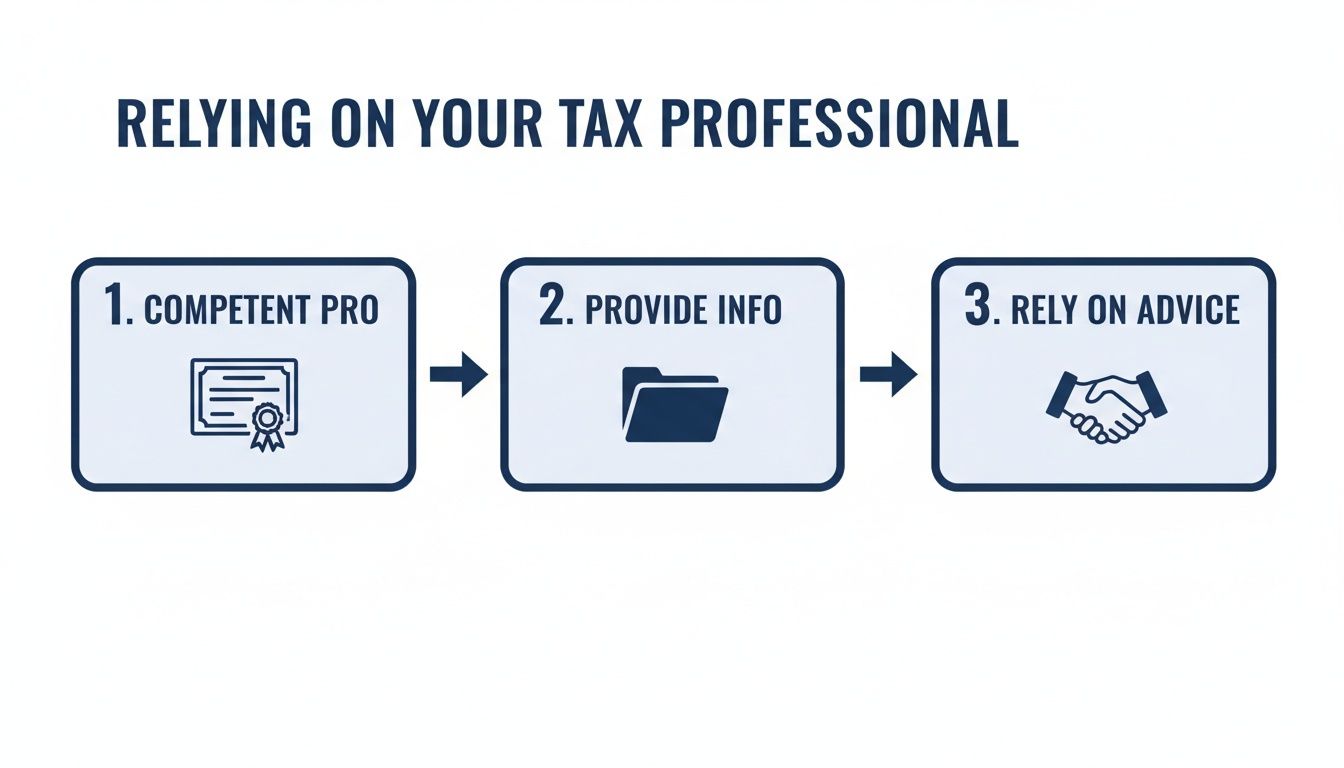
Think of it like a three-legged stool. If any one of the legs is weak or missing, your entire argument will come crashing down. To win, you have to prove your advisor was competent, that you gave them everything they needed to do the job right, and that you honestly trusted their advice. Nail all three, and you've shown the IRS you acted with "ordinary business care and prudence"—their words for doing what any sensible person would do.
The Three Pillars of Professional Reliance
To build a solid case based on professional reliance, your argument needs to rest securely on three pillars. Each one is absolutely critical to proving your case to the IRS.
- Your Advisor Was Competent: First, you have to show the person you hired actually knew what they were doing. This means they were a qualified CPA, enrolled agent, or tax attorney with a solid professional reputation.
- You Provided All Necessary Information: You can't hold back information—whether by accident or on purpose—and then point the finger at your advisor. You must have proof that you gave them complete and accurate records to work with.
- You Relied on Their Advice in Good Faith: This is a big one. It means you genuinely believed the advice was correct and followed it. If the advice sounded too good to be true or was obviously questionable, the IRS will argue that a reasonable person would have sought a second opinion.
This isn't just an IRS guideline; it's a legal standard hammered out in major tax court cases like Neonatology Associates v. Commissioner. The courts have consistently recognized that taxpayers aren't expected to be experts in the labyrinth of tax law, which makes relying on a professional a perfectly legitimate reason for penalty relief.
Demonstrating Competence and Due Diligence
So how do you prove all this? Proving your advisor was competent usually starts with their credentials and experience. A key aspect of a professional's ability to bolster your reasonable cause claim often lies in their use of efficient tools, such as robust and effective systems for meticulous organization and process management. These tools, like legal case management software, demonstrate a level of professionalism that supports your claim. Your job is to document everything.
Hold onto your engagement letters, save email chains, and keep notes from meetings. You need a paper trail that clearly shows you provided all the relevant data and did your part.
This documentation creates an undeniable record that you upheld your end of the bargain. If your tax pro then makes a substantive mistake, like misinterpreting a complex part of the tax code, you have a very strong argument for penalty relief. Our team at Defense Tax Partners helps clients organize and present this very evidence to build the strongest possible case. You can learn more at https://www.michigantaxattorneys.net/.
The data shows just how effective this defense can be. According to the Taxpayer Advocate Service, for certain complex international penalties handed out between 2018 and 2021, the abatement rate hit an incredible 84 percent by dollar value. This figure underscores just how often well-argued reasonable cause claims—many of which hinge on professional advice—are successful. You can dig into the specifics in the Annual Report to Congress.
A Step-by-Step Guide to Requesting Penalty Abatement
Figuring out that your situation qualifies for penalty relief is a huge win. But that’s just the first step. Now you have to formally ask the IRS to remove the penalties, and this is where the details really matter. You’ll need to be precise, communicate clearly, and back up your story with solid proof to successfully argue for an abatement of penalties reasonable cause.
The process can feel intimidating, but if you break it down into a few manageable steps, it becomes much easier. The goal is to present a logical, chronological, and compelling case that leaves the IRS with a clear picture of what happened.
Kicking Off the Process With IRS Form 843
For most written requests, your official starting point is IRS Form 843, Claim for Refund and Request for Abatement. This is the document that gets the ball rolling and tells the IRS exactly what you’re asking for and why.
The form itself is pretty straightforward, but Line 7, the "Explanation," is where you need to be strategic. While you'll attach a detailed letter, this box needs a concise summary of your request. Think of it as a headline for your case.
For example: "Requesting abatement of failure-to-file and failure-to-pay penalties for tax year 2022 due to reasonable cause (taxpayer's serious illness). A detailed explanation and supporting medical documents are attached."
Drafting a Persuasive Reasonable Cause Letter
The reasonable cause letter is the heart and soul of your request. This is your chance to tell your story, connect the dots for the IRS agent reviewing your file, and prove you acted as a responsible taxpayer would under the same difficult circumstances.
A powerful letter tells a clear story in three parts:
- The Timeline: Start by laying out the sequence of events chronologically. Be specific with dates. For instance, "On March 15, 2023, I was hospitalized after a serious car accident. I remained in the hospital until April 20, 2023, and was completely unable to manage my financial or personal affairs during this time."
- The Direct Impact: Next, draw a straight line from those events to your inability to file or pay on time. Don't make the agent guess. State it plainly: "My incapacitation during this critical period, which overlapped with the April 18, 2023 tax deadline, made it impossible to gather my records or file my return."
- The Road to Compliance: Finally, explain what you did to get back on track as soon as you could. This shows your good faith. For example, "I contacted my accountant the moment I was medically cleared in May 2023, provided all necessary documents, and filed my overdue return on June 1, 2023."
Expert Tip: Keep your letter factual, to the point, and professional. Avoid overly emotional language and stick to the facts of what happened. Your supporting documents will provide the objective proof to back up your words.
Assembling Your Supporting Documentation
Your letter tells the story, but your documentation proves it’s true. Without solid evidence, your request is just a claim. The exact documents you'll need depend on your specific reason for abatement, but they must always be clear, dated, and directly relevant to the timeline you've laid out.
Remember, a complete, well-organized package drastically improves your odds of getting a "yes" on the first try. Missing documents or a confusing explanation can lead to a quick denial, pushing you into the time-consuming appeals process.
The table below outlines some of the key documents you'll want to gather based on common reasons for non-compliance.
Essential Documentation for Your Claim
| Reason for Abatement | Primary IRS Evidence | Primary Michigan Evidence |
|---|---|---|
| Serious Illness/Death | Dated hospital records, a letter from a doctor on letterhead, death certificate. | Same as IRS; Michigan Form 5049 is often used for these requests. |
| Natural Disaster | Insurance claims, police/fire department reports, FEMA documentation, photos of damage. | State-level disaster declarations, insurance claims, contractor repair estimates. |
| Reliance on Professional | Signed engagement letter, proof of professional's credentials (CPA license, etc.), written correspondence showing the incorrect advice. | Correspondence and documentation proving you relied on the professional's guidance. |
Having these documents ready to go ensures your request is not only compelling but also verifiable, giving the tax authorities every reason to grant your request for relief.
Understanding the Financial Stakes of Your Claim

When you're trying to prove you had reasonable cause for a tax mistake, you're doing a lot more than just trying to get a late fee removed. You're defending yourself against penalties that can be financially devastating, sometimes even bigger than the tax you originally owed. Getting a handle on these numbers is key, because it shows just how critical it is to build a rock-solid, well-documented case.
The IRS doesn't see penalties as minor slap-on-the-wrist fees. They are serious financial punishments meant to ensure compliance. For too many people, these penalties can trigger a debt spiral that feels impossible to climb out of. A strong reasonable cause argument is often your best—and sometimes only—line of defense.
The High Cost of Serious Penalties
Just how high are the stakes? Very. The reasonable cause exception can protect you from accuracy-related penalties under Section 6662, which usually tack on a hefty 20 percent of the tax in question. It also applies to civil fraud penalties under Section 6663, which come with a crushing 75 percent penalty.
Think about it this way: if a dispute over a deduction ends up costing you an extra $10,000 in taxes, an accuracy-related penalty adds another $2,000. If the IRS alleges fraud, that penalty jumps to a staggering $7,500. You can find more detail about IRS penalties and reasonable cause on thetaxadviser.com.
Your reasonable cause letter isn't just an explanation; it's a financial shield that can stop thousands, or even tens of thousands, of dollars from being added to your bill.
A successful claim can mean the difference between a tax issue you can manage and a financial event that completely upends your life. The IRS is far more likely to hit you with these severe penalties if your explanation is weak, lacks proof, or if you don't provide one at all.
A Practical Example of the Impact
Let's break this down with a real-world scenario to see the difference a successful claim makes.
- Scenario: A small business owner accidentally underpays their taxes by $25,000 because of a complicated accounting error.
- Without Reasonable Cause: The IRS hits them with an accuracy-related penalty. That’s an extra $5,000 (20% of $25,000), bringing the total owed to $30,000, not including interest.
- With a Successful Claim: If the owner can prove they were relying on advice from a competent CPA who made an honest mistake, that entire $5,000 penalty can be wiped away. They would only owe the original tax.
This simple example shows a $5,000 savings. As the tax amounts and penalties get bigger, the savings become even more substantial, which is why getting professional help is often a smart investment.
Of course, penalty abatement only helps with the penalties. If the original tax debt is still a major hurdle, you might need to explore other solutions. You can learn more about what an Offer in Compromise is in our guide.
When Should You Bring in a Professional?
You can certainly handle minor tax hiccups on your own, but knowing when to call in a professional is a crucial judgment call. Trying to navigate a serious tax problem without the right expertise is like trying to fix your own transmission—the chances of making things worse are just too high. Certain situations are clear red flags, signaling the problem has moved beyond a DIY fix.
Spotting these red flags early can save you from costly errors, sleepless nights, and an outcome far worse than the original notice. If your case involves a mountain of penalties, a complex business setup, or a request that's already been shot down, it's time to get an expert in your corner.
High-Stakes Scenarios Demanding an Expert
Not all penalty notices carry the same weight. You should seriously consider hiring a tax attorney if your situation has any of these elements.
- Significant Penalty Amounts: If the penalties are staggering—we’re talking thousands or even tens of thousands of dollars—the financial risk of a failed abatement request is just too great to handle alone.
- Complex Business or International Issues: The tax code gets incredibly complicated when it involves partnerships, corporations, or foreign assets. One small misstep in these areas can unleash a tidal wave of penalties, making professional guidance an absolute must.
- Allegations of Fraud or Negligence: An IRS notice that mentions "fraud" or "negligence" is a five-alarm fire. These are serious accusations with severe consequences. You need a legal advocate to protect your rights and build a proper defense, period.
- A Previously Denied Request: If the IRS has already denied your request for an abatement of penalties reasonable cause, your only path forward is the appeals process. This is a formal, quasi-legal setting where having professional representation isn't just a good idea; it’s practically a prerequisite for success.
The Value a Tax Attorney Brings to Your Case
Hiring an experienced tax attorney from a firm like Defense Tax Partners is about so much more than just filling out paperwork correctly. It's about bringing legal firepower to the fight to get you the best possible result. A seasoned attorney knows the arguments that actually work with IRS agents and appeals officers. They can dissect your situation, pinpoint the strongest legal justifications, and frame your story in the most persuasive way.
A tax attorney is both your shield and your advocate. They take over all communications with the IRS, which keeps you from saying the wrong thing under pressure, and they make sure every deadline and procedural box is checked perfectly.
Ultimately, they run the entire show, from drafting the initial request to fighting for you in the appeals system if it comes to that. This frees you up to focus on your life while a pro works to safeguard your financial future. If you're dealing with a tough tax problem, the first step is finding the right representation. You can check out our guide on finding a tax attorney in various Michigan locations to learn more.
Common Questions About Reasonable Cause Penalty Relief
As you start pulling everything together for your penalty abatement request, some very practical questions are bound to pop up. Let's walk through some of the most common things taxpayers ask so you can confidently handle the final steps of the process.
What Is the Deadline for Requesting Penalty Abatement?
When it comes to the IRS, timing is everything. You generally have three years from the date you filed the tax return in question, or two years from the date you actually paid the tax, whichever is later.
This is a hard deadline set by the statute of limitations. If you miss it, you lose your chance to have the penalties reviewed, no matter how compelling your case is. That’s why it’s so important to act as soon as you realize there's a problem.
Can I Get Penalties Waived if I Still Owe the Tax?
Yes, and this is a point of confusion for many people. It’s a myth that you need to be fully paid up before you can ask for penalty relief. The IRS views the tax you owe and the penalties they charged as two distinct things.
While not having enough money to pay your taxes isn't a valid reason for filing late, it can absolutely be a reason to abate the failure-to-pay penalties. The goal is to show the IRS that you managed your financial affairs as responsibly as you could, but circumstances beyond your control still made it impossible to pay on time.
You can—and should—request penalty relief even if you're setting up a payment plan or exploring other tax debt solutions like an Offer in Compromise. These processes can run at the same time.
What Happens if the IRS Denies My Request?
A denial isn't a final "no." It's simply the end of the first round. If the IRS rejects your initial request, you have the right to appeal. This is a crucial step that moves your case to a different, independent division: the IRS Office of Appeals.
The job of an Appeals Officer is to resolve disputes fairly and avoid court. They often look at cases from a wider perspective, even considering the "hazards of litigation"—basically, the risk that the IRS might lose if you took them to court. This is where having a tax professional on your side can make a world of difference, as they know how to build the kind of legal argument that an Appeals Officer will find persuasive.
Does a Clean Tax Record Help My Reasonable Cause Claim?
It helps immensely. A good compliance history is the main requirement for something called a First Time Abatement, but it also adds serious weight to any reasonable cause claim. Think of it as character evidence.
A clean record tells the IRS agent that this mistake wasn't business as usual for you. It shows them you're a responsible taxpayer who was thrown off course by a major event, not someone who's careless or defiant. This simple fact adds a layer of credibility to your story and backs up your claim that you were acting with "ordinary business care and prudence" before life got in the way.
