
What Happens If IRS Audits You? A Michigan Guide
That envelope usually lands in the mailbox on an ordinary day.
You open it expecting a routine IRS notice, then your stomach drops. The letter says your return was selected for examination. You reread it twice, then start asking the same questions many taxpayers ask. Is this serious? Did I do something wrong? How much can this cost? What happens if IRS audits you and you do not know where to start?
That reaction is normal. People across Michigan call after getting a notice in Detroit, Lansing, Grand Rapids, Ann Arbor, and Oakland County with the same mix of fear and confusion. Some are wage earners who claimed a credit. Some run a business or work for themselves. Some have investment income, rental properties, or multiple entities. The common thread is that the letter feels personal, even when the audit process is largely procedural.
An audit is not the same thing as a criminal case. It is an examination of a tax return. But it can become expensive, time-consuming, and much broader if you handle the first few steps poorly. The taxpayers who usually fare better are the ones who slow down, read the notice carefully, and respond with a plan instead of panic.
The IRS Letter Arrived What Now
The first mistake I see is not fraud, carelessness, or missing paperwork. It is panic.
A taxpayer opens the notice, sees a response deadline, and either freezes or calls the IRS before understanding what the agency is asking for. That early phone call often does more harm than good. Once people start explaining from memory, they can box themselves into positions that documents do not support.
Start with the notice, not your fear
Look at four things first:
- Tax year involved: Audits are tied to specific returns and periods.
- What item the IRS questions: Income, deductions, credits, business expenses, filing status, or something else.
- How the audit will happen: By mail, in an IRS office, or in person at your home or business.
- Response deadline: Missing it gives the IRS control of the pace.
If your records are scattered, pause and create a file before answering anyone. A practical way to steady yourself is to use an organized document checklist. Even a general resource like this ultimate checklist for auditors can help you sort receipts, account statements, prior returns, and supporting records before you respond.
Tip: Do not send documents the IRS did not request. Oversharing can expand the scope of the audit.
What usually helps in the first day
A calm first response is almost always better than a fast emotional one. Pull your copy of the filed return. Compare it to the notice. Mark the exact line items the IRS appears to be testing.
Then ask a practical question. Can I prove this item cleanly with records?
If the answer is yes, the next move is organization. If the answer is no, you still have options, but the strategy changes. You may need to reconstruct records, narrow the issue, or decide whether representation is necessary before the audit gets further along.
Understanding Audit Triggers and Types
Most taxpayers want to know why this happened. Sometimes the answer is obvious. Sometimes it is not.
The IRS does not audit only wealthy taxpayers, and it does not audit only people accused of cheating. The agency audits a small slice of filed returns overall, but the financial stakes are real. The odds of an IRS audit are approximately 4 out of every 1,000 returns, taxpayers earning over $1 million face audit rates of 1% to 11%, the IRS also frequently audits returns claiming the Earned Income Tax Credit, and in fiscal year 2024 the IRS closed 505,514 audits resulting in over $29.0 billion in recommended additional tax according to the IRS compliance presence statistics.
Why returns get selected
Some audits start because a return does not match third-party reporting. W-2s, 1099s, brokerage statements, and business reporting often create easy comparison points.
Others start because something on the return looks unusual compared with similar taxpayers. Large deductions relative to income, business losses, complex credits, or self-employment entries often get closer review.
Then there are related audits. If the IRS examines a partnership, S corporation, or another taxpayer tied to your transactions, your return can get pulled in too.
The three main audit types
Think of these like levels of medical review. A correspondence audit is closer to a follow-up question. An office audit is more like a specialist appointment. A field audit is the full workup.
| IRS Audit Types Compared | Method | Scope | Typical Issues |
|---|---|---|---|
| Correspondence audit | Narrow | Missing support for credits, deductions, or income matching issues | |
| Office audit | In-person at IRS office | Moderate | Business expenses, rental activity, itemized deductions, multiple questioned items |
| Field audit | IRS examines records at your home, business, or representative’s office | Broad | Businesses, high-income returns, complex income streams, books and records review |
What each type means in practice
Correspondence audit
This is the least intrusive on paper, but it still deserves care. The IRS asks for proof of specific items. If your response is complete, the case can stay narrow. If your response is vague or disorganized, the examiner may push for more.
Office audit
An office audit usually means the IRS wants context, not just paperwork. The examiner can ask follow-up questions in real time. That creates more risk for taxpayers who speak casually or guess.
Field audit
A field audit is the one many taxpayers should consider serious from day one. The agent may want to understand how a business operates, how records are kept, and whether reported numbers match day-to-day reality. If you are facing one, this overview of what is a field audit helps explain why the setting and preparation matter.
Key takeaway: The type of audit tells you how much control you still have. The more intrusive the format, the more important strategy becomes.
The IRS Audit Process from Notice to Resolution
Once the audit starts, the path usually follows a predictable sequence. That is good news. A structured process is easier to manage than a vague threat.
Here is the roadmap most taxpayers are dealing with when they ask what happens if IRS audits you.
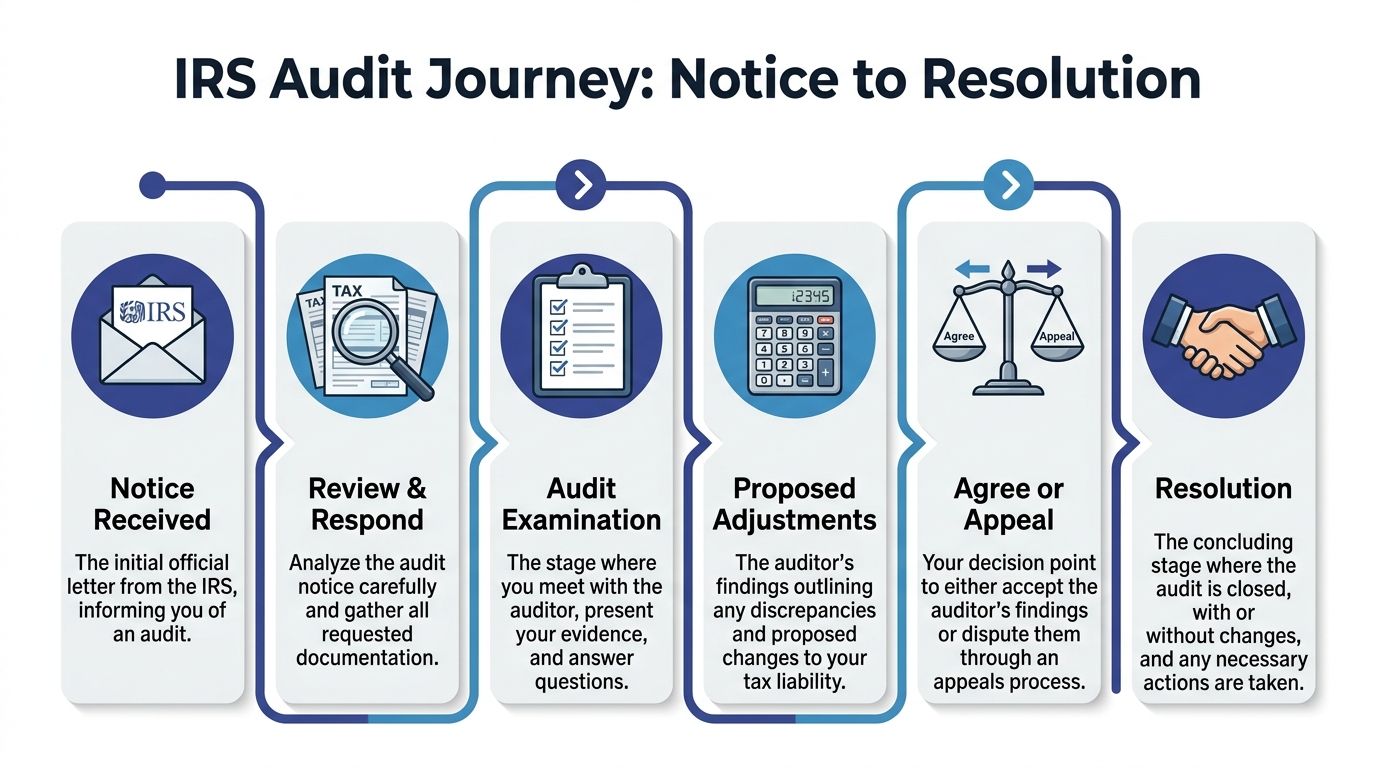
Step one, read the notice exactly as written
The notice identifies the year under examination and the issues the IRS wants to review. Sometimes it asks only for documents. Sometimes it schedules a meeting. Sometimes it signals that the IRS already sees a mismatch and expects you to disprove it.
This first letter matters because it sets the initial boundaries. If the return issue is narrow, your response should stay narrow too.
Step two, gather documents by issue
Do not collect records in random stacks. Build your file around each disputed item.
A clean audit file often includes:
- Return copy: The filed return and all schedules.
- Income support: W-2s, 1099s, K-1s, brokerage records, or bookkeeping reports.
- Expense proof: Receipts, invoices, canceled checks, bank statements, and credit card statements.
- Explanatory records: Mileage logs, calendars, ledgers, closing statements, or entity documents.
- Prior correspondence: Any IRS letters already received on the same matter.
Step three, prepare for contact with the examiner
If the audit is by mail, the quality of your written response often shapes the entire case. If the audit is in person, preparation becomes even more important.
A common mistake is answering the question the taxpayer thinks the IRS meant to ask. Answer only the question the notice asks.
Another mistake is trying to “tell the whole story” in a long, emotional letter. Auditors do not grade sincerity. They evaluate substantiation and consistency.
Tip: If a document hurts your position, do not hide it. But do not lead with unnecessary explanations before you understand the legal issue.
Step four, the examination phase
During an office or field audit, the examiner reviews records, asks questions, and may request more documentation. At this stage, the audit can either stay contained or widen.
The practical rules are simple:
- Answer accurately: Never guess.
- Keep it tight: Do not volunteer unrelated facts.
- Request time when needed: It is better to supplement later than to speculate.
- Track every request: Keep a written log of what the IRS asked for and when you provided it.
If you want a realistic sense of timing, this explanation of how long does a IRS audit take is useful because many taxpayers assume the process ends quickly when it often does not.
Step five, proposed changes
If the examiner disagrees with part of the return, the IRS issues a Notice of Proposed Adjustment. That notice lays out additional tax, interest, and penalties. According to Gordon Law, the interest is compounded daily at the federal short-term rate plus 3%, penalties are often 20%, and the taxpayer generally has a 30-day window to protest to IRS Appeals. The same source notes that expert representation can result in full concessions in about 43% of cases, and if the finding is not appealed the matter can move to a 90-day deficiency notice and eventually to liens or levies through automated collection as described here.
Step six, agreement, appeal, or litigation posture
At this point, the case usually goes one of three ways.
You agree
You sign and work on payment or resolution.
You partly agree
You accept some changes and challenge others.
You disagree
You pursue an administrative appeal and, if necessary, prepare for Tax Court once a statutory notice is issued.
The right choice depends on the records, the legal issue, and the amount at stake. What does not work is silence. Once deadlines pass, the IRS gets procedural advantages that are hard to unwind later.
Navigating the Spectrum of Audit Outcomes
Many taxpayers imagine only two endings. You win or you lose. Real audit outcomes are more varied than that.

Best outcome, no change
A no-change result means the IRS accepts the return as filed after reviewing the records. That is the cleanest resolution. It happens when the taxpayer can substantiate the questioned items or the examiner concludes the original treatment was correct.
This is why organization matters so much. A well-supported return gives the auditor less room to make assumptions.
Middle outcomes, agreed or partially agreed adjustments
Many audits end with some adjustment, but not every adjustment means disaster. Sometimes the issue is limited to one deduction category, one credit, or one reporting error.
An agreed case means the taxpayer accepts the proposed changes. A partially agreed case is more nuanced. You may accept a disallowed expense category but still dispute a penalty, a credit denial, or the IRS’s calculation.
Hard outcomes, penalties and collection pressure
When the IRS concludes the return contained serious errors, the consequences can escalate fast. According to Polston Tax, the IRS can pursue severe consequences for fraudulent returns, including up to three years of imprisonment and fines up to $100,000. The same source explains that the normal audit period is three years, extends to six years when gross income was underreported by more than 25%, and there is no time limit for fraudulent returns. It also notes the IRS may impose a 20 percent penalty for incorrectly claimed credits in its discussion of audit penalties.
That does not mean every audit carries fraud risk. Most do not. But when a case involves altered records, omitted income, fabricated deductions, nominee accounts, or false explanations, the danger changes.
What drives the outcome
A few factors usually determine where an audit lands:
- Quality of records: Can you prove the number on the return.
- Consistency: Do your documents match your explanation.
- Scope control: Did the audit stay on the original issue or spread.
- Behavior during the audit: Guessing, exaggerating, and hiding records make cases worse.
- Legal posture: Some disputes are factual. Others turn on how tax law applies.
Key takeaway: The most expensive audit is often not the one with the worst original facts. It is the one handled badly after the notice arrives.
If the IRS assesses additional tax and the matter is not resolved, collection tools can follow. Liens affect property and borrowing capacity. Levies can reach wages and bank accounts. By the time a case gets to that stage, the best opportunities to narrow the dispute have usually already passed.
Your Taxpayer Bill of Rights and Immediate Actions
People often respond to an audit as if the IRS can demand anything, anytime, in any way. That is not how the system works.

You have rights during an audit, including the right to be informed, the right to challenge the IRS position, the right to appeal, the right to privacy, and the right to representation. In practical terms, those rights matter most in the first few days after the notice arrives.
The rights that matter most in an audit
The right to representation
You do not have to manage direct IRS communication alone. Filing Form 2848, a power of attorney, allows a representative to step in for you.
The right to finality
The IRS generally has a limited period to audit a filed return. That matters when an examiner asks you to sign extensions.
The right to challenge the IRS position
You can submit records, explanations, legal arguments, and appeal adverse findings.
What to do in the first 24 to 48 hours
- Read the notice slowly. Confirm the tax year, issues, and deadline.
- Pull the filed return. You cannot defend what you have not reviewed.
- Preserve records. Do not throw anything away, even if it looks minor.
- Stop casual calls. Do not phone the IRS just to “see what this is about.”
- Create a chronology. Note when the return was filed, who prepared it, and what documents support the disputed items.
- Separate facts from assumptions. Many taxpayers assume the IRS is questioning one issue when the notice shows another.
- Decide whether to use a representative. This is especially important for in-person audits, multi-year issues, and business returns.
What not to do
- Do not ignore the letter: Deadlines matter.
- Do not alter records: Reconstruction is allowed. Fabrication is not.
- Do not send originals unless specifically required: Keep your own file complete.
- Do not sign extensions automatically: Understand why the IRS wants more time.
According to Patriot Software, the IRS generally has a three-year statute of limitations to audit a return, but disorganized records often lead taxpayers to sign Form 872 to extend that period. The same source notes that filing Form 2848 can stop direct IRS contact and allow a representative to handle communications and negotiate penalty relief as discussed here.
Tip: Signing an extension is sometimes useful. It is not automatically bad. But you should know what you gain and what you give up before agreeing.
When You Should Hire a Tax Attorney
Some audits are manageable without legal representation. Others are not.

The hard part for most taxpayers is recognizing which kind they have. By the time it becomes obvious, they may already have made avoidable mistakes.
Clear signs the audit is too risky for DIY
Field audit notice
If the IRS wants to examine records at your business or dig into operations, this is no longer a simple substantiation exercise.
Multiple years under review
A dispute over one year can turn into a pattern case. That raises the stakes quickly.
Business ownership or self-employment
Business audits often involve income reconstruction, expense substantiation, payroll issues, or owner draws. Those cases can widen fast.
Fraud indicators or aggressive language in notices
If the IRS seems to be focusing on omitted income, fabricated deductions, altered records, or intentional conduct, you should treat the matter carefully.
Large proposed adjustments
The larger the adjustment, the less room there is for trial-and-error communication.
What an attorney changes
A tax attorney does more than explain forms. Good representation helps control scope, frame the facts, and keep the case from drifting into avoidable admissions.
That can mean:
- handling examiner communication
- organizing and presenting records
- pushing back on unsupported adjustments
- evaluating penalty exposure
- preparing an appeal if the examination result is wrong
- coordinating federal and state responses when the case affects both
For Michigan taxpayers who want someone else to deal directly with the IRS during an audit, an IRS audit representative can step into that role through the proper authorization.
Defense Tax Partners is one option for Michigan residents and businesses who need federal audit representation and related state tax defense. The firm handles audit communications, response strategy, penalty issues, and parallel Michigan Treasury matters.
Attorney or CPA
Sometimes a CPA is the right first call, especially when the issue is narrow and heavily document-based. A tax attorney becomes especially important when the case involves legal dispute, fraud risk, privilege concerns, collections exposure, appeals, or overlapping state consequences.
Protecting Your Assets in Michigan After an IRS Audit
Many national articles stop at the federal result. For Michigan taxpayers, that is where the second problem often begins.
A federal audit does not always stay federal. Michigan often learns about IRS adjustments through data-sharing, and the state can use that information to review your state return too.
The Michigan ripple effect is real
If your federal taxable income changes, your Michigan return may need to change as well. That sounds simple. It rarely feels simple in practice.
The problem is timing. Taxpayers are often so focused on the IRS outcome that they miss the state follow-up window.
According to Super Lawyers, Michigan's conformity rules require taxpayers to file an amended state return within six months of a federal audit's closure to avoid additional state penalties. The same source notes that data-sharing between the IRS and the Michigan Department of Treasury often alerts the state to federal changes, and over 15% of IRS small business audits lead to subsequent state tax adjustments in this discussion of audit consequences.
Why Michigan cases get more complicated
Michigan tax issues often spread beyond individual income tax.
A federal business adjustment can trigger questions about:
- Sales tax compliance
- Payroll withholding
- Pass-through entity reporting
- Owner compensation and distributions
- Residency and allocation issues
That is why Michigan audit defense often requires one coordinated plan instead of two separate reactions.
What works better than waiting
Taxpayers sometimes assume they should wait for Michigan to contact them. That is usually the wrong instinct.
A controlled amendment, filed at the right time and with the right framing, often puts you in a better position than letting the state discover the issue on its own. Waiting can limit your options and increase penalty exposure.
Key takeaway: When the IRS changes your return, ask immediately whether Michigan must be addressed too. Do not assume the federal closing letter ends the matter.
Frequently Asked Questions About IRS Audits
Can an IRS audit lead to criminal charges?
Usually, no. Most audits stay civil. The risk changes if the IRS sees signs of intentional fraud, false documents, concealed income, or knowingly false explanations. If those facts are in play, treat the case cautiously and get legal advice before making statements.
What if I cannot pay after the audit ends?
You still need to address the liability. Ignoring an assessed balance can lead to collection action. Depending on the facts, taxpayers may be able to pursue payment arrangements, penalty relief, or other resolution options. The key is acting before liens or levies gain momentum.
Can my spouse be affected if we filed jointly?
Yes. A joint return generally creates joint exposure. In some situations, one spouse may have arguments for relief from some or all of the liability, especially where the other spouse controlled the finances or the reporting issue was not shared.
What if identity theft affected my return?
Identity theft cases require a different response because the audit may be tied to false filings, income misreporting, or account confusion that was not your doing. These cases usually need both correction of the IRS record and careful handling of proof issues.
Should I attend the audit interview myself?
Not always. For straightforward matters, attendance may be appropriate. For in-person examinations, business audits, or cases involving judgment calls, it is often better to have a representative manage or tightly control communication.
What happens if IRS audits you and you did make a mistake?
Then the goal shifts. You focus on limiting scope, proving what you can prove, correcting what needs correction, and reducing penalties where the facts support it. Trying to bluff through an error usually makes the result worse. Owning the issue strategically is often the better path.
If you received an IRS audit notice in Michigan, the most important move is usually the next one. Read the letter carefully, preserve your records, and treat the federal and state consequences as one connected problem, not two separate surprises.
