
Innocent Spouse vs Injured Spouse Relief Explained
The difference between innocent spouse and injured spouse relief really boils down to one question: are you dealing with a tax debt or a seized tax refund?
Innocent spouse relief, filed using Form 8857, is your defense when the IRS says you owe more tax because of your spouse's mistake on a joint return. On the other hand, injured spouse allocation, which uses Form 8379, is what you need when your share of a tax refund gets taken to pay your spouse’s separate, old debts.
Understanding Your Options for Joint Tax Debt

When you file a joint tax return, you and your spouse are both on the hook for the entire tax bill. The IRS calls this "joint and several liability," a legal term that gives them the power to collect the full amount from either of you—it doesn't matter who earned the income or made the error. For many Michigan taxpayers, this rule can turn into a nightmare when an old tax problem suddenly comes back to life.
These protections aren't just a recent invention. Congress expanded these relief programs back in 1998 after realizing that an estimated 1.25 million joint filers were getting hit with extra tax bills, often leaving one spouse to pay for mistakes they had no idea even existed.
Differentiating the Two Paths to Relief
The specifics of your situation will determine which path to take. This isn't just about filling out a different form; these two options solve completely different financial problems. A solid understanding of Innocent Spouse Relief is a great starting point for anyone facing a joint tax liability.
- Innocent Spouse Relief is your tool for tackling tax liabilities. You'd use this when you feel you shouldn't be held responsible for an understated tax bill that came from your spouse's unreported income or illegitimate deductions.
- Injured Spouse Allocation is all about getting your seized refund back. This applies when your joint refund is intercepted to cover separate debts your spouse owes, like overdue student loans, back child support, or state income tax.
For a clearer picture, this table highlights the fundamental differences.
Quick Guide Innocent Spouse vs Injured Spouse
| Relief Type | Core Problem It Solves | IRS Form to File | Key Goal |
|---|---|---|---|
| Innocent Spouse | You are being held liable for tax debt from your spouse's errors on a joint return. | Form 8857 | To get relief from paying tax, interest, and penalties you did not cause. |
| Injured Spouse | Your share of a joint tax refund was seized to pay for your spouse's past-due debts. | Form 8379 | To reclaim your portion of a refund that was unfairly taken. |
Choosing the wrong form is a common mistake that leads to an automatic denial from the IRS. This can cause frustrating delays and might even put you at risk of missing strict filing deadlines. When the situation gets complicated, it’s crucial to know all the available solutions. For instance, our guide on what an Offer in Compromise is explores another potential strategy for handling significant tax debt: https://www.michigantaxattorneys.net/blog/what-is-an-offer-in-compromise/.
Innocent vs. Injured Spouse Relief: Understanding Who Qualifies for What
When you're dealing with a tax issue stemming from a joint return, figuring out your options can feel overwhelming. Two common solutions are innocent spouse relief and injured spouse allocation, but they address completely different problems. The eligibility rules are strict, and you can't qualify for both in the same tax year, so getting it right from the start is absolutely crucial.
The fundamental difference comes down to the nature of the tax problem. Innocent spouse relief is for when there’s a tax understatement—a fancy way of saying you owe the IRS more money than you reported. On the other hand, injured spouse allocation is for when you’re dealing with an overpayment—your refund—that the government seized to pay off your spouse's separate debt.
Eligibility for Innocent Spouse Relief
To even be considered for innocent spouse relief, you have to meet a few basic conditions. First, you must have filed a joint return that has an understated tax liability. Second, you generally need to file your claim within two years from the date the IRS first tried to collect that tax from you.
From that starting point, the path splits into three distinct types of relief, which were established under IRC Section 6015 back in 1998. This framework is a critical safeguard, especially since the U.S. is one of the few developed countries that still strictly enforces joint and several liability for married couples.
Here are the three avenues you can pursue:
Traditional Innocent Spouse Relief: This is for situations where your spouse (or ex-spouse) messed up—they either didn't report income, or they claimed deductions or credits they shouldn't have. The burden is on you to prove you didn't know about it and had no reason to know. The IRS will also evaluate whether it would be fundamentally unfair to make you pay.
Separation of Liability Relief: This option literally separates the tax debt between you and your spouse. To qualify, you must be divorced, legally separated, or have lived apart for at least 12 months. If approved, you’re only on the hook for the portion of the tax debt connected to your own income and deductions.
Equitable Relief: Think of this as the safety net. It's the most flexible option and might apply if it would be unfair to hold you liable for the tax debt, even if you don't technically meet the rules for the other two types. We often see this come into play in difficult situations involving spousal abuse or extreme financial control.
The "reason to know" test is a major hurdle in many innocent spouse cases. The IRS will look at your education level, financial situation, and involvement in the family finances to determine if you should have been aware of the tax error.
Sorting through these complex rules requires a solid grasp of tax law. For a deeper dive, check out our guide on what is innocent spouse relief to see how your specific situation stacks up.
Eligibility for Injured Spouse Allocation
Compared to the maze of innocent spouse rules, the criteria for injured spouse allocation are much more straightforward. That’s because the issue itself is simpler. You aren’t asking the IRS to forgive a debt; you're just asking for your fair share of a tax refund that was taken.
To qualify as an injured spouse, you have to check all of these boxes:
- You filed a joint tax return. This relief is only for couples who filed together.
- You are not legally obligated to pay the past-due debt. The debt must belong solely to your spouse. Common examples include their federal student loans, state income tax from before your marriage, or past-due child support.
- You made and reported tax payments. You need to show you had federal income tax withheld from your paycheck or made estimated tax payments during the year.
- You reported income. You must have earned income that was included on that joint tax return.
The whole point is to demonstrate to the IRS that a portion of the total refund belongs to you because you earned income and paid your own taxes. The IRS then "allocates" or splits the refund based on each spouse's financial contribution. It's not a simple 50/50 split; it’s a specific calculation based on the numbers.
Eligibility Checklist Innocent vs Injured Spouse
Seeing the requirements side-by-side really clarifies which path you should be on. Each factor points toward a different form and a completely different strategy.
| Eligibility Factor | Innocent Spouse Relief (Form 8857) | Injured Spouse Allocation (Form 8379) |
|---|---|---|
| Type of Tax Issue | Tax understatement (you owe more tax) | Refund offset (your refund was seized) |
| Marital Status | Can be married, divorced, or separated. | Must have filed a joint return. |
| Knowledge Requirement | You must prove you didn't know about the error. | Your knowledge of the debt is irrelevant. |
| Spouse's Debt | The debt is a joint tax liability on the return. | The debt is a separate, past-due obligation of your spouse. |
| Your Financial Input | Not a direct requirement, but lack of benefit helps. | You must have paid taxes and earned income. |
Ultimately, choosing between innocent spouse and injured spouse relief boils down to these eligibility rules. A simple misinterpretation can lead to a denied claim and a lot of wasted time, leaving you exposed to IRS collections or forcing you to forfeit a refund you rightfully earned.
Navigating the Application Process and Deadlines
Successfully getting tax relief is about much more than just filling out a form. You have to understand the deadlines, pull together the right documentation, and be prepared for the IRS review process. The path you take—innocent spouse or injured spouse—determines every action, and one wrong move can mean a denied claim and a lost opportunity.
When it comes to innocent spouse relief, the clock starts ticking immediately. You generally have a strict two-year window to file Form 8857 from the date the IRS first tries to collect the tax from you. That "first collection activity" could be a formal notice of intent to levy or even the seizure of your state tax refund. This deadline is unforgiving and a common reason why otherwise valid claims fail.
This decision tree can help you figure out which path is the right one for your situation.
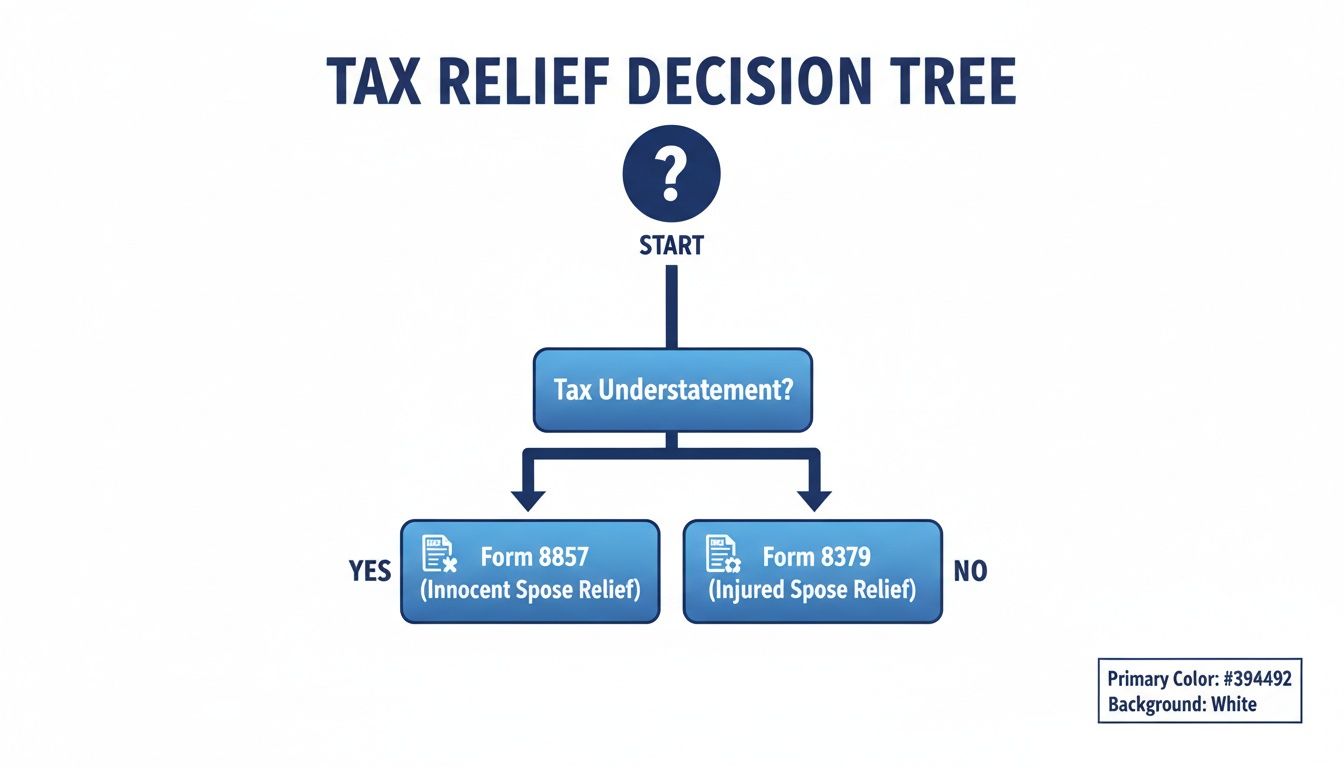
The visual guide gets straight to the point: a tax understatement is handled with Form 8857 for innocent spouse relief, while a seized refund is addressed with Form 8379 for injured spouse allocation.
Building Your Innocent Spouse Case
Submitting Form 8857 is just the opening move. You'll need to provide a detailed, well-written statement explaining exactly why you qualify. This is your chance to build a compelling narrative, but it has to be backed up with solid proof.
The IRS will put your claim under a microscope, paying close attention to your argument that you had no knowledge—or "reason to know"—of the tax error. Your supporting documentation is absolutely vital.
Evidence that can make or break your case includes:
- Financial Records: Bank statements, loan applications, and other financial papers can show that you didn't personally benefit from the unpaid tax.
- Proof of Separation: If you're seeking Separation of Liability relief, a divorce decree or legal separation agreement is non-negotiable.
- Evidence of Duress: For cases involving spousal abuse or financial control, documents like police reports or court orders are critical to securing Equitable Relief.
Keep in mind, the IRS is legally required to notify your spouse (or ex-spouse) about your claim. They will get a chance to submit their own information, which can turn an already stressful process into a contentious and complicated one.
Filing for Injured Spouse Allocation
The application for injured spouse allocation using Form 8379 is typically a less adversarial process, but it still demands accuracy. Here, the goal is simple: prove what percentage of the joint refund truly belongs to you.
The timeline is also more generous. You have three years from the original return's due date (including extensions) or two years from the date you paid the tax, whichever is later, to file your claim.
You can file Form 8379 in one of two ways:
- With Your Joint Tax Return: If you know your refund is likely to be seized, you can file Form 8379 proactively right along with your Form 1040.
- By Itself After an Offset: If the refund seizure came as a surprise, you can file Form 8379 on its own to get your portion back.
To support your claim, you'll need documents that clearly separate your income and tax payments from your spouse's. This means W-2s, 1099s, and any records of estimated tax payments for both of you. The IRS doesn't just split the refund 50/50; they perform a specific calculation to determine your rightful share.
The IRS Review and What to Expect
Once you submit your paperwork, each claim follows a very different journey. An injured spouse claim filed with a tax return is a relatively straightforward numerical review, often processed within 11-14 weeks.
An innocent spouse claim, on the other hand, triggers a much deeper investigation that can easily take six months or more. The IRS will dig into your financial history for the years in question, evaluate the evidence you've provided, and consider any information submitted by your spouse.
The result could be full relief, partial relief, or an outright denial. A thoroughly documented, professionally prepared application is your single best defense against long delays and a negative outcome.
Deciding Which Relief Option Fits Your Situation
The rules and checklists are one thing, but figuring out where you stand in the innocent spouse vs. injured spouse debate really comes down to your specific circumstances. The right choice often becomes obvious once you see how these options play out in the real world. By walking through a couple of common scenarios Michigan taxpayers run into, you can start to see which path makes the most sense for you.
At its core, the distinction is pretty straightforward. Are you being hit with a notice for a new tax debt you didn't know about, or has the IRS intercepted a refund you were counting on? Just answering that one question will point you toward the right form and the right strategy almost every time.
Scenario 1: Innocent Spouse Relief in Detroit
Let's picture someone in Detroit who just finalized a difficult divorce. Out of the blue, they get a CP2000 notice from the IRS demanding an extra $25,000 in taxes from a joint return they filed with their ex two years ago. After a little digging, they find out their former spouse conveniently forgot to report a huge chunk of income from a side business.
The Detroit resident was completely in the dark. Their ex handled all the finances, was secretive about money, and none of that extra cash ever made it into their joint account. The problem here is a tax understatement—a brand-new debt created entirely by their ex-spouse's actions.
- The Problem: An unexpected tax bill caused by an ex-spouse's unreported income.
- The Solution: File Form 8857, Request for Innocent Spouse Relief.
- The Goal: To demonstrate to the IRS that they had no knowledge or "reason to know" about the hidden income, and that it would be completely unfair to make them pay that $25,000 debt.
This is a textbook case for innocent spouse relief. Trying to file an injured spouse claim here would be a waste of time because there's no refund to protect—only a new liability to fight.
Scenario 2: Injured Spouse Allocation in Grand Rapids
Now, imagine a married couple from Grand Rapids. They both have jobs, and both have federal taxes withheld from their paychecks. They file their joint return and are looking forward to a $4,000 refund. But instead of a check, they get a letter from the Treasury Offset Program (TOP). The notice explains their entire refund was taken to cover the husband's old, defaulted federal student loan from long before they were married.
The wife has absolutely no legal connection to that debt. Her income and withholdings are what generated a large portion of that $4,000 overpayment.
- The Problem: Their joint tax refund was seized to pay one spouse's separate, pre-existing debt.
- The Solution: File Form 8379, Injured Spouse Allocation.
- The Goal: To get back her share of the refund by showing the IRS exactly how much of the overpayment came from her wages and withholdings.
This is a clear-cut situation for an injured spouse claim. There isn't a new tax debt; the issue is all about a refund that was unfairly seized.
The bottom line is all about context. An IRS notice demanding more money points toward Innocent Spouse Relief. A letter about a confiscated refund is a direct signal to file for Injured Spouse Allocation. Using the wrong form for your problem is a guaranteed denial.
When the Situation Isn't So Clear-Cut
Of course, life is rarely that simple. What happens if a spouse technically knew about the tax issue but was coerced or threatened into signing the return? In a situation like that, they might not meet the strict "no reason to know" test for traditional innocent spouse relief.
However, they could still be a candidate for Equitable Relief, which is the most flexible category under the innocent spouse umbrella. Equitable relief allows the IRS to look at the entire picture—all the facts and circumstances—to decide if it would simply be unfair to hold that spouse responsible for the debt. It's a critical safety net for messy and difficult cases.
Choosing the right path from the very beginning is the most important step you'll take. If your situation lines up neatly with one of these examples, you have a solid starting point. But if your case has overlapping issues or other complicating factors, getting professional advice is the only way to ensure you're protecting yourself and your finances.
How Michigan State Tax Debts Impact Federal Relief
For Michigan residents, resolving a tax problem with the IRS often feels like crossing the finish line, but it can be just half the battle. Your federal tax situation is tightly woven with your state obligations, and a debt with one can easily trigger collections from the other. This link is most obvious when the Treasury Offset Program (TOP) comes into play.
The TOP is a powerful federal program that can intercept your federal tax refund to pay off certain past-due debts. While people often think of it for things like student loans, it's also used to collect delinquent state income taxes. This means an old debt with the Michigan Department of Treasury can stop your IRS refund in its tracks, even if you're completely up-to-date with the feds.
The Role of the Treasury Offset Program
This is where the innocent spouse vs. injured spouse distinction becomes so important. An injured spouse claim is your first line of defense against a TOP seizure. It's specifically designed to protect your share of a joint refund from being taken for a debt that isn't yours.
For instance, say your joint IRS refund is grabbed to pay off your spouse's old Michigan tax bill from before you were married. Form 8379 is exactly what you need to get your portion back. It forces the IRS to figure out how much of the refund came from your income and payments and then issue that share directly to you.
When a joint tax refund is issued, it can be automatically offset for all sorts of things, including past-due federal taxes, state taxes, child support, or other federal nontax debts. An injured spouse claim is how you claw back your share of that seized refund. This is critical to remember, because innocent spouse relief doesn’t protect refunds or overpayments—it only deals with the underlying tax liability itself. You can find more details on how this process works at Rudler.cpa.
Michigan's Own Innocent Spouse Rules
While an injured spouse claim can shield your federal refund from a state debt, it does absolutely nothing to resolve the state tax liability itself. Michigan has its own version of innocent spouse provisions that are similar—but not identical—to the federal rules. This can create a two-front battle that demands a coordinated strategy.
You might win innocent spouse relief from the IRS for a joint federal tax debt, only to discover the Michigan Department of Treasury is still coming after you for the state portion. The state won't automatically grant you relief just because the IRS did. You have to file a separate, formal request with Michigan's tax authorities.
Navigating both IRS and Michigan state tax relief requires a deep understanding of two different systems. A victory at the federal level offers no guarantee of success with the state, making a local expert's guidance essential for complete protection.
Failing to tackle both liabilities can leave your personal assets exposed. The state has significant enforcement power, and understanding how to stop state tax garnishment is a key part of any complete defense plan. The specific knowledge a local tax firm brings to the table is a major advantage in protecting your wages, bank accounts, and property from both federal and state collectors.
When You Need a Professional Tax Advocate

The IRS makes forms 8857 and 8379 available to everyone, but don't let that fool you. Trying to navigate the innocent spouse vs. injured spouse rules on your own can be a high-stakes gamble. The regulations are tangled, the proof they demand is specific, and one small mistake could get your claim denied, leaving you on the hook for a huge tax bill or a lost refund.
It’s crucial to know when you can handle this yourself and when it’s time to call in a professional. Certain situations are immediate red flags, and if you see them in your case, seeking legal counsel isn't just a good idea—it’s a necessary step to protect your financial future.
Red Flags That Demand Professional Guidance
A simple, clear-cut injured spouse claim might be something you can manage. But the second things get complicated, the risks shoot up. Innocent spouse cases, in particular, are put under a microscope by the IRS and almost always have a better shot with an expert on your side.
Here are the key signs that you need a tax attorney:
- The Tax Debt is Large: When the liability is substantial, you can be sure the IRS will put more resources into investigating it. An attorney knows how to build a rock-solid, evidence-backed case that can withstand that intense level of scrutiny.
- You Suspect Fraud or Hidden Assets: If you believe your spouse was intentionally dishonest with the IRS—hiding income, inventing deductions—proving you had no knowledge of it becomes infinitely more difficult. A tax lawyer understands how to uncover the right evidence to separate you from any fraudulent activity.
- Your Claim Was Already Denied: If the IRS has already said no, your next move might be appealing to the U.S. Tax Court. That isn’t just more paperwork; it’s a formal legal proceeding where professional representation is essential.
- You're Dealing with an Uncooperative or Hostile Ex-Spouse: The IRS has to notify your spouse or ex-spouse when you file for innocent spouse relief. If you expect them to fight your claim or lie, an attorney can step in to manage those communications and build a counter-argument to protect you.
A professional tax advocate does far more than fill out forms. They are skilled negotiators who speak the IRS's language, anticipate roadblocks, and craft a compelling narrative that shields your income and assets from seizure.
The Strategic Advantage of Legal Counsel
An experienced tax attorney from Defense Tax Partners doesn’t just read the tax code; they understand how IRS agents right here in Michigan think about and handle these exact types of cases. We know how to frame your story in the strongest possible light, ensuring your application is complete, persuasive, and filed correctly from the start.
This kind of expert guidance dramatically increases your chances of success, giving you much-needed peace of mind and a clear strategy to move forward.
Common Questions We Hear All the Time
When you're dealing with a joint tax issue, confusion is completely normal. The rules for innocent spouse relief versus injured spouse allocation can be tricky, and getting them right is essential to protecting your finances. Let's walk through some of the questions our clients ask us most frequently.
Can I Still File for Innocent Spouse Relief if I’m Not Divorced?
Yes, absolutely. Many people mistakenly believe you have to be divorced or separated to qualify, but that’s not always the case. You can be granted innocent spouse relief or equitable relief even if you are still married and living with your spouse.
The key isn't your marital status itself, but whether you can prove you meet the other requirements. The IRS will focus on whether you genuinely didn't know about the understated tax and if holding you responsible for it would be patently unfair.
What if I Accidentally File the Wrong Form?
This is a critical mistake you want to avoid. If you file the wrong form—like sending in Form 8379 for an innocent spouse issue—the IRS will simply deny your claim. They won't look at the details and redirect it for you.
This kind of procedural error creates major setbacks. You’ll face significant delays while interest and penalties continue to grow on the tax debt. Worse, you could blow past the strict filing deadline for the correct form, losing your chance for relief entirely.
Choosing between Form 8857 (Innocent Spouse) and Form 8379 (Injured Spouse) is the first hurdle. Getting it wrong stops the process cold before anyone even looks at the merits of your case.
How Long Does It Take to Get a Decision?
The timelines for these two claims are worlds apart, mostly because one is a simple calculation and the other is a full-blown investigation.
Injured Spouse Claim (Form 8379): This one is much faster. When filed with your tax return, the IRS usually processes it in about 11 to 14 weeks.
Innocent Spouse Claim (Form 8857): Be prepared to wait. This claim triggers a much deeper review. The IRS is required by law to notify your spouse (or ex-spouse) and give them an opportunity to participate, which adds time. You should expect the entire process to take six months or more.
No matter which form you file, submitting a thorough and well-organized application is the best thing you can do to keep things moving and avoid unnecessary hold-ups.
