
Your Guide to the IRS Identity Verification Letter
Receiving a letter from the IRS can make anyone's heart skip a beat, but an IRS identity verification letter is usually nothing to worry about. Think of it less as an accusation and more as a security checkpoint. It’s a standard anti-fraud measure the IRS uses to make absolutely sure that your tax return and your refund are going to the right person—you.
Why You Received an IRS Identity Verification Letter

So, why did this letter land in your mailbox? The simplest explanation is that the IRS's automated systems flagged something on your tax return that seemed a little out of the ordinary. It’s very similar to when your bank calls to confirm an unusual purchase on your credit card. They're not accusing you of anything; they’re just pausing the transaction to protect your account.
This proactive step is a direct result of the rise in tax-related identity theft. By flagging returns that don't quite match your usual filing history, the IRS can stop a fraudulent refund from ever being sent out. The whole point is to protect you, your money, and the integrity of the tax system.
Common Triggers for an IRS Verification Letter
The system isn't perfect, and several perfectly normal life events can trigger a verification letter. These automated flags don't mean you did anything wrong; they just require a quick human confirmation.
Some of the most common triggers include:
- A New Address: If you moved and filed from a new location for the first time, the system might want to double-check.
- Big Changes in Income: Did you get a major promotion or change jobs? A substantial jump or drop in your reported income can catch the system's attention.
- Filing for the First Time: New taxpayers are often asked to verify their identity to get properly established in the IRS system.
- Known Data Breaches: If your personal information was exposed in a data breach somewhere else, the IRS might take extra precautions with your tax return as a safeguard.
Don't feel singled out—this has become an incredibly common part of the filing process. Just during the 2024 filing season, the IRS put a hold on over 1.9 million tax returns while waiting for taxpayers to verify their identities. Millions of people received letters like the 5071C or 4883C, which shows just how seriously the agency is taking fraud prevention. You can learn more about this process in the annual report from the Taxpayer Advocate Service.
An identity verification letter is fundamentally a protective measure. It pauses the process to ask a simple but critical question: "Is this really you?" Answering it promptly and correctly is the key to unlocking your refund.
It's also crucial to remember that this is not an audit. While an audit is a much more in-depth review of your finances, a verification letter is simply about confirming your identity. You can learn more about what happens if you get audited in our detailed guide. The bottom line is that a verification letter is a temporary roadblock that you can clear with a timely response.
How to Confirm Your IRS Letter Is Authentic
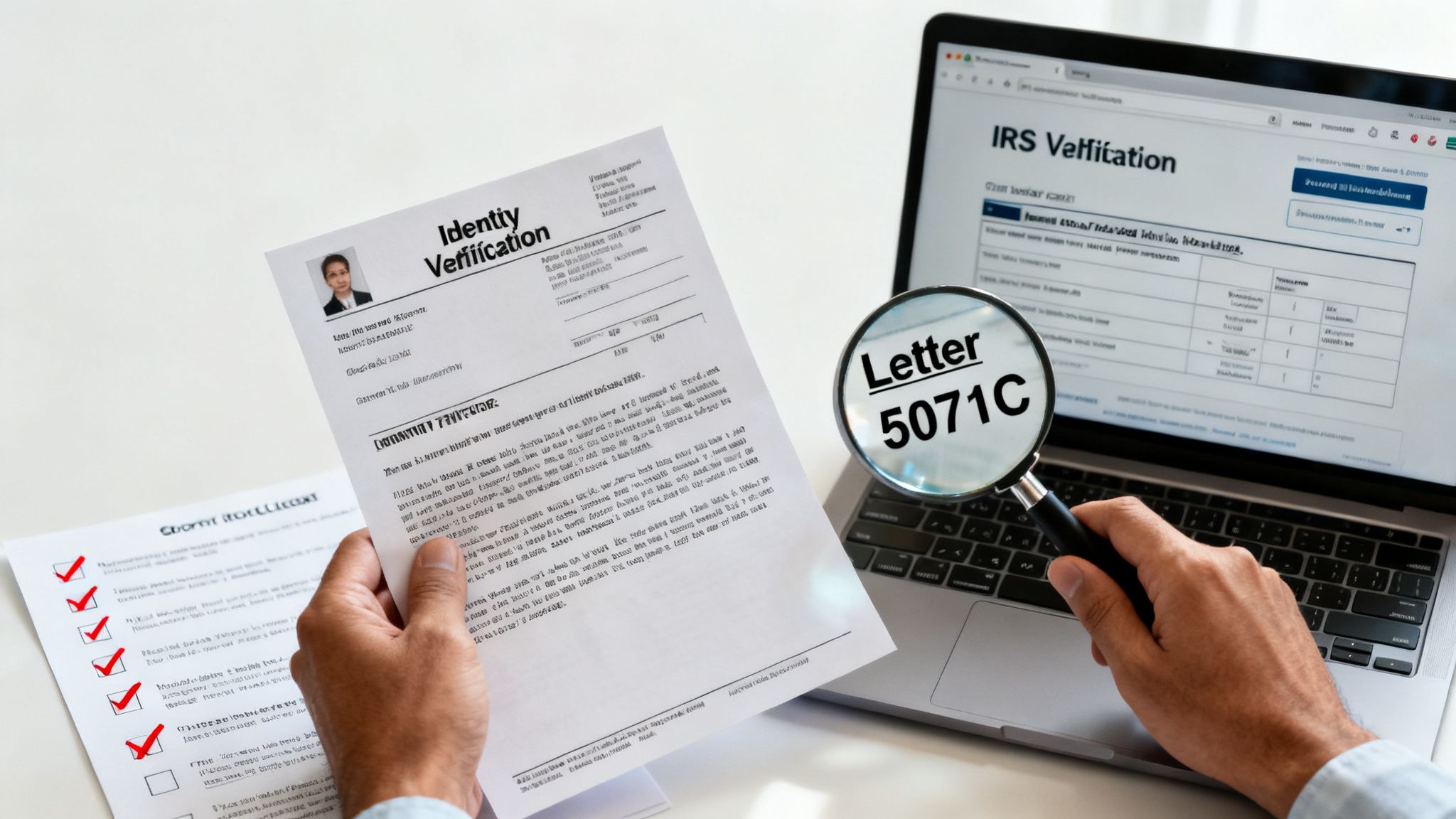
Before you do anything else, your first step is to be absolutely certain the IRS identity verification letter you’re holding is the real deal. Scammers are incredibly skilled at creating convincing fakes designed to steal your personal information. A healthy dose of skepticism is your best defense.
It's just like getting an unexpected text message from your bank. You wouldn't click the link or call the number in the text, right? You'd go straight to the bank's official website or call the number on the back of your debit card. Treat any communication claiming to be from the IRS with that same level of caution.
Spotting the Red Flags of a Scam
Real IRS correspondence follows very specific protocols, which is good news for you. It means that scams often have tell-tale signs if you know what to look for.
Keep an eye out for these classic red flags:
- Urgent Demands for Money: The IRS never cold-calls or emails to demand immediate payment.
- Odd Payment Methods: If a notice asks for payment via gift card, wire transfer, or cryptocurrency, it’s 100% a scam. The IRS doesn't operate that way.
- Threats and Intimidation: Scare tactics are a scammer's favorite tool. The IRS won't threaten you with immediate arrest, deportation, or revoking your driver's license over the phone or in an initial letter.
- Email Requests for Sensitive Info: The agency primarily communicates through physical mail. It will not ask for PINs, passwords, or credit card details in an email.
While identity verification letters usually come in the mail, it's smart to be on guard against all types of fraud. Knowing how to identify phishing scams is a crucial skill for protecting your information online.
A legitimate IRS identity verification notice will direct you to verify your identity through specific, secure channels. It will never demand payment to resolve the identity issue.
How to Verify the Letter Directly with the IRS
So, the letter doesn’t have any obvious red flags. Great. The next step is to confirm its authenticity directly with the source. Do not use any phone numbers or websites printed on the letter itself until you're sure they are official.
Here’s the right way to do it:
- Find the Letter or Notice Number: Every official IRS notice has a unique number printed on it, almost always in the top-right corner. For identity verification, you'll likely see codes like 5071C, 4883C, or 5747C.
- Check it on IRS.gov: Go directly to the official IRS website in a fresh browser window. Use the site's search feature to look up the notice number from your letter. The search results should lead you to an official page explaining what that specific notice is about.
- Confirm the Contact Info: If the letter tells you to go to a website, double-check that the URL is a legitimate IRS.gov address. Anything else, like "IRS.com" or "IRS-help.org," is a fraud. The same goes for phone numbers—cross-reference them with the official contact numbers listed on the IRS website.
Taking a few extra minutes to go through these steps gives you peace of mind. You'll know for certain that you're dealing with a genuine request and not walking into a scammer’s trap.
Preparing for Your IRS Identity Verification
Once you've confirmed your IRS letter is legitimate, the ball is in your court. The next step is all about preparation. Think of it like a chef prepping their ingredients before service—having everything organized and within reach makes the entire process smoother and far less stressful.
Taking a few minutes to gather the right documents is the single best thing you can do to get this sorted out quickly. If you're missing a key piece of information when you're on the phone or online, you'll likely have to hang up and start the whole process all over again. A little prep work now can save you from a world of frustration later.
The Non-Negotiable Items You'll Need
Before you even think about calling the IRS or visiting their website, get these essential items together. You will absolutely be asked for them, no matter which verification method you choose.
- The IRS Letter Itself: This is your key to the whole process. Whether it's a 5071C, 4883C, or another similar notice, it contains a unique control number. You can't start the verification without it.
- The Tax Return in Question: Have a full copy of the Form 1040 (or 1040-SR, etc.) that the letter is about. The IRS will ask you to verify specific numbers directly from the return, like your Adjusted Gross Income (AGI) or the exact refund amount you claimed.
- A Government-Issued Photo ID: You'll need this to prove you are who you say you are. Make sure your driver's license, state ID, passport, or military ID is current and not expired.
Having these three items ready proves you're the person who actually filed the tax return.
The Supporting Paperwork
Next, pull together the financial documents you used to prepare that tax return in the first place. An IRS agent might ask for details from these forms to add another layer of verification. It's always better to have them on hand and not need them than to get caught flat-footed.
Think of it like building a case file. Each W-2 or 1099 is another piece of evidence confirming that the tax return is genuinely yours. A well-organized file means you can answer any question the IRS throws at you without missing a beat.
Here's what to gather for your supporting file:
- All Your Income Forms (W-2s, 1099s): Collect every W-2 from your employers and any 1099s you received for contract work, investment income, or other payments.
- Your Prior Year's Tax Return: The focus will be on the current return, but the IRS sometimes uses information from last year's return as an extra security question. Keep a copy handy just in case.
This level of organization does more than just prepare you; it shows the IRS you're taking this seriously. When you can quickly reference a specific figure on a W-2, the entire conversation becomes more efficient.
Your Identity Verification Checklist
To make this even easier, here’s a simple checklist to help you gather everything you need. Ticking these boxes before you start will ensure you're fully prepared for a smooth verification process.
| Document Category | Specific Item(s) Needed | Pro Tip for Preparation |
|---|---|---|
| IRS Notice | The specific letter you received (e.g., 5071C, 4883C) | Keep the letter front and center. The control number is the most critical piece of information on it. |
| Tax Return | A complete copy of the Form 1040 for the year in question | Print a physical copy or have the PDF open and ready. Don't rely on memory for figures like your AGI. |
| Personal ID | A valid, unexpired driver's license, state ID, passport, or military ID | Check the expiration date now. An expired ID will bring the process to a halt. |
| Income Proof | All W-2s, 1099-NEC, 1099-MISC, and other 1099s used for filing | Have them organized by payer so you can find a specific form quickly if asked. |
| Historical Data | A copy of the previous year's tax return | This is your backup. It's often used for "out-of-wallet" questions to confirm your identity. |
Once you have everything on this list collected and organized, you're officially ready to move forward and choose your verification method.
Choosing Your Verification Method
Once you've confirmed the IRS letter in your mailbox is legitimate, it's time to decide how you'll respond. The IRS gives you three main ways to verify your identity, and each one moves at a different speed and has its own set of requirements. Knowing what each path entails ahead of time will help you pick the one that fits you best.
Think of it like choosing your lane at the DMV. You've got the fast, self-service kiosk, the standard line to speak with a clerk, and a special appointment for more complicated issues. They all get you to the same place—a verified identity—but the journey is different. The goal here is to choose the route that gets you through correctly on the first try.
The Fast Lane: Online Verification
For most people, the quickest and easiest way to clear this up is by using the IRS's secure online portal. Your letter, which is often a 5071C, will point you to a specific web address, usually IDVerify.IRS.gov. The best part? It's open 24/7, so you can handle it whenever you have a free moment, no waiting on hold required.
To use this option, you’ll need to have a few things handy:
- A digital copy of your Form 1040 for the year in question.
- Access to the email address you used when you filed.
- Your personal account number from a credit card, mortgage, student loan, home equity loan, or car loan to help prove who you are.
- A mobile phone that’s registered in your name.
The system will guide you through a series of questions that only you should be able to answer, pulling from both your tax return and your financial history. It’s designed to be a one-and-done session.
This ID Verify tool has become a critical part of the IRS's fight against fraud. In a single recent year, the number of successful online verifications jumped to 885,957 from 588,026 in a prior period, which shows just how effective it is.
This flowchart gives you a simple visual to make sure you have everything ready to go before you even start.
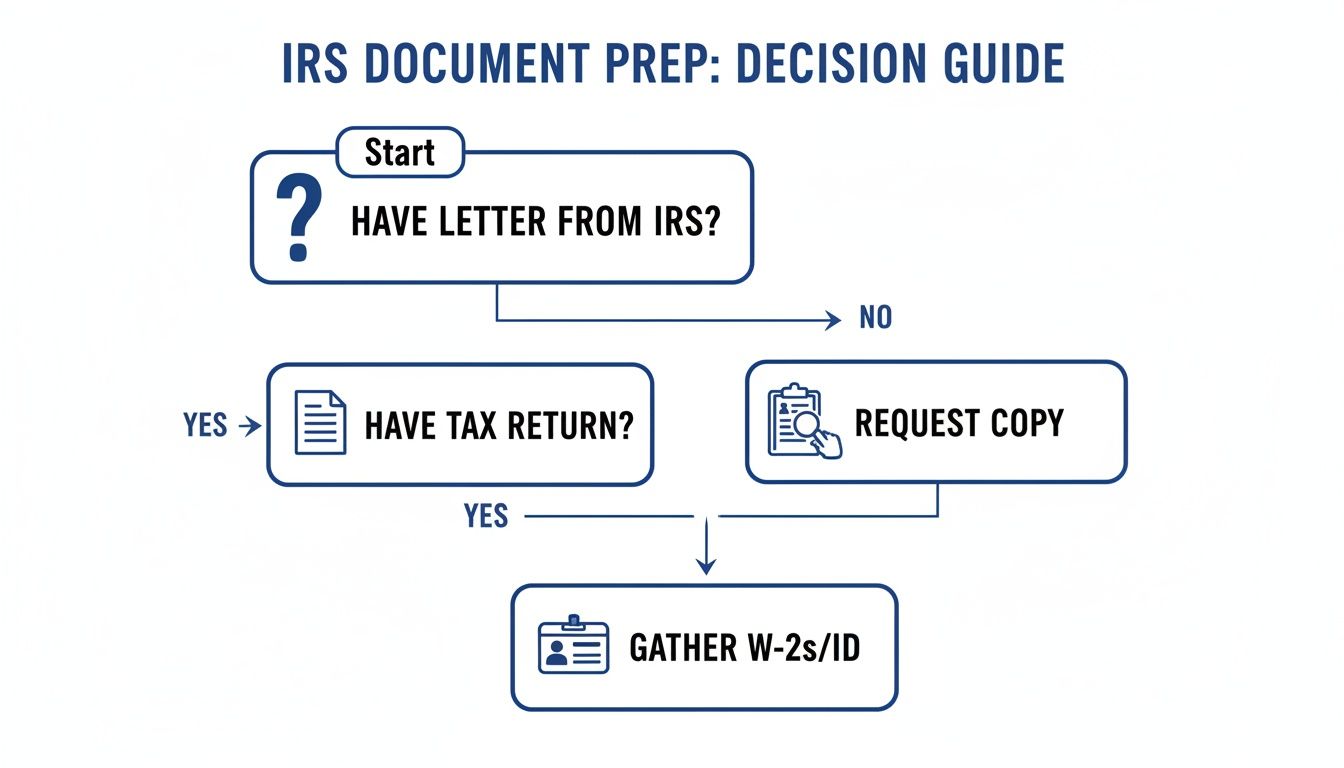
As you can see, having your letter and the matching tax return are the absolute first steps to making this process as smooth as possible.
Verification by Telephone
If you're not comfortable handling this online or you hit a technical snag, your next best bet is to verify your identity over the phone. Your letter will include a specific toll-free number for the Taxpayer Protection Program. Just be sure to have all your documents laid out in front of you before you dial.
An IRS agent will ask you questions very similar to the ones on the website. They’ll be looking at your current and prior-year tax returns, so be prepared to confirm numbers like your adjusted gross income or the employer listed on your W-2.
Be patient. Hold times can be notoriously long, especially during the chaos of tax season. Try calling early in the morning or later in the week—you might have better luck getting through faster.
It's crucial to understand that while a tax professional can help you prepare for the call, you have to be the one on the phone answering the questions. The IRS needs to hear your voice to confirm it's really you. If you need help preparing for this kind of IRS interaction, it can be useful to understand the role of an IRS audit representative.
In-Person Verification at a TAC
In some less common cases, or if you simply can't verify online or by phone, the IRS might require you to come in and verify your identity face-to-face. A letter like the 5747C will instruct you to schedule an appointment at a local IRS Taxpayer Assistance Center (TAC). You can't just show up; an appointment is mandatory for this.
To get ready for your visit, you'll need to bring a small file of documents:
- The original IRS letter you received.
- A valid, government-issued photo ID (like a driver's license).
- A second form of identification, such as a birth certificate, Social Security card, or even a utility bill.
- A complete copy of the tax return they're asking about.
This is definitely the most time-consuming option, but it offers a direct, personal interaction with an IRS employee who can walk you through the final steps. It’s a necessary fallback for people in complex situations or for those who don't have the specific documents needed for the other methods.
What Happens After You Verify Your Identity
Successfully verifying your identity with the IRS feels like a huge relief, but it’s not quite the end of the road. Think of it less as crossing the finish line and more as getting back in the race. Your verification unlocks your tax return, moving it from a suspended "hold" pile into the standard processing queue.
From the IRS's perspective, your return was stuck at a security checkpoint. Now that you've shown your ID, it's cleared to proceed, but it still has to go through all the normal sorting and review steps before your refund can be issued. This is a critical point: verification doesn't trigger an instant payout; it simply gets the ball rolling again.
The Post-Verification Timeline
The big question on everyone's mind is, "So, when do I get my refund?" The IRS is pretty clear about managing expectations here, and it's a timeline that requires some patience.
Once you've successfully verified your identity, it can take up to nine weeks for the IRS to process your return and send out your refund. That nine-week clock starts ticking from the day your verification is confirmed, not the day you first filed your taxes.
This buffer gives the agency the time it needs to complete its final review and make sure every detail on your return is accurate.
How to Track Your Refund Status
While you're waiting, you aren't completely in the dark. The IRS has a handy tool designed specifically for this situation.
About two to three weeks after you've completed the verification process, you can start using the official "Where's My Refund?" tool on the IRS.gov website. This online portal is your best source for tracking your return's progress as it moves through the system, updating you as the status changes from "Return Received" to "Refund Approved" and finally to "Refund Sent." The system is typically updated once every 24 hours, usually overnight.
Possible Outcomes After Processing
Once that nine-week period is up, a few things can happen. In the best-case scenario, your refund is approved and issued, either through direct deposit into your bank account or as a paper check in the mail.
However, sometimes the IRS's final review uncovers a different issue or a discrepancy. If that's the case, you won't get your refund just yet. Instead, you’ll receive another official notice in the mail detailing the adjustments the IRS made to your return. If you don't agree with their changes, you have every right to challenge them. Knowing how to dispute a tax assessment is key if you find yourself in this boat.
And if more than nine weeks go by without a refund or a notice? That's your cue to pick up the phone and contact the IRS directly to find out what's causing the hold-up.
When Verification Reveals True Identity Theft

Sometimes, as you work through the steps to resolve an IRS identity verification letter, a much more serious problem comes to light. You might have the jarring realization that your return was flagged because a criminal has already filed a fake return using your Social Security number. It’s an incredibly stressful discovery, but identifying the fraud is the first critical step toward reclaiming your identity.
When this happens, the verification letter is no longer a routine security check. It's the first alarm bell signaling a much bigger issue. The actions you take next are crucial for containing the damage and starting the recovery process. This is no longer just about a delayed tax refund; it's about protecting your entire financial life.
Your Immediate Action Plan
If you confirm a fraudulent return was filed in your name, you have to move quickly. The main goal is to build a defensive wall around your personal information to stop any further damage. This means alerting both the IRS and the major credit bureaus right away.
Your first official move with the IRS is to file Form 14039, the Identity Theft Affidavit. Think of this as the formal report that tells the IRS you've been victimized. By submitting it, you legally declare that the fraudulent return wasn't yours and kickstart the agency’s internal process for fixing your tax records.
At the same time, you need to shield your credit. Contact the three major credit bureaus—Equifax, Experian, and TransUnion—and place a fraud alert on your profile. This alert signals to lenders that they need to take extra steps to verify your identity before opening any new accounts, effectively blocking thieves from taking out loans or credit cards in your name.
If you find you're a victim of identity theft, it's wise to learn more about broader protection strategies. You can find more information on how to protect against identity theft.
Locking Down Your Tax Account for the Future
After you’ve filed the affidavit, the next proactive step is to secure your tax account from future attacks. The most powerful tool the IRS provides for this is the Identity Protection PIN (IP PIN).
An IP PIN is a special six-digit number the IRS issues to you each year. Once you’re in the program, no one can file a tax return using your Social Security number unless they also have that year’s specific IP PIN. It essentially acts as a secret key that only you and the IRS have, making it nearly impossible for a thief to file a fraudulent return using your information again.
This whole process can feel overwhelming, and you're not alone. The scale of tax identity theft has been a major challenge for years. For instance, back in 2013 and 2014, the IRS was handling about 730,000 identity theft cases each year. This created massive backlogs and often required victims to send in the same documents over and over again to different departments. You can read a detailed analysis of these identity theft case statistics from the Taxpayer Advocate Service.
How a Michigan Tax Attorney Can Help
Trying to navigate the aftermath of tax identity theft on your own can be a bureaucratic nightmare. The paperwork is complicated, getting a straight answer from the IRS is slow, and the consequences—like getting hit with bogus tax debts or collection notices—are serious. This is exactly when getting professional help makes all the difference.
At Defense Tax Partners, our Michigan-based attorneys are here to manage this entire ordeal for you. We handle it all, from correctly filing your Form 14039 to communicating directly with the IRS to get your records corrected. We work to resolve any mistaken tax debts or collection actions that stem from the fraud, making sure your financial standing is restored. Because we are based in Michigan, we understand the state’s specific enforcement trends and use that local knowledge to protect you effectively.
Common Questions About IRS Verification Letters
Getting a letter from the IRS can be nerve-wracking, and the identity verification process is no exception. It’s natural to have questions. Let’s walk through some of the most common concerns we hear from taxpayers so you can feel more confident about handling it.
What Happens If I Ignore the Letter?
Ignoring an IRS notice is one of the worst things you can do. If you don't respond to the identity verification letter, your tax return gets stuck in limbo. The IRS won't process it, and any refund you're expecting will be frozen indefinitely.
Worse, the IRS will eventually flag your return as potentially fraudulent and may reject it outright. This creates a much bigger headache, forcing you to re-file and likely causing complications with your tax account for years to come. This problem absolutely will not go away on its own.
How Long Until I Get My Refund After I Verify?
Once you’ve successfully jumped through the hoops and verified who you are, the clock starts on processing your return.
The IRS officially states it can take up to nine weeks to process your return and issue a refund after your identity is confirmed. You can start checking the Where's My Refund? tool on the IRS website about two to three weeks after you complete the verification process.
What If the Online Verification Tool Didn't Work?
First off, don't panic. It's surprisingly common for the IRS online tool to fail to verify someone's identity. If you hit this roadblock, you still have clear next steps.
Your letter will include a toll-free number for the Taxpayer Protection Program—that's your next move. Get all your documents together before you call to make the process as smooth as possible. If for some reason the phone verification doesn't work either, the letter will guide you on how to schedule an in-person appointment at a local IRS Taxpayer Assistance Center (TAC).
Can a Tax Professional Handle This for Me?
This is a crucial point: you must complete the actual verification yourself. Because the process involves answering personal questions that only you would know, an IRS agent needs to speak directly with you or have you complete the online steps.
However, that doesn't mean you're on your own. A seasoned tax professional can be your guide. At Defense Tax Partners, we can help you get all your documents in order and prepare you for the call or online session. More importantly, if the verification process uncovers that you're a victim of identity theft, we step in to manage the entire fallout—from filing fraud affidavits to clearing your name with the IRS and resolving any fake tax debts.
