
How to Dispute Tax Assessment (how to dispute tax assessment): A Practical Guide
Receiving that official-looking envelope from the IRS or the Michigan Department of Treasury can make your heart sink. It’s a feeling I’ve seen countless clients experience, but your next move is what truly matters. Take a deep breath. My first piece of advice is always the same: do not panic, and whatever you do, don't just pay the amount they claim you owe. You have rights, and this is your opportunity to use them.
What to Do When You Receive a Tax Assessment Notice

When that tax assessment arrives, it's easy to let stress take over. But an emotional reaction is the biggest misstep you can make. Whether you're looking at a CP2000 from the IRS or a Notice of Intent to Assess from Michigan, think of it as the government's opening statement, not a final verdict.
Your job now is to put on your detective hat and scrutinize every line of that notice. The law requires tax agencies to explain why they're proposing changes to your return. Your task is to find that explanation and figure out exactly what it means for you.
Decoding Your Tax Assessment Notice
Every notice has a few critical pieces of information you need to find right away. I've seen clients get overwhelmed by the jargon, but if you focus on these key areas first, you'll be on the right track. Overlooking these details can mean missing deadlines and losing your appeal rights.
To make it easier, here's a quick reference guide to help you understand the most important parts of an IRS or Michigan tax assessment notice.
Decoding Your Tax Assessment Notice Key Sections Explained
| Section of Notice | What It Means | Your Immediate Action |
|---|---|---|
| Notice Number and Date | This is the specific ID for this letter (e.g., IRS CP2000, Michigan Form 168). The date starts the clock on your response time. | Write this number down. You'll need it for all future communication. |
| Tax Year in Question | The notice will clearly state which tax year(s) are being adjusted. | Pull your tax records and files for that specific year immediately. |
| Proposed Changes | This is the core of the notice. It details the adjustments, like unreported income or disallowed deductions. | Carefully compare their numbers to your own records. This is where you'll find the error. |
| Amount Due | You'll see the proposed extra tax plus any penalties and interest calculated so far. | Remember, this is a proposed amount. It is not final and is subject to change. |
| Response Deadline | This is the most important date on the page. It’s your deadline to dispute, typically 30 to 60 days away. | Circle this date on your calendar. Highlight it. Set a reminder. Do not miss it. |
This table helps you cut through the noise and focus on what's actionable. Pinpointing these sections gives you a clear starting point for your response.
Crucial First Step: Your absolute priority is to mark the response deadline on your calendar. Missing it can cause the assessment to become final, making it much harder to challenge and opening the door to aggressive collection actions.
Is It a Simple Correction or a Formal Audit?
Not all notices are created equal. You need to figure out if you're dealing with a simple automated correction or the beginning of a more serious examination.
For instance, an IRS CP2000 notice is usually an automated letter. It's triggered when the income on your return doesn't line up with the W-2s or 1099s the IRS got from your employer or bank. It’s a discrepancy notice, not a full-blown audit. A simple mismatch like this can often be cleared up with a well-written letter and a few supporting documents.
On the other hand, if a notice requests a mountain of documents or asks to schedule an in-person meeting, you're likely facing a formal audit. Knowing the difference helps you understand how serious the situation is and plan your response accordingly. A formal audit demands a much more comprehensive strategy from day one.
Ignoring any of these notices is a recipe for disaster. The situation can escalate quickly, leading to much bigger problems. You can learn more about what happens when the government gets serious by reading our guide on what is a tax levy. Understanding the stakes is the best motivation to handle this correctly and right now.
Building Your Case with Compelling Evidence

Let’s be clear: a successful tax dispute is won with facts, not feelings. When you challenge an assessment from the IRS or the Michigan Treasury, the burden of proof is squarely on your shoulders. It’s up to you to show them precisely why their conclusions are wrong, and that requires clear, organized, and persuasive documentation.
Think of it like you're preparing for court. Every receipt, bank statement, and mileage log is a piece of evidence. Showing up with a jumbled pile of papers sends a message that you’re unprepared. A well-organized file, on the other hand, tells the agent you’re serious and have a valid position worth considering.
Identifying the Right Documentation
The specific evidence you’ll need is dictated entirely by the issue at hand. Vague claims are a waste of time and will get you nowhere. You need to directly counter the agency's adjustments with concrete proof.
Here are a few common scenarios we see all the time and the documents you'll need to fight back effectively.
- Disallowed Business Deductions: If an agency says your business expenses aren't valid, you need to prove two things: that you actually paid them and that they were "ordinary and necessary" for your work. This means digging up bank statements, canceled checks, credit card statements, and detailed receipts or invoices for every single expense in question.
- Unreported Income: The IRS or Treasury claims you earned more than you reported, often based on a 1099-MISC or 1099-K. Your best defense is your own bank records. You have to be able to trace every deposit and prove that the income reported on your return lines up with the money that actually came in.
- Disputed Mileage or Travel Expenses: An estimate just won't cut it here. For any vehicle deductions, you need a contemporaneous mileage log—one kept throughout the year—that details the date, start and end locations, business purpose, and total miles for each trip. For travel, you need receipts for flights, hotels, and meals, plus proof that the trip was primarily for business purposes.
For business owners, part of staying prepared involves keeping tax forms in order. Using a dedicated vendor tax form collection portal can make a world of difference, ensuring all your 1099s and W-9s are organized and ready when you need them most.
Organizing Your Evidence for Maximum Impact
Once you've gathered all your documents, how you present them is just as critical as what's in them. Remember, the agent reviewing your file is looking at hundreds of cases. Make their job easier, and you’ll immediately stand out. That shoebox of receipts? Leave it at home.
Your goal is to tell a clear, logical story with your paperwork. First, make copies of everything—never send your original documents. Organize these copies into a binder with clear tabs that correspond to each item being disputed on the notice.
Pro Tip: I always advise clients to create a one-page summary sheet that acts as a roadmap for the auditor. List each disputed item, briefly state your position, and then point them to the exact document that proves your case (e.g., "See Tab A – 2023 Mileage Log").
This simple step transforms a confusing mess of records into a coherent, easy-to-follow argument. When an agent can quickly find the proof they need to verify your claims, your credibility goes through the roof. If penalties are also part of your assessment, you may want to review our guide on how Form 843 can be used for penalty abatement.
A Real-World Example in Action
Let’s say a freelance graphic designer in Detroit gets a notice from the Michigan Department of Treasury. They’ve disallowed $5,000 in home office expenses and another $3,000 in supply costs.
Here's how she'd build a rock-solid case:
- For the Home Office: She would gather a year's worth of utility bills, her homeowner's insurance policy, and a simple floor plan of her home. The floor plan would show the exact square footage of her exclusive-use office space compared to the total square footage of the house.
- For the Supply Costs: She’d pull every single receipt and invoice for her software subscriptions, stock photo purchases, and computer equipment. Then, she'd create a simple spreadsheet listing each purchase, the date, vendor, amount, and a short note on its business purpose.
- Final Assembly: She would organize all these documents behind labeled tabs in a binder. At the very front, she'd include that summary sheet, neatly explaining her home office calculation and providing a grand total for the supply receipts.
This level of detail shows the Treasury agent she isn't just pulling numbers out of thin air—she can prove every last dollar. That kind of thorough preparation is often the deciding factor in getting a dispute resolved quickly and in your favor.
Choosing the Right Dispute Strategy
Once you’ve organized your evidence, it’s time to decide how you’re going to challenge the assessment. This is a critical decision. Not all tax disagreements are created equal, and using the wrong approach can waste precious time or even weaken your position.
The best path forward depends entirely on the nature of the disagreement. Are you correcting a simple clerical error, or are you preparing for a complex legal argument? Your choice boils down to a few key options with both the IRS and the Michigan Department of Treasury. Think of it like a toolbox—you need to select the right tool for the job.
Amended Return for Simple Errors
Sometimes, the simplest fix is the right one. If the agency’s proposed change is correct because of a clear mistake on your part—maybe you forgot a W-2 or miscalculated a credit—the best route is often filing an amended return.
By filing an amended return (IRS Form 1040-X or Michigan Form MI-1040X), you're essentially getting a do-over. You correct the original filing, accept the agency's changes, and settle the updated tax amount. It's the fastest, most straightforward way to resolve honest mistakes, signaling cooperation and helping you sidestep a drawn-out dispute.
Formal Protest Letter for Substantive Disagreements
What happens when you fundamentally disagree with the tax agency's position? If your dispute is based on a difference of opinion on facts or law, an amended return just won't cut it. This is where a formal protest letter comes in.
This is your opportunity to build your case in a detailed, structured argument, supported by the evidence you’ve gathered. A protest letter is the right move in situations like these:
- Disputes over deductions: The agency disallowed legitimate business expenses that you can prove were ordinary and necessary.
- Factual disagreements: The assessment is based on bad information, like attributing income to you that actually belongs to someone else.
- Legal interpretations: You and the agency see the application of a specific tax law or regulation differently.
This is a more formal approach that requires a clear and persuasive presentation. It officially kicks off a more involved dispute process.
Key Insight: A well-crafted protest letter can often resolve a dispute at this initial stage, preventing the need for escalation. It shows the examiner you're prepared, serious, and have a valid, evidence-based position, which can be enough to make them reconsider their assessment.
Audit Reconsideration for New Information
Did you miss the initial notice? Or was an audit completed without your input? If so, you might be able to request an audit reconsideration. This asks the IRS to re-evaluate a previous audit, but there's a catch: you must have new, substantial information that wasn't provided during the original exam.
This isn't a second chance to argue the same points. It’s for specific situations where crucial documents weren’t available, or you simply didn't know about the audit until it was over. While it has specific eligibility rules, it can be a powerful tool for getting a fair outcome.
Collection Due Process Hearing for Enforcement Actions
If your case has already moved to the collections stage and the IRS has filed a Notice of Federal Tax Lien, you have a critical right: requesting a Collection Due Process (CDP) hearing. This is a formal meeting with the IRS Independent Office of Appeals.
A CDP hearing is more than just a last resort. It allows you to challenge the underlying tax liability (if you haven't had a chance before) and, just as importantly, propose collection alternatives. You can negotiate a payment plan or explore other settlement options. You can learn more about how to resolve tax debt by reading our guide on what an Offer in Compromise is. The CDP hearing is an essential protection for taxpayers facing enforcement actions.
Federal vs. Michigan Tax Dispute Options at a Glance
Navigating the different dispute channels can be confusing. This table breaks down the most common methods for both the IRS and the Michigan Department of Treasury, helping you see which approach best fits your situation.
| Dispute Method | Best For | Key Form(s) | Typical Timeline |
|---|---|---|---|
| Amended Return | Correcting simple, undisputed errors (e.g., missed income, wrong filing status). | IRS: 1040-X MI: MI-1040X |
3-6 months for processing. |
| Formal Protest | Substantive disagreements over facts, deductions, or legal interpretations. | Written protest letter following agency guidelines. | 6-12 months or longer at the exam/audit level. |
| Audit Reconsideration | Presenting new, significant information after an audit has closed. | IRS: Request in writing with supporting documents. | Varies widely, often several months. |
| CDP Hearing | Challenging collection actions (liens, levies) and proposing alternatives. | IRS: Form 12153 | Must be requested within 30 days of the notice. |
Choosing the right strategy from the start is half the battle. By understanding the purpose and requirements of each option, you can position your case for the best possible outcome.
The importance of a timely, strategic challenge can't be overstated. Consider findings from high-stakes property tax appeals in Cook County, Illinois. From 2021-2023, businesses that appealed their assessments secured nearly $25.5 billion in valuation reductions. While unrepresented homeowners had lower success rates, persistence paid off—those who appealed saw their tax bills rise 8.48 percentage points less than those who didn't. As these insightful findings on tax appeals show, an evidence-backed dispute can dramatically change the outcome—a principle we at Defense Tax Partners apply every day for Michigan taxpayers.
Writing a Powerful Protest Letter That Gets Results
When you’re staring down a tax assessment you know is wrong, a simple amended return often won't cut it. This is where your formal protest letter comes in. It’s more than just a letter; it's your official opening argument, and it might be the single most critical document you prepare.
I’ve seen it time and time again: a well-crafted, professional protest can stop an issue in its tracks, resolving it before it ever escalates. On the flip side, a vague, emotional, or incomplete letter practically guarantees you’ll be fighting an uphill battle from the start.
Think about the agent on the other side. They’re sifting through hundreds of cases with limited time. Your goal is to make it incredibly easy for them to see your side, follow your evidence, and ultimately, agree with you. Professionalism and clarity are your biggest assets.
This decision tree gives you a quick visual on when a formal protest is the right move versus a simpler correction.
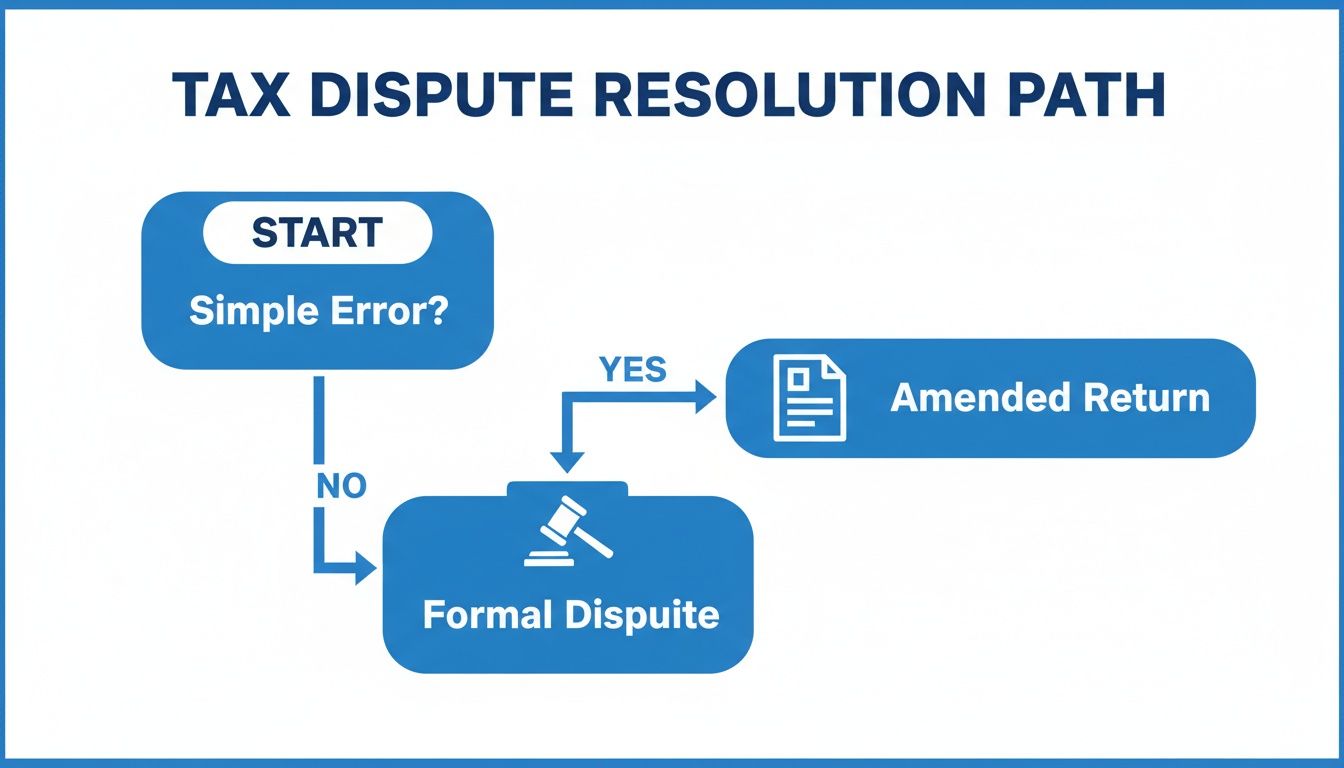
As you can see, once you've ruled out a simple math or reporting error, the path forward is a more formal dispute. Your protest letter is the first, and most important, step on that path.
The Anatomy of a Winning Protest Letter
Every formal protest, whether it's going to the IRS or the Michigan Department of Treasury, has a non-negotiable checklist of required information. Miss one of these, and your protest could be tossed out on a technicality before anyone even considers the merits of your case.
Here’s exactly what you need to include:
- Your Full Identification: Start with your name, current address, and Social Security Number (or Employer Identification Number). Don’t forget a daytime phone number where they can actually reach you.
- A Clear Statement of Intent: The very first sentence should leave no room for doubt. Something like, "This letter constitutes my formal protest of the proposed changes detailed in your notice dated [Date of Notice]."
- Specific Notice Details: You must identify the exact notice you're fighting. Include its number (e.g., IRS CP2000, Michigan Notice of Intent to Assess) and its date.
- The Tax Periods in Question: Clearly state the tax year or years involved, such as "for the tax year ending December 31, 2022."
- An Itemized List of Disagreements: Get specific. "I disagree with the expenses" is useless. Instead, list each point precisely: "I dispute the disallowance of $4,500 in home office expenses."
- The Penalty of Perjury Statement: This is mandatory. You have to include this phrase (or one very close to it) just above your signature: "Under penalties of perjury, I declare that I have examined the facts presented in this statement and any accompanying documents, and, to the best of my knowledge and belief, they are true, correct, and complete."
- Your Signature and the Date: It sounds obvious, but an unsigned protest is invalid. Period.
Think of this structure as the foundation. Without it, the rest of your argument, no matter how compelling, will crumble.
How to Craft a Compelling Factual Argument
With the formalities out of the way, you get to the heart of your letter: the "Statement of Facts." This is your chance to tell your side of the story. The only rule is to be objective, factual, and straight to the point.
This is not the place for emotion. Phrases like "this is totally unfair" or "I can't believe this" will only work against you. Stick to the cold, hard facts. For instance, if you're disputing disallowed business meal deductions, don't just claim they were for work.
Build a clear, evidence-based narrative instead:
"The proposed adjustment disallows $850 in business meal expenses. As documented in the attached logs (Exhibit C) and corresponding receipts (Exhibit D), every meal was conducted with a current or prospective client for the specific purpose of discussing project proposals. The logs detail the date, attendees, business topics discussed, and location for each meal, fully satisfying the substantiation requirements."
See the difference? This approach directly connects your statement to the proof, giving the agent a clear path to follow your logic and verify your claims.
Backing It Up with Legal Authority
The final piece of the puzzle is your "Statement of Law" or "Argument." This is where you explain why the law is on your side. You don't need a law degree, but citing the specific tax code section or regulation you're relying on adds immense credibility.
If you’re not sure of the exact statute, don't guess. Instead, focus on the logic. Explain why the facts you laid out mean your expenses meet the "ordinary and necessary" business expense standard, for example. A simple, logical argument is always more powerful than a flimsy attempt to cite a complex legal case.
By presenting a protest that is clear, structured, and backed by solid evidence, you are taking the most powerful first step toward winning your dispute.
When to Hire a Tax Professional
Deciding to handle a tax dispute yourself versus bringing in a professional is a critical judgment call. Let's be honest, for a simple notice about a math error, you can probably manage it on your own. But there are very clear lines in the sand, and crossing them without an expert is a gamble you don’t want to take.
Knowing when to wave the white flag and call for backup can mean the difference between a quick resolution and a draining, expensive fight with the IRS or the Michigan Department of Treasury.
The whole thing really boils down to two factors: complexity and stakes. If the amount of money they claim you owe is life-changing, or if the problem spans several years, you’re in a different league. When you get into the weeds of tricky tax law—think depreciation schedules or innocent spouse claims—the risk of saying or doing the wrong thing skyrockets. At that point, you're not just correcting a typo; you're in a negotiation where knowing the rules of the game is everything.
Red Flags That Scream "Get Help Now"
Some situations are so serious that trying to DIY them is a recipe for disaster. It's like trying to perform your own dental work after watching a few online videos. The potential for making things much, much worse is just too high.
If you see any of these signs, it’s time to pick up the phone:
- The bill is huge. What counts as "huge" is personal, but if the tax, penalties, and interest would seriously disrupt your life, you need a pro.
- An agent is coming to you. A field audit, where an IRS agent shows up at your business or home, is a major escalation. You need representation to manage the process and protect your rights from the very start.
- The issue is legally complicated. Is your entire argument based on a specific interpretation of the tax code or a past court case? You need someone who speaks that language for a living.
- They're threatening to take your assets. Once you get a formal notice of intent to levy your bank account or garnish your wages, the clock is ticking—fast. A tax professional can often step in immediately to halt collections and open up other options.
The Real-World Benefits of Expert Representation
Hiring a firm like Defense Tax Partners isn't just about paying someone to fill out paperwork. It's about leveling a very uneven playing field. The IRS and state agencies have armies of auditors and lawyers. A good tax pro is your expert in the other corner, someone who knows their playbook inside and out.
A seasoned tax attorney or enrolled agent brings immediate, practical advantages. They take over all communication with revenue officers, removing the emotion and stress from your plate. They live and breathe the deadlines, know who to call to escalate an issue, and understand how to frame an argument that the IRS Independent Office of Appeals will actually listen to. When grappling with these complexities, exploring how legal tech empowers individuals and small businesses can also reveal new avenues for support and effective dispute resolution.
The Professional Edge: One of the biggest advantages is getting access to settlement options you'd likely never secure on your own. A pro can negotiate to have penalties removed (abatement), settle your debt for less than you owe (Offer in Compromise), or set up a manageable payment plan. They get better results because they know what arguments work and which ones fall flat.
Why Having a Pro in Your Corner Matters
The data backs this up. Time and again, studies show that professional representation tilts the odds in the taxpayer's favor. For instance, a deep dive into residential property tax appeals in Cook County found that while success rates can be low overall, having an attorney provided a clear advantage. In one study, attorney involvement nudged the success rate from 1% to 1.3% county-wide. While that might sound small, it reflects a consistent pattern: expert representation improves outcomes. You can read more about these fascinating insights from the study of tax appeals for a closer look at the numbers. This same principle absolutely applies to IRS and state income tax disputes.
At Defense Tax Partners, we bring that same advantage to our clients here in Michigan. We've seen it all—from audits and liens to innocent spouse cases—and we know the specific tactics used by the IRS and the Michigan Treasury. With hundreds of 5.0 reviews, our team focuses on structuring settlements that you can actually afford, working to reduce your liability and keep your assets safe.
The most important first step is recognizing when your problem has grown beyond a simple DIY fix. That’s the moment you put yourself on the path to a real solution.
Common Questions About Tax Assessment Disputes
Even with a solid plan, it's completely normal to have questions when you decide to fight a tax assessment. The process can feel overwhelming, and the details really do matter. Here are some of the most common questions we hear from Michigan taxpayers as they get ready to challenge the IRS or the Michigan Department of Treasury.
Can I Dispute an Assessment If I Already Paid It?
Yes, absolutely. You can still challenge an assessment after paying it, but the game changes a bit. Once you pay, you’re no longer disputing a proposed tax; you're filing a claim for a refund.
For a federal issue, this usually means filing an amended return, or Form 1040-X, to state your case and ask for your money back. The IRS gives you a specific window for this: three years from the date you filed the original return or two years from the date you paid the tax, whichever is later.
What Happens If I Miss the Response Deadline?
Missing the deadline on your initial notice is a serious problem. When that happens, the proposed assessment usually becomes final, and the agency will start collection actions. That could mean a tax lien on your property or a levy on your bank account.
All is not lost, though. You might still be able to request an audit reconsideration if you have new information they haven't seen. The other route is to pay the tax and then file a formal claim for a refund. The bottom line is to act fast to avoid losing your appeal rights.
Should I Handle This Myself or Hire a Professional?
This is the big question, and the answer really depends on the complexity of your case and what's at stake. If it’s a small, obvious error, you might be able to handle it yourself.
However, bringing in a professional from a firm like Defense Tax Partners is almost always the right move if:
- The amount of money involved is significant.
- The issue involves tricky legal interpretations or spans multiple tax years.
- The agency has assigned a revenue officer or is threatening to take your assets.
- You're facing an in-person field audit at your home or business.
Expert Insight: I've seen it time and again: strategic, well-supported appeals get results. An informed dispute, backed by solid evidence and a deep understanding of the rules, stands a much better chance of success. A tax professional levels the playing field and ensures your rights are protected.
How Long Does a Tax Dispute Usually Take?
The timeline can vary wildly. A simple mail audit might be wrapped up in a few months. On the other hand, a complex case that goes all the way to the IRS Independent Office of Appeals or the Michigan Tax Tribunal could easily take more than a year. You have to be patient.
Just look at the high-stakes property tax world. Recent data from San Francisco shows that tough appeals are a marathon. Out of 2,420 appeals resolved by June 30, 2023, a staggering 55% led to tax reductions on properties worth over $60 billion. Those wins didn't happen overnight. They highlight that persistence, backed by strong evidence, is what gets the job done. You can learn more about how successful tax challenges are structured. This same principle applies to IRS and Michigan tax disputes—a thorough, well-documented case is your surest path to a good outcome.
