
How to Stop State Tax Garnishment and Protect Your Wages
A garnishment notice is a direct threat to your financial stability, but it's not the final word. The fastest way to stop a state tax garnishment is to immediately contact the Michigan Department of Treasury. Your goal is to either pay the debt in full or, more commonly, work out an alternative payment arrangement.
Acting quickly is your single most powerful tool. It's what protects your wages and stops further collection actions dead in their tracks.
Your Paycheck Is Garnished—What Happens Next?
Getting that official-looking envelope from the Michigan Department of Treasury feels like a gut punch. It’s designed to. The "Notice of Intent to Garnish" is a formal, aggressive warning that the state is ready to take money directly from your employer before you ever see it.
It's natural to feel a wave of panic, but a clear-headed, strategic response is far more effective. This notice kicks off a critical, time-sensitive window where the actions you take—or don't take—will determine the outcome.
Ignoring it is the worst possible move. The state will simply proceed, your employer will be legally forced to comply, and a chunk of your income will vanish. This isn't just a threat; it's the start of a legal process that demands your immediate engagement.
The First Calls and Critical Information
Your first move is to pick up the phone. Don't put it off. You need to call the Michigan Department of Treasury collection agent whose name is on your notice.
Before you dial, get these essential items together to make the call productive:
- Your Notice of Intent to Garnish: Have the physical document in front of you. It has key info like your case number and the agent assigned to your file.
- Your Social Security Number: The state uses this to pull up your tax account.
- Your Most Recent Pay Stub: You can't negotiate a realistic solution without knowing your gross and net pay.
- A Basic Household Budget: Know your essential monthly expenses (rent, mortgage, utilities, food). This is crucial for arguing for a payment plan you can actually stick to.
This initial call is all about opening a line of communication. It shows the state you’re serious about resolving the debt and can pause the automatic escalation that’s already in motion. For more context, it helps to understand what a tax levy is, as it's another common collection tool. You can learn more here: https://www.michigantaxattorneys.net/blog/what-is-a-tax-levy/
A Real-World Lansing Example
I recently helped a client in Lansing who got this exact notice on a Tuesday. By Wednesday morning, we were on a conference call with the Treasury. Because we acted within 48 hours, we secured a temporary hold on the garnishment, stopping it before it ever hit his paycheck.
That quick action gave us the breathing room we needed to gather his financial documents and ultimately negotiate an installment agreement that actually fit his budget. When your paycheck is on the line, every hour counts. Understanding the legal options, like those outlined in how to stop a garnishment, provides a clear path forward.
This three-step process shows the immediate action plan to follow after receiving a garnishment notice.
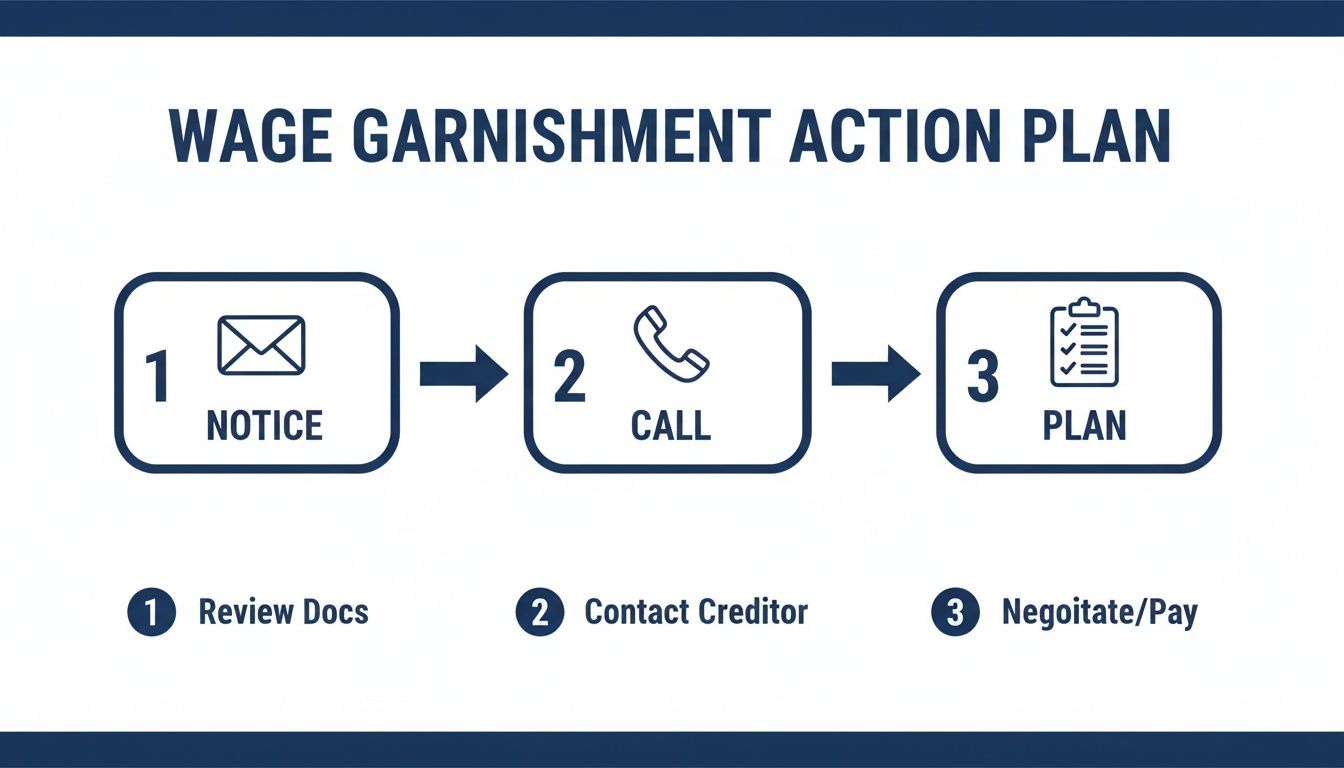
As the graphic shows, replacing panic with a methodical response—reviewing the notice, making contact, and forming a plan—is the key to getting back in control of the situation.
Michigan’s Aggressive Collection Tactics
It's critical to understand the environment you're dealing with. Michigan residents face some of the most aggressive state tax collection practices in the entire country.
In one recent year, Michigan collected a staggering $136.5 million just from garnishing tax refunds. That comes out to $13,546 per 1,000 residents—miles ahead of the next closest state. These aggressive tactics go beyond refunds; the state will seize lottery winnings and even stimulus checks to collect on a debt.
This context isn't meant to scare you. It's to underscore why swift, decisive action on your part is absolutely necessary.
Negotiating a Release for Your State Tax Debt
Once you've made that first crucial call to the Michigan Department of Treasury, you've cracked the door open to a real solution. Now it's time to push it wide open. The immediate goal is getting the garnishment lifted, but the long-term objective is to negotiate a formal plan to resolve the tax debt for good.
For most people in Michigan, this boils down to two main paths: setting up an Installment Agreement or pursuing an Offer in Compromise (OIC). While both can stop a garnishment in its tracks, they are fundamentally different tools designed for very different financial situations.
Figuring out which one is right for you is the key to a sustainable resolution, not just kicking the can down the road.

The Installment Agreement: Your Path to Steady Repayment
Think of an Installment Agreement as a straightforward payment plan. It's the most common way to resolve a state tax debt. You agree to pay the full amount you owe—taxes, penalties, and interest—through a series of manageable monthly payments.
From the state's perspective, a reliable payment plan is far better than the administrative headache of an ongoing wage garnishment. If you can present a realistic proposal backed by solid financial information, they are usually willing to work with you.
To get an agreement in place, you’ll need to lay your financial cards on the table. This typically means filling out Michigan's Form 990 (Collection Information Statement). This form gives the Treasury a detailed snapshot of your income, assets, and monthly living expenses, which they use to decide on a payment they believe you can handle.
An Insider's Tip: The state's calculation of your "ability to pay" can be notoriously rigid. They use standardized national and local expense figures that often don't reflect the true cost of living in places like Metro Detroit or Grand Rapids. This is where an experienced professional can make a huge difference—by arguing for a payment based on your actual budget, not a generic formula.
Once the Installment Agreement is approved and you've made that first payment, the Treasury will issue a "Release of Garnishment" to your employer. Just stay current on the plan, and the garnishment stays off.
The Offer in Compromise: A Fresh Start for Those Who Qualify
An Offer in Compromise (OIC) is a much more complex, but potentially life-changing, solution. An OIC allows certain taxpayers to settle their entire tax debt for less—sometimes much less—than the total amount owed.
Let's be clear: this isn't about negotiating what you think is a "fair" amount. It’s a data-driven process based entirely on what the state believes it can realistically collect from you.
The state will only accept an OIC if they're convinced it’s the most they will ever get. To even be considered, you generally have to meet one of two tough conditions:
- Doubt as to Collectibility: You must prove that your income and assets will never be enough to pay the full debt.
- Doubt as to Liability: You have to show clear evidence that the original tax assessment was wrong.
Submitting an OIC is an exhaustive process requiring the same financial disclosures as an Installment Agreement, but under a much more powerful microscope. The state calculates your "Reasonable Collection Potential" (RCP) to determine the absolute minimum offer they will entertain. Because this is such an intricate process, it's worth digging deeper into what a Michigan Offer in Compromise really entails.
Michigan Tax Resolution Options at a Glance
Choosing between an Installment Agreement and an Offer in Compromise is a critical decision. This table breaks down the key differences to help you see which approach might be a better fit for your financial reality.
| Feature | Installment Agreement | Offer in Compromise (OIC) |
|---|---|---|
| Who It's For | Taxpayers who can afford to pay the full debt over time. | Taxpayers facing severe financial hardship who cannot pay the full amount. |
| Debt Resolution | You pay the full tax debt, including penalties and interest. | You settle the tax debt for less than the full amount owed. |
| Primary Requirement | Proving you can make consistent monthly payments. | Proving you cannot pay the full debt due to limited assets and income. |
| Complexity & Scrutiny | Moderate. Focus is on your monthly cash flow. | Very high. In-depth review of all assets, income, and future earning potential. |
| Approval Likelihood | High, if the proposed payment plan is reasonable. | Low. The state has very strict eligibility criteria. |
| Impact on Credit | A state tax lien may remain until the debt is paid, affecting credit. | The tax lien is released upon acceptance and payment, often improving credit faster. |
Ultimately, the Installment Agreement is about managing the debt you have, while the OIC is about eliminating a debt you can't possibly manage.
Real-World Example: A Detroit Auto Worker's Story
I recently worked with a line worker at a Detroit-area auto plant. He received a garnishment notice threatening to take 25% of his paycheck, which would have made it impossible to pay his mortgage. He owed over $18,000 in state taxes from a side business that had gone under a few years back.
His steady income meant he wasn't a candidate for an OIC, but the state's initial demand for a $750 monthly payment was a non-starter. We jumped in.
We prepared a meticulous Collection Information Statement that painted a true picture of his family's finances, including high childcare costs and union dues—critical expenses the state's rigid formulas had completely ignored. By documenting everything, we showed that a $250 monthly payment was the absolute most he could handle without risking default.
The Treasury agent saw the logic and agreed. We locked in the Installment Agreement, the garnishment was released within a week, and now he's on a predictable path to becoming debt-free without the threat of losing his home.
The damage from wage garnishments is real and devastating. Studies show the average garnished worker loses about 11% of their gross pay, an amount that can wipe out a family's entire budget for groceries. For those earning between $25,000 and $39,999 a year, the rates are even worse, with up to 4.6% of workers in that bracket facing garnishment. This isn't just a financial inconvenience; it's a crisis that demands an immediate and effective strategy.
Proving Financial Hardship to Pause a Garnishment

Sometimes, a payment plan just isn’t in the cards. When a real financial crisis hits—a sudden job loss, a medical emergency, or another event that guts your income—even the smallest monthly payment is impossible. A wage garnishment at a time like this can feel like the final blow.
Thankfully, Michigan tax law offers a critical safety net for these exact situations. It’s called Currently Not Collectible (CNC) status. Getting this designation temporarily stops all collection actions, including that painful wage garnishment. It's the state's formal way of acknowledging that right now, you simply can't afford to pay.
But getting approved for CNC status isn't as simple as telling the state your budget is tight. You have to build a rock-solid case, backed by hard evidence, that proves you are experiencing a genuine financial hardship.
What “Hardship” Really Means and How to Document It
The Michigan Department of Treasury considers hardship to be the inability to meet your basic, reasonable living expenses. We’re not talking about cutting back on extras; we’re talking about the core costs of living—keeping a roof over your head, putting food on the table, keeping the lights on, and paying for essential medical care.
To make your case, you need to paint a clear, honest picture of your financial life. This means gathering the documents that tell your story.
The essential paperwork includes:
- Proof of Income (or Lack Thereof): Recent pay stubs or unemployment benefit statements showing your current income, especially if it has been drastically reduced.
- Bank Statements: You'll need at least the last three months to show your account balances and demonstrate where your money is going.
- A Detailed Household Budget: This is where you list every source of income against every necessary monthly expense. Be meticulous and absolutely honest.
- Proof of Major Expenses: Mortgage statements, rent receipts, utility bills, and car payments are standard.
- Documentation for Extraordinary Costs: This is key. Gather the medical bills, prescription receipts, or proof of childcare costs that are straining your finances.
When you're submitting these documents, you're sharing some of your most sensitive financial data. It's wise to be familiar with standard fax security protocols to ensure your information is transmitted safely and securely to the state agency.
The Request Process for CNC Status
With your documentation in hand, the next step is to officially ask for CNC status. You’ll typically do this by filling out the same Collection Information Statement (Form 990) used for an Installment Agreement. The key difference is that your numbers will clearly show that your monthly expenses outstrip your income, leaving nothing left for a tax payment.
Submitting the form is just the first step. A state revenue officer is going to review every single line item and piece of paper you send. They are trained to spot anything that looks out of place and will absolutely question expenses that seem inflated or non-essential.
Key Takeaway: Honesty and thoroughness are everything here. The fastest way to get your request denied is to submit an incomplete or exaggerated claim. The state is looking for a truthful story of your financial struggle, supported by undeniable proof.
If your request is approved, the Treasury will place your account in CNC status. This immediately stops the wage garnishment and puts a pause on all other collection efforts.
What Happens After You’re Approved
It’s crucial to understand that CNC status is almost never a permanent fix. Think of it as a temporary pause button. The state will typically review your account every 12 to 24 months.
When that review comes around, you’ll have to provide updated financial information. If your situation has improved enough that you can afford to start making payments, the state will remove the CNC status and work with you to set up a payment arrangement.
Real-World Scenario: Relief for an Oakland County Family
We once worked with a family in Oakland County where the primary wage earner was seriously injured on the job and went on long-term disability. Their income was cut by more than 60%, and they quickly fell behind on their state taxes. The garnishment notice was a nightmare, threatening to take a huge chunk of the little money they had left.
We jumped into action. We gathered all their disability statements, the mountain of medical bills, and a detailed budget showing they were already in the red each month just covering their mortgage and groceries. We presented this complete package to the Treasury, proving that any payment at all would jeopardize their ability to stay in their home.
The state agreed and granted them CNC status. The garnishment stopped instantly. It gave them the breathing room they desperately needed to focus on recovery without the constant stress of watching their paycheck disappear. It wasn’t a permanent solution, but it was the lifeline they needed at that moment.
What If the State Is Just Plain Wrong?
So far, we've walked through how to handle a tax debt you actually owe. But what happens when the garnishment notice shows up and the numbers are completely off? Or worse, you don't owe a dime? It happens far more often than people realize, and there's nothing more frustrating than seeing your paycheck seized for a debt that isn't even yours.
Maybe the Michigan Department of Treasury is working with faulty income data, the amount they claim you owe is wildly inflated, or you've been a victim of tax identity theft. In these situations, your strategy shifts completely. You're not trying to negotiate a payment plan; you're going on the offensive to fight the underlying debt. This is where you enter the administrative appeals process—the formal channel for setting the record straight.
The Two Fights: Collection vs. Liability
Before you dive in, you need to understand a critical distinction. Are you fighting the collection action (the garnishment itself) or the underlying tax liability (the debt)?
- Challenging the Collection: This is a procedural argument. You’re essentially saying the state didn't follow the rules—for example, they failed to send you the required legal notices before they started taking your money.
- Challenging the Liability: This is the more fundamental battle. Here, you're arguing the entire premise of the debt is wrong. You’re stating, "I don't owe this money," and you have the proof.
This section is all about that second fight—challenging the liability itself. This is your path forward when the state’s math is wrong, and it requires a methodical, evidence-based approach to get them to back down.
Your First Move: The Informal Conference
Before things escalate into a full-blown legal battle, Michigan law provides a crucial first step: the informal conference. This is your best, and often simplest, opportunity to sit down with a Treasury referee and plead your case directly.
But there's a catch, and it's a big one. You have to request this conference within 60 days of receiving the "Final Assessment" notice. If you miss that deadline, your appeal options can become severely limited. Don't let that window close.
Think of this meeting as less of a courtroom drama and more of a fact-finding mission. Your job is to present clear, undeniable proof that the state's assessment is flawed.
We see this happen for a few common reasons:
- Identity Theft: Someone hijacked your Social Security number and either filed a fake return or earned income under your name.
- Innocent Spouse Relief: Your former spouse is the one who racked up the tax debt without your knowledge, and it’s completely unfair to hold you accountable for it.
- Phantom Income: The state thinks you earned money you never actually received. This is a frequent nightmare for freelancers and gig economy workers with messy 1099s.
- Simple Clerical Errors: A typo on a tax return—made by you or by the state—can lead to a costly mistake.
Building a Bulletproof Case
Winning an appeal boils down to one simple word: documentation. You can’t just tell the state they’re wrong; you have to prove it with a mountain of evidence. The burden of proof, unfortunately, falls squarely on your shoulders.
Let's say the state claims you earned $50,000 more last year than you actually did. To knock down that claim, you need to build a case file that leaves absolutely no room for doubt.
Your evidence package should be airtight. I typically recommend gathering:
- Complete Bank Statements: Pull all of your statements for the year in question. Highlight every single deposit so you can create a verifiable trail of your actual income.
- Affidavits: If you can, get sworn, notarized statements from clients or former employers confirming exactly what they paid you.
- A Corrected Return: Prepare an amended or "pro-forma" tax return that shows what the numbers should have been. This gives the referee a clear picture of the error.
- Supporting Proof: If this is an identity theft case, you absolutely must include a copy of your police report and your official FTC identity theft affidavit.
This is where bringing in an experienced tax attorney can make all the difference. We know exactly what kind of evidence a Treasury referee finds compelling and, just as importantly, how to present it. We can cut through the bureaucratic noise and focus the state’s attention on the specific facts that win your case. It significantly boosts your odds of success and is often the fastest way to stop the garnishment for good.
Why a Michigan Tax Attorney Is Your Best Defense
Let's be blunt: facing a wage garnishment from the Michigan Department of Treasury on your own is an uphill battle. It’s not just about the money. You're stepping into a complex legal system where the rules are written to favor the state. Trying to handle this alone often feels like you're in a fight where you don't know the rules and your opponent does.
Hiring a specialized tax attorney isn't giving up; it’s a strategic decision to even the odds. It’s about bringing in a professional who not only knows the playbook but has spent a career mastering it.
Speaking the Language of the Treasury
One of the biggest hurdles I see clients face is just communicating effectively with the state. Revenue officers and state agents are trained negotiators. They do this all day, every day. They have their own language, a specific set of procedures, and frankly, very little patience for someone who doesn't understand the process.
An experienced Michigan tax attorney cuts right through that noise. We know exactly who to call, how to package your financial information in a way that makes sense to them, and how to frame a resolution the state is actually likely to accept. In many cases, we can get a garnishment put on hold with a single phone call because we speak their language and they know we're prepared to follow through.
This direct line of communication is invaluable. It shifts the dynamic from a stressful, often confrontational process into a professional negotiation. That’s the first real step toward finding a workable solution and stopping the immediate financial drain.
When Professional Help Is Non-Negotiable
While I believe anyone dealing with the Treasury can benefit from guidance, some situations are simply too risky to handle alone. If your case involves any of the following, you really should prioritize getting legal counsel:
- High-Dollar Tax Debts: Once your tax bill climbs into the five-figure range, the state's collection efforts become far more aggressive. The solutions are also much more complex.
- Business Tax Issues: Problems with payroll taxes (like Form 941), sales tax, or the dreaded Trust Fund Recovery Penalty are incredibly serious. These can pierce the corporate veil and attach directly to you as the business owner.
- Multiple State Actions: If the state has already slapped a tax lien on your property and is garnishing your wages, you're fighting a war on two fronts. These problems are intertwined and demand a coordinated legal strategy. Our guide on how to remove Michigan tax liens explains just how complicated this can get.
In these high-stakes scenarios, one small mistake can create devastating financial consequences that can follow you for years.
One of the most critical advantages an attorney brings to the table is attorney-client privilege. This legal shield means our conversations are completely confidential. You can be 100% transparent about your financial situation, knowing your words can't be used against you by the state—a protection that vanishes the moment you speak directly to a revenue officer.
The Michigan Advantage
When you're choosing who to hire, local expertise is everything. Michigan has its own unique tax laws, administrative rules, and even unwritten procedures that an out-of-state "national" firm simply won't know. A local Michigan tax attorney lives and breathes the nuances of dealing with the Treasury Department in Lansing.
We know the revenue officers. We understand their collection priorities and what they're looking for to approve a deal. We have a deep knowledge of state-specific relief programs that can make all the difference. This insider perspective allows us to build solutions tailored to the Michigan system, often securing outcomes that are out of reach for those trying to navigate this alone.
Answering Your Michigan Tax Garnishment Questions
When you get a garnishment notice, a million questions race through your mind. You need straight answers, fast. Let's tackle some of the most common and urgent concerns we hear from Michigan taxpayers when their paycheck is suddenly on the line.
How Much of My Paycheck Can Michigan Take?
The state of Michigan can legally garnish up to 25% of your disposable earnings. Now, "disposable earnings" isn't your total gross pay; it's the amount left after legally required deductions like federal and state taxes have been withheld.
But it’s not always a flat 25%. Federal consumer protection laws can come into play, sometimes lowering that amount, especially for those with lower incomes. The goal is to leave you with enough to cover basic living expenses.
Don't just assume the Treasury's math is correct. We've seen errors happen. It's always a good idea to have a tax professional double-check the calculation to ensure they're only taking what they're legally allowed to.
Can Bankruptcy Stop a State Tax Garnishment in Michigan?
Yes, it can stop it immediately. When you file for any chapter of bankruptcy, the court issues an "automatic stay." Think of this as a powerful, immediate stop sign for all creditors, including the Michigan Department of Treasury. This federal injunction forces them to halt the wage garnishment right away.
A Word of Caution: Stopping the garnishment is one thing; getting rid of the tax debt is another. Whether your state tax liability can actually be wiped out (discharged) in bankruptcy is a very complex issue. It hinges on things like how old the tax debt is and if your returns were filed on time. You'll need to speak with both a tax attorney and a bankruptcy attorney to get the full picture.
Is My Social Security or Disability Income Safe?
Generally, yes. While the federal government can go after Social Security for federal tax debts, Michigan state law protects Social Security and disability benefits from being garnished for state tax debts.
The critical issue, however, is how you manage your money. If you have those protected benefits direct-deposited into the same bank account as your regular wages, they can get swept up in a bank levy, which can happen alongside a wage garnishment.
The safest strategy is to open a separate, dedicated bank account exclusively for your Social Security or disability funds. This keeps them from mixing with other money (commingling) and makes it simple to prove they are exempt.
How Long Does a Michigan Tax Garnishment Last?
A Michigan tax garnishment isn't a one-and-done deal. It's continuous. Once your employer gets that order, they are legally bound to withhold money from every single paycheck until they're told to stop.
The garnishment will only end when one of three things happens:
- The entire tax debt, plus all the penalties and interest, is paid off completely.
- You successfully negotiate a release from the state, typically by setting up an Installment Agreement or an Offer in Compromise.
- The legal time limit for the state to collect the debt (the statute of limitations) runs out, which is very rare.
This problem won't solve itself. You have to take action to stop the financial bleeding and get your full paycheck back.
