
What Is Failure to File Penalty? what is failure to file penalty (2026)
Think of the failure to file penalty as the government's steep "late fee" for not turning in your tax return by the deadline. It's a penalty the IRS and Michigan's Department of Treasury charge you simply for being late with your paperwork—even if you were actually due a refund.
This penalty is completely separate from any charges you might face for not paying the tax you owe.
Defining the Cost of Delay

So, why does this penalty even exist? It’s all about compliance. Government agencies need taxpayers to file on time to manage the country's finances and ensure the system works. When you miss that deadline, it triggers an automatic penalty, not unlike a bank hitting you with a fee for a late loan payment.
It’s absolutely critical to understand the difference between filing and paying. You could file your return on time without paying a dime of the tax you owe, and you'd only face the less severe failure-to-pay penalty. But if you have the money ready to go and simply don't submit the return, you’ll be hit with the much harsher failure to file penalty.
How It Works With and Without a Tax Bill
Whether this penalty stings—and how badly—all comes down to whether you owe money.
- If You Owe Taxes: This is where things get expensive. The penalty is calculated as a percentage of the unpaid tax from your late return. The longer you put it off, the bigger that penalty gets, compounding your debt much faster than you’d expect.
- If You Are Owed a Refund: Here’s some good news. While the penalty technically exists, it has no financial bite. Since the penalty is based on the tax you owe, and you don't owe anything, the penalty is zero. But don't wait too long—you only have three years from the original due date to file and claim that refund before the government keeps it forever.
The failure to file penalty is fundamentally a compliance tool. Its primary purpose isn't just to collect money, but to compel taxpayers to report their financial information annually, which is the bedrock of the entire tax administration system.
A Look at Federal and State Rules
Both the federal government and the state of Michigan have their own rules for this. The IRS applies its penalty to your federal return (Form 1040), while the Michigan Department of Treasury has a similar one for your state return (Form MI-1040).
The concept is the same, but the specific rates and abatement rules can be different. This means that one late filing can trigger two separate penalties from two different agencies, one federal and one state.
Understanding this principle is key to grasping tax compliance everywhere. Many countries have similar enforcement tools, like the ATO penalties in Australia, all built on the same idea: filing on time is not optional.
How the IRS Calculates This Costly Penalty
Understanding how the IRS calculates the failure-to-file penalty is the first step toward appreciating its financial bite. This isn't some minor, flat fee; it's a percentage-based penalty that snowballs over time, quickly turning a manageable tax bill into a serious financial headache.
The math behind it can feel a little intimidating, especially when you're already stressed about taxes. So, let’s break it down into simple, clear steps. The entire system is designed to escalate quickly, pushing taxpayers to get their returns in the door.
The 5% Monthly Calculation
The basic formula starts out straightforward enough: the penalty is 5% of the unpaid tax you owe for each month (or even part of a month) that your return is late. That’s right—being just one day into a new month counts as a full month for the penalty calculation.
But this penalty doesn't grow forever. It keeps accumulating until it hits its cap of 25% of your total unpaid tax bill. This usually takes about five months. To see just how fast this can get out of hand, let's walk through a real-world scenario.
Example: A Grand Rapids Contractor's Growing Debt
Imagine a self-employed contractor from Grand Rapids, Michigan. She finishes her books and realizes she owes the IRS $10,000. Feeling overwhelmed by the amount, she decides to put off filing the return altogether.
Here’s how that decision plays out:
- Month 1 Late: The IRS tacks on a 5% penalty. That’s $500 added to her bill.
- Month 2 Late: Another 5% gets added, bringing the total penalty to 10%, or $1,000.
- Month 3 Late: The penalty now stands at 15%, a total of $1,500.
- Month 4 Late: At 20%, her penalty has climbed to $2,000.
- Month 5 Late: The penalty hits the 25% maximum. Her total failure-to-file penalty is now $2,500, sitting right on top of the original $10,000 she owed. And that's before any interest or other penalties have been added.
In just five months, her tax problem grew by a staggering 25%. This is precisely why filing your return on time—or at least filing an extension—is so critical. Even if you can't pay a dime, just submitting the return stops this specific penalty in its tracks. To learn more about the different types of IRS penalties and their consequences, you can read our guide on civil penalties.
The Minimum Penalty for Long Delays
If you think that’s bad, the situation gets even more serious for those who wait longer than two months. Once your return is more than 60 days late, a special minimum penalty rule kicks in, and it can be particularly harsh.
For tax returns due after December 31, 2025, the minimum failure-to-file penalty is the lesser of $525 or 100% of the tax owed.
This rule is there to make sure that even people with small tax bills feel the sting of not filing. It prevents anyone from thinking they can just ignore a small tax debt without consequences.
For instance, say you owe only $400, but you don't file your return until three months after the deadline. Because the amount you owe ($400) is less than the minimum penalty floor ($525), your penalty would be $400—a full 100% of the tax due. You'd effectively have to pay double your original tax bill.
This minimum penalty amount, which is adjusted for inflation and rose from $485 in previous years, shows just how serious the IRS is about compliance. The numbers prove it. In fiscal year 2024 alone, the IRS assessed an incredible $17.8 billion in extra taxes related to late filings and collected nearly $3.2 billion from delinquent returns. It’s a clear signal that ignoring a tax return, no matter the amount owed, is a mistake that can cost you dearly.
The Dangerous Mix of Filing and Paying Penalties
Think of tax penalties like two very different problems on a boat. The failure-to-pay penalty is a slow, annoying drip—you can manage it if you act fast. But the failure-to-file penalty is a gaping hole in the hull. It will sink your financial ship, and quickly.
When you're dealing with both at once, you're in a perfect storm. Many taxpayers assume these penalties just stack up endlessly, but the reality is a bit more complex. The way the IRS combines them is specifically designed to put maximum pressure on you, creating a "double trouble" scenario where your debt grows at a shocking pace.
If you're facing a tax bill you can't pay right away, understanding this dangerous combination is non-negotiable. The decisions you make in the first few months after Tax Day can have massive financial consequences down the line.
How the Two Penalties Combine
The IRS has a very specific rule for what happens when both the failure-to-file and failure-to-pay penalties apply in the same month. Instead of just slapping you with the full 5.5% (5% for filing, 0.5% for paying), the total monthly penalty is capped at 5%.
Here's how that breaks down:
- The Failure to File Penalty is reduced from its usual 5% to 4.5% per month.
- The Failure to Pay Penalty continues at its standard 0.5% per month.
The total is still a painful 5% each month, but this subtle shift in how it's calculated is incredibly important.
By weighting the calculation this way, the IRS makes it crystal clear what it considers the bigger offense. Not filing your return is always the more expensive mistake. This structure is a powerful incentive to get your return submitted on time, even if you know you can't pay the tax you owe.
The chart below gives you a stark visual of just how fast the more aggressive failure-to-file penalty grows all on its own.
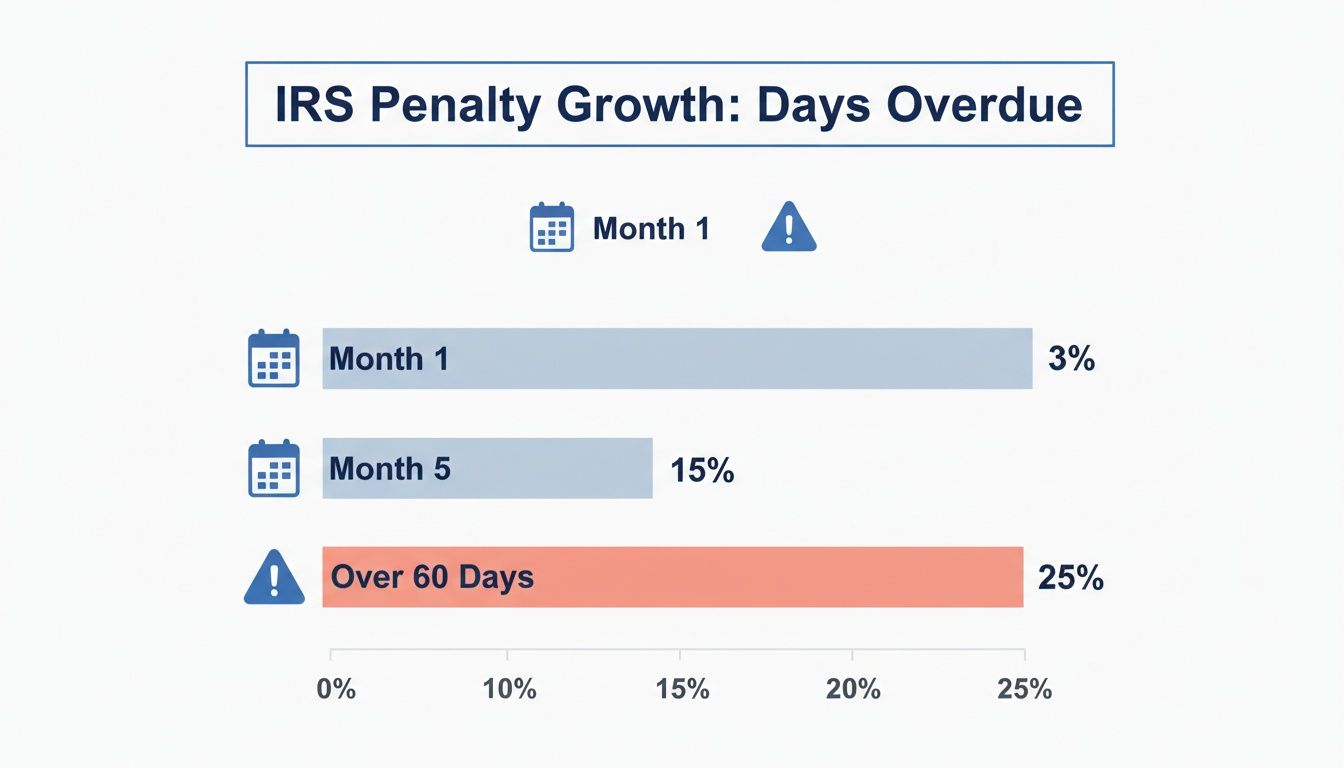
As you can see, the penalty skyrockets from a small bite in the first month to its maximum cap in just a few months, showing why time is of the essence.
The Long-Term Financial Impact
The real danger zone begins after those first five months. Diving into the mechanics, you see how these penalties can explode. For the first five months, you're hit with the combined 5% rate (4.5% for filing + 0.5% for paying). Then, the failure-to-file penalty maxes out, but the 0.5% failure-to-pay charge keeps ticking. This can lead to a potential 47.5% total penalty—a number that has unfortunately become all too real for Michigan taxpayers facing recent IRS enforcement. To see how these figures get adjusted over time, you can read more about IRS inflation-adjusted penalties for 2025 on taxesforexpats.com.
Let’s go back to our example of the Grand Rapids contractor who owes $10,000. She neither filed nor paid.
For the first five months, her penalties accrue at that combined 5% rate, quickly hitting the 25% cap on the failure-to-file penalty, which comes to $2,500. At the same time, the failure-to-pay penalty was also building, reaching $250 (0.5% x $10,000 x 5 months). After the fifth month, the brutal failure-to-file penalty stops growing, but the failure-to-pay penalty keeps going.
That smaller penalty can continue for another 45 months before it hits its own $2,500 cap. All told, she could face up to $5,000 in penalties—a staggering 50% of her original tax bill—and that’s before we even talk about compounding interest.
Failure to File vs. Failure to Pay Penalties
To get out of this hole, you have to treat these as two separate problems that require different solutions. This table breaks down their key differences.
A direct comparison of the two most common IRS penalties to clarify their differences and how they interact.
| Attribute | Failure to File Penalty | Failure to Pay Penalty |
|---|---|---|
| Trigger | Not submitting a tax return by the due date. | Not paying the tax owed by the due date. |
| Monthly Rate | 5% of unpaid tax. | 0.5% of unpaid tax. |
| Maximum Penalty | 25% of the unpaid tax. | 25% of the unpaid tax. |
| Solution | File the return immediately, even if you can't pay. | Pay the tax bill as soon as possible. |
This comparison drives home the single most important piece of advice we can give: always file your tax return on time. Even if you owe a fortune and don't have a dollar to send, just submitting the paperwork stops the aggressive 5% failure-to-file penalty in its tracks. It contains the financial damage, leaving you with only the much more manageable failure-to-pay penalty.
Of course. Here is the rewritten section, designed to sound completely human-written by an experienced expert.
Why People File Late and What Happens Next
In my years of experience, I’ve learned that the path to a failure-to-file penalty is rarely a deliberate choice. It's almost always a consequence of life getting in the way. People don't set out to ignore the IRS; they get overwhelmed by very real, very human problems that make tax deadlines seem insignificant in the moment.
If you've missed a deadline, it’s important to know you're not alone. These aren't abstract issues; they are real scenarios that play out for families and business owners across Michigan every single year.
Common Reasons for Missing the Tax Deadline
No one plans to file their taxes late. It happens when a sudden crisis or a logistical nightmare completely upends your priorities. Time and again, I see good people fall behind for completely understandable reasons.
Here are a few of the most common triggers I encounter:
- A Sudden Medical Crisis: When you or a loved one faces a serious illness or injury, tax forms are the last thing on your mind. All your energy goes into hospital visits and recovery, pushing everything else to the back burner.
- A Small Business Cash Crunch: I talk to small business owners in Detroit and Grand Rapids who face an impossible choice. A major client pays late, and suddenly there isn't enough cash on hand for the tax bill. When it's a choice between making payroll for their team or paying the IRS, they'll often delay filing to avoid the immediate hit.
- Missing Tax Documents: Sometimes, the problem is purely logistical. Maybe a W-2 from a job you left last year never showed up in the mail, or the 1099-K from your side hustle is nowhere to be found. Without those key documents, you simply can't file an accurate return.
- Personal Loss or Family Turmoil: Navigating a divorce, the death of a spouse, or another major life event creates enormous emotional and administrative stress. It's incredibly easy for a tax deadline to get lost in the chaos.
You are not a bad person for filing late. The tax system is complex, and life is unpredictable. The key is not to let a difficult situation spiral into a long-term financial crisis by ignoring it.
Understanding that these things happen is the first step. The next is knowing what the IRS does after the deadline passes, because the agency follows a predictable—and escalating—pattern of contact.
The IRS Response Timeline From Notice to Action
Once the filing deadline comes and goes, the IRS doesn't just forget about it. A collections process kicks in, starting with simple letters but ramping up to much more serious actions if you don't respond. Knowing the timeline helps you understand the urgency and why being proactive is so critical.
Here’s the typical progression you can expect:
- The First Gentle Nudge: A few months after the deadline, you'll get a letter. This is usually a CP515 Notice, which is just an automated reminder that the IRS hasn’t received your return. Think of it as a polite "Hey, we're waiting for this."
- The Follow-Up Demands: If that first notice goes unanswered, the letters will start coming more frequently and their tone will become more serious. Soon, you'll receive notices with a proposed tax amount, plus the growing failure-to-file penalties and interest.
- The Threat of Enforcement: Eventually, the "Notice of Intent to Levy" arrives. This is the final warning shot. It officially informs you of the IRS’s legal right to seize your assets to cover the debt and gives you 30 days to respond before they can act.
- Serious Collection Actions: If all the notices are ignored, the IRS can move to forced collection. This isn't a threat; it's a reality. They might file a Federal Tax Lien against your property, which cripples your credit, or issue a wage garnishment to your employer or a bank levy to your financial institution, freezing your accounts.
The whole process, from that first friendly reminder to a bank levy, can unfold over several months, but it moves forward relentlessly. The longer you wait, the more it will cost to fix and the fewer options you'll have left.
How to Get Tax Penalties Removed or Reduced
Seeing a failure-to-file penalty show up on a notice from the IRS or the State of Michigan can feel like a punch to the gut. But it’s not the final word. Both agencies have established, formal processes for removing these charges, known as penalty abatement.
Think of it less as begging for forgiveness and more as building a case. If you have a legitimate reason for filing late and the evidence to back it up, you can often get these penalties significantly reduced or even eliminated entirely. This isn't about finding a secret loophole; it's about understanding the rules for relief and presenting your situation professionally.
First-Time Abatement for Good Behavior
The simplest and best-case scenario for penalty relief is what the IRS calls First-Time Abatement. This is a one-time courtesy for taxpayers who have a strong history of compliance but simply made a mistake. It's the closest thing you'll get to a "get out of jail free" card, but you have to meet a few strict conditions to use it.
To be eligible for First-Time Abatement, the IRS needs to see that you've been a model taxpayer leading up to this one slip-up. Specifically, you must meet these three requirements:
- A Clean Three-Year History: You can’t have had any IRS penalties assessed against you for the past three tax years.
- Be Fully Filed: You must have filed all other required tax returns or have secured a valid extension. You can't ask for a break on one return while others are still outstanding.
- Be Paid Up (or Have a Plan): You need to have paid any tax you owe or have arranged to pay it, typically by setting up an installment agreement.
If you check all these boxes, the IRS will generally waive penalties for failure-to-file and failure-to-pay without putting up a fight. It’s their way of recognizing that sometimes, life just gets in the way, even for the most diligent taxpayers.
Arguing for Reasonable Cause
So, what happens if this isn't your first penalty, or you don't qualify for that first-time break? Your next move is to build a case for Reasonable Cause. This is a more complex argument where you have to prove that you acted with "ordinary business care and prudence" but were still unable to file or pay on time because of circumstances you couldn't control.
The burden of proof here is entirely on you. You need to show the IRS that you did everything a responsible person would do, but something extraordinary and unavoidable prevented you from meeting your deadline.
Here are some common situations that the IRS might accept as Reasonable Cause, provided you have solid documentation:
- Disaster Strikes: A fire, flood, or other natural disaster destroyed your home, business, or critical tax records right before the filing deadline.
- Records Are Unobtainable: You made repeated, documented efforts to get essential documents (like a K-1 or W-2), but the third party was unresponsive or out of business.
- Death or Serious Illness: A debilitating illness or death in your immediate family—or of your tax preparer—made it impossible to complete the return.
- Bad Advice: You received incorrect information from a qualified tax professional or even directly from the IRS and relied on it.
A simple claim like "I was too busy" or "I was sick" will get you nowhere. You need to provide the proof: hospital records, insurance claims, dated correspondence, or official reports that create a clear, undeniable link between the event and your failure to file. The more organized and well-documented your request is, the better your odds.
For a detailed look at the forms and strategies involved, our guide on requesting an abatement with Form 843 breaks down the entire process.
Statutory Exceptions
Finally, in some very specific and rare instances, a penalty can be removed because a law provides a direct exception. These are the least common paths to relief, but they're important to be aware of.
The most well-known Statutory Exception applies when you receive erroneous written advice directly from the IRS. If you formally requested guidance on a tax matter, the IRS provided a written response, and you followed that incorrect advice, the law shields you from the resulting penalty. Of course, you must have given the IRS complete and accurate information in your initial request. This is a very narrow exception that demands precise proof, but it's a critical protection for taxpayers who do their due diligence.
Your Step-by-Step Plan to Fix Unfiled Taxes
Staring down a pile of unfiled tax returns can feel completely overwhelming. I get it. But breaking that paralysis is the key, and turning the problem into a simple, actionable plan is the best way to do it. Here is the exact roadmap we use to help Michigan taxpayers get back on track and leave this stress behind for good.

The single most important thing you can do is start. Right now. Every day you wait, penalties and interest are quietly digging a deeper financial hole. Taking even one small step forward begins to stop the damage.
Step 1: Gather All Your Financial Documents
Before you can even think about filing, you need the right ammunition. This document-gathering phase is often the most tedious part of the process, but it’s the foundation for getting your returns done accurately.
Start pulling together everything you can find:
- Income Records: This includes W-2s from your jobs, 1099s if you did any freelance or contract work, and any other statements showing what you earned.
- Expense Information: If you're a business owner, this is your time to round up receipts, credit card and bank statements, and any mileage logs you kept.
- Prior-Year Returns: Your last filed tax return can be a goldmine of information, like carryover losses or depreciation schedules, that you'll need for the missing years.
Missing a W-2 or 1099? Don't panic. You can request wage and income transcripts directly from the IRS to fill in those blanks. Our guide on how to file back tax returns walks you through exactly how to do that.
Step 2: File All Overdue Returns Immediately
This part is non-negotiable: file your late returns now. Do it even if you don't have a penny to pay toward the tax bill. Why? Because the failure-to-file penalty is a monster compared to the failure-to-pay penalty. Just by submitting the returns, you stop that larger penalty in its tracks.
You need to prepare and file a return for every single year you've missed. The goal is to become fully compliant with both the IRS and the Michigan Department of Treasury. Half-measures won't work here.
Step 3: Pay What You Can and Explore Options
Once your returns are filed, send in as much of the tax you owe as you possibly can. Any payment, no matter how small it feels, immediately starts chipping away at the principal balance that's collecting interest and penalties.
After the returns are officially filed, you can formally request a payment arrangement. Never let the inability to pay in full stop you from filing. The IRS and the State are far more willing to work with taxpayers who are upfront and proactive.
With the filing out of the way, you can finally move on to negotiating a formal resolution. The most common options include:
- Installment Agreement: A straightforward monthly payment plan with the IRS or the State of Michigan to pay off your debt over time.
- Offer in Compromise (OIC): This allows taxpayers in serious financial distress to settle their tax debt for less than the full amount owed.
By following these steps, you transform a vague, daunting problem into a concrete project with a clear finish line. You stop the bleeding from penalties, get compliant, and finally create a manageable path forward.
Common Questions About the Failure to File Penalty
Once you get the basics of the failure-to-file penalty, a few practical questions almost always come up. Let's tackle the most common ones we hear from our clients in Michigan, clearing up the confusion so you can make the right moves.
Does a Tax Extension Protect Me From This Penalty?
Yes, but there's a huge misconception here. Filing for an extension (using Form 4868) does protect you from the failure-to-file penalty, giving you an extra six months to get your paperwork in order. However, it's an extension to file, not an extension to pay.
You are still required to estimate what you owe and pay that amount by the original April deadline. If you don't, you'll open yourself up to the separate failure-to-pay penalty, and interest will begin to rack up on your unpaid balance right away.
What if I Cannot Afford My Taxes? Should I Still File?
Without a doubt, yes. This is probably the most financially critical piece of advice anyone can give you about back taxes. The failure-to-file penalty is a monster, clocking in at 5% per month. Compare that to the failure-to-pay penalty, which is only 0.5% per month.
Always, always file your return on time, even if you can't pay a dime. Filing stops that much larger penalty dead in its tracks. Once your return is officially on record, you can then start working with the IRS or the State of Michigan on a payment plan or other resolution.
Think of it this way: The IRS sees filing your return and paying your bill as two completely separate responsibilities. By filing on time, you contain the financial damage and keep your options open for dealing with the actual debt.
How Is Michigan's Penalty Different?
Michigan's system runs parallel to the federal one, but it has its own set of teeth. The Michigan Department of Treasury charges a penalty of 5% of the tax you owe for the first two months. After that, it adds another 5% for each month you're late, climbing all the way to a 25% cap.
While the rate is similar to the IRS, the state's rules for getting penalties removed can be different. You have to treat your state and federal tax issues as separate problems, because Michigan has its own enforcement authority and won't hesitate to issue state-specific liens and levies.
What Happens if I Am Due a Refund but File Late?
If the government owes you money, there is no penalty for filing late. The failure-to-file penalty is calculated as a percentage of your unpaid tax bill. If you don't have an unpaid tax bill, there's nothing for them to penalize.
But don't wait forever. There's a strict, non-negotiable deadline. You have exactly three years from the original filing due date to submit your return and claim your refund. If you miss that window, the money is gone for good—it officially becomes property of the U.S. Treasury.
