
What Happens If You Don’t File Taxes in Michigan: A Quick Guide
When you don't file your federal or Michigan tax returns, the problem doesn't just go away. In my experience, this is the single most costly mistake a taxpayer can make. Almost immediately, automated systems at both the IRS and the Michigan Department of Treasury flag your account, kicking off a series of expensive and stressful events that only get worse over time.
What starts with a few letters in the mail can quickly escalate into penalties, mounting interest, and aggressive collection actions.
The Immediate Consequences of Not Filing Taxes
The government doesn’t need you to file a return to figure out that you owe them money. They have copies of your W-2s and 1099s. When you miss the filing deadline, their systems set in motion a predictable chain of events designed to calculate a tax bill for you and then collect it.
Think of it like a small crack in a dam. At first, it’s just a trickle, but ignoring it allows the financial pressure to build until it bursts. The first major step the IRS takes is to prepare what’s known as a Substitute for Return (SFR).
What Is a Substitute for Return?
Don't be fooled by the name—an SFR is not a helpful courtesy. It's the IRS filing a tax return for you using only the income information it has on hand. Most importantly, this return is calculated to benefit the government, not you.
The Substitute for Return almost always results in a much higher tax bill because it ignores every deduction and credit you're legally entitled to. It won't include your dependents, mortgage interest, student loan payments, or any business expenses. It’s the worst-case-scenario version of your tax return.
This automated assessment isn't a friendly reminder; it's the official start of a serious financial headache. This process isn't rare, either. It impacted over 1.2 million taxpayers in 2023 alone, with the average SFR assessment hitting a staggering $25,000.
To give you a better sense of how quickly things move, here's a look at the initial IRS timeline after a missed deadline.
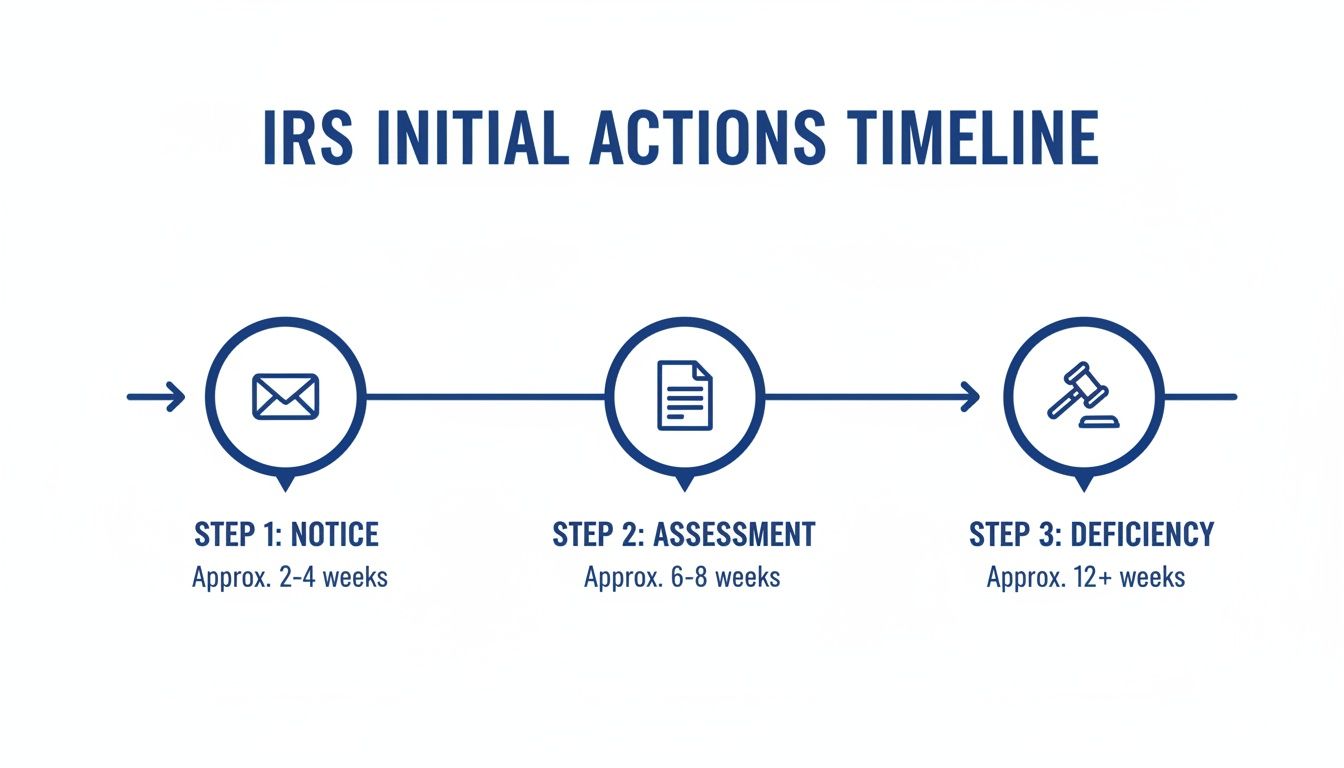
As you can see, what begins as a simple notice can turn into a formal Notice of Deficiency in less than a year. Once that happens, you only have 90 days to dispute the amount in U.S. Tax Court before it becomes a legally enforceable debt.
Initial IRS Actions for Non-Filers at a Glance
This table breaks down the first wave of automated actions you can expect from the IRS when you fail to file.
| IRS Action | What It Means for You | Typical Timeline |
|---|---|---|
| CP59 Notice | The first official letter informing you that the IRS has no record of your return. | 6-12 months after the tax deadline. |
| Substitute for Return (SFR) | The IRS creates a high-liability return on your behalf using only your income data. | 12-18 months after the tax deadline. |
| Notice of Deficiency | A formal legal notice stating the amount the IRS believes you owe, starting a 90-day clock to respond. | 18-24 months after the tax deadline. |
Failing to act within that 90-day window is what opens the door to the government's most powerful collection tools.
The Escalation to Collection Actions
Once the IRS finalizes the debt based on the SFR and the 90-day period expires, things get very real, very fast. The IRS can now use its significant legal power to seize your assets to satisfy the debt.
These enforcement tools include:
- Federal Tax Liens: This is a public claim against all your property—your home, car, and any future assets. It wrecks your credit score and makes it almost impossible to get a loan.
- Bank Levies: The IRS can directly seize funds from your checking and savings accounts without any further warning. One day the money is there, the next it's gone.
- Wage Garnishment: A legal order is sent to your employer, forcing them to withhold a large chunk of your paycheck and send it straight to the IRS before you ever see it.
These actions are financially devastating and can turn your life upside down overnight. To get a better handle on how the IRS takes property, you can read our detailed guide explaining what a tax levy is.
Ultimately, the only way to stop this damaging process is to take back control by filing your own, accurate tax return to correct the inflated SFR assessment.
How Penalties and Interest Make a Tax Problem Explode
The moment the tax deadline passes, a financial clock starts ticking, and it’s not on your side. If you owe the government but haven't filed, the IRS and the Michigan Treasury begin tacking on penalties and interest that can make a manageable tax bill spiral into a nightmare. It's a one-two punch that you need to understand to avoid.
Think of it this way: two different meters start running at once, both adding to what you owe. The first—and by far the most aggressive—is the Failure-to-File penalty. The government comes down hard on this because the entire system relies on people actually filing their returns.
The second meter is the Failure-to-Pay penalty. This one is for the outstanding balance itself. While the rate is lower, it adds up month after month, running right alongside the much larger failure-to-file penalty.
Understanding the Two Main Penalties
Here’s the most important thing to grasp: the penalty for not filing is dramatically worse than the penalty for not paying. The government would much rather you file on time, even if you can't pay a dime, than ignore your filing obligation altogether.
The Failure-to-File penalty is 10 times more expensive than the Failure-to-Pay penalty. This isn't an accident; it's designed to push taxpayers to file no matter what.
Let's break down how they compare:
- Failure-to-File Penalty: This beast is calculated at 5% of your unpaid tax bill for each month (or even part of a month) your return is late. It maxes out once it hits 25% of your unpaid tax.
- Failure-to-Pay Penalty: This is a much slower burn at 0.5% (one-half of one percent) of your unpaid taxes each month the bill isn't settled. It also caps out at 25% of your tax debt.
What happens if both apply in the same month? The IRS gives a small concession. The 5% Failure-to-File penalty is reduced by the 0.5% Failure-to-Pay penalty, so the combined hit for that month is still 5%, not 5.5%.
Daily Interest: The Debt Snowball
As if the penalties weren't bad enough, the IRS also charges interest on everything—the original tax you owe and the penalties as they get added. This is where things get really ugly.
Unlike the monthly penalties, interest compounds daily. The rate changes every quarter, but it has recently hovered around a painful 8% per year. Daily compounding is a powerful force; you're essentially paying interest on your interest, which makes the debt grow much faster.
Let’s walk through a quick example. Say you owe $10,000.
- Penalties Kick In: Right away, monthly penalties of up to 5% start piling on. Your $10,000 becomes $10,500, then $11,000, and so on.
- Interest Starts Accumulating: At the same time, interest is being calculated every single day on that growing total of tax and penalties.
- The Snowball Effect: Before you know it, a $10,000 problem has ballooned into a $15,000 or $20,000 crisis, all because you didn't act.
This combination of steep monthly penalties and relentless daily interest is precisely how tax debts get out of control. It's a financial trap designed to escalate quickly. If you're already in this situation, there might be a way out. To see if you qualify for relief, you can learn more about IRS penalty abatement programs in our detailed guide.
When the IRS Begins Aggressive Collection Actions
If you’ve been ignoring those official-looking envelopes from the IRS and the Michigan Department of Treasury, their approach is about to change dramatically. The automated letters eventually stop, and that’s when forceful, life-altering collection actions begin. This is the moment a paper problem becomes a real-world crisis, capable of disrupting your financial life almost overnight.

These enforcement tools aren't just warnings; they are the government actively seizing assets and income to cover the debt created by your unfiled returns. Understanding what they are is key to grasping just how serious this situation can get.
The Federal Tax Lien: A Claim on Everything You Own
The first major weapon the government usually deploys is the Notice of Federal Tax Lien. It’s important to understand what a lien is—and isn't. The government isn't taking your property (yet). Instead, they are placing a public, legal claim against it, essentially telling the world you owe them money.
This claim attaches to all your current and future assets, including:
- Real Estate: Your home in Grand Rapids or that cottage up north.
- Personal Property: Cars, boats, and any other valuables.
- Financial Assets: This claim covers all your financial interests.
- Business Assets: If you own a business in Detroit, the lien attaches to its property and even its accounts receivable.
The consequences of a tax lien are financially devastating. It craters your credit score, making it nearly impossible to get a mortgage, a car loan, or even a credit card. It effectively freezes your financial life until the tax debt is fully resolved.
Tax Levies: The Direct Seizure of Your Assets
If a lien is a claim on your property, a levy is the government actually seizing it. This is where the IRS moves from staking a claim to actively taking your property to pay off your tax bill. A levy isn't a threat; it’s the direct, and often sudden, removal of your assets.
An IRS levy is one of the most powerful collection tools available to any creditor. It allows the government to take your property without going to court first—a power very few other entities have.
The most common types of levies are on bank accounts and wages. A bank levy means the IRS legally orders your bank to freeze your account and send the funds directly to them. Imagine waking up to find your checking and savings accounts completely empty. That is the stark reality of a levy.
Wage Garnishment: A Continuous Drain on Your Paycheck
Perhaps the most disruptive collection action is a wage garnishment, which is technically a continuous levy on your salary. Here, the IRS sends a legal order straight to your employer, forcing them to withhold a significant portion of your paycheck and send it to the government before you ever touch it.
This isn't a one-time deal. The garnishment continues, paycheck after paycheck, until the entire tax debt—including every last penalty and all accrued interest—is paid in full. This can leave you with barely enough money to cover basic living expenses, creating incredible financial and personal stress.
The real-world impact of these actions is severe. Wage garnishments can take up to 70% of your disposable income, with the IRS seizing an average of $450 per week. Bank levies can clean out accounts without warning, contributing to the $4.1 billion the IRS levied from taxpayers in 2023. These aggressive tactics are precisely what happens when you don't file taxes and let the problem fester. For more on the global impact of such policies, you can discover more insights about tax justice reports.
What Happens Down the Road? The Lingering Effects of Unfiled Returns
The immediate shock of penalties or collection notices is just the beginning. While things like liens and levies demand urgent attention, it's the hidden, long-term consequences that can truly derail your financial life for decades to come.
One of the most dangerous and widely misunderstood concepts is the statute of limitations. You might hear that the IRS only has three years to audit you or ten years to collect a debt. That's true, but there's a huge catch: for those rules to apply, a tax return must be filed. If you never file, the clock never starts.
Think about that for a moment. It means there is no expiration date on the government's right to come after you for the taxes, penalties, and interest from that unfiled year. This isn't a problem that just fades away; it's a financial ghost that can reappear ten, twenty, or even thirty years later, usually when you can least afford it.
A Permanent Roadblock to Your Financial Goals
Unresolved tax issues cast a long, dark shadow over your most important life milestones. For any lender or financial institution, an unfiled return is a massive red flag, shutting down access to the credit you need to move forward.
When a background check reveals unfiled returns or an active federal tax lien, you can expect lenders to deny your application outright. This can stop you from:
- Buying a home by blocking your mortgage application.
- Starting or growing a business with a small business loan.
- Lowering your monthly payments by refinancing existing debt.
- Securing student loans for your children's education or your own.
A tax lien, which is a common outcome of this process, is particularly damaging. It can stay on your credit report for years, even after you've paid the debt, broadcasting a history of financial trouble that makes lenders incredibly nervous.
A Special Warning for Michigan Business Owners
If you own a business in Michigan, failing to handle payroll taxes puts you in a uniquely dangerous position. The IRS has a powerful tool called the Trust Fund Recovery Penalty (TFRP), and they are not afraid to use it.
When you withhold Social Security and Medicare taxes from an employee's paycheck, you are holding that money "in trust" for the government. If you fail to turn it over, the IRS takes it extremely seriously. The TFRP gives them the authority to bypass the corporate structure and hold individuals personally responsible for the debt—this could be you as the owner, a director, or even the bookkeeper.
This means your personal assets are fair game. Your home, your savings, your retirement accounts—all of it can be seized to cover the business's unpaid payroll taxes. It's a fast track to personal financial ruin.
The Problem of Joint Liability and "Innocent Spouse" Relief
For married couples in Michigan, filing a joint return means you are both on the hook for 100% of the tax bill, regardless of who earned the money. This concept, called "joint and several liability," can turn into a disaster if one spouse has a history of unfiled returns, dragging the other down with them.
Thankfully, there's a potential way out. If you were truly unaware of the issue, you might qualify for Innocent Spouse Relief. It's not an easy path, but it can be done. In fact, in 2024, relief was granted in 65% of defended cases nationwide, wiping out $300 million in tax debt. Success often hinges on expert negotiation; we've seen high-net-worth clients sidestep millions in liability with the right strategic approach. You can get a sense of the broader issues by reading up on these global tax trends and their financial impact.
Ignoring unfiled returns is a gamble you can't win. The problem doesn't vanish—it quietly grows, creating a permanent barrier to your financial stability and future peace of mind.
A Practical Roadmap to Getting Caught Up
Looking at a stack of unfiled tax returns can feel paralyzing. I get it. But there’s a clear, well-traveled path out of this situation and back to solid ground. This isn't about finding a magic wand; it's about taking deliberate, manageable steps to regain control.

The journey back to compliance starts with one crucial action: filing the overdue returns. This single move stops the relentless failure-to-file penalties from piling up and, just as importantly, finally gets the statute of limitations clock ticking.
Step 1: Gather Your Documents
Before you can file, you need the raw materials. Even if it's been years, you can get your hands on the income records needed to prepare an accurate return. Your first task is to round up every document that shows what you earned during those unfiled years.
This usually means finding your:
- W-2 forms from any employers.
- 1099 forms for freelance work, interest, or other miscellaneous payments.
- Records of other income, like money from a rental property or a side business.
If you’re staring at a blank folder, don't panic. The IRS keeps a record of everything reported under your Social Security number. You can request a Wage and Income Transcript directly from the IRS for each missing year. This transcript is a goldmine—it contains all the data from your W-2s and 1099s.
Step 2: Prepare and File the Returns
With your income information in hand, it's time to actually prepare the returns. It’s absolutely critical that these are done right. This is your opportunity to claim every single deduction and credit you were entitled to, which can dramatically lower the inflated tax bill the IRS might have cooked up with a Substitute for Return (SFR).
Filing these back taxes is non-negotiable. Think of it as the key that unlocks the door to every other solution. You simply can't access any of the IRS's relief programs until all your required returns are officially on the books.
You cannot negotiate a settlement or payment plan on a tax debt that hasn’t been officially established through a filed return. Filing is the key that unlocks all other resolution strategies.
Our team has guided countless clients through this exact process. For a more detailed breakdown, you can read our guide on how to file back tax returns.
Step 3: Explore Your Resolution Options
Once your returns are filed and you know the true amount of your tax debt, you can shift from defense to offense. The IRS and the State of Michigan have several formal programs designed to help people manage what they owe. The right strategy for you will depend entirely on your current financial picture.
Here are the most common and effective solutions:
Penalty Abatement: The IRS might agree to wipe away penalties if you have a solid reason, what they call "reasonable cause." Even better, the First-Time Abatement program is an administrative waiver that can forgive failure-to-file and failure-to-pay penalties for taxpayers with an otherwise clean compliance history.
Installment Agreement (IA): This is a formal payment plan. It allows you to pay off your tax debt in manageable monthly chunks over time, typically up to 72 months. It's a straightforward way to get current without worrying about aggressive collections like levies.
Offer in Compromise (OIC): For those in a tough financial spot, an OIC lets you settle your tax debt for less than you actually owe. The IRS takes a hard look at your income, expenses, and assets to determine what you can realistically pay. An OIC is a high bar to clear, but for the right person, it's a true fresh start.
Currently Not Collectible (CNC) Status: If you truly can't afford basic living expenses, let alone a tax payment, the IRS may place your account in CNC status. This puts a temporary hold on all collection actions, including wage garnishments. The IRS will check in on your financial situation periodically, but it provides immediate breathing room when you need it most.
Taking that first step is always the hardest part. By gathering your documents, getting those returns filed, and exploring these proven options, you can begin to dismantle the problem piece by piece and get your financial peace of mind back.
Why You Need a Michigan Tax Attorney on Your Side
It's one thing to handle a small, straightforward tax issue on your own. It's another thing entirely to be staring down years of unfiled returns, an audit notice from the IRS, or aggressive collection actions from the state.
When the stakes get this high, knowing what happens if you don't file taxes is just the first step. The next, and most critical, is getting an expert in your corner. This is where a Michigan tax attorney transitions from a helpful resource to an essential shield for your financial future. If you're dealing with a significant tax debt, active levies and liens, or a stack of unfiled returns, the time for a DIY approach is over.
The Home-Field Advantage of Local Legal Counsel
There's a real, tangible benefit to hiring an attorney who lives and breathes Michigan tax law. A local expert isn't just familiar with the rules; they understand the nuances of the local IRS field offices in places like Detroit and the specific procedures of the Michigan Department of Treasury.
This kind of on-the-ground knowledge is priceless when you're negotiating with revenue officers or fighting a state-level assessment. They know the people, the processes, and the playbook.
Beyond local know-how, a tax attorney offers a crucial protection that a CPA or other tax preparer simply can't: attorney-client privilege. This legal safeguard keeps your conversations confidential. It means you can be completely honest about your situation, knowing your words can't be turned around and used against you by the IRS.
Think of attorney-client privilege as a secure vault for your conversations. It creates a safe space for the kind of candid, strategic discussions necessary to build a strong defense and find the best way forward.
When Is It Time to Make the Call?
Knowing the right moment to bring in a professional can save you an immense amount of stress and money. It's time to seriously consider hiring an attorney if you find yourself in any of these situations:
- You're Facing an Audit: Whether it's the IRS or the Michigan Treasury, an attorney can step in to manage all communications, prep you for any meetings, and rigorously defend your returns.
- The Government Is Seizing Assets: If you're dealing with liens, levies, or wage garnishments, an attorney can immediately begin negotiating to have these aggressive collection tactics released.
- Your Business Taxes Are a Mess: This is especially critical for issues like unpaid payroll taxes, which can trigger the dreaded Trust Fund Recovery Penalty against you personally.
- You Have Several Years of Unfiled Returns: An attorney can quarterback the entire process, from preparing the old returns to get you compliant to negotiating a final settlement you can live with.
Whether you're dealing with a complex personal tax issue in Oakland County or a business tax dispute in Lansing, a skilled Michigan tax attorney is your best advocate. They have the tools to protect your assets, the experience to negotiate effectively, and the knowledge to map out the clearest path back to financial health.
Frequently Asked Questions About Unfiled Taxes
When you're dealing with unfiled taxes, a lot of specific questions pop up. Let's tackle some of the most common ones head-on to give you some clarity and reinforce what we've covered.
Is There a Statute of Limitations on Unfiled Taxes?
This is a huge misconception. No, there is absolutely no statute of limitations for the IRS to assess tax if you never filed a return.
Think of it this way: the clock that limits how long the IRS has to audit you (usually three years) or collect from you (ten years) doesn't even start ticking until you actually file. If you never file for a particular year, that window legally stays open forever. It's a critical point—filing the return is the only thing that gets that countdown started.
What if I Can't Afford to Pay the Taxes I Owe?
File anyway. Seriously. You should always file your tax return on time, even if you can't pay a single dollar of the balance.
The penalty for failing to file is much, much worse than the penalty for failing to pay. By simply filing the return, you stop the most expensive penalty in its tracks.
Filing your return, even if you send in zero payment, is the most important first step. It protects you from the harshest penalties and opens the door to programs designed to help you handle the debt.
Once you've filed, you can start looking at real solutions for the debt itself, like:
- IRS Installment Agreement: A formal plan to make manageable monthly payments over time.
- Offer in Compromise (OIC): An agreement with the IRS to settle your tax debt for less than the full amount, typically reserved for those in serious financial distress.
- Currently Not Collectible (CNC) Status: A temporary pause on collection efforts if you're facing extreme financial hardship.
Can I Go to Jail for Not Filing My Taxes in Michigan?
While it’s technically possible, let's be clear: going to jail for simply failing to file is incredibly rare. Criminal charges for tax evasion are almost always reserved for cases involving intentional, willful fraud.
We're talking about situations where someone is actively trying to deceive the government—using fake documents, deliberately hiding income, or running an illegal business.
For the vast majority of Michigan taxpayers who have just fallen behind, the consequences are financial, not criminal. You'll be dealing with penalties, interest, and collection actions like liens or levies. The single best way to show you had no criminal intent is to face the problem head-on. Filing those old returns and working toward a payment solution demonstrates your desire to get right with the government, which is the exact opposite of what criminal investigators are looking for.
