
Report IRS Identity Theft: How to report irs identity theft and recover finances
The first sign of tax identity theft is almost always a piece of mail from the IRS that just doesn't add up. It might be a notice about a tax return you haven't filed yet or a tax transcript you never requested. Sometimes, it’s the gut-punch of having your e-filed return rejected because a return using your Social Security Number (SSN) is already in the system.
These aren't simple administrative mix-ups. They are loud, clear signals that a criminal has used your personal information to commit tax fraud, and you need to act fast.
Recognizing the Signs of Tax Identity Theft
Tax identity theft often starts quietly. A thief gets your information from a data breach and files a fraudulent tax return in your name, often months before you've even started gathering your own W-2s. The problem only surfaces when that unexpected IRS letter lands in your mailbox, causing immediate confusion and alarm.
For most people I've worked with, the moment of discovery is when they try to e-file their legitimate return. The software boots it back with an error message: a return has already been accepted for this Social Security Number. It's a jarring experience. It means a thief beat you to it, filed a bogus return with your data, and probably had a fraudulent refund sent to an account they control.
Unexpected IRS Correspondence
Beyond a rejected e-file, the most common red flags arrive as official IRS notices. These aren't just informational mailings; they are specific communications that point directly to fraud.
- IRS Notice CP01E: This one tells you the IRS received a tax return that seems to use your SSN, but the name or address doesn't match their records.
- A Balance Due Notice (like a CP14): You suddenly get a bill for taxes owed on income you never earned. This happens when a fraudulent return was filed that actually created a tax liability under your name instead of a refund.
- IRS Letter 5071C: This letter is critical. It means the IRS flagged a return filed with your SSN as suspicious and needs you to verify your identity. You can find out exactly how to handle this by reading our guide on the IRS identity verification letter.
Other Warning Signs of Tax Fraud
Sometimes the signs aren't just limited to your IRS account. The fraud can spill over into your broader financial life. Keep an eye out for these indicators:
- You get a W-2 or 1099 from a company you've never worked for.
- You pull your official tax records and see wages or other income reported from an unknown employer.
- You're notified about an IRS audit or collection activity for a tax year you thought was settled long ago.
Key Takeaway: The signs of tax identity theft are definitive and demand immediate action. An unexpected IRS notice or a rejected e-file isn't a glitch—it's a clear signal that your identity has been compromised. You must start the process to report the IRS identity theft right away.
This problem is far more widespread than people think. The Federal Trade Commission received a staggering 1,135,291 reports of identity theft recently, with tax-related fraud being a major component. For victims, this means criminals are actively using stolen SSNs to file fake returns and collect refunds that don't belong to them.
Familiarizing yourself with common schemes, like the ones involving IRS scams, can also help you spot fraudulent contact before it turns into a full-blown identity crisis. If you see any of these signs, don't wait. The faster you move, the sooner you can stop the damage and begin to fix it.
When you realize you're a victim of tax identity theft, the shock and confusion can be overwhelming. But your first move is clear and non-negotiable: you must formally report the crime to the IRS.
This is done by filing IRS Form 14039, the Identity Theft Affidavit. Think of this form as your official declaration that a thief has used your identity. It's the critical first step that triggers an IRS investigation and puts a protective marker on your tax account, stopping further fraudulent activity in its tracks.
Many people discover the theft in a few common, and always unwelcome, ways. This is the typical journey.
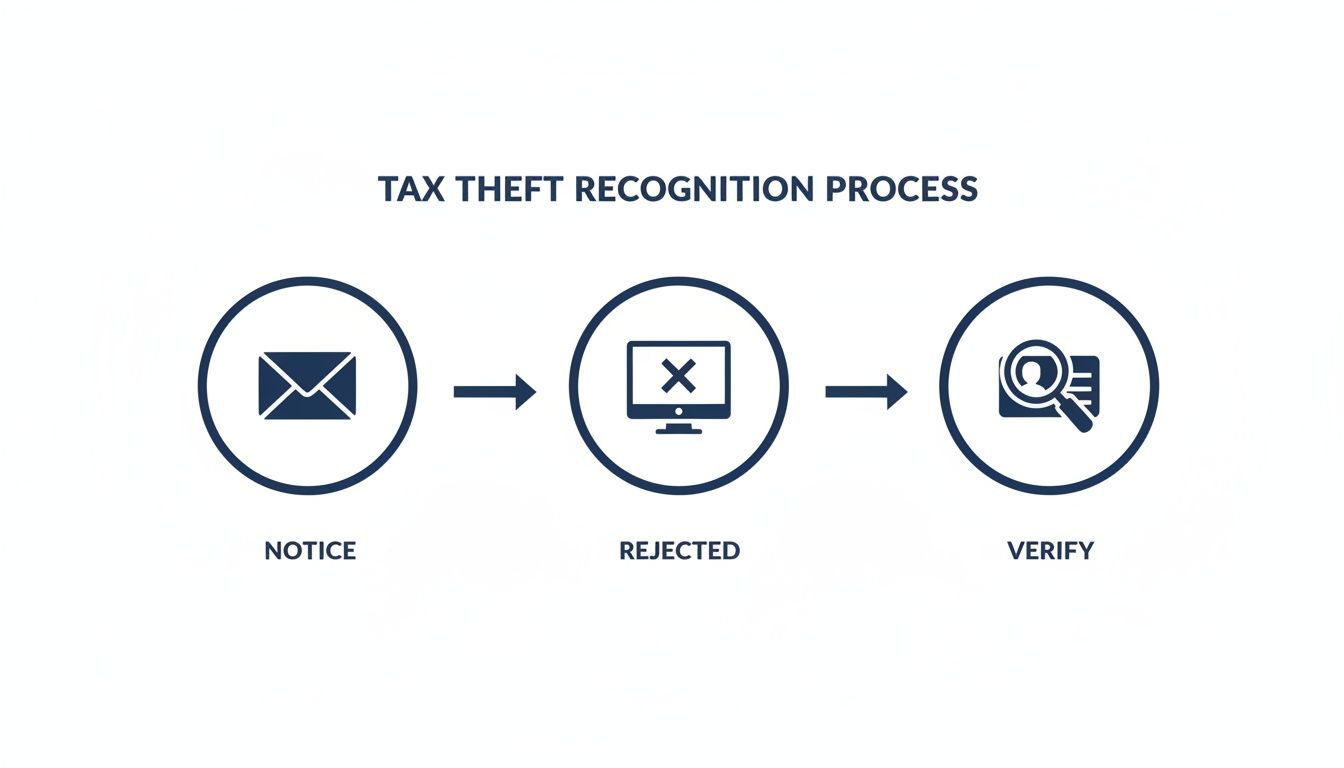
Whether it was a startling IRS notice in the mail or a gut-wrenching e-file rejection, the path forward starts with Form 14039.
Before diving into the form itself, it’s essential to act swiftly on several fronts. The moments after discovering identity theft are critical for containing the damage.
Essential Actions to Take Immediately After Discovering Tax ID Theft
Here's a checklist of the most important first steps you need to take. This isn't just about the IRS; it's about protecting your entire financial identity.
| Action Item | Why It's Critical | Contact/Resource |
|---|---|---|
| File Form 14039 | Officially notifies the IRS of the identity theft and starts their resolution process. | IRS Form 14039 |
| Contact Credit Bureaus | Place a fraud alert or credit freeze to prevent thieves from opening new accounts. | Equifax, Experian, TransUnion |
| File a Police Report | Creates an official record of the crime, which can be crucial for disputing fraudulent accounts. | Your local police department |
| Report to the FTC | The FTC compiles data and provides a personalized recovery plan through IdentityTheft.gov. | IdentityTheft.gov |
Taking these actions in parallel creates a strong defensive perimeter while you work through the specific tax-related issues with the IRS.
Getting Form 14039 Right the First Time
While the form itself isn't terribly complex, accuracy is everything. A single mistake or omission can send you to the back of the line, delaying the entire process.
Section A: Your Personal Information
Double-check that your name, address, and Social Security Number (SSN) are perfect. If you file jointly and your spouse was also impacted, include their information as well. This section has to be flawless.
Section B: The Tax Year and Discovery
This is where you pinpoint the problem. If you tried to file your 2023 return and it was rejected, you'll check the box for the 2023 tax year.
You’ll also need to explain how you found out. The form gives you checkboxes for common scenarios, like receiving an IRS notice or having your e-file rejected. Pick the one that fits your situation. This gives the IRS agent a quick snapshot of what went wrong.
Telling Your Story—Clearly and Concisely
You’ll find a space in Section B to explain what happened in your own words. The temptation to write a long, frustrated letter is understandable, but it won't help your case. From my experience, brevity and facts are what get results.
Your goal is to provide a clear, factual summary. Stick to the essentials. For instance: "On April 10, 2024, my attempt to e-file my 2023 tax return was rejected with error code IND-181. The reason given was that a return had already been filed using my SSN. I did not file that return, nor did I authorize anyone to do so."
This kind of direct statement gives the IRS agent precisely what they need. If you received a notice like a CP01A or 5071C, be sure to include that specific notice number.
Putting Your Submission Package Together
You can't just send in the form by itself. To successfully report IRS identity theft and have the agency take you seriously, you need to provide proof. An incomplete package is the number one reason for delays.
Your submission must include:
- A fully completed and signed Form 14039.
- A clear copy of a government-issued photo ID (your driver's license, passport, or state ID card works perfectly).
- A copy of the document that tipped you off—the IRS letter, a screenshot of the e-file rejection, etc.
You'll either mail or fax this package. The correct mailing address or fax number is listed right in the instructions for Form 14039 and depends on where you live.
After you send it, be prepared to wait. The IRS investigation can take 120 days or even longer. In the meantime, you'll still need to file your legitimate tax return, but you'll have to do it the old-fashioned way: by paper mail. Your e-filing capabilities will be locked down until your case is fully resolved.
Working with the IRS Identity Protection Specialized Unit
Once you mail in your Form 14039 affidavit, your case is officially on the IRS's radar. It gets routed to a specific group called the Identity Protection Specialized Unit, which is set up exclusively to deal with the fallout from tax-related identity theft. This isn't just another department—this is the team that will untangle the mess, clear the fraudulent activity from your account, and help you lock it down for good.
Filing the form is the first move, but now comes the part that requires real patience. Based on our experience with these cases, you should prepare for the investigation to take a significant amount of time. A typical timeframe is 120 days, but it can often stretch longer. It's frustrating, I know, but there's a lot happening behind the scenes even when it feels quiet.

During this period, agents are validating your identity, removing the fraudulent tax return tied to your name, and working to finally process your legitimate, paper-filed return. Any refund you're owed is frozen until this is all sorted out. Communication from the IRS can be sparse, which only adds to the anxiety, but rest assured that having your case with this specialized unit means it's in the right hands.
Your New Best Friend: The Identity Protection PIN
The most critical tool you’ll get from this process is an Identity Protection PIN (IP PIN). Think of it as a second password for your tax account. It’s a six-digit number, unique to you and the IRS, that you’ll be required to use every time you file a federal tax return from now on.
It's a simple but incredibly effective security measure. If anyone tries to e-file a return using your Social Security number without that specific PIN, the IRS system will automatically reject it. It slams the door shut on criminals trying to use your information again.
The IP PIN is your single best defense against becoming a repeat victim of tax identity theft. Once the IRS confirms you as a victim, you're automatically enrolled in the program. You'll get a new PIN in the mail every year, usually around December or January, to use for that year's filing season.
Guard this number as carefully as you would your SSN. A huge red flag for a scam is anyone calling, texting, or emailing you asking for your IP PIN—the IRS will never do that.
How the IP PIN Program Works in Practice
After the IRS resolves your identity theft case, they will automatically mail you a CP01A Notice. This letter will contain your new IP PIN for the upcoming tax season, and you'll get a new one every year going forward.
Here are the key things to remember:
- It’s an Annual Thing: You get a brand-new IP PIN every single year. Last year's PIN won't work.
- It's Mandatory for Filing: Whether you e-file or mail in your return, you must include the correct IP PIN. If it's missing or wrong, your return will be rejected or its processing will be seriously delayed.
- For Joint Filers: If both you and your spouse receive an IP PIN, you both need to enter your own PINs when you file your joint return.
For anyone who hasn't been a victim but is worried about the possibility, the IRS has opened a voluntary opt-in program. You can visit the IRS website's Get an IP PIN tool to verify your identity and get a PIN proactively. It’s a smart move for extra peace of mind.
What to Do While You Wait
While the IRS unit does its work, your role is to stay organized and patient. I always advise clients to keep a dedicated folder for everything related to the identity theft case. This includes copies of the Form 14039 you sent, any notices from the IRS, and notes from any phone calls.
Don't forget, you still have a legal obligation to file your taxes for the year the fraud occurred. Since your SSN is flagged, you won't be able to e-file. Instead, you'll need to go old-school:
- Prepare your correct tax return.
- Print a physical copy.
- Attach a copy of your completed Form 14039 to your return.
- Mail the complete package to the IRS address specified in the form instructions.
Taking this step ensures you stay compliant while the IRS sorts out the fraud. The wait can feel endless, but understanding the process and the powerful protection of the IP PIN provides a clear path forward to getting your tax life back on track.
Fixing Your Tax Record and Tackling State-Level Headaches
Once you've reported the identity theft to the IRS, the real work of cleaning up the mess begins. A fraudulent return filed with your Social Security Number doesn't just disappear—it creates a real, tangible problem on your official tax account. It's up to you to get it corrected. For those of us in Michigan, this is often a two-front battle, as you'll need to address the fallout with the state as well.
Even with an open IRS investigation, you are still legally required to file your true tax return for the year. But here’s the catch: because your SSN is now flagged for fraud, you can't e-file. You’ll have to go old-school and file a paper return by mail.
This isn't as simple as printing your forms and dropping them in a mailbox, though. You have to be very deliberate to make sure your legitimate return is connected to your identity theft case and not mistaken for a duplicate filing.
Filing Your Paper Return the Right Way
Think of the paper return you're mailing as a crucial piece of evidence. It needs to give the IRS agent reviewing your file the full context of what's happening. Without that, you risk having it rejected or further complicating your case.
When you mail your return to the IRS, your package must include:
- Your complete, accurate paper tax return, properly signed and dated.
- A copy of the Form 14039, Identity Theft Affidavit, you already filed. This is your case's anchor.
- Copies of any IRS notices you've received, like a CP14 notice demanding payment or a 5071C letter asking you to verify your identity.
- A short, simple cover letter explaining that you are filing your legitimate return while your identity theft claim (referenced by the attached Form 14039) is being investigated.
Assembling this package correctly creates a clear paper trail. It immediately tells the IRS employee handling your mail that this return is part of an active fraud case. Keep in mind, paper returns are processed much more slowly, and any refund you're owed will be held until the investigation is fully resolved.
Don't Forget About the Michigan Department of Treasury
Tax identity theft is rarely confined to the federal level. If a criminal has your information, they'll almost certainly try to cash in with a fraudulent state tax return, too. For Michigan taxpayers, this means you need to get ahead of the problem with the Michigan Department of Treasury.
The process is a mirror image of what you do with the IRS. You need to alert the state and prove the return filed wasn't yours.
First, call the Michigan Department of Treasury to report the fraud. When you get someone on the line, explain the situation and let them know you’ve already filed a Form 14039 with the IRS. They'll guide you on their specific requirements, which almost always involve submitting Michigan’s own Form 3174, Identity Theft Declaration. You'll also need to send copies of your driver's license, the police report, and your federal affidavit.
And just like with the IRS, you'll have to file a paper Michigan tax return (like the MI-1040) by mail, bundling it with all your supporting identity theft documents.
It's easy to focus on the IRS and forget the state, but that's a costly mistake. Ignoring a fraudulent Michigan return can trigger incorrect tax bills, aggressive collection actions, and even state tax liens. You must work with both agencies to get your records fully corrected.
Identity theft is a nationwide scourge, but it often concentrates in certain areas. In 2023, Georgia had the unfortunate distinction of leading the country with 457 identity theft reports per 100,000 residents. States like Florida, Nevada, and Texas weren't far behind, which shows just how organized these criminal rings are. While Michigan's numbers may not be as high, this data from ConsumerAffairs.com is a stark reminder of why protecting your information at both the federal and state levels is so critical.
If the fraudulent filing created an incorrect tax balance that lingers on your account, simply filing the correct return might not be enough. Once the immediate identity theft issues are sorted out, you may need to file an amended return to formally correct your tax record. To see exactly how that works, you can read our comprehensive guide on how to amend a tax return. This final step ensures your account is accurate, finally closing the book on the financial chaos caused by the theft.
Securing Your Finances Beyond the IRS

When you discover your identity has been used to file a fraudulent tax return, it’s easy to focus solely on the IRS. But that's a mistake. The criminals who have your Social Security number and other sensitive details won’t just stop with tax fraud—they have the keys to your entire financial life.
Your next moves are about building a fortress around your credit and personal data, and that work starts immediately after you’ve dealt with the initial tax issue.
The First Call: Contacting the Credit Bureaus
First things first, you need to get in touch with the three major credit bureaus: Equifax, Experian, and TransUnion. You have two main options here, and it's important to understand the difference.
- Fraud Alert: This is a good initial step. It flags your credit file, forcing lenders to take extra steps to verify your identity before opening any new accounts. The best part? You only have to contact one bureau. They are required by law to inform the other two. An initial alert lasts for one year and is completely free.
- Credit Freeze: This is the heavyweight option. A credit freeze, also known as a security freeze, locks down your credit report completely. No one—not even you—can open a new line of credit while the freeze is in place. It's the highest level of protection available. To do this, you'll need to contact each of the three bureaus individually.
So, which one should you choose? A fraud alert is a quick and easy way to get immediate protection. But if you are a confirmed victim of tax identity theft, I almost always recommend a credit freeze. It might seem a bit inconvenient, but the peace of mind it offers is invaluable.
The threat is more serious than many people realize. Recent data reveals that in 2026, an American became a victim of identity theft every 4.9 seconds, which led to a staggering 6,471,708 fraud reports filed with the FTC. According to an in-depth analysis of identity theft statistics from Security.org, this problem has seen a 20-fold increase since 2001, fueled by sophisticated scams targeting everything from tax refunds to new credit accounts.
Your Official Record: Filing a Report with the FTC
Your next critical task is to file a report at IdentityTheft.gov. This is the federal government’s official, one-stop resource for victims, and it’s a step you cannot skip.
Going through the process generates an FTC Identity Theft Report. Think of this as your official police report for the financial world. It’s the proof you'll need to clean up the mess.
With this report, you can:
- Dispute fraudulent accounts and get them removed from your credit history.
- Stop debt collectors from hounding you for debts you didn't create.
- More easily obtain replacements for stolen government IDs.
Even better, IdentityTheft.gov doesn’t just take your report—it gives you a personalized recovery plan. It generates pre-filled letters and a clear checklist, taking a lot of the stressful guesswork out of the equation.
As you move forward, staying organized is key to preventing future issues. Taking the time to prepare for tax season and file with confidence can make it easier to spot red flags early on.
And while you now have a special IP PIN to protect your federal tax return, it's vital to know how to use it correctly each year. To get more comfortable with this tool, you may want to read our detailed guide on the IRS Identity Protection PIN.
When to Hire a Tax Attorney for Your Identity Theft Case
While you can often handle the basics of reporting IRS identity theft on your own, some situations can quickly become too complex or high-stakes to manage alone. It's crucial to recognize when it's time to call in a professional. Moving from self-help to legal representation isn't an admission of defeat; it's a strategic move to prevent a prolonged financial nightmare.
If you’ve followed all the steps, submitted your Form 14039, and are still hitting a brick wall with the IRS, that’s your first major red flag. Cases can easily get lost in the shuffle of the IRS bureaucracy. An experienced tax attorney knows how to cut through the red tape and escalate your case so it gets the attention it deserves.
When the IRS Rejects Your Identity Theft Claim
Here’s a scenario I’ve seen play out far too often: You did everything by the book. You filed the affidavit, sent in your supporting documents, and waited patiently for months. Then, a letter arrives from the IRS stating they’ve rejected your claim. They insist the fraudulent return is yours and that you’re on the hook for the taxes.
This is a gut-wrenching turn of events. At this point, you're no longer just trying to fix a clerical error; you are officially in a dispute with the IRS.
A tax attorney can immediately jump in to:
- File a Formal Appeal: They know the exact procedures for appealing an adverse IRS decision and can build a robust, evidence-based case to prove you're the victim.
- Communicate with the Right People: Attorneys have established lines of communication with IRS agents and appeals officers that are simply not available to the general public.
- Strengthen Your Evidence: They understand what kind of proof carries weight with the IRS and can guide you in gathering the specific documentation needed to overturn their initial finding.
Trying to reverse an incorrect IRS determination on your own is an uphill battle that most people are simply not equipped to win.
When Fraud Leads to Major Tax Debt and Collections
Sometimes identity theft doesn't result in a thief getting a refund. Instead, the fraudulent return creates a massive—and entirely false—tax bill in your name. Before you even have a chance to process what's happening, the IRS collections machine roars to life. You might start getting notices threatening tax liens on your home or levies against your bank accounts and wages.
If your identity theft case has escalated to active IRS collections, you need to call a tax attorney right away. Collection actions can cripple your finances, and you can't afford to wait for the identity theft unit to slowly work through its caseload.
An attorney can demand an immediate hold on all collection activities while your identity theft claim is properly investigated. They can negotiate directly with IRS Revenue Officers, ensuring your assets are shielded from seizure while they work to clear your name and zero out the fraudulent balance on your account.
Complex Cases Involving Businesses or Large Sums
Tax identity theft isn't just a personal problem. Michigan business owners are also prime targets, and the fallout can be devastating. A fraudulent filing involving payroll taxes, S-Corp returns, or complicated partnership structures can threaten the very existence of a business.
Likewise, if the theft involves a significant amount of money—like a six-figure stolen refund or a massive bogus tax bill—the stakes are simply too high to handle it yourself. An experienced tax attorney provides the strategic oversight needed to untangle these complex situations, protecting both your personal and business finances. They can navigate the intricate details and resolve the case far more efficiently, preventing long-term damage to your financial health and reputation.
