
Received a Notice of Levy from IRS? A Michigan Taxpayer’s Guide
Receiving a letter from the IRS is rarely good news, but a notice of levy is on a whole other level. This isn't just a bill or a warning; it’s a legal order from the IRS to seize your property to cover an unpaid tax debt.
Think of it this way: a tax lien is the IRS putting a public claim on your property, like a "dibs" on your house or car. A levy is the actual seizure—the moment they come to collect. It’s one of the most serious enforcement tools they have, and it signals that their patience has run out.
Decoding an IRS Notice of Levy and What It Means for You
That official IRS envelope can be intimidating, but a notice of levy means the situation has become critical. The IRS has shifted from asking for payment to actively taking it.
This isn't an ambush, though. A levy is the final step in a long, predictable process. It’s the government's last resort after sending you multiple warnings and giving you chances to fix the problem. When they finally issue a levy, they can legally take things like:
- Your bank accounts: They can freeze and empty the funds right out of your personal or business accounts.
- Your paycheck: The IRS can order your employer to send a large chunk of your wages directly to them. This is known as wage garnishment.
- Other income: They can also intercept Social Security benefits, retirement income, and payments you receive as an independent contractor.
The Paper Trail: How the IRS Gets to a Levy
The IRS can't just decide to levy your assets out of the blue. They are legally required to follow a specific procedure, which gives you several opportunities to respond before things get this serious. This "paper trail" is a key part of your taxpayer rights.
Typically, the IRS sends a series of four notices, each one more serious than the last. It starts with a simple bill and ends with a final, legally-binding warning.
The Four Stages of IRS Collection Notices
| Notice Code (Example) | Notice Title | What It Means | Can the IRS Levy Yet? |
|---|---|---|---|
| CP14 | Notice of Unpaid Tax | This is the first official bill for a balance due. It's a straightforward request for payment. | No. This is just the initial notification. |
| CP501 | Reminder – You Have an Unpaid Balance | The first reminder. The tone is still informational, but the urgency is starting to build. | No. It's still a reminder notice. |
| CP503 | Second Reminder – You Have an Unpaid Balance | Another reminder, but the language is getting more serious. It often mentions the possibility of a lien. | No. Still in the warning phase. |
| Letter 1058/LT11 | Final Notice of Intent to Levy and Notice of Your Right to a Hearing | This is the final, official warning. It gives you 30 days to either pay or appeal. This is the last stop. | Yes. After the 30-day window expires, the IRS is legally cleared to start seizing your assets. |
Seeing this progression laid out makes it clear: a levy is entirely preventable if you take action when you receive one of the earlier notices.
A levy is the IRS's final resort after other collection attempts have failed. The good news is that even at this stage, you have options to stop the process and protect your assets.
Understanding this sequence is your best defense. If you know which notice you’ve received, you know how much time you have left to act. For Michigan residents, responding quickly can mean the difference between resolving your debt and having your bank account emptied. You can learn more about what a tax levy entails in our detailed guide.
Your First Steps After Receiving a Levy Notice
Getting a notice of levy from the IRS can feel like the floor has dropped out from under you. It’s a serious situation, but the absolute worst thing you can do is panic or pretend it didn't arrive. Your very first move is simple but critical: do not ignore that letter.
Inside that envelope is vital information and, most importantly, a hard deadline. The Final Notice of Intent to Levy typically gives you just 30 days to formally respond before the IRS can start seizing your property and assets. Think of this 30-day window as your lifeline—it’s the time you have to get ahead of the problem before it spirals.
What to Do Immediately
Every hour counts. What you do in the first few days after opening that letter can completely change the outcome. Here's a straightforward, three-step plan to protect your assets and start building a path toward a solution.
Read the Notice Carefully: Look for the specific notice number (it might be an LT11 or Letter 1058) and find the exact response deadline. That date is now the most important date on your calendar.
Contact a Qualified Tax Professional: This is not a "do-it-yourself" situation. An experienced tax attorney can immediately contact the IRS for you. If you're still within that 30-day window, they can file a request for a Collection Due Process (CDP) hearing. This is a game-changer because a timely CDP request legally stops all levy actions while your case is being considered.
Gather Your Financial Documents: Start pulling together your recent pay stubs, bank statements, and a simple list of your monthly income and expenses. Having this paperwork ready allows your representative to negotiate from a position of strength, whether that means setting up a payment plan or proving financial hardship.
This timeline shows how the IRS communicates before a levy. It's not a sudden event, but the last step in a long process.
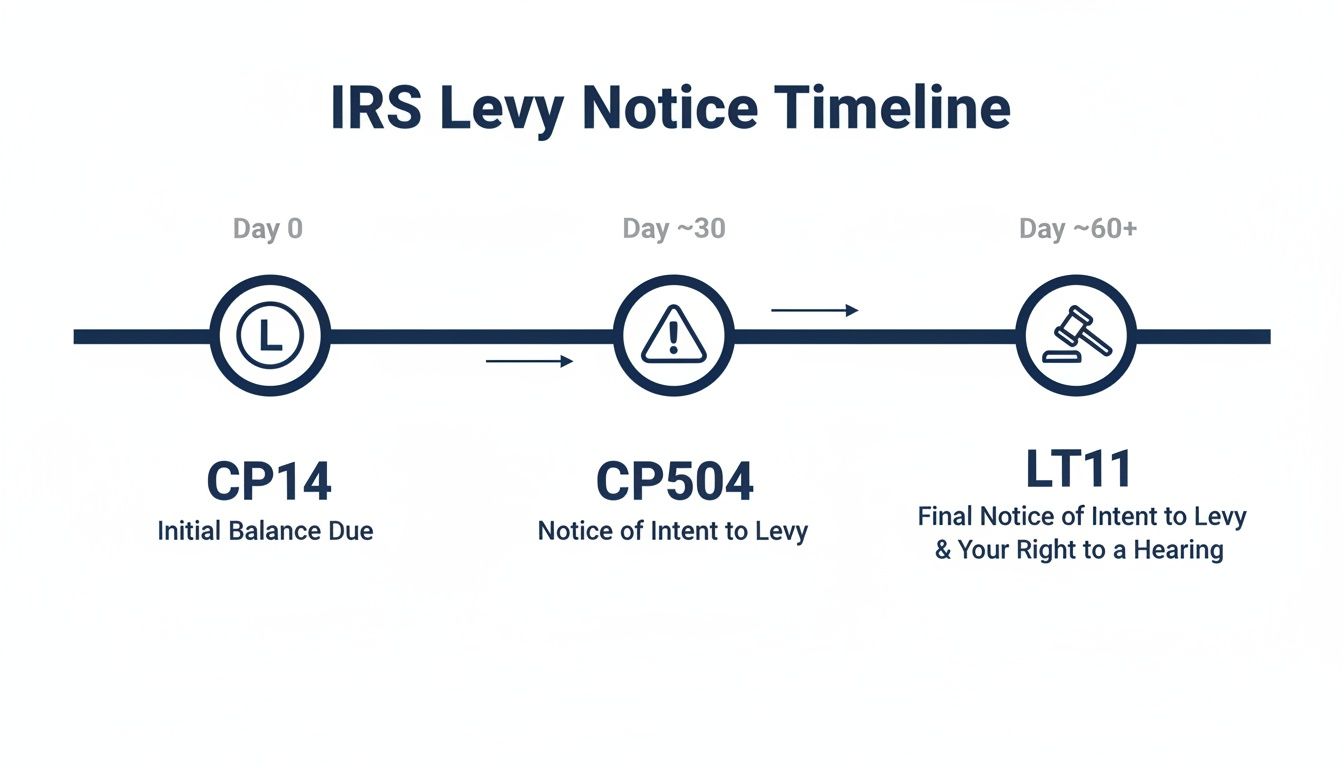
As you can see, a levy doesn't come out of the blue. It’s the final warning after a series of notices, and you have the power to step in and stop it.
The moment a Final Notice of Intent to Levy is in your hands, the clock is officially ticking. Your most powerful move is to respond immediately, especially by filing for a CDP hearing. This is what halts the formidable IRS collection machine and protects your financial stability.
By taking these first steps, you're no longer just a target. You’re actively engaging with the IRS to find a real solution, with an expert on your side. This proactive stance is the key to successfully navigating a notice of levy from the IRS.
Understanding What the IRS Can and Cannot Seize
When an IRS notice of levy lands in your mailbox, it’s easy to let your mind race. What’s on the line? While the IRS has far-reaching collection powers, they aren't absolute. Knowing exactly where their authority begins and ends is the first step toward regaining control.
The IRS almost always goes after the low-hanging fruit first: liquid assets. Why? Because they're easy to access and convert to cash to pay down your tax debt. This means things like the money in your bank accounts and your regular paycheck are their primary targets.

Common Assets the IRS Can Seize
The IRS has a wide net it can cast over your property and financial accounts. Let's break down some of the most common targets.
- Bank Accounts: A bank levy is a one-time event, but it's powerful. The day your bank receives the notice, they freeze your account. The funds are then held for a 21-day period before being sent directly to the IRS. You can get more details in our guide on what a bank levy is and how it works.
- Wages and Salary: Unlike a bank levy, this is a continuous drain. A wage garnishment legally requires your employer to divert a portion of every single paycheck to the IRS. This continues until the levy is released or your debt is paid in full.
- Retirement Accounts: Many people assume their retirement savings are untouchable, but that's not the case. Funds in your 401(k) or IRA can be levied, though the IRS typically uses this as a later-stage tactic when other methods haven't worked.
- Business Assets: If you’re a business owner in Michigan, the IRS can go after your accounts receivable, your business bank accounts, and even physical assets like company vehicles, equipment, or inventory.
A wage levy can be particularly devastating, as it hits your primary source of income. But you aren't left with nothing. The law provides for exemption amounts based on your filing status and the number of dependents you claim, which are updated each year. To see how these exemptions are calculated, you can review the official guidelines in the IRS Internal Revenue Manual.
Assets the IRS Generally Cannot Seize
While the IRS’s reach is broad, federal law puts a fence around certain assets. These protections are designed to ensure a levy doesn't leave you completely destitute, providing a critical safety net.
It's a common misconception that the IRS can take everything you own. The law explicitly protects certain assets to prevent a levy from causing complete destitution, providing a safety net for taxpayers facing financial hardship.
This means some of your property is legally off-limits. Here’s what the IRS is generally prohibited from taking:
- Certain unemployment and workers' compensation benefits.
- Specific disability payments and public assistance funds.
- Necessary schoolbooks and clothing for you and your family.
- A portion of your wages and other income, as calculated by the exemption tables.
- Your primary residence, except in very specific and rare circumstances that require a federal judge to sign off on the seizure.
Your Main Options for Stopping an IRS Levy
Getting that levy notice in the mail can feel like the end of the road. But it’s not. Even at this point, you have well-established, powerful options to stop the IRS in its tracks and finally resolve what you owe. The trick is to understand what these programs are and to act fast to find the right fit for your financial situation.
These aren't just temporary fixes. They're formal agreements with the IRS that can halt a levy cold and give you a clear path forward. The three main routes are each designed for different financial circumstances, from paying what you owe over time to seeking relief from a debt that feels completely overwhelming.
Settle for Less with an Offer in Compromise
What if you could resolve your entire tax debt for just a fraction of the original amount? That's the powerful idea behind an Offer in Compromise (OIC). This is a formal IRS program that allows taxpayers in specific situations to settle their tax liabilities for less—sometimes significantly less—than what they were first told they owed.
Now, an OIC is a serious process, and it’s not for everyone. The IRS will take a hard look at what they call your "reasonable collection potential," which is a fancy term for your ability to pay based on your income, expenses, and the equity you have in your assets. They typically only accept an OIC when your offer represents the most they could realistically hope to collect from you.
To even be considered, you have to meet some non-negotiable criteria:
- You must have filed all your required tax returns.
- You must have made all required estimated tax payments for the current year.
- You cannot be in an open bankruptcy case.
If your financial reality truly makes paying the full tax debt impossible, an OIC might be the most powerful solution available to you.
Pay Over Time with an Installment Agreement
If you know you can pay off your tax debt, just not all at once, then a formal Installment Agreement (IA) is almost always the best path. Think of it as a structured payment plan. It lets you make consistent, affordable monthly payments over a set period, which can be up to 72 months.
The good news is that setting up an IA is usually much more straightforward than getting an OIC approved. As long as your total bill—tax, penalties, and interest combined—is under $50,000, you can often apply for a payment plan right on the IRS website without having to submit a mountain of financial paperwork. Once your IA is approved, it immediately stops all levy actions, including wage garnishments. If that’s your main concern, we have a detailed guide on how to stop IRS wage garnishment.
An approved Installment Agreement is a binding contract with the IRS. As long as you stick to the plan and stay current on your future taxes, the IRS agrees to back off from aggressive collections like levies.
Pause Collections with Currently Not Collectible Status
For Michigan taxpayers who are facing a genuine economic crisis, there’s a third option: Currently Not Collectible (CNC) status. This doesn't make the tax debt disappear, but it does hit the pause button on all collection activity, including levies.
To qualify for CNC status, you have to prove to the IRS that your income is barely covering basic living expenses, with nothing left over for tax payments. They will scrutinize your financial information, and if they agree with your assessment, they will stop the threatening notices and halt any active levies.
Just remember, CNC status is not a permanent solution. The IRS will check in on your financial situation from time to time, and if your income goes up, they can and will restart collections. All the while your account is in CNC status, penalties and interest will continue to pile up on your balance.
The Process for Getting an IRS Levy Released
Stopping an active levy is your immediate goal, but getting it formally released is what truly gives you back control over your money. A levy release is the official document the IRS sends to your bank or employer, ordering them to stop freezing your accounts and garnishing your pay.
It's crucial to understand what a release does—and doesn't—do. A release stops the bleeding, but it doesn't cure the underlying problem. Your tax debt is still there, waiting for a permanent solution.
The good news is that the IRS is legally required to release a levy under certain circumstances. The most powerful argument you can make is that the levy is causing an immediate and severe economic hardship. If you can show them you can't cover basic living expenses like rent, utilities, or food, they have to back off. This is often the fastest way to stop a levy cold.
Conditions That Trigger a Levy Release
Beyond proving hardship, a few other actions will force the IRS's hand and get them to issue a formal release. Taking one of these steps signals that you're working toward a resolution, which is exactly what they want to see.
- Pay the Debt in Full: This is the most straightforward path. Once the debt is cleared, the levy has no legal standing.
- Set Up an Installment Agreement: As soon as the IRS formally accepts your proposal for a payment plan, they are required to release any active levies.
- Get an Offer in Compromise (OIC) Approved: If you successfully negotiate a settlement for less than you owe (an OIC) and make your first required payment, the levy comes off.
- The Collection Statute Expires: The IRS typically only has 10 years to collect a tax debt. Once that clock runs out, any levies tied to that debt must be released.
A levy release from the IRS is your green light to move forward. It means the immediate threat is over, giving you the breathing room needed to execute a long-term resolution like a payment plan or Offer in Compromise.
Don't think for a second that levies are random. They are a calculated part of the IRS's collection strategy. In Fiscal Year 2023 alone, the agency issued around 600,000 levies, a number that jumped 10% from the previous year. You can dig into these trends yourself by reviewing the IRS Data Book and related activity reports.
Once your bank sends levied funds to the IRS, clawing that money back is an uphill battle. It's not impossible, but it requires immediate, professional action to prove the funds were exempt from seizure. That’s why acting before the 21-day holding period is up isn't just important—it's everything.
Why a Michigan Tax Attorney Is Your Best Ally
Trying to navigate an IRS notice of levy on your own is like stepping into a high-stakes negotiation without knowing the rules. This isn't just about paperwork; it's a serious financial battle where legal expertise can make all the difference. An experienced Michigan tax attorney is more than just an advisor—they become your shield.

The moment you hire an attorney, they take over all communication with the IRS. Their first move is to stop the immediate financial damage. By filing the right legal requests, like a Collection Due Process hearing, they can put a legal stop to the levy. This crucial step gives you the breathing room you need to figure out a real solution.
Leveraging Local Knowledge for a Stronger Case
This is where a local expert truly shines. A Michigan-based attorney brings a deep understanding of our state's specific economic landscape, which is incredibly powerful when arguing for financial hardship or a payment plan you can actually afford.
Think about it. An attorney familiar with Michigan can frame your financial situation with vital context, such as:
- The high cost of living in Metro Detroit versus other parts of the state.
- The impact of regional employment trends on your industry and income.
- Other state-specific economic pressures the IRS might otherwise overlook.
This isn't just about presenting numbers; it's about telling a compelling story that makes a strong case for relief, whether it's an Offer in Compromise or getting your account placed in Currently Not Collectible status.
Having a professional who speaks the IRS's language and understands their procedures is critical. They transform a stressful, one-sided demand into a structured negotiation where your rights are protected at every turn.
From managing deadlines to speaking directly with revenue officers, your attorney handles every detail. Their expertise not only gives you the best shot at getting the levy released but also offers invaluable peace of mind when you need it most.
Frequently Asked Questions About IRS Levies
Getting a notice of levy from the IRS can be terrifying, and it's natural to have a million questions running through your head. Let's tackle some of the most pressing concerns people have when they find themselves in this situation.
Can the IRS Take My House with a Levy?
This is the big one, the question that keeps people up at night. First, let's clear up a common point of confusion: the difference between a lien and a levy.
Think of an IRS lien as a public claim against your property. It's a legal placeholder that says, "the government gets paid first" if you sell or refinance your house. It secures the debt, but it doesn't mean they're kicking you out.
A levy is the next step—the actual seizure of an asset. While the law technically allows the IRS to seize and sell a primary residence, this is incredibly rare. It's a drastic measure used only in the most extreme cases of non-compliance and involves a complex legal process. It is truly a last resort.
It's also worth noting that federal tax issues aren't the only threat to your home. You could also receive an official notice about a tax delinquency from your local county for unpaid property taxes, which comes with its own set of rules and risks.
How Long Does an IRS Levy Last?
There's no single answer here, because the duration depends entirely on what the IRS is taking.
Bank Levy: This is a one-time shot. The IRS freezes and takes whatever is in your account on that specific day, up to the amount you owe. Any money you deposit the next day is safe from that particular levy.
Wage Garnishment: This is a completely different beast. It’s a continuous levy that attaches to your paycheck. Your employer will be required to send a portion of your wages to the IRS every single pay period until the debt is paid in full, you negotiate a release, or the debt expires.
A levy on a bank account is a snapshot in time, while a wage garnishment is a continuous drain. Understanding which type you're facing is key to planning your response.
Will Filing for Bankruptcy Stop an IRS Levy?
Yes, it almost always does. The moment you file for bankruptcy, a powerful legal injunction called an “automatic stay” immediately goes into effect.
This court order acts like a stop sign for most creditors, including the IRS. It forces them to halt all collection activities, which means any active levies or wage garnishments must cease right away.
But here’s the critical part: stopping the levy isn’t the same as eliminating the tax debt. Whether the underlying taxes can be wiped out (discharged) in bankruptcy is a much more complicated question. It depends on the type of tax, how old it is, and whether you filed your returns on time. This is where you absolutely need an expert to analyze your specific situation.
