
Get a New York State Taxes Payment Plan for Debt Relief in 2026
That 'Tax Notice' envelope from the New York State Department of Taxation and Finance is enough to make anyone’s stomach drop. The language is intentionally firm, and the numbers—plus the penalties and interest that are already piling up—can feel like an impossible mountain to climb.
It’s tempting to set it aside and hope it goes away. Don’t. Ignoring a tax debt is the single worst move you can make. The state has powerful tools to collect what it's owed, and they won't hesitate to use them. We're talking about bank levies that freeze your accounts, wage garnishments that take money directly from your paycheck, and even asset seizure.
But there's good news: New York State has a built-in safety valve for this exact situation. It's called an Installment Payment Agreement (IPA).
What Exactly Is a New York Installment Payment Agreement?
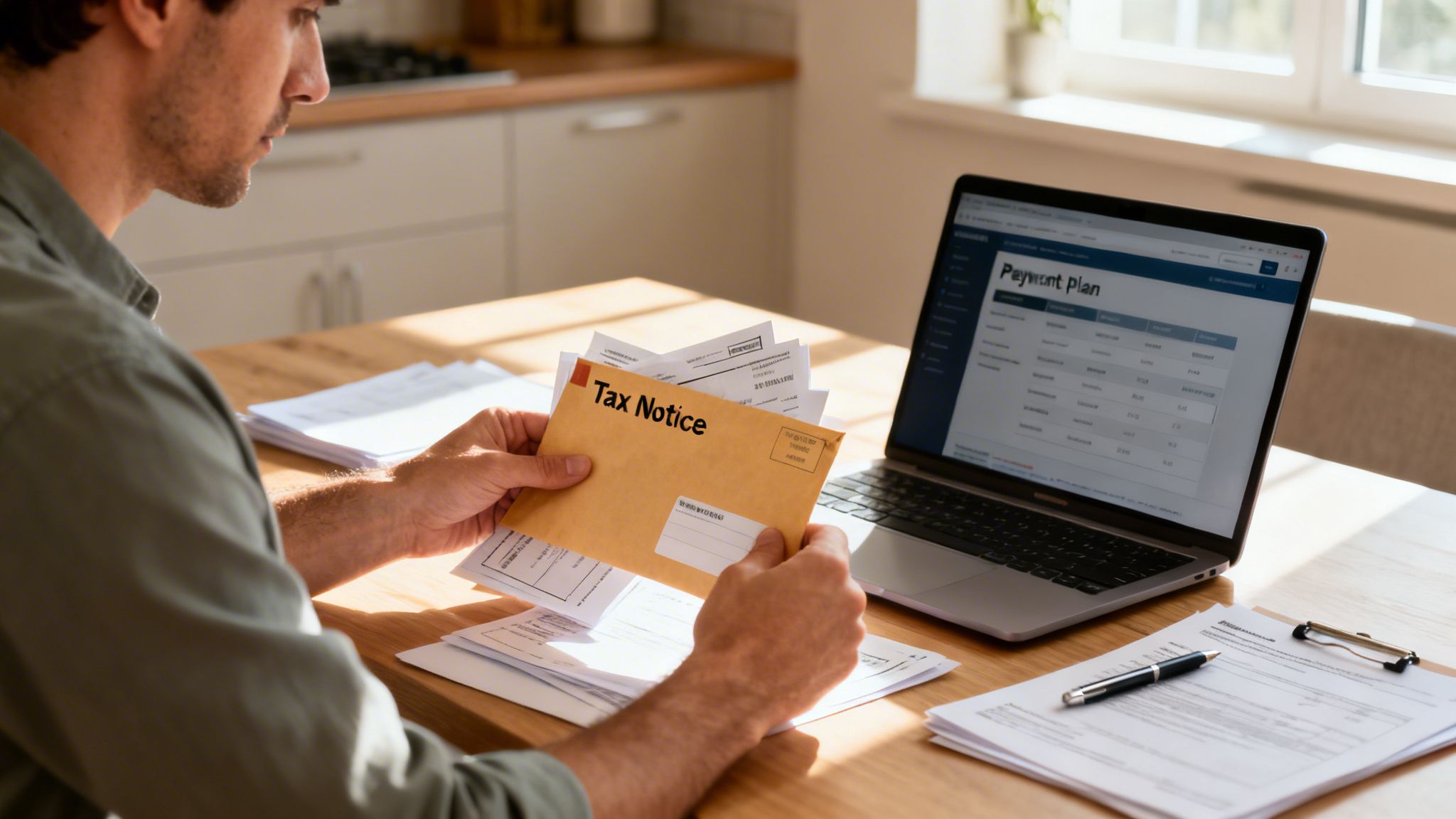
Think of an IPA as a formal contract between you and the state. It allows you to pay off your tax liability through a series of predictable monthly payments instead of one lump sum.
For many taxpayers, this is a lifeline. If your total balance is $20,000 or less, you can often set up a plan to pay it off over 36 months. This transforms a huge, intimidating bill into a manageable part of your monthly budget.
This program is more important than ever. New York's tax collections have seen a massive jump, with personal income taxes and the new Pass-Through Entity Tax (PTET) combined surging from $13.3 billion in Fiscal Year 2019 to $18.5 billion in FY 2026. This tax stream now makes up a staggering 23% of New York City's total tax revenues. With the state collecting more aggressively, having a formal payment plan in place is critical.
To give you a clearer picture, here is a quick summary of what the NY Installment Payment Agreement entails.
NY Installment Payment Agreement at a Glance
| Feature | Details |
|---|---|
| Eligibility Cap | Typically available for tax debts of $20,000 or less. |
| Payment Term | Can extend up to 36 months. |
| Protection | Halts aggressive collection actions like levies and wage garnishments. |
| Interest & Penalties | Continue to accrue until the debt is fully paid. |
| Application Fee | A setup fee may be required to initiate the plan. |
| Compliance | Requires all future tax returns to be filed and paid on time. |
This table highlights the core components, but the real value is the stability and control it gives you over your financial life.
Why a Formal Plan Is Non-Negotiable
You might think that just sending in partial payments whenever you can is good enough. Unfortunately, it's not. Without a formal IPA, the state's collection clock keeps ticking. Those informal payments won't stop them from levying your bank account or garnishing your wages.
An Installment Payment Agreement is more than just a payment schedule; it's a financial ceasefire. You commit to making consistent payments, and in return, the state agrees to pause its most severe collection tactics.
This formal arrangement gives you legal protection and, just as importantly, peace of mind. The cycle of threatening letters stops, and you regain control. You have a clear, state-approved path to becoming debt-free.
If you're feeling lost and aren't even sure of the full scope of your tax situation, a good starting point is to confirm exactly what you owe. Before you can create a plan, you need to know the full picture. Learning how to check if you owe back taxes is the first, most crucial step toward resolving your obligations and getting back on solid financial ground.
Are You Eligible for a NYS Tax Payment Plan?
Thinking about a payment plan for your New York State taxes? Before you even start an application, it's smart to see if you actually qualify. The state has some firm rules, and knowing them now can save you a ton of frustration later.
The biggest hurdle, and it's a non-negotiable one, is that all of your required tax returns must be filed. New York won't even consider an Installment Payment Agreement (IPA) if you have missing returns. From their perspective, they can't agree on a payment amount until they know the full extent of what you owe. So, if you're behind on filing, that’s your first job.
The $20,000 Dividing Line
The amount you owe is the single biggest factor in how simple—or how complicated—this process will be. New York essentially has two different paths.
Owe $20,000 or Less? If your total bill, including any penalties and interest, comes in at $20,000 or less, you're in luck. You can generally get set up with a payment plan online, often with automatic approval. It’s the fastest route, and these plans typically give you up to 36 months to pay.
Owe More Than $20,000? This is where things get more serious. Once your debt crosses that $20,000 threshold, you can't use the simple online system. You’ll have to submit a formal request and provide a detailed look at your finances.
The bottom line is this: for larger debts, the state needs to be convinced that you can't pay in full right now, but you can afford the monthly payments you’re proposing. You'll have to prove it with documentation.
Financial Disclosure for Larger Debts
When you owe more than $20,000, get ready to open your books. You'll be required to fill out what’s known as a Collection Information Statement. This is a deep dive into your income, living expenses, assets, and other debts.
Let’s say you’re a freelance web developer who owes $35,000 after a couple of unexpectedly good years. To get an IPA, you can’t just ask for one. The state will want to see everything, including:
- Income verification: Invoices, 1099s, and bank statements showing your monthly cash flow.
- Essential expenses: A breakdown of your rent or mortgage, utilities, groceries, car payments, and other necessary costs.
- A list of your assets: The value of your home, car, savings accounts, and any investments.
The Department of Taxation and Finance uses this data to run the numbers and determine what they consider a "reasonable" monthly payment. They’ll only approve a plan if your own figures show you can make the payments without going broke. Be thorough and honest here; incomplete or inaccurate financial statements are one of the top reasons a New York State taxes payment plan request gets denied.
So, you've confirmed you're eligible for a New York State Installment Payment Agreement (IPA). That's a great first step. Now, it's time to formally apply.
How you approach this depends entirely on one number: the total amount you owe. New York has two very different paths, and the fork in the road is at the $20,000 mark. If your debt is under that amount, you’re looking at a much simpler process than if you owe more.
For Debts Under $20,000: The Online Fast Track
If your total tax bill is $20,000 or less, the state wants to make this easy for you. The fastest and most direct route is using the NYS Department of Taxation and Finance's online system.
You'll need to create an "Online Services" account on their website first. Once you're in, you can head to the payment section and request an IPA. Because your balance is below the threshold, the process is largely automated. In many cases, you can get approved for a payment plan—typically for up to 36 months—almost instantly.
For Debts Over $20,000: The Paper-Based Approach
When your tax debt climbs above $20,000, the streamlined online portal is no longer an option. Instead, you'll need to roll up your sleeves and prepare a paper application using Form DTF-5, Installment Payment Agreement Request.
This form requires a full financial disclosure. It’s more than just a request; it’s a detailed proposal. You’ll have to break down your monthly income, essential living expenses (like housing, food, and utilities), assets, and any other debts.
The goal here is to propose a monthly payment that you can realistically afford without it being so low that the state rejects it out of hand. Finding that sweet spot is the key to getting your agreement approved.
This flowchart gives you a quick visual of how to determine your application path.
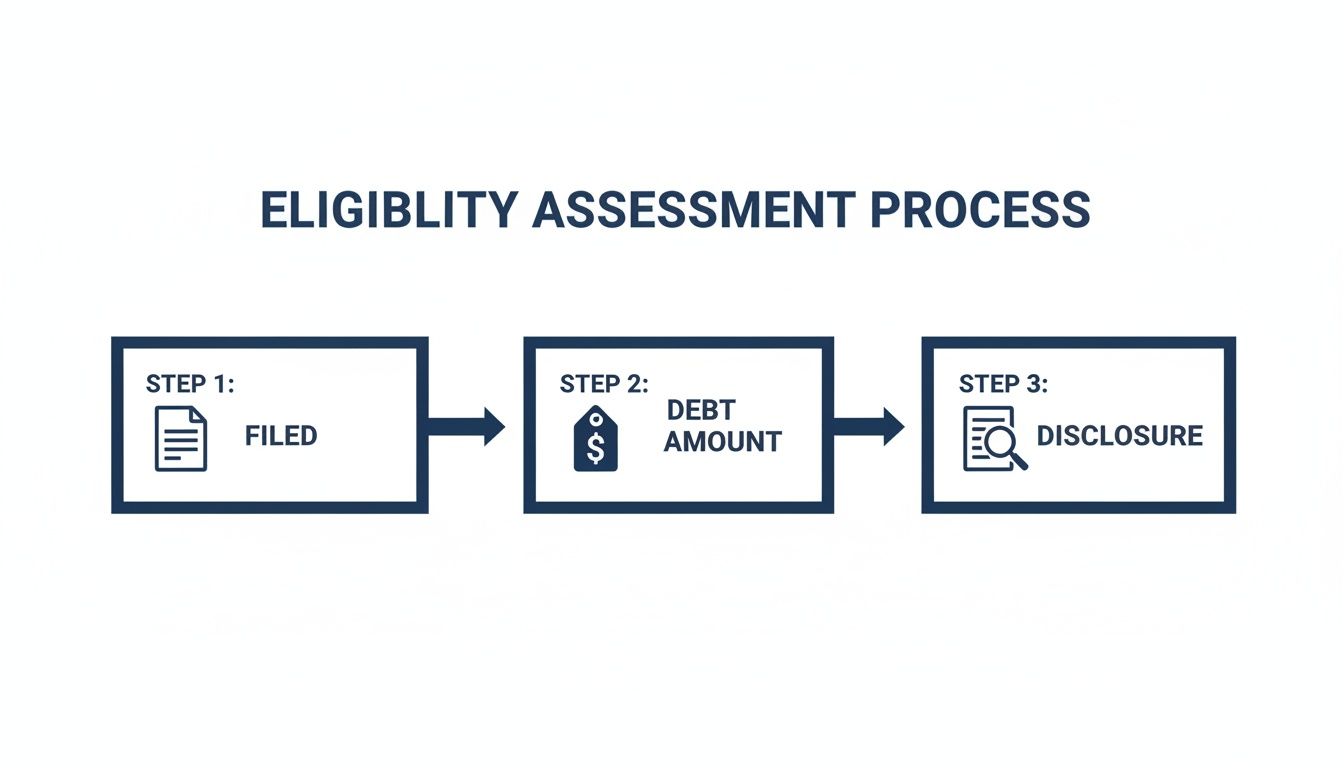
As you can see, the debt amount is the critical factor that separates the simple online process from the more involved paper-based financial disclosure.
Pro Tip: When you fill out Form DTF-5, be thorough and honest. I always tell my clients to back up every number with documentation—bank statements, pay stubs, utility bills, mortgage statements. A transparent, well-documented application shows you're acting in good faith and dramatically increases your chances of the state saying "yes."
While the paper application for debts over $20,000 has more hoops to jump through, don’t let it discourage you. An approved IPA is your best defense against aggressive collection tactics like bank levies and wage garnishments.
This isn't just a New York-specific strategy; it's a fundamental principle of tax resolution everywhere. Understanding your financial standing and proposing a data-backed payment plan is crucial for protecting your assets.
It's also worth noting that this process has a federal counterpart. The IRS equivalent of Form DTF-5 is Form 9465. While the specific details differ, the core concept of proposing a viable payment plan based on your financial situation is exactly the same. If you're also dealing with federal tax issues, you'll find our guide on the instructions for Form 9465 helpful. Managing both state and federal liabilities requires a coordinated approach.
You’ve successfully negotiated a payment plan with New York State. Take a moment to appreciate that win—you’ve stopped the flood of aggressive collection notices and now have a clear path forward.
But getting the Installment Payment Agreement (IPA) approved is just the first step. The real work is in managing it correctly. Think of your IPA as a formal contract, because that’s exactly what it is. The state isn’t looking for “close enough”; they expect strict, consistent compliance. Straying from the terms can undo all your hard work and put you right back in the crosshairs of liens and levies.
Make Every Payment on Time, Every Single Time
This is the golden rule, and it’s non-negotiable. The New York State Department of Taxation and Finance has zero flexibility when it comes to late or partial payments. Even one slip-up can be enough to default your entire agreement.
Treat this payment like your mortgage or car payment—the due date is firm, and the amount is set in stone. Your best bet is to automate it. Go to your bank's website or use the state’s online portal to set up recurring payments. This takes human error out of the equation and ensures your plan stays in good standing without you having to stress about it each month.
Stay Current on All New Tax Filings and Payments
Here’s a common tripwire I see people stumble over all the time. Your agreement to pay off old debt comes with another critical condition: you must stay perfectly compliant on all future tax obligations.
This means two things:
- File on time. All your future tax returns, whether it’s your personal Form IT-201 or any business filings, must be submitted by their deadlines.
- Pay new taxes in full. If you owe taxes for 2026, you must pay that new balance by the deadline. You cannot simply add it to your existing payment plan.
If you have a payment plan for a 2023 tax bill but then fail to pay your 2025 taxes on time, the state can—and likely will—cancel your IPA for the old debt and immediately resume collection actions.
The Harsh Reality of a Default
Defaulting on your IPA isn't a minor setback; it's a financial cliff. The moment you default, the protective shield of your payment plan vanishes.
When you default, the state’s collection machine roars back to life instantly. All the tools they set aside—wage garnishments, bank account levies, and tax warrants—are immediately back on the table. You won’t get a polite reminder; you’ll get a notice that action has already been taken.
On top of that, trying to get a new payment plan after a default is incredibly difficult. You’ve broken their trust, and the Department will be far more reluctant to give you a second chance at a flexible solution.
What to Do If You Can't Make a Payment
Life happens. A sudden job loss, a medical crisis, or a major home repair can wreck your budget and make your monthly IPA payment impossible. If you see this coming, the worst thing you can do is nothing.
Proactive communication is your only defense. The second you know you're going to have trouble, you need to contact the NYS Department of Taxation and Finance. Don't wait until you've already missed the payment. Call them, explain the change in your financial situation, and ask to formally modify your payment plan. Be ready to back it up with new financial documents, just as you did when you first applied.
By getting out in front of the problem, you show you're still committed to making things right. The state is much more willing to work with someone who is being honest and proactive than with someone who just goes silent. A single phone call can be the difference between a modified, affordable plan and a devastating default.
Exploring Alternatives to a Standard Payment Plan
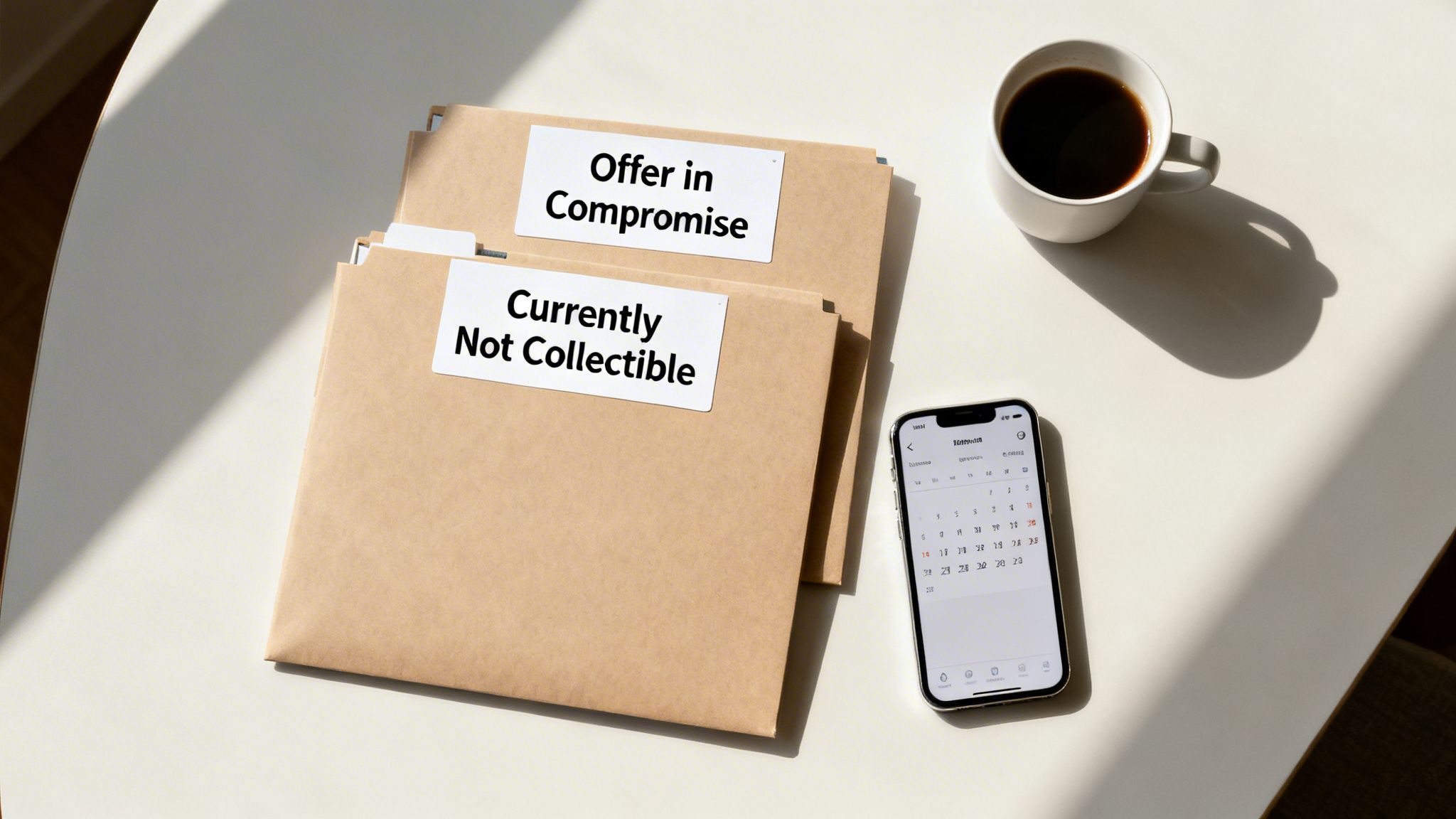
A New York State Installment Payment Agreement (IPA) is a great tool for many people, but it’s built on one big assumption: that you can actually afford the monthly payments. What happens when you can’t? What if your financial situation has become so difficult that even a small payment each month is simply impossible?
The good news is that the state understands life doesn’t always fit into a neat box. They have other powerful tax relief programs for individuals and businesses facing genuine financial hardship. It’s critical to know these alternatives, because one of them might be a much more realistic path forward than a standard New York State taxes payment plan.
When a Payment Plan Is Not the Answer
Let's be clear: an IPA helps you manage your tax debt, not reduce it. You're still on the hook for the full amount you owe, plus all the interest and penalties that continue to pile up. This works if you’re just dealing with a temporary cash-flow problem, but it’s a poor solution if you have a fundamental inability to pay.
Frankly, forcing yourself into a payment plan you can't keep is a recipe for disaster. You’ll eventually default, which puts you right back at square one, facing the state’s aggressive collection actions all over again. If your income has been slashed or a personal crisis has caused your expenses to spiral, it's time to look past the IPA.
The Offer in Compromise: A Path to Debt Settlement
This is the one many people have heard about. An Offer in Compromise (OIC) is a formal agreement you can make with the NYS Department of Taxation and Finance to settle your tax debt for less—sometimes much less—than what you originally owed.
However, this isn't a casual negotiation. It’s a rigorous process reserved for taxpayers in serious financial trouble.
To have a shot at an OIC, you must prove there’s “doubt as to your ability to pay” the full tax liability. This requires opening your financial life to the state, providing exhaustive documentation to show that you cannot now, nor in the foreseeable future, pay the debt in full.
The state will put your finances under a microscope, looking at:
- Ability to Pay: Your current and potential future income measured against your necessary living expenses.
- Equity in Assets: The value of everything you own, from your home and car to bank accounts and retirement funds.
- Overall Financial Condition: A complete picture of your economic circumstances.
You are essentially making a case that it’s in the state's best interest to accept a smaller, lump-sum payment from you now. Why? Because it’s more than they could ever hope to collect from you through regular channels. To get a better feel for this complex process, you might find it helpful to review our guide explaining what an Offer in Compromise is and how it can be a lifeline for those who qualify.
Currently Not Collectible Status for Severe Hardship
What if you have no money to spare? What if your income is so low that it only covers the absolute basics, like rent and food? In these dire situations, you may qualify for Currently Not Collectible (CNC) status.
Being placed in CNC status means the state agrees to temporarily halt all collection efforts. They won't touch your bank accounts or garnish your wages because they recognize you have no disposable income for them to take.
CNC isn't a get-out-of-jail-free card. Your tax debt doesn't vanish—in fact, interest and penalties keep accruing. The state will also check in on you periodically, and if your financial situation improves, they will expect you to start paying.
Still, for someone going through a severe (but hopefully temporary) crisis, CNC status provides invaluable breathing room. It gives you a chance to get back on your feet without the constant stress of looming collections.
Common Questions About NYS Tax Payment Plans
Even when you think you have a handle on the process, setting up a tax payment plan with New York State can leave you with some nagging questions. This area of tax law is full of nuances, and getting straight answers is the best way to feel confident about your next steps. Let's walk through some of the most common questions I hear from taxpayers dealing with an Installment Payment Agreement (IPA).
Will Interest and Penalties Stop If I Get a NYS Payment Plan?
This is where a lot of confusion comes in, so let’s be perfectly clear: no, an approved payment plan does not stop interest and penalties from building up.
While getting into an agreement is a huge win because it stops aggressive collection efforts like wage garnishments and bank levies, your total debt will keep growing. Interest and late-payment penalties will continue to be added to your unpaid balance until you’ve paid off every last cent.
Think of a New York State taxes payment plan as a shield—it protects your income and assets from being seized while giving you a structured way to get out of debt. It’s a resolution tool, not a free pass on the extra costs.
What Happens If I Cannot Afford My Monthly Payment?
Life happens. You might lose your job, face an unexpected medical emergency, or run into another financial roadblock that makes your payment unaffordable. If this occurs, the absolute worst thing you can do is nothing. Just stopping your payments will cause your agreement to default, and you'll be right back where you started.
You need to contact the NYS Department of Taxation and Finance right away—don't even wait until you've missed the payment. You’ll have to explain what changed and formally ask to modify your agreement. Be prepared to back it up with proof, like recent pay stubs, bank statements, or other financial records that show your hardship.
Acting proactively shows the state you're trying to do the right thing. It's your best defense against having your plan canceled and collections resuming. Open communication is key.
Can I Get a NYS Payment Plan If I Live Out of State?
Yes, you absolutely can. Where you live now has no bearing on your eligibility for a New York State taxes payment plan. If you owe taxes to New York—maybe from when you used to live there, earned income from a NY source, or had a business in the state—you fall under their tax laws and can use their resolution programs.
The application itself is the same whether you're in Buffalo or San Diego. That said, managing the process from afar can be tricky, especially if the debt is large or your financial situation is complicated. Many out-of-state taxpayers hire a tax professional in New York to represent them, which can make the negotiation go much more smoothly.
How Long Does NYS Take to Approve a Payment Plan?
The timeline for approval really depends on how much you owe and how you apply.
For debts of $20,000 or less: If you've filed all your returns and apply through your Online Services account, you can often get an answer instantly. The system is mostly automated for these smaller, straightforward cases, and you can get a standard 36-month plan approved on the spot.
For debts over $20,000: This is a different story. An application for a larger amount requires you to submit Form DTF-5 and a detailed financial statement. This kicks off a manual review by a state agent, and you should be prepared to wait. It can take anywhere from several weeks to a few months for them to go through your finances and make a decision.
The department needs that extra time to verify your income and expenses to make sure the payment you're proposing is realistic for you but also acceptable to them.
Finally, keep in mind that you generally can't juggle multiple payment plans for different tax years. The state expects you to roll all your outstanding debts into one single, consolidated agreement. If you're already on a plan and then get hit with a new tax bill, it could put your entire agreement at risk. You’d have to contact them immediately to roll the new debt in, which would almost certainly mean a higher monthly payment. The only way to keep your payment plan safe is to stay current on all your new tax obligations.
