
Your Guide to Michigan Treasury Collections
Getting a notice about Michigan Treasury collections can make your stomach drop. That official envelope from the state is designed to get your attention, and it usually works. But here's the first thing to remember: don't panic.
This notice isn't a final verdict. It’s the start of a formal, and frankly, predictable process. The State of Michigan isn't looking to immediately ruin your life; they're simply letting you know there's a debt that needs to be addressed. Understanding how this process unfolds is the first step to getting back in control.
What Happens When You Face Michigan Treasury Collections
When that letter from the Michigan Department of Treasury arrives, it’s easy to feel overwhelmed. But I always tell my clients to see it as an opening for communication, not a dead end. The state has a very structured way of doing things, and it absolutely does not start with seizing your bank account or property.
Instead, the process begins with a series of official notices. This gives you several chances to respond and figure out a solution long before things get more serious.
A Roadmap of the Collections Process
Think of it this way: the collections journey has a clear roadmap with predictable stops along the way. Ignoring the first few signs only leads to a much rougher road ahead. The real key is to engage early.
To help you see where you are on that map, we can break the entire process down into four main stages. Each one comes with its own specific notices and a clear set of actions you should take.
Here is a simple breakdown of how a typical tax debt case moves through the Michigan Treasury's system, from the first bill to the most severe enforcement actions.
The Four Stages of Michigan Treasury Collections
| Stage | Typical Notice Received | What It Means | Recommended Action |
|---|---|---|---|
| Stage 1 | Bill for Taxes Due | This is the first official bill. It states the tax owed, penalties, and interest. It's an invitation to pay or make contact. | Pay the bill if you can. If not, immediately contact the Treasury or a tax professional to discuss options. |
| Stage 2 | Notice of Intent to Assess | The situation is getting more serious. The Treasury is giving you a final chance to resolve the debt before a formal assessment is issued. | Do not ignore this. This is a critical window to propose a payment plan, challenge the debt, or seek professional help. |
| Stage 3 | Final Bill for Taxes Due (Final Assessment) | The debt is now officially assessed and legally enforceable. The clock is ticking, and the Treasury's enforcement powers are now active. | Your options are narrowing. Immediately pursue a resolution like an Installment Agreement or an Offer in Compromise. |
| Stage 4 | Enforcement Action (Levy, Lien, Garnishment) | The Treasury is now actively using its legal tools to collect the debt by force from your assets, wages, or property. | This is an emergency. Contact a tax defense attorney immediately to stop the enforcement and negotiate a solution. |
As you can see, the Treasury gives you multiple off-ramps before resorting to the most aggressive tactics. They would genuinely prefer to work with you to find a manageable solution.
The most powerful tool you have in this entire process is proactive communication. The Treasury's most severe actions, like liens and levies, are almost always a last resort used only when a taxpayer has been unresponsive.
These enforcement actions can include placing a tax lien on your home or business, levying your bank accounts (freezing and seizing the funds), or garnishing your wages directly from your paycheck. The financial and personal fallout can be devastating, which is why it's so critical to solve the problem long before it reaches this stage.
By understanding where you are in the process, you can make informed decisions, protect your assets, and find a resolution that works for you.
Decoding the Three Phases of the Collections Process
If you’re dealing with a tax issue from the State of Michigan, the first step toward a solution is figuring out exactly where you stand. The entire Michigan Treasury collections process moves through three distinct phases, each one ramping up the urgency.
Think of it as a financial weather forecast. It starts with a distant storm watch, giving you time to prepare. That watch then becomes a direct warning, and before you know it, the storm makes landfall. Knowing your position in this timeline is crucial for taking the right steps before the situation gets worse.
Phase One: The Billing Phase
This is the “storm watch” stage. The Treasury believes you might have a tax liability, but its heavy-handed enforcement powers are still on the horizon. The goal here is communication. The letters you receive will be informational, designed to get you to respond and clarify the situation.
The most important document you’ll see in this phase is the Notice of Intent to Assess. This isn't a bill. It's the Treasury's formal way of saying, "We think you owe this amount, and here's why." This notice kicks off a 30-day countdown before they make the debt official.
Getting this notice is your cue to act. This is the absolute best time to dispute any mistakes, submit missing documents, or open a line of communication. Ignoring it is like seeing dark clouds gather and deciding not to find shelter.
This timeline illustrates how the process moves from the first bill toward potential enforcement, showing you the windows of opportunity you have along the way.
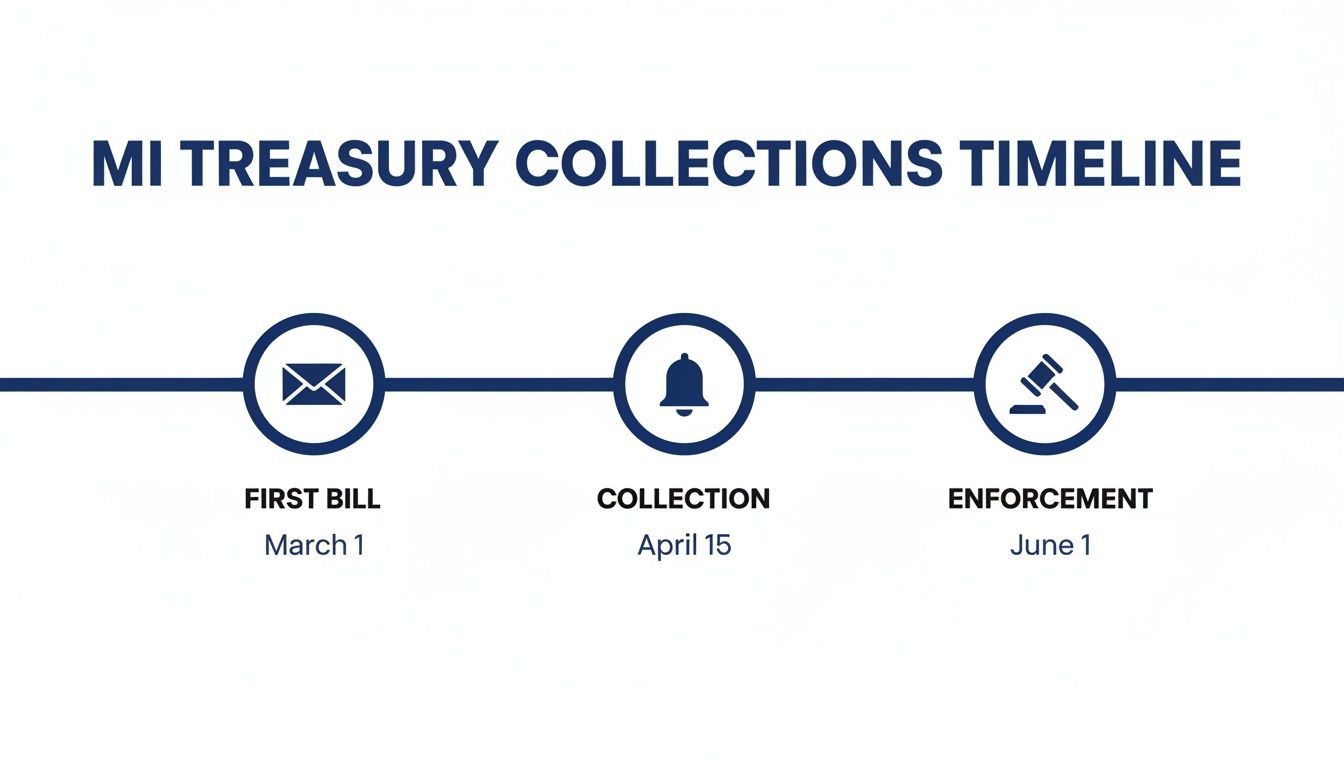
As you can see, you have multiple chances to get ahead of the problem before the state takes more serious actions like seizing funds or garnishing wages.
Phase Two: The Collections Phase
If the billing phase ends without a resolution, you've moved into the “storm warning” stage. At this point, the Treasury issues a Final Assessment or a Final Bill for Taxes Due. This is no longer a proposal—it’s now an official, legally enforceable debt on the state's books.
The tone of the letters will shift, becoming much more firm and direct. You might get something titled Intent to Seize Assets or a similar jarring warning.
This is a critical moment. The Treasury now has the legal authority to use its enforcement tools, but it's giving you one last chance to set up a payment plan or find another solution before it does. It's not too late to be proactive, but the clock is ticking.
And make no mistake, the state’s collection arm is powerful. In fiscal year 2026, the Michigan Department of Treasury brought in a staggering $41.5 billion in total state taxes, up from $40.1 billion in fiscal year 2024. These numbers show just how effective the state is at collecting what it's owed, which is why you can't afford to take this phase lightly. You can dig into how current year tax collections compare to prior years on Michigan.gov.
Phase Three: The Enforcement Phase
This final stage is the “storm making landfall.” It kicks in when the Treasury decides talk is over and starts using its powerful legal tools to take assets and force payment. This only happens after all the previous notices and opportunities have been ignored.
Common enforcement actions at this point include:
- Tax Liens (Warrants): The state places a public claim on your property, from your house to your business assets. This wrecks your credit and makes it impossible to sell or refinance until the debt is paid.
- Bank Levies: The Treasury sends a legal order directly to your bank, instructing them to freeze your accounts and hand over the funds to satisfy your tax debt.
- Wage Garnishments: Your employer receives a legal order to withhold a portion of every paycheck and send it straight to the Treasury.
Once you’re in the enforcement phase, you have a true emergency on your hands. Finding a resolution is still possible, but it’s far more difficult and requires immediate, expert help to stop the seizures and protect whatever assets you have left.
The Treasury's Most Powerful Enforcement Tools

When the letters and warnings stop working, the Michigan Treasury collections process enters its most aggressive stage. This is the point where the state stops asking nicely and starts actively taking what it's owed, using some pretty heavy-hitting legal tools to do it.
Understanding what comes next isn’t about scare tactics. It’s about being realistic about the severe consequences of doing nothing. These enforcement actions aren't random; they are the predictable outcome when a tax debt is ignored for too long. Each one is designed to bring your financial life to a screeching halt until you resolve the debt. Let's break down the three weapons the Treasury most often uses.
Tax Warrants: The State's Claim on Your Property
First, you have the state tax warrant, which for all intents and purposes is the same as a tax lien. Think of it as the state planting a flag on your property—both real estate and personal assets—and publicly declaring its legal claim.
Once the Treasury files a tax warrant with your county’s Register of Deeds, it’s a public record. The fallout is immediate and damaging:
- Blocked Sales and Refinancing: Forget selling your house or refinancing your mortgage. The warrant must be paid off from the proceeds before you see a single dollar.
- Crushed Credit Score: A state tax warrant is a major red flag on your credit report. Getting approved for new loans, credit cards, or even a car lease becomes nearly impossible.
- Right to Seize: Most importantly, the warrant gives the Treasury the legal authority to eventually seize and sell your property to cover the debt.
A tax warrant essentially holds your most valuable assets hostage. It’s a powerful motivator designed to corner you financially. While the state’s first step is just to file the warrant, it’s a clear signal that seizure could be on the horizon if you don’t act. For taxpayers facing collections, it's also helpful to know how to respond effectively, and this powerful template demand letter can be a crucial reference.
Levies: The Direct Seizure of Your Assets
If a tax warrant is a claim, a levy is the actual seizure. For most people, this is the most jarring and disruptive action the Michigan Treasury can take. A levy is a legal order sent to a third party holding your money—almost always, your bank.
Here’s a real-world scenario I see all the time: A small business owner in Detroit goes to pay a vendor, only to have her debit card declined. She calls the bank and discovers her account balance is zero. The Treasury issued a levy, the bank froze every penny, and by law, it has to turn that money over to the state.
A levy is not a negotiation; it's a swift, unilateral action. It can freeze your personal checking and savings accounts, business accounts, and even certain investment accounts. The funds are seized without any further warning.
The situation becomes dire almost instantly. Checks start bouncing, you can't make payroll, and your personal and business life grinds to a halt. If you want to dive deeper into the mechanics of this tool, you can learn more about a state tax levy in our detailed guide.
Wage Garnishments: Taking Your Paycheck
The third major enforcement tool is the wage garnishment. With a garnishment, the Treasury takes its cut before the money even hits your bank account. A legal order goes straight to your employer, forcing them to withhold a portion of your wages from every single paycheck and send it directly to the state.
Under Michigan law, the Treasury can garnish up to 25% of your disposable earnings. This isn't a one-time thing. It continues paycheck after paycheck until the entire tax debt—plus all the penalties and interest—is paid in full.
A wage garnishment can be financially devastating. It leaves you with far less money to cover basic needs like your mortgage, car payment, and groceries. It also puts you in the uncomfortable position of having your employer know about your tax problems. These three tools—warrants, levies, and garnishments—are the core of the Treasury’s collection strategy, and they make it crystal clear why being proactive is your only real defense.
Understanding Your Rights as a Michigan Taxpayer
When you're up against the Michigan Department of Treasury, it’s easy to feel overwhelmed. They have significant power, but it's crucial to remember that this isn't a one-way street. You, as a taxpayer, are protected by a specific set of rights that are guaranteed by law.
Knowing these rights is the first step in shifting your perspective. Instead of just reacting to scary notices, you can become an active participant in your own defense. The foundation for all of this is the Michigan Taxpayer Bill of Rights, and it’s not just a set of guidelines—it's the law. It exists to ensure you are treated fairly and professionally throughout any audit or collection action.
The Right to Professional Representation
One of the most important rights you have is the ability to hire a professional to represent you. You absolutely do not have to face the Michigan Treasury on your own. You can authorize a qualified tax attorney, CPA, or Enrolled Agent to step in and handle all communications for you.
Bringing in a professional is a game-changer. An experienced representative speaks the Treasury’s language, knows their procedures inside and out, and ensures your rights are protected at every turn. Once a Power of Attorney (Form 151) is filed, the Treasury is legally required to direct all calls and notices to your representative, giving you an immediate professional buffer and some much-needed breathing room.
The Right to Appeal and Challenge the Debt
You have the absolute right to question any tax bill you believe is wrong. The first notice you receive from the Treasury is just their opening position—it is not the final word. The system has built-in checkpoints that allow you to make your case.
It all starts with the informal conference. After you get an Intent to Assess notice, you have 30 days to request one. This is your first, and often best, chance to resolve the disagreement directly with a Treasury officer before the debt is officially finalized.
If the informal conference doesn't lead to a resolution, you can take it to the next level.
- Formal Hearing: You can file an appeal with the Michigan Tax Tribunal. This is an independent judicial body that will hear your case impartially, separate from the Treasury itself.
- Court of Claims: For some specific legal challenges, this court is another venue where you can formally dispute the state's position.
Don't just accept an assessment at face value. Simply paying a bill without asking questions could mean you're paying thousands more than you actually owe on a debt that was incorrect from the start.
It's important to understand the financial pressure behind the state's collection activities. Michigan's state income tax collections hit a high of $16.2 billion in 2024 before leveling out to $14.7 billion in 2025. This gives you a sense of the scale and why the Treasury pursues delinquent accounts so aggressively. You can see more on Michigan's tax collection trends and economic impacts to understand the bigger picture.
The Right to a Fair and Impartial Process
Finally, you are legally entitled to a fair process. This means the Treasury cannot use abusive, harassing, or deceptive tactics to collect a tax debt. Their agents must identify themselves, clearly state their purpose, and treat you with professionalism.
Every enforcement action—whether it’s a lien, levy, or wage garnishment—must follow strict legal procedures. If you're already dealing with a garnishment, know that you have options to fight it. Our guide explains in detail how you can stop a state tax garnishment in Michigan.
Of course, knowing your rights is one thing; using them effectively is another. Having a knowledgeable tax attorney in your corner ensures you can confidently use every tool available, from requesting that initial informal conference to taking your case to the Tax Tribunal. That expertise can transform you from a taxpayer under stress into an empowered advocate for your own financial future.
Taking Control: Practical Ways to Settle Your Michigan Tax Debt

It’s one thing to know what the Michigan Department of Treasury can do, but it's another thing entirely to know what you can do about it. The reality is that there are several well-established ways to resolve your tax liability, get the state to back off, and start putting your financial life back together.
These aren't secret tricks or loopholes. They are structured, official programs available to taxpayers who are ready to face the problem head-on. Moving from a place of fear to a position of control begins with understanding these options. Let's walk through the most effective solutions for dealing with the Michigan Treasury collections division.
Get on a Payment Plan with an Installment Agreement
For many people, the real issue isn’t the total tax owed—it's the impossibility of paying it all in one lump sum. If that sounds familiar, an Installment Agreement is your most direct path forward. This solution allows you to break down your tax liability into a series of manageable monthly payments over time.
Think of it like any other payment plan. By negotiating a fixed monthly payment that actually works with your budget, you can immediately stop more aggressive collection tactics like bank levies or wage garnishments. As long as you make your payments on time, the Treasury will hold off.
Generally, to be eligible, you'll need to:
- Agree that you owe the tax.
- Get up-to-date on filing any missing tax returns.
- Show that you don't have the funds to pay the full balance right now.
An agreement provides immediate breathing room and creates a clear, predictable route to resolving your debt.
Settle for Pennies on the Dollar with an Offer in Compromise
What if you’ll never be able to pay the full amount? In cases of genuine financial hardship, an Offer in Compromise (OIC) can be a game-changer. This powerful tool allows you to propose settling your tax debt with the Treasury for less—sometimes significantly less—than what you originally owed.
Be warned: this isn't for everyone. An OIC is specifically designed for taxpayers in dire financial straits, where the state concludes it's highly unlikely they could ever collect the full amount. You're essentially making an "offer" based on a detailed analysis of what you can realistically afford to pay. The Treasury will scrutinize your entire financial situation—income, assets, living expenses, and future prospects—before saying yes or no.
An accepted Offer in Compromise can be a true fresh start, resolving what feels like an impossible debt. But the process is demanding, and you’ll need to provide exhaustive proof of your financial situation.
The state only accepts an OIC if they believe it's the most they can ever hope to collect. Clearing that high bar is tough, and building a persuasive case that satisfies the Treasury’s strict standards is where professional help often makes the difference.
Ask for a Break on Penalties with a Penalty Abatement
Sometimes, the original tax bill has ballooned with steep penalties and interest. If you had a good reason for not filing or paying on time, you might be able to get those penalties waived through a Penalty Abatement.
This involves formally asking the Treasury to remove the penalties by demonstrating you had reasonable cause for the delay. You can't just say you forgot or were short on cash. You need a compelling reason backed by documentation.
Valid examples often include:
- A serious illness or death in your immediate family.
- Your home or business records were lost in a fire, flood, or another disaster.
- You relied on incorrect advice from a tax professional.
- A sudden and severe financial hardship prevented you from paying.
Getting thousands of dollars in penalties removed can make the underlying tax debt much easier to tackle. Once the core debt is handled, you can focus on cleaning up your record. Our guide on how to remove tax liens offers further steps for after you've resolved the liability.
Press Pause with Currently Not Collectible Status
For those in a true financial crisis, the Treasury may grant Currently Not Collectible (CNC) status. This is a temporary halt to all collection actions—it stops the levies, liens, and garnishments, giving you time to get back on your feet.
This status is reserved for people whose income is so low that it doesn't even cover basic living expenses. The debt doesn't go away—in fact, interest and penalties continue to grow—but the immediate pressure is off. You will have to provide the Treasury with detailed proof of your income and expenses. They will also check in on you periodically, and if your financial situation improves, you'll be expected to start paying again.
The state's collection efforts are aggressive, partly because they're a major source of revenue. In 2026, for example, Michigan's sales and gross receipts taxes alone brought in $18.1 billion. This figure, which you can explore on the St. Louis Fed's website, highlights why the Treasury is so motivated to collect what's owed and why it’s so important for taxpayers to use these official resolution programs to protect themselves.
When you're facing a collections notice from the Michigan Treasury, your mind starts racing with questions. The official notices can be confusing and intimidating, and it's easy to get lost in the legal jargon. Let's cut through the noise and get straight to the practical answers for the questions that are likely keeping you up at night.
These are the real-world concerns we hear from clients every day. Getting clear, straightforward answers is the first step toward taking back control.
How Long Can the Michigan Treasury Collect a Tax Debt?
One of the first things people want to know is whether a tax debt just… goes away. And the answer is, eventually, yes. In Michigan, the state generally has a six-year statute of limitations to collect on a tax debt. The clock on those six years typically starts ticking from the date the tax was due or when you filed the return, whichever came later.
But—and this is a big one—it's rarely a simple countdown. Think of the statute of limitations not as a timer, but as a stopwatch. Certain actions you take can pause the clock, or even reset it back to zero.
The Treasury is well aware of these rules, and many common taxpayer actions can accidentally extend their window to collect. The clock can be paused or reset if you:
- File for bankruptcy. This "pauses" the collection clock for the entire time you're in the bankruptcy process, plus another six months after.
- Submit an Offer in Compromise. While the Treasury reviews your offer, the clock is stopped.
- Sign a payment agreement. Agreeing to a payment plan almost always extends the collection statute to cover the life of the agreement.
- Are out of the country for an extended time. The clock can be suspended if you are outside the U.S.
The key takeaway is that you can’t just hide and hope the debt will expire. The Treasury is very adept at using these rules to keep a debt legally enforceable for much longer than six years.
Can the Treasury Take My Retirement or Social Security?
This is a source of tremendous anxiety, especially for those who are retired or getting close. Fortunately, federal law puts a protective shield around certain funds.
As a general rule, the Michigan Treasury cannot directly levy or garnish:
- Social Security benefits
- Supplemental Security Income (SSI)
- Veterans' benefits
- Most qualified retirement accounts like 401(k)s and IRAs, as long as the money stays in the plan.
Here’s the catch, and it’s a crucial one. That protection vanishes the moment those funds are deposited into your regular bank account and get mixed with other money. Once commingled, the funds are no longer automatically exempt. If the Treasury levies that bank account, the burden is on you to prove which portion of the money came from a protected source—a very difficult task.
Expert Tip: While the Treasury can't raid your 401(k) or garnish your Social Security check at the source, your money becomes fair game once it hits a mixed-use bank account. If you rely on these funds, consider keeping them in a separate, dedicated account to maintain their protected status.
What Is a Michigan Innocent Spouse Claim?
It’s a nightmare scenario we see far too often. You filed a joint return with your spouse in good faith, only to find out years later that they hid income or claimed bogus deductions. Now, the Treasury holds you equally responsible for a massive tax bill you knew nothing about.
For situations like this, Michigan law provides a form of relief called an Innocent Spouse Claim.
This claim is designed to free you from responsibility for a tax debt that was created entirely by your spouse (or ex-spouse) without your knowledge. To have a shot at qualifying, you have to prove three key things to the Treasury:
- The tax bill is the result of an error that belongs solely to your spouse.
- When you signed the joint return, you didn’t know—and had no reason to know—that the tax was understated.
- Looking at all the facts, it would be fundamentally unfair to hold you liable for the debt.
Successfully making an Innocent Spouse Claim requires building a detailed and convincing case. It’s your job to prove to the Treasury that you were truly an innocent party.
Will Bankruptcy Stop Treasury Collections?
Yes. Filing for bankruptcy provides powerful and immediate relief from Michigan Treasury collections.
The second you file for Chapter 7 or Chapter 13 bankruptcy, a federal court order called the "automatic stay" goes into effect. This is a legal shield that instantly halts almost all collection actions from your creditors, and that absolutely includes the Michigan Department of Treasury.
The automatic stay legally forces the Treasury to stop:
- Wage garnishments
- Bank levies
- Threatening calls and letters
- Any efforts to enforce a lien
This gives you a critical breathing spell to sort out your finances. The long-term outcome, however, depends on several factors. Some older income tax debts might be completely dischargeable—or wiped out—in bankruptcy. Other types of taxes, like trust fund taxes, generally are not. Whether your specific Michigan tax debt can be discharged involves navigating a complex set of timing rules and legal tests.
