
Michigan Property Tax Estimator: Forecast Your 2026 Bill
If you've ever tried to use a generic online calculator to estimate your Michigan property tax, you probably realized it wasn't much help. National averages just don't work here. To get a real number you can actually budget for, you need to understand three specific Michigan terms: State Equalized Value (SEV), Taxable Value (TV), and the local millage rate.
Getting a handle on these is the key to forecasting your tax bill with any accuracy.
How Michigan Property Taxes Actually Work
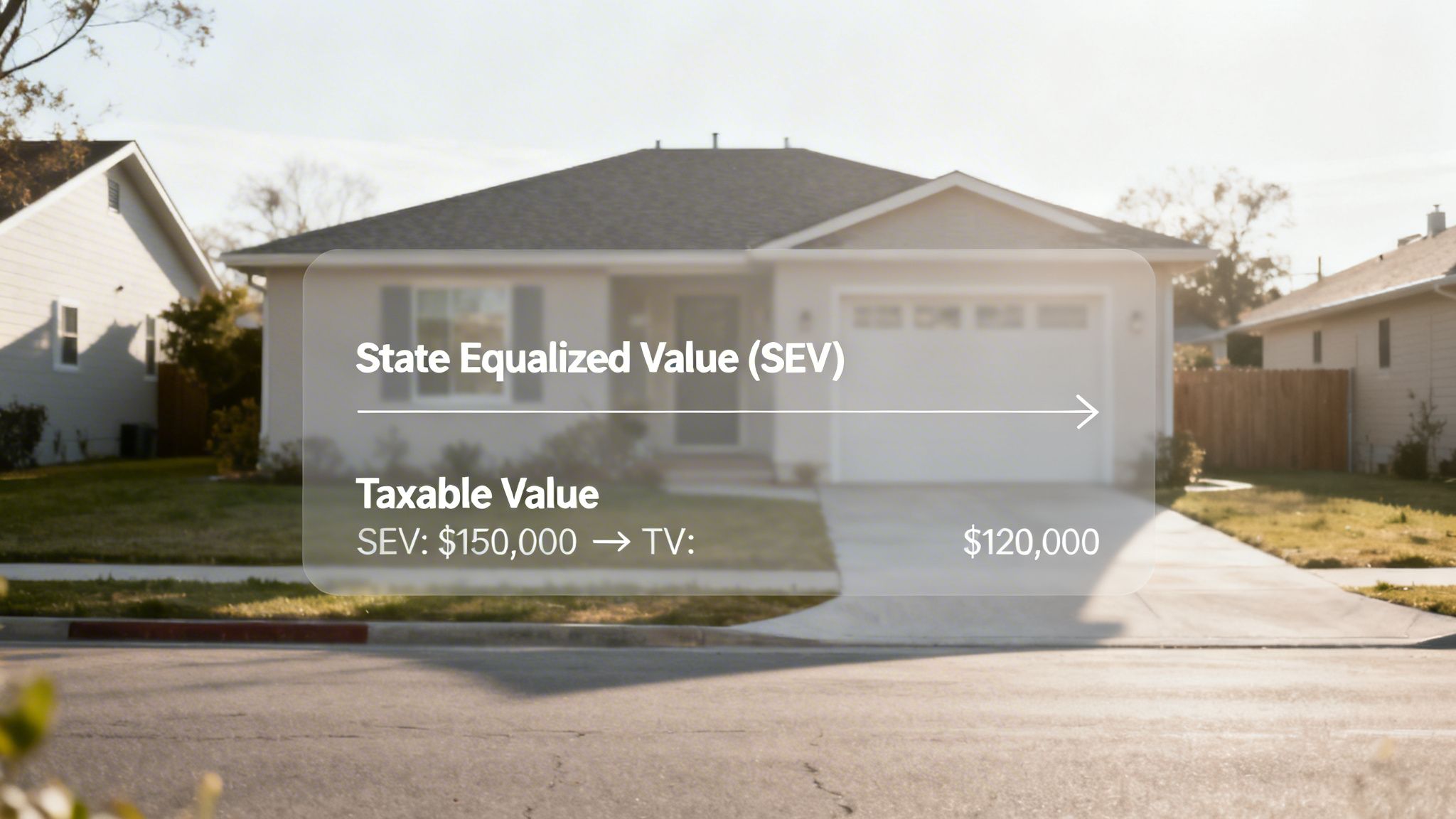
Don't let the assessment notice intimidate you. The entire Michigan system comes down to just two property values and a local tax rate. Once you see how they connect, you can take control of your budget and stop dreading that envelope from the treasurer's office.
Everything starts with your annual assessment. To get a better sense of this foundational step, it helps to first understand what a property tax assessment means and how that initial valuation kicks off the entire process.
To help you keep these terms straight, here’s a quick reference table.
Key Michigan Property Tax Terms at a Glance
| Term | What It Means for Your Bill | How It Is Determined |
|---|---|---|
| State Equalized Value (SEV) | The starting point; represents 50% of your home's estimated market value. | Determined annually by your local assessor based on recent comparable sales in your area. |
| Taxable Value (TV) | This is the crucial number. Your final tax bill is calculated using this value, not the SEV. | It's the lower of your SEV or your previous year's TV, increased by the rate of inflation (or 5%, whichever is less). This is the "cap." |
| Millage Rate | The tax rate itself. One "mill" is $1 of tax for every $1,000 of your Taxable Value. | Set by local taxing authorities (county, city, schools) and approved by voters to fund public services. |
This table is a great cheat sheet, but let's break down exactly what these numbers mean for your wallet.
SEV vs. Taxable Value: The Core Difference
For tax purposes, your property has two different values, and this is where most of the confusion comes from. They are almost never the same amount.
State Equalized Value (SEV): Think of this as the assessor's best guess at half your home's current market value. If homes like yours are selling for $300,000, your SEV will likely be around $150,000. It reflects the current, often hot, real estate market.
Taxable Value (TV): This is the number that actually matters for your tax bill. Thanks to a constitutional amendment known as Proposal A, your TV is "capped." As long as you own the property, it cannot increase from one year to the next by more than the rate of inflation or 5%, whichever is lower.
This is why your TV is often significantly less than your SEV, especially if you've owned your home for a long time. Your bill is based on your Taxable Value, which provides a layer of protection from sharp spikes in the housing market.
Key Insight: I've seen countless clients mistake their SEV for the value they'll be taxed on. The gap between your home's market value (reflected in the SEV) and its lower, capped Taxable Value is the single biggest source of sticker shock and confusion for Michigan homeowners.
What Is a Millage Rate?
Once you have your home's Taxable Value, the final piece of the puzzle is the millage rate. It’s a simple concept: one "mill" is equal to $1 of tax for every $1,000 of Taxable Value.
Your total millage rate isn't one single number; it's a stack of smaller rates levied by all the different government bodies that serve your specific address. This combination is unique to your location.
These typically include rates for:
- Your county government
- Your city, village, or township
- Your local K-12 school district
- Community colleges or intermediate school districts
- Special authorities (like libraries, parks, or transportation)
Each of these entities gets voter approval for its specific millage rate to fund its budget. Your total rate is simply all of them added together. For example, if your total rate is 45 mills, you'll pay $45 for every $1,000 of your Taxable Value. This local control is exactly why taxes on an identical house can be thousands of dollars different just one town over.
The Enduring Impact of Proposal A on Your Taxes
If you really want to get a handle on your Michigan property taxes, you have to go back to a single piece of legislation from 1994: Proposal A. This voter-approved constitutional amendment completely changed the game for property taxes in the state, and its rules are still the foundation of every tax bill today.
Before Proposal A, taxes were based on a home's Assessed Value, which was tied directly to the ups and downs of the real estate market. This created a lot of anxiety for homeowners, as a hot market could lead to sudden, massive tax hikes. Proposal A was designed to bring predictability and stability by creating a new figure: Taxable Value (TV).
The Taxable Value Cap
This is where the real protection for homeowners comes in. Proposal A established a "cap," ensuring your property's Taxable Value can't jump by more than 5% or the rate of inflation—whichever is lower—in a given year.
This cap is precisely why your Taxable Value is often significantly less than your home's actual market value (or its State Equalized Value). It also explains how two neighbors in nearly identical houses can have vastly different tax bills. The long-time resident reaps the benefits of years of capped increases, while the recent buyer's taxes are based on today's higher market reality.
Key Takeaway: Your tax bill is calculated using your capped Taxable Value, not what your home could sell for today. Grasping this one concept is the most critical step to understanding your Michigan property taxes.
The Uncapping Event
But that protective cap isn't permanent. When a property is sold or ownership is transferred, the law requires an "uncapping." This is a reset. The Taxable Value immediately jumps up to the current State Equalized Value, which is 50% of the new purchase price.
This uncapping is the number one cause of "sticker shock" for new homebuyers in Michigan. We see it all the time: a buyer looks at the seller's low tax bill and budgets for a similar amount, only to face a bill that's double or even triple what they expected.
The introduction of this taxable value system was a seismic shift. In fact, after Proposal A passed, property taxes plummeted to a low of 3.1% of personal income in 1994. While rates have climbed since then, the cap continues to moderate tax burdens across the state. You can read a detailed report on the history of Michigan's property tax changes from the state itself.
Never, ever rely on the seller's current tax bill to estimate your own future costs. You must always assume the property will uncap when you buy it.
How to Calculate Your Michigan Property Tax Bill by Hand
Let's move beyond the theory and get our hands on some real numbers. Running the numbers yourself is the best way to double-check your tax bill for accuracy or forecast what you’ll owe on a new home. This isn't just a math problem; it's a fundamental skill for every Michigan homeowner.
At its core, the calculation is surprisingly straightforward:
(Taxable Value / 1,000) x Total Millage Rate = Your Estimated Tax Bill
To make this formula work, you only need to track down two pieces of information: your property's Taxable Value (TV) and the specific millage rates for your jurisdiction. Here’s how you find them and piece them together.
First, Pin Down Your Taxable Value
Your property's Taxable Value is public record, and you can almost always find it on your local city or township assessor's website. These sites typically have an online property search where you can look up your home by its address or parcel ID number.
Once you find your property's record, you'll be met with a lot of numbers. You can safely ignore the SEV, the Assessed Value, and any "market value" estimates. The only number that matters for this calculation is the Taxable Value. This is the capped figure that your actual tax bill is based on.
What if you're trying to estimate taxes for a home you're planning to buy? This is where many new buyers get tripped up. A sale "uncaps" the property's taxes, resetting the value.
- Start with the home’s purchase price—let’s say $300,000.
- The assessor will typically set the new SEV (and thus the new Taxable Value) at 50% of that price, which would be $150,000.
- This new $150,000 figure is the Taxable Value you should use for your estimate.
This uncapping process is the single biggest reason for "sticker shock" among new homeowners in Michigan.
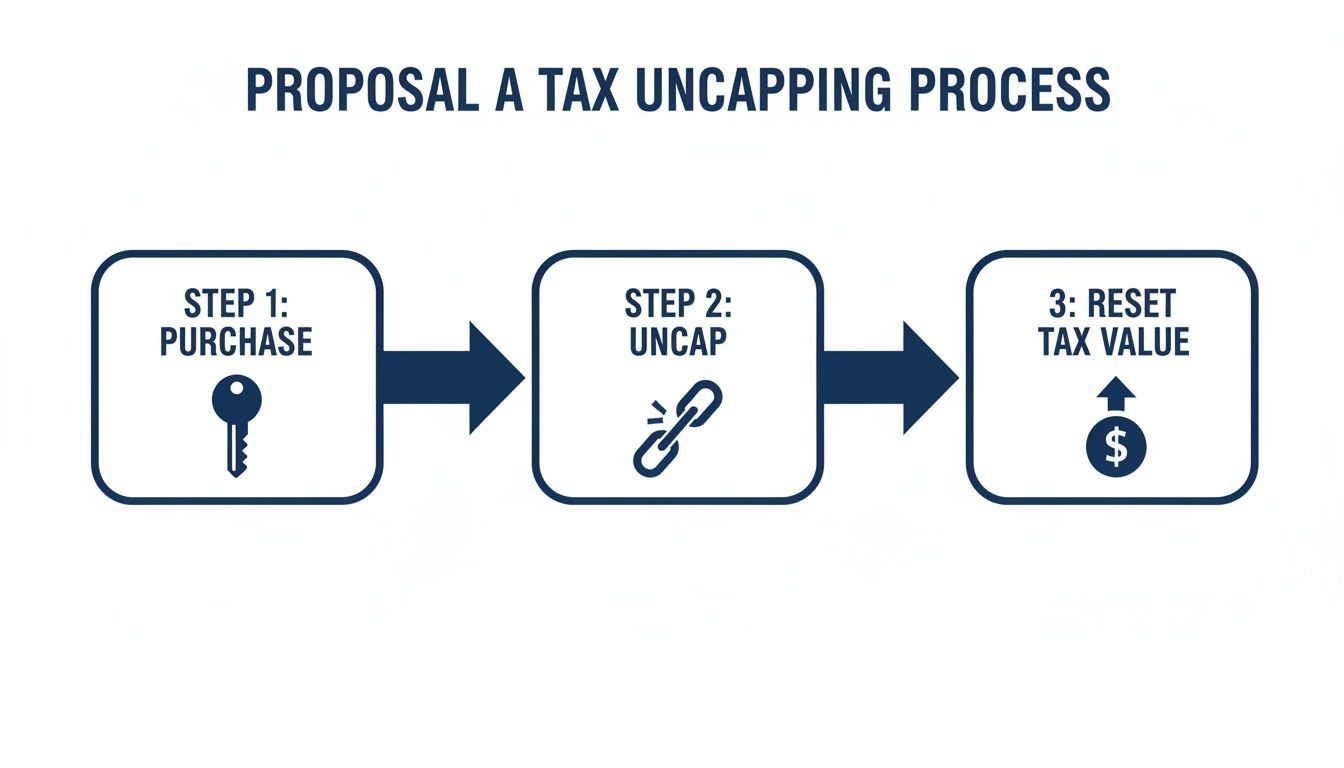
As you can see, the value jumps significantly upon transfer, which is why a new owner's tax bill is often much higher than the previous owner's.
Next, Find Your Local Millage Rates
Now you need the other half of the equation: the millage rates for your specific property. Just like the Taxable Value, these are published on your local government's website, usually on pages for the Treasurer or Assessor's office. You’re looking for a document often called a "Millage Rate Breakdown" or something similar.
This document will list all the separate entities levying taxes—the county, city/township, local schools, community college, library, and so on. You're looking for the total millage rate.
A Word of Warning: You will likely see two different total rates. One will be for "Homestead" or "Principal Residence" properties, and the other will be a higher rate for "Non-Homestead" properties (e.g., rentals, commercial buildings, second homes). If this is your primary residence, you must use the lower Homestead rate.
That lower rate is thanks to the Principal Residence Exemption (PRE). This valuable exemption removes the local school operating tax from your bill, a rate that can be as high as 18 mills.
Putting It Together: A Real-World Example
Let's walk through a quick example to see it all in action.
Imagine you own a primary residence in a Michigan city. You've done your homework:
- Taxable Value: You checked the assessor’s site and confirmed your TV is $120,000.
- Millage Rate: You found the correct "Homestead" millage rate for your tax district is 48.5 mills.
Now, you just plug those numbers into the formula. First, divide your Taxable Value by 1,000 to determine how many "mills" you'll be charged for ($120,000 / 1,000 = 120).
Then, multiply that result by your total millage rate: 120 x 48.5 mills = $5,820.
Your estimated annual property tax liability is $5,820. In Michigan, this total amount is typically split between a summer and a winter tax bill.
Knowing how to run this simple calculation empowers you. You can spot potential errors on your tax bills and, just as importantly, create an accurate budget when you're looking to buy. This knowledge is your best defense against the costly surprises that can catch so many Michigan homeowners off guard.
Why Your Home's Location Dictates Your Tax Bill
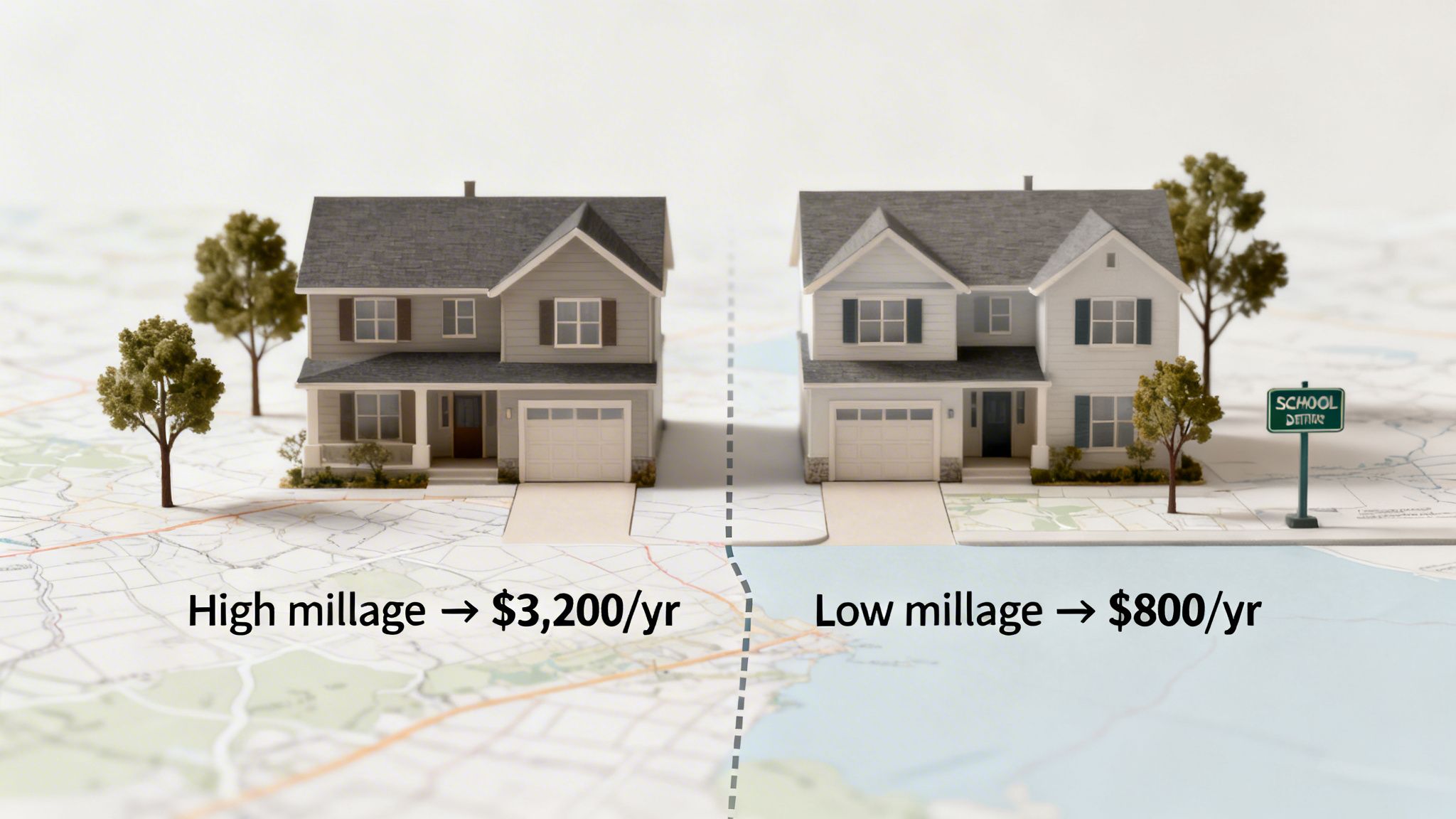
When it comes to Michigan property taxes, the old real estate mantra "location, location, location" has never been more true. Your physical address—sometimes down to the specific side of the street you live on—can have a bigger impact on your tax bill than almost any other factor.
This is precisely why a generic Michigan property tax estimator rarely gets it right. Two homes with identical market values can easily have tax bills that are thousands of dollars apart, simply because they sit in different school districts, townships, or cities. These differences all come down to local millage rates, which are the taxes voted on by residents to fund their community's services.
Where Do The Millage Rate Differences Come From?
The main reason for these tax variations is that every local government entity—your city, county, and school district—sets its own tax rates. When you get your tax bill, you’re not just paying a single bill to the state. Instead, you're funding a whole stack of local needs.
These funds are allocated to a wide range of public services, including:
- County operating budgets and specific needs like parks or jails.
- City or township services such as police, fire departments, and road work.
- Local school district operations and voter-approved bonds.
- Community college and library funding.
A growing city investing in new infrastructure will naturally have a higher millage rate than a rural township with fewer services. This is a critical point to remember: a home's sale price is just one part of the long-term affordability picture.
The differences across Michigan’s 83 counties are quite telling. A quick look at the data shows just how much property tax burdens can vary depending on where you live.
Median Property Tax Comparison Across Michigan Counties (2026 Data)
| County | Median Property Tax Paid | Average Millage Rate (Homestead) |
|---|---|---|
| Washtenaw | $5,500+ | ~60 mills |
| Oakland | $4,241 | ~52 mills |
| Wayne | $2,794 | ~68 mills |
| Kent | $3,500 | ~45 mills |
| Macomb | $3,100 | ~48 mills |
As you can see, a homeowner in Washtenaw County might pay nearly double what someone in Wayne County pays on a median basis, even though Wayne County's average millage rate is higher. This highlights the complex interplay between property values and tax rates.
The Real-World Impact Of Location
Let’s put this into a practical scenario. Consider two identical homes, both with a Taxable Value of $150,000.
- Home A is located in a township with a total homestead millage rate of 32 mills.
- Home B is just across the county line in a city with a total rate of 55 mills.
Doing the math, the owner of Home A would owe $4,800 per year ($150,000 / 1,000 x 32). Meanwhile, the owner of Home B is looking at a bill of $8,250 ($150,000 / 1,000 x 55). That's a staggering difference of over $3,400 every single year for the exact same value home, based entirely on its location.
It's also worth noting that major home improvements can increase your property's value and, eventually, your tax assessment. Knowing the potential home remodeling return on investment is smart, but remember it can trigger a higher tax bill down the road. If financial hardship ever makes it difficult to keep up, it's crucial to understand the process and your rights. You can learn more by reading about what a tax lien certificate means for you. This knowledge is key to making informed decisions about your property.
Challenging an Inaccurate Property Tax Assessment
So, you've run the numbers yourself, maybe even used an estimator, and your official tax bill still seems way out of line. What gives?
Often, the problem isn’t the millage rate but the assessed value the township has placed on your home. If you suspect your assessment is inflated, you absolutely have the right to challenge it. But be aware: it’s a process with tight deadlines, and you have to follow the right steps.
Your first move shouldn't be a formal appeal. Start with a simple, informal chat with your local assessor's office. You'd be surprised how many discrepancies get cleared up this way. Bring your property record card and any notes you have. Sometimes the fix is as simple as correcting a clerical error, like inaccurate square footage or the wrong number of bathrooms listed on your record.
Building Your Case for the Board of Review
If that informal conversation doesn't resolve the issue, it's time to prepare for the local Board of Review. This is a panel of your fellow citizens who hear assessment appeals, and they typically meet in March.
Filing an appeal is free, but you need to show up with a solid, evidence-based case. Just walking in and saying, "My taxes are too high," will get you nowhere.
Your one and only goal is to prove that your home’s assessed value is greater than 50% of its likely market value. To do that, you need to gather hard evidence:
- Comparable Sales: Find three to five recent sales of homes in your immediate area that are genuinely similar to yours—think size, age, style, and condition. The goal is to show these "comps" sold for less than what the assessor's valuation suggests your home is worth.
- Photographic Evidence: Take clear photos of any major problems that drag down your home’s value. A failing roof, a cracked foundation, or significant water damage are all relevant. If you have contractor estimates for the repairs, even better.
- Recent Appraisal: Have you refinanced lately? A recent, independent appraisal can be a very powerful tool to support a lower valuation.
The Board of Review is focused on one thing: market value. Your entire argument needs to be grounded in real estate data, not your frustration with the final tax bill. Your most compelling point will always be showing that similar homes are selling for less.
When to Escalate to the Michigan Tax Tribunal
What if the local Board of Review turns you down? Your next option is to take your case to the Michigan Tax Tribunal. This is a much more formal, court-like proceeding where you'll present your evidence all over again.
Honestly, this is where things can get intimidating for most homeowners. The rules of evidence are stricter, and the process is far more complex.
If your case involves a substantial dispute over your property's value or you're facing real financial hardship from unmanageable taxes, this is the point where getting professional help is a very smart move. For a detailed breakdown of the entire appeals ladder, take a look at our guide on how to dispute a property tax assessment in Michigan.
A tax law firm can step in to build your strongest case, handle negotiations with the tax authorities, and represent you before the tribunal to fight for a fair and accurate valuation.
Common Questions About Michigan Property Taxes
Even after you get the hang of the property tax calculator, some things can still feel confusing. From our experience working with homeowners across Michigan, we've found that a few key questions pop up time and time again.
Here are some clear, practical answers to the issues we see most often.
Why Did My Property Taxes Go Up if My Taxable Value Is Capped?
It’s one of the most common calls we get, and the frustration is understandable. You know Proposal A is supposed to limit how much your Taxable Value can increase, yet your tax bill just jumped. What gives?
Usually, it comes down to one of three things.
First, your local community might have approved new millages. These voter-approved funds for schools, roads, or other public services get added to your bill, increasing the total amount you owe even if your home's value didn't change.
The second reason—and this is the big one—is a recent home purchase. When a property sells, the Taxable Value gets "uncapped" and immediately resets to the current State Equalized Value (SEV), which is typically much higher. This is almost always the cause of a dramatic tax spike for new homeowners.
Finally, you might be seeing new special assessments on your bill. These are one-off charges for specific local improvements, like new sidewalks or sewer connections, and they aren't limited by the same caps. It's always a good idea to compare your current tax statement to last year's to see exactly which line items have changed.
Key Insight: Remember, Proposal A's cap only limits how fast your Taxable Value can rise each year. It doesn't freeze your total tax bill. Voter-approved millages and special assessments can—and often do—increase what you ultimately pay.
Can I Estimate Taxes for a Home I Plan to Buy?
Not only can you, but you absolutely should. But here's a critical piece of advice: never use the seller's current tax bill to predict your own. This is a classic mistake that catches many Michigan homebuyers by surprise.
When that home is sold, its Taxable Value uncaps. To get a realistic estimate of what you'll actually pay, you need to calculate the new Taxable Value.
It’s pretty simple. Just take the home's purchase price—let's say it's $400,000—and cut it in half. That gives you the new State Equalized Value (SEV), which in this case is $200,000. That $200,000 figure becomes the home's new Taxable Value for the year following the sale. From there, you just multiply it by the local millage rate to get a solid forecast of your future tax bill.
What Happens if I Cannot Afford My Property Tax Bill?
Falling behind on your property taxes in Michigan is a serious problem that escalates quickly. It starts with steep interest and penalties, but it can lead to a tax lien on your home and, eventually, foreclosure. The most important thing you can do is act fast.
Your first call should be to your local treasurer’s office. Don't wait. Ask them directly about any poverty exemptions, deferment programs for seniors or disabled individuals, or other hardship relief they might offer.
If you're already facing a significant tax debt, it's wise to learn more about how to remove a tax lien in Michigan to protect your property. When the situation feels overwhelming, a tax resolution professional can step in to negotiate with the authorities and find a solution that keeps you in your home and protects your financial future.
