
A Complete Guide to the IRS Offer in Compromise Calculator
If you're staring down a mountain of tax debt, you've probably heard about the IRS Offer in Compromise (OIC). It sounds like a lifeline—a chance to settle your tax bill for less than you owe. But how much less? That's the million-dollar question, and the answer isn't based on what feels fair. It’s a cold, hard calculation.
This is where an IRS Offer in Compromise calculator comes in. Think of it as a financial "pre-flight check." It’s a tool that runs your financial numbers through the IRS's own formula to estimate the minimum amount they'd likely accept to clear your debt. It calculates your Reasonable Collection Potential (RCP), giving you a brutally honest preview of your chances before you dive into the formal application process.
What Is the IRS Offer in Compromise Calculator?
The IRS Offer in Compromise calculator is essentially a financial simulator. It forces you to look at your own finances through the exact same lens an IRS agent will. Its main job is to stop taxpayers from submitting offers that are dead on arrival.
By grounding your offer in the strict reality of IRS guidelines, you can dramatically improve your shot at success. An OIC isn't a negotiation in the traditional sense; it’s a data-driven decision based on a specific formula. The calculator makes you confront the numbers—your assets, your income, and only the expenses the IRS deems "allowable"—to arrive at a baseline settlement figure.
For Michigan residents already dealing with the pressure of collections, getting this number right from the start is absolutely critical. You can learn more about the fundamentals of this process in our detailed guide on what an Offer in Compromise entails.
Before we get into the details, here's a quick summary of what the calculator does.
Quick Overview of the IRS Offer in Compromise Calculator
This table breaks down the tool's purpose, the information it needs from you, and what it gives you in return.
| Component | Description |
|---|---|
| Core Function | To simulate the IRS's formula for calculating a minimum acceptable settlement offer. |
| Key Inputs | Your assets (home equity, cash, vehicles), monthly income, and IRS-allowed monthly living expenses. |
| Primary Output | An estimated Reasonable Collection Potential (RCP), which serves as the baseline for your offer amount. |
This tool essentially translates your financial life into the language the IRS speaks, providing a clear, data-driven starting point.
Why a Realistic Calculation Matters
Let’s be clear: submitting an OIC is a long shot for most people. The acceptance rates have historically hovered around 30-40%, but the environment has gotten much tougher.
For the fiscal year ending in September 2024, the acceptance rate fell to a staggering low of just 21%. That’s a massive drop, and it sends a clear message: the IRS is more selective than ever. This is precisely why running the numbers beforehand isn't just a good idea—it's essential.
The calculator’s main purpose is to align your expectations with the IRS's non-negotiable formula. It translates your complex financial life into a single number that determines your eligibility and potential success.
Key Functions of the OIC Calculator
A proper calculation does more than just spit out a number. It gives you critical insights and helps you strategize.
Specifically, the tool helps you:
- Determine Preliminary Eligibility: It gives you a fast "yes" or "no" on whether you even meet the basic financial criteria to bother applying.
- Calculate a Minimum Offer Amount: This is its core function—generating the estimated settlement figure based on your ability to pay.
- Identify Financial Weaknesses: The process can instantly flag problems that would get you disqualified, like having too much equity in your home or a monthly disposable income that the IRS considers too high.
By using an IRS Offer in Compromise calculator correctly from the very beginning, you avoid wasting precious time, money, and emotional energy on an offer that has no chance. It transforms a hopeful guess into a strategic, data-backed proposal.
The Core Components of Your OIC Calculation
Before you can get a realistic number from an IRS Offer in Compromise calculator, you need to peek under the hood. The entire machine runs on one critical formula: your Reasonable Collection Potential (RCP). This isn't just a guideline; it's the exact calculation the IRS uses to figure out the absolute minimum settlement they'll even look at.
Think of the RCP as the IRS's own financial x-ray of your life. It's designed to answer one question from their point of view: "What's the most we can realistically squeeze out of this taxpayer before the clock runs out on their debt?" Your offer has to meet or beat this number. Period. The formula itself is built on two main pillars: what you own today and what you can afford to pay tomorrow.
This is how the calculator, the formula, and your final offer all connect.
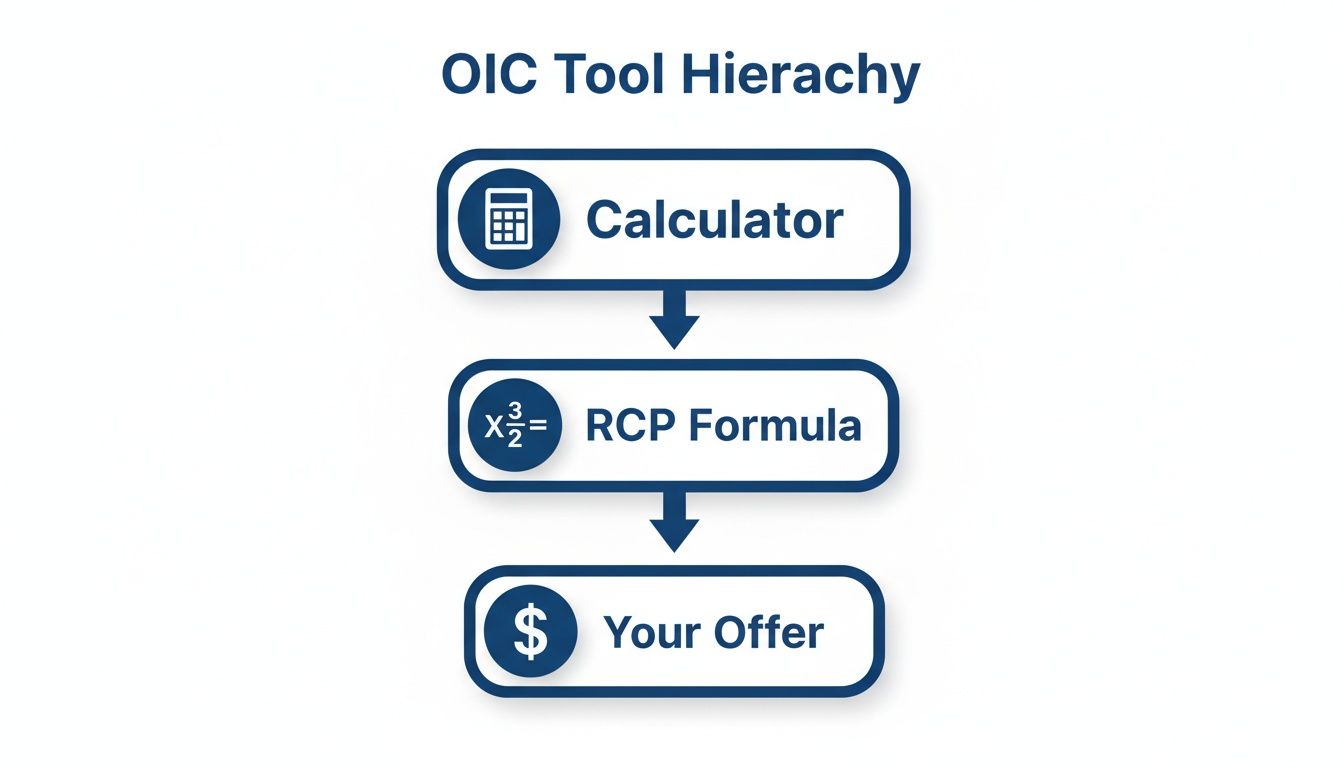
As you can see, the calculator is just a tool. The RCP is what really matters. Let's break down exactly what goes into that all-important number.
Pillar 1: Your Equity in Assets
First, the IRS takes a hard look at everything you own. They create a detailed inventory of your assets to see what could be sold off to cover your tax bill. But here's a key detail: they don't use the full market price.
Instead, the IRS calculates a "quick sale value" (QSV), which is typically just 80% of an asset's fair market value. That 20% haircut is their way of accounting for the costs and hassle of a forced, speedy sale. After they get that discounted value, they subtract what you still owe on it (like a mortgage or car loan). The leftover amount is your net equity, and it goes straight into the RCP formula.
Common assets they'll tally up include:
- Real Estate: The QSV of your home and other properties, minus the outstanding mortgage.
- Vehicles: The QSV of your cars, trucks, and motorcycles, minus what you owe on any auto loans.
- Bank Accounts: Every penny in your checking, savings, and other cash accounts.
- Retirement Funds: The value of 401(k)s, IRAs, and other retirement plans, minus any loans or potential early withdrawal penalties.
Getting this right means having a firm grip on your own finances. A big part of that is knowing how to read financial reports effectively.
Pillar 2: Your Future Disposable Income
The second major piece of the puzzle is your future earning potential. The IRS needs to figure out how much you can afford to pay them each month over a set period. And trust me, their math is a lot more rigid than your personal budget.
They start with your gross monthly income from all sources—no exceptions. Then, they let you subtract a limited set of allowable living expenses, which are based on strict national and local standards. These IRS-approved amounts often have little to do with what you actually spend on things like housing, food, and transportation.
The IRS takes your gross monthly income, subtracts their approved expenses, and arrives at your monthly "disposable income." They multiply that number by either 12 or 24, depending on your offer's payment terms, to get the total future income component of your RCP.
Why 12 or 24? If you propose paying off the settlement in five months or less, they use a 12-month multiplier. If you need a longer payment plan (from 6 to 24 months), they'll hit you with the 24-month multiplier. As you can imagine, this choice makes a huge difference in your final offer amount.
Pillar 3: Special Circumstances
While the first two pillars cover almost every case, there are two rare exceptions that can change the game, even if your RCP calculation comes out low. These aren't about your ability to pay but are based on unique arguments about fairness.
- Doubt as to Liability: You'd use this if there's a legitimate, evidence-based dispute over whether you even owe the tax in the first place.
- Effective Tax Administration (ETA): This is a Hail Mary for situations where paying the tax would cause an exceptional economic hardship or would simply be unfair, even if you technically have the assets.
These are not simple checkboxes on a form. Arguing for one of these requires a mountain of proof and a compelling story that goes far beyond what any OIC calculator can handle. They almost always demand the guidance of an experienced tax professional to have any shot at success.
How to Accurately Use the OIC Calculator

Getting an accurate result from the IRS Offer in Compromise calculator isn't about guesswork; it's about methodical data collection. Think of yourself as a financial detective building a solid case. Your mission is to gather precise, verifiable information that perfectly matches what the IRS will eventually demand to see.
The entire process hinges on assembling a complete and honest picture of your financial life. This means digging up pay stubs, bank statements, loan documents, and property valuations. The goal here is to leave no stone unturned. Any omission or innocent mistake can lead to a wildly inaccurate calculation and, almost certainly, a rejected offer down the road.
Step 1: Gather Your Financial Documentation
Before you even think about plugging numbers into the calculator, you have to collect all the necessary paperwork. This is easily the most labor-intensive part of the process, but it's the foundation of everything that follows. The IRS operates on proof, not promises, so every single number you enter needs a document to back it up.
Here’s a quick checklist of the essential documents you’ll need to have on hand:
- Income Verification: Get your pay stubs for the last three to six months. If you're self-employed, you'll need your profit and loss statements for that same period.
- Bank Statements: Print out statements for all your checking and savings accounts, again covering the past three to six months.
- Asset Information: Find recent statements for any retirement accounts (401k, IRA), investment accounts, and whole life insurance policies.
- Loan Documents: Locate the most recent statements for your mortgage, auto loans, and any other major debts to verify the outstanding balances.
To make sure your inputs are spot-on, a specialized finance tax document analyzer can be a huge help in processing and verifying the data for your offer.
Step 2: Value Your Assets Correctly
Correctly valuing your assets is one of the most common stumbling blocks for people. The IRS uses a very specific formula, so you have to learn to see your assets from their perspective. You can't just use what you think something is worth; you need to find its fair market value (FMV) and then calculate its quick sale value (QSV).
For Michigan taxpayers, this requires a bit of local context:
- Real Estate: For a home in Oakland County, for example, you’d use recent comparable sales from Zillow or a local realtor to find the FMV. Then, you multiply that value by 80% to arrive at the QSV.
- Vehicles: For a work truck used by a small business in Lansing, you'd look up its private party sale value on Kelley Blue Book (KBB) or Edmunds. That number is your FMV.
- Other Assets: For items like furniture or jewelry, be realistic. Use a conservative resale value—what you could actually get for it if you had to sell it quickly.
From that QSV, you then subtract any outstanding loan balance. The result is the net realizable equity—the number that actually goes into your OIC calculation.
Step 3: Calculate Your Monthly Disposable Income
Finally, you have to figure out your monthly disposable income, but you have to do it by the IRS's strict rules. You'll start with your total gross monthly income and subtract only the allowable expenses outlined in the IRS Collection Financial Standards. These standards cover necessities like food, housing, and transportation, but the amounts are standardized and may not reflect what you actually spend.
Crucial Insight: The IRS Offer in Compromise calculator is a viability test, not a guarantee. Acceptance rates dropped to just 21% in FY2024, which really highlights the need for absolute precision. The calculator is designed to flag fatal flaws early, like having the ability to pay in full before your debt expires—a primary reason for rejection.
After you've carefully entered all your data, the IRS Offer in Compromise calculator will generate a preliminary figure. This number represents the absolute minimum the IRS would likely even consider. It gives you a realistic baseline for your potential offer and helps guide your next strategic steps with a qualified tax professional.
Real-World OIC Calculations for Michigan Taxpayers

The theory is one thing, but seeing the numbers come to life is where it all starts to make sense. Let's walk through two hypothetical, yet realistic, scenarios for Michigan taxpayers to show you exactly how the IRS Offer in Compromise calculator works in practice.
We'll break down their finances, plug the numbers into the Reasonable Collection Potential (RCP) formula, and watch how their minimum offer amount gets calculated. You'll quickly see how the same rules can lead to wildly different results depending on someone's financial picture.
Scenario 1: The Detroit W-2 Couple
Let's meet John and Mary from Detroit. They both work regular W-2 jobs and bring in a combined gross monthly income of $7,500. After a tough stretch of unemployment a few years back, they fell behind and now owe the IRS a daunting $85,000. They own a home, have two car payments, and have been contributing to a 401(k).
Here's how the IRS would calculate their RCP.
1. Tally Up the Equity in Their Assets
First, the IRS looks at what could be sold off to pay down the debt. This is the asset side of the equation.
- Home: The house has a Fair Market Value (FMV) of $250,000, with $210,000 left on the mortgage.
- Quick Sale Value (80% of FMV): $250,000 x 0.80 = $200,000
- Net Equity: $200,000 – $210,000 = -$10,000. Because it's negative, the IRS counts this as $0.
- Vehicles (2 cars): Their cars have a combined Blue Book value of $25,000, but they still owe $15,000.
- Quick Sale Value (80% of FMV): $25,000 x 0.80 = $20,000
- Net Equity: $20,000 – $15,000 = $5,000.
- 401(k) Retirement Fund: The current balance is $40,000.
- Quick Sale Value (80% of Balance): $40,000 x 0.80 = $32,000.
- Bank Accounts: Between checking and savings, they have $1,500.
Add it all up, and their total asset component for the RCP is $38,500 ($5,000 + $32,000 + $1,500).
2. Figure Out Their Future Disposable Income
Next up is cash flow. The IRS compares their income to a set of standardized allowable expenses.
- Gross Monthly Income: $7,500
- IRS Allowable National/Local Standard Expenses: $7,200
- Monthly Disposable Income: $7,500 – $7,200 = $300
If they choose the lump-sum payment option (paid within 5 months), the IRS multiplies this monthly figure by 12.
- Future Income Component: $300 x 12 = $3,600
Minimum Offer Calculation: By putting the two pieces together, we find their total Reasonable Collection Potential.
$38,500 (Assets) + $3,600 (Future Income) = $42,100
So, for John and Mary, the absolute floor for an offer the IRS would even look at is $42,100 to resolve that $85,000 tax bill.
Scenario 2: The Grand Rapids Small Business Owner
Now, let's look at Sarah, a consultant in Grand Rapids. She owes $120,000, mostly from not paying enough in self-employment taxes as her business grew. Her situation is a bit more complicated because the IRS treats business assets and income differently.
Her business averages $10,000 a month in gross revenue. After $4,000 in necessary business expenses, she has a net of $6,000 to live on.
1. Tally Up the Equity in Her Assets (Personal & Business)
Sarah's assets are a mix of things for her business and personal life.
- Home: She rents, so her home equity is $0.
- Business Vehicle: Her work truck has a KBB value of $18,000 and is fully paid off.
- Quick Sale Value (80% of FMV): $18,000 x 0.80 = $14,400.
- Business Equipment: The quick-sale value of her computers and office gear is estimated at $2,000.
- Bank Accounts: Her personal and business accounts combined have $4,000.
Her total asset component comes out to $20,400 ($14,400 + $2,000 + $4,000).
2. Figure Out Her Future Disposable Income
Her income calculation begins after her business expenses are paid.
- Net Monthly Business Income: $6,000
- IRS Allowable Personal Living Expenses: $5,900
- Monthly Disposable Income: $6,000 – $5,900 = $100
Using that same 12-month multiplier for a lump-sum offer:
- Future Income Component: $100 x 12 = $1,200
Minimum Offer Calculation: Combine her assets and income potential, and we get her RCP.
$20,400 (Assets) + $1,200 (Future Income) = $21,600
To settle her $120,000 debt, Sarah's starting offer would need to be at least $21,600.
Scenario Comparison: Michigan Taxpayer OIC Calculations
This table gives a side-by-side look at how two different financial situations in Michigan result in very different OIC calculations.
| Financial Component | Scenario 1 (Detroit Couple) | Scenario 2 (Grand Rapids Business Owner) |
|---|---|---|
| Total Tax Debt | $85,000 | $120,000 |
| Asset Equity | $38,500 | $20,400 |
| Monthly Disposable Income | $300 | $100 |
| Future Income Component | $3,600 (x12 multiplier) | $1,200 (x12 multiplier) |
| Minimum OIC Offer (RCP) | $42,100 | $21,600 |
This highlights a key takeaway: even with a much higher tax debt, Sarah's lower asset value and tighter monthly budget result in a significantly lower minimum offer. It shows that your ability to pay, not the amount you owe, is what truly drives the negotiation. For taxpayers facing similar challenges, understanding all the options for an IRS tax settlement in Monroe, MI or anywhere else in the state is a critical first step.
Common Mistakes to Avoid When Calculating Your Offer
Jumping into the IRS Offer in Compromise calculator is a critical step, but a simple mistake in what you enter can sink your entire effort before it even starts. Getting a realistic settlement figure isn't just about punching in numbers; it’s about sidestepping the common pitfalls that lead to bad calculations, quick rejections, and a whole lot of wasted time.
Remember, an offer that looks too good to be true is an immediate red flag for the IRS agent reviewing your case. Many people accidentally inflate or deflate their Reasonable Collection Potential (RCP), which is the number the IRS uses to decide what you can truly afford to pay. Knowing what not to do is just as important as knowing the formula itself. This is especially true for small business owners here in Michigan, who often face a much higher bar for getting a business-related OIC approved.
Underestimating Future Income
One of the most frequent mistakes I see is people getting too pessimistic about their future earnings. It's tempting to use your worst month's income as the standard, but the IRS is smarter than that. They'll look at your income history over several months to spot the real trend.
If you're a freelancer, have a side gig, or your income just goes up and down, the IRS will simply average it out. Intentionally using a "worst-case scenario" number creates an artificially low offer that an agent will spot from a mile away. They are trained to look for consistency, and a sudden, unexplained drop in your projected income is going to need a very, very good explanation.
Miscalculating Asset Equity
This is another huge stumbling block. It usually goes wrong in one of two ways:
- Forgetting to Subtract Loans: You have to subtract any outstanding loans from your asset's value. Forgetting to deduct your $220,000 mortgage from your home's $250,000 Quick Sale Value (QSV) is a massive blunder. That single mistake just incorrectly added a quarter-million dollars to your ability to pay in the eyes of the IRS.
- Using the Wrong Value: People often use the full market price or what they originally paid for an asset. The IRS doesn't care about that. They only care about the QSV, which is typically 80% of what it's worth today. Starting with the wrong number throws off the entire calculation from the get-go.
Claiming Unallowable Expenses
This is a big one. You can only claim expenses that the IRS considers necessary, and they have strict national and local standards for these. Just because you actually spend $800 a month on groceries for your family doesn't mean the IRS will allow it. If the national standard for your family size is $650, that’s the number you have to use.
Claiming your actual, higher expenses instead of the IRS-approved amounts is one of the fastest ways to get an OIC rejected. The calculator and the agent reviewing your case will only accept the standardized figures for most expense categories.
If you don't stick to their numbers, your monthly disposable income will look much lower than what the IRS believes it is, and your offer will almost certainly be rejected.
Ignoring Basic Eligibility Rules
Before you even think about calculations, you have to be in good standing with the IRS. So many people waste hours calculating an offer, only to find out they weren't even eligible to apply in the first place.
You absolutely cannot have an OIC accepted if you have:
- Unfiled Tax Returns: All required tax returns must be filed. No exceptions.
- Missed Estimated Payments: You have to be current on your estimated tax payments for this year.
- An Open Bankruptcy Proceeding: If you're in an active bankruptcy case, you're not eligible to submit an OIC.
Running the numbers with an IRS Offer in Compromise calculator is a complete waste of time if these fundamental requirements aren't met first. The IRS will just return your application without ever looking at the numbers. This is a critical point for Michigan business owners, as data from the Taxpayer Advocate Service's annual report shows that business offers face intense scrutiny and are often rejected even when they seem reasonable.
Avoiding these common mistakes is what turns the calculator from a simple estimator into a powerful tool for building a successful Offer in Compromise.
Why a Calculator Is Only the First Step
Plugging your numbers into an IRS Offer in Compromise calculator is a fantastic, indispensable first step. It gives you a clear-eyed, data-driven snapshot of where you stand in the eyes of the IRS. Think of it as a financial compass—it points you in the right direction and gives you that raw number you need to see if an OIC is even in the ballpark.
But getting an Offer in Compromise accepted is so much more than just a number. The calculator gives you the “what”—the minimum amount the IRS might accept. It can't, however, give you the “how” and the “why” needed to actually close the deal. It's a tool for estimation, not persuasion.
A successful OIC hinges on a compelling narrative, backed by meticulous documentation and smart negotiation. These are things a purely mathematical tool just can't deliver. Your financial hardship is unique, and simply filling in boxes on a form doesn't tell the full story that an IRS Revenue Officer needs to hear.
Beyond the Numbers: The Role of Strategy
An experienced tax professional doesn't just run the numbers; they build a persuasive case around them. That figure from the calculator? That's just the starting point of the conversation, not the end of it. The real work begins when a professional starts advocating on your behalf.
This involves critical actions that go far beyond what any calculator can do:
- Arguing for Expense Deviations: A professional can make a case for why your unique circumstances justify expenses that are higher than the rigid IRS national standards.
- Negotiating Asset Valuations: They can professionally challenge the IRS’s valuation of your assets, bringing in evidence to support a lower, more realistic figure.
- Defending Your Offer: An expert will go to bat for you, presenting your case to an IRS agent in the strongest, most favorable light.
A calculator gives you a baseline figure from standardized inputs. A tax professional crafts the story that justifies that figure, anticipates the red flags, and defends it against an IRS agent's scrutiny. It’s the difference between a guess and a strategy.
Building a Winning Case
Ultimately, your path to tax resolution should absolutely start with the calculator. It's a powerful reality check. But your very next move should be to talk with a professional who can build a winning strategy around that initial number. They are the ones who translate cold, hard numbers into a persuasive argument that can withstand the IRS examination process.
When you're facing a serious tax issue, knowing your options and having local expertise on your side is critical. For those looking for representation, you can find a list of our Michigan tax attorney locations to see how we help taxpayers all across the state. Getting an OIC accepted is about proving your case, and that takes far more than a calculation—it requires professional advocacy.
Common Questions About the OIC Calculator
As you start plugging numbers into the IRS Offer in Compromise calculator, a few "what if" scenarios are bound to pop up. Your financial life isn't static, so it's natural to wonder how changes might affect your potential offer. Let's tackle some of the most common questions that come up.
What if My Financial Situation Changes?
This is a big one. What happens if your income takes a nosedive—or you get a huge promotion—after you've run the numbers but before the IRS has made a decision? The OIC process can take months, and a lot can change in that time.
The key takeaway is this: your offer must reflect your financial reality when the IRS makes its final call, not just on the day you mailed the forms. If your situation improves significantly (like a big inheritance or a new, high-paying job), you have to let them know. On the flip side, if things get worse due to a job loss or unexpected medical bills, that also changes the equation and can impact the final agreement.
Does This Calculator Work for Michigan State Taxes?
For Michigan residents, it's crucial to understand this distinction: the IRS Offer in Compromise calculator is for federal tax debt only. It has zero connection to what you might owe the Michigan Department of Treasury.
State tax agencies, like Michigan's, are completely separate from the IRS. They have their own settlement programs, their own rules, and their own application processes. You can't use your federal calculation for state tax issues. It's a whole different ballgame.
Can I Include a Potential New Job in My Calculation?
It's tempting to want to account for future income, especially if you have a promising job offer on the table. But when using the calculator, you must stick to your current, provable financial situation.
The IRS won't consider speculative income. They make their decision based on hard data—what you can prove right now. Your offer should be grounded in today's reality. If you do land that better-paying job before your offer is officially accepted, you'll need to update the IRS then. For now, just work with the facts.
Article created using Outrank
