
Does the IRS Use Collection Agencies? A Guide for Taxpayers
Yes, it’s true. The IRS absolutely uses private collection agencies (PCAs) to go after certain overdue tax debts. This isn't a scam, but it’s a legitimate government program that can catch taxpayers by surprise.
If you get a letter or a call from an agency about a tax bill, your first instinct might be to dismiss it. But don’t. It's crucial to verify who you're dealing with, because ignoring a legitimate notice can lead to serious problems down the road.
Understanding the IRS Private Debt Collection Program
Receiving a demand for payment on an old tax debt can feel jarring, and it’s smart to be skeptical. Scammers love to impersonate the IRS. However, in this case, the reality is that the IRS does outsource the collection of specific, older debts to private companies.
Think of it this way: the IRS is managing millions of taxpayer accounts. To handle the sheer volume, it sometimes brings in specialized contractors to work on cases that are no longer being actively pursued by its own agents.
This is all part of a formal initiative known as the Private Debt Collection (PDC) program. The IRS is very particular about which accounts get assigned. Typically, these are "inactive" debts—accounts where the IRS has already tried to collect but has since moved on to more pressing matters.
Why Does the IRS Outsource Debt?
It really boils down to efficiency. The IRS has a massive backlog and only so many resources to go around. By handing off certain accounts to PCAs, the agency can free up its own staff to concentrate on more complex issues like active audits, high-dollar cases, and enforcing levies.
The goals of the PDC program are straightforward:
- Boost Collections: To recover federal tax dollars that might otherwise be lost for good.
- Manage Resources: Allow IRS personnel to focus on higher-priority enforcement actions.
- Create Options: Give taxpayers another avenue to finally resolve their long-standing debts.
According to the Taxpayer Advocate Service, this program was officially established in 2017 to help the IRS manage its overwhelming caseload. It’s a system where specific, overdue federal tax accounts are assigned to one of a handful of authorized private agencies. These agencies then contact taxpayers to set up a payment plan, but they have to play by a strict set of rules. You can find a detailed analysis of this IRS program and its impact on taxpayers on the TAS website.
Here's the most important thing to remember: even if a PCA is handling your account, you still have all your original taxpayer rights. The private agency is just a middleman, authorized to talk about payment options. You always have the right to work directly with the IRS instead.
IRS vs. Private Collection Agency At a Glance
It can be confusing to figure out who is contacting you and what they're allowed to do. This table breaks down the key differences between dealing with the IRS directly and interacting with one of its authorized private collection agencies.
| Aspect | Direct IRS Contact | Private Collection Agency (PCA) Contact |
|---|---|---|
| Initial Contact | Always starts with an official letter (e.g., CP14 Notice). | Always starts with an official letter from the PCA, which includes IRS Publication 4518. |
| Phone Calls | Will never demand immediate payment over the phone or threaten arrest. | Can call you to discuss payment options, but cannot demand immediate payment via gift cards or wire transfers. |
| Payment Method | Payments are always made out to the "U.S. Treasury" and sent to the IRS, not a person or agency. | Payments are always made out to the "U.S. Treasury" and submitted through IRS.gov/payments, not to the PCA itself. |
| Enforcement Power | Can file liens, issue levies on bank accounts/wages, and seize property. | Cannot file liens, issue levies, or take any enforcement action. They can only discuss payment arrangements. |
| Negotiation | Can discuss a wide range of resolutions, like an Offer in Compromise or Currently Not Collectible status. | Primarily focused on setting up payment plans. Cannot negotiate other resolutions. |
Understanding these distinctions is your first line of defense. A legitimate PCA will follow these rules to the letter, while a scammer will pressure you to break them. Always verify before you act.
How to Tell a Real Debt Collector from a Scam
Getting a call about tax debt is instantly alarming, and for good reason. Scammers love to impersonate the IRS, but you also need to know that the IRS does use legitimate private collection agencies (PCAs). Telling the difference is everything, and it all comes down to knowing the strict rules of engagement they are required to follow.
Here’s the most important thing to understand: a real PCA will never, ever make a phone call their first point of contact. Before your phone rings, a very specific two-step process has to happen through the mail. It's a critical safeguard built into the system to protect you.
First, the IRS itself will send you a letter called a CP40 Notice. This official notice lets you know your account is being transferred to a private collection agency and will clearly state the agency's name and contact information. Shortly after, you’ll get a second, separate letter—this time from the PCA itself, introducing themselves.
Key Takeaway: An unexpected phone call demanding payment for a federal tax debt is an immediate, massive red flag. Legitimate collection starts with two letters in your physical mailbox: one from the IRS (the CP40) and one from the agency. No letters, no legitimacy.
Know the Authorized Agencies
The IRS doesn't just farm out tax debt to any collection firm. They have an exclusive and very short list of authorized contractors. As of right now, the IRS is only working with these three agencies:
- CBE Group
- ConServe
- Coast Professional, Inc.
That’s it. If you get a call or letter from any other company claiming to be collecting on behalf of the IRS, you are dealing with a scam. Memorizing these three names is one of the simplest and most powerful ways to protect yourself.
This chart helps visualize the legitimate process and when a PCA would get involved.
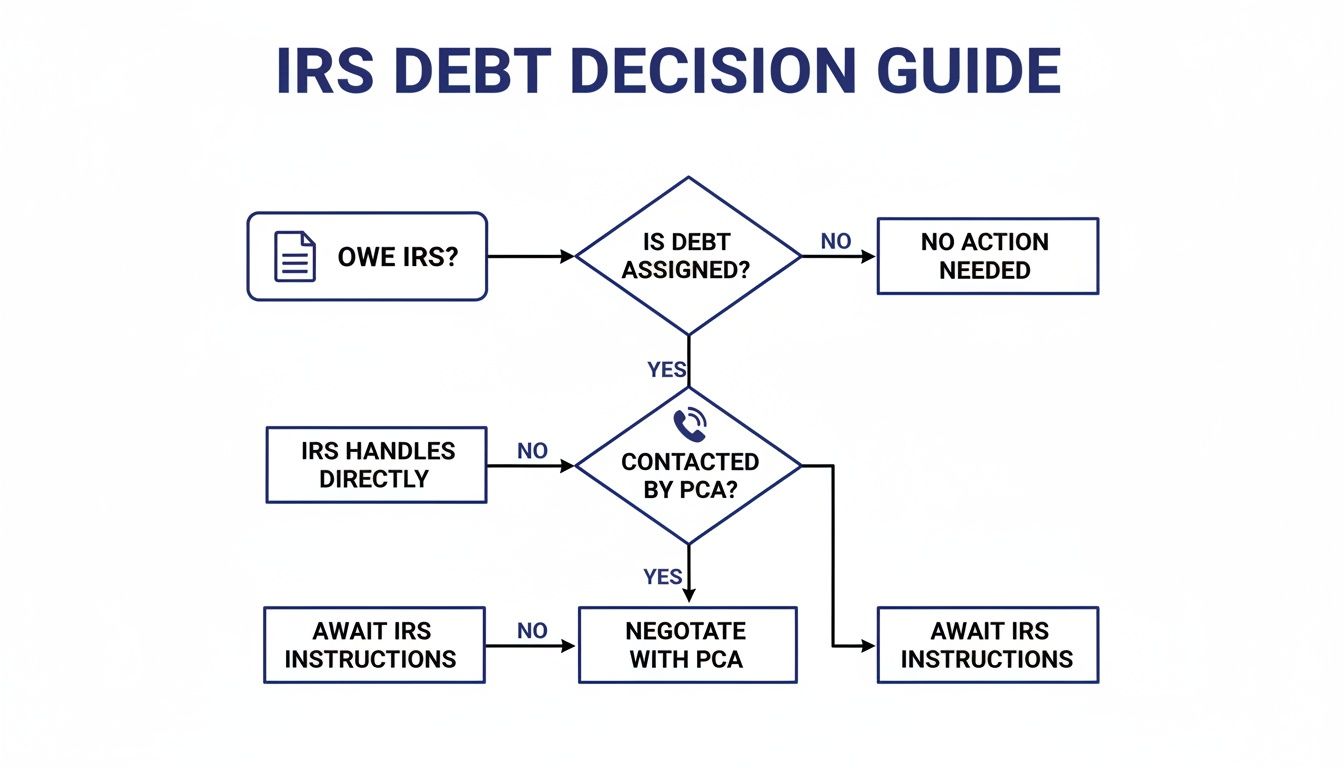
As you can see, contact from a private agency is one of the last steps in a long process, reinforcing why those initial IRS notices are so important.
Your Verification Checklist
Even if a caller says they're from CBE Group, ConServe, or Coast Professional, you can't take them at their word. Scammers know these names, too. The smart move is to hang up and verify everything independently.
- Do Not Engage or Share Information. Never give out personal details like your Social Security number or confirm financial information on a call you didn't initiate. Just hang up.
- Find Your Official Letters. Locate the CP40 Notice from the IRS and the initial contact letter from the PCA. These are your source documents.
- Call the IRS Directly. If you can’t find the letters or you're suspicious about the ones you received, call the IRS directly to ask if they have, in fact, assigned your account to a collector.
- Authenticate the PCA. Go to the official IRS website's page on the Private Debt Collection program. Use the phone number listed there to call the agency back. Never use a number a caller gives you or that you see in a suspicious email.
Remember, the IRS sends letters for various reasons, including to confirm your identity. It's helpful to understand the difference between a collection notice and an IRS identity verification letter so you can feel confident when handling any official communication. Following this verification checklist is the surest way to know you’re talking to the right people.
2. The Rules of Engagement: What a PCA Can and Cannot Do
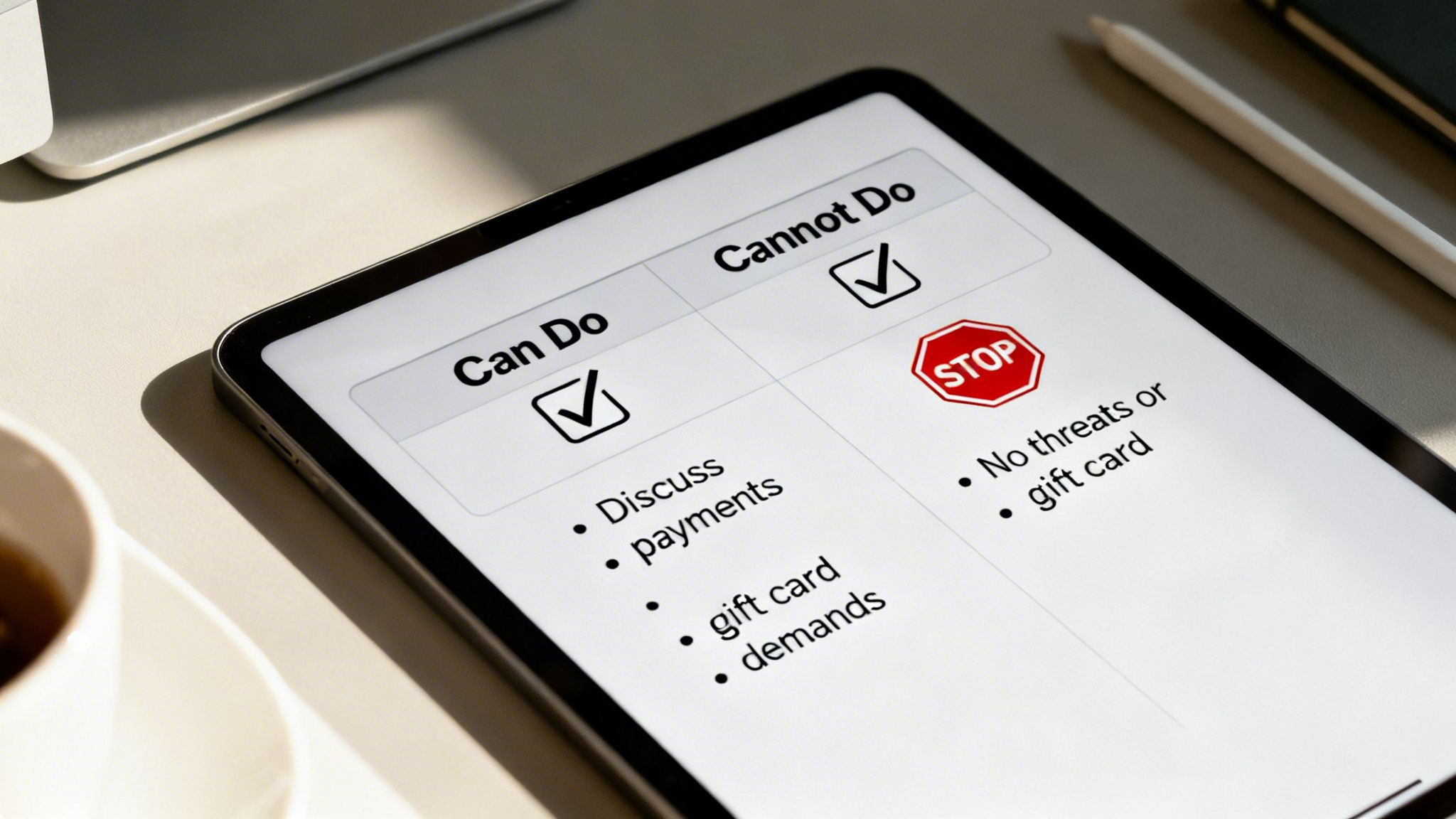
When you get a call from someone saying they’re collecting on behalf of the IRS, knowing the rules of engagement is your single best defense. A legitimate private collection agency (PCA) operates on a very short leash, with strict limitations set by both the IRS and federal law. Understanding these boundaries is the key to spotting and shutting down intimidation tactics.
Think of these agencies as facilitators, not enforcers. Their one and only job is to get in touch with you and help you find a way to pay your overdue tax bill. They can walk you through your options and show you how to set up payments, whether electronically or with a check to the U.S. Treasury.
But here’s the critical part: the line between what a PCA can and cannot do is crystal clear. Their authority is incredibly limited—a fact that aggressive callers and outright scammers are counting on you not knowing.
What a Legitimate PCA Can Do
Authorized collection agencies—CBE Group, ConServe, and Coast Professional, Inc.—have a narrow, well-defined script to follow. When one of their representatives calls, they are permitted to:
- Call you about your tax debt, but only after you’ve received two official letters in the mail: the CP40 from the IRS and a separate letter from the agency itself.
- Discuss payment, but they must always direct you to make payments directly to the U.S. Treasury. They will point you to the official IRS.gov/payments portal.
- Help you establish a payment plan (an installment agreement) where payments are debited directly from your bank account by the IRS.
- Ask for financial details, much like an IRS employee would, to figure out what kind of payment arrangement you can realistically handle.
What a PCA Absolutely Cannot Do
The restrictions on PCAs are even more important to burn into your memory. Any deviation from these rules is a massive red flag. A legitimate agency working for the IRS will never:
- Threaten you. Period. They can't threaten you with arrest, deportation, or a lawsuit. This is the number one tactic of impersonation scams.
- Demand immediate payment over the phone, especially using a specific, untraceable method like a prepaid debit card, gift card, or wire transfer.
- Ask you to make a payment out to them. All checks must be made payable to the "U.S. Treasury." No exceptions.
- Take enforcement action. A PCA has zero authority to put a lien on your property or issue a levy against your bank account or wages.
The power to enforce tax collection through serious measures like liens and levies belongs exclusively to the IRS. A private agency can talk about your debt, but they cannot take your property. Scammers often invent this power to create panic.
It's crucial to understand the legal authority that separates a government body from a private contractor. For example, very specific laws outline who can garnish wages without notice in Utah and in other states. A PCA simply does not have this power. If anyone calls claiming to represent the IRS and threatens these actions, you can be certain you're dealing with a fraud.
Your Options for Resolving the Debt
Just because a private debt collector is calling about your IRS tax bill doesn't mean you've lost control. In fact, you hold more cards than you might think. You are in the driver's seat and can choose how to proceed—and you are never forced to deal with the PCA if you don't want to.
The most important thing to remember is that a private collection agency is just a messenger. They cannot take enforcement action, like levying a bank account or garnishing wages. So there's no need to feel pressured into a decision right there on the phone. You have every right to step back, evaluate your situation, and choose the path that works best for you.
Take Control of the Conversation
When a PCA calls, their job is to guide the conversation toward getting a payment. Your first move should be to calmly and professionally take back control.
Having a simple script ready can make all the difference.
Sample Script: "Thank you for the information. I am aware of this matter. I will not be discussing my finances with you today. I will be contacting the IRS directly (or my tax attorney) to determine my resolution options. Please do not call me again, as I will only be communicating in writing from this point forward."
This statement accomplishes three critical things almost immediately:
- It stops the questioning cold.
- It asserts your right to work directly with the IRS or your own representative.
- It invokes your powerful right under the Fair Debt Collection Practices Act (FDCPA) to demand all future communication be in writing.
This simple act puts you back in charge and gives you the breathing room to make a clear-headed decision without a collector breathing down your neck.
Decide Who You Want to Work With
After that initial contact, you have a fundamental choice to make. You are not obligated to work with the private collector at all.
Your primary options are:
- Work Directly with the IRS: You can completely bypass the PCA. Simply go to the IRS website to set up a payment plan or look into other resolution programs on your own.
- Dispute the Debt: If you don't believe you actually owe the tax, you have every right to challenge it. This is typically done by working with the IRS or a tax professional to review your account records and file the necessary paperwork.
- Hire a Tax Attorney: A qualified tax attorney can step in and handle all communications with both the PCA and the IRS on your behalf. We can analyze your complete financial picture and negotiate for the best possible outcome for you.
Explore Your Resolution Options
The PCA's main goal is to get you into a standard payment plan. It's their simplest path. However, you may qualify for far more powerful solutions that they can't—and won't—offer you.
For example, an Offer in Compromise (OIC) is an IRS program that allows certain taxpayers to settle their tax debt for less than the full amount owed. It's a game-changer for people in the right financial situation, but it's not something a PCA can set up for you. Our firm has extensive experience helping clients with this process, and you can learn more about what an Offer in Compromise is and see if it might be a fit.
Never let a collector rush you into a simple payment plan without first exploring all the avenues available to you.
Spotting the Red Flags of an IRS Impersonator
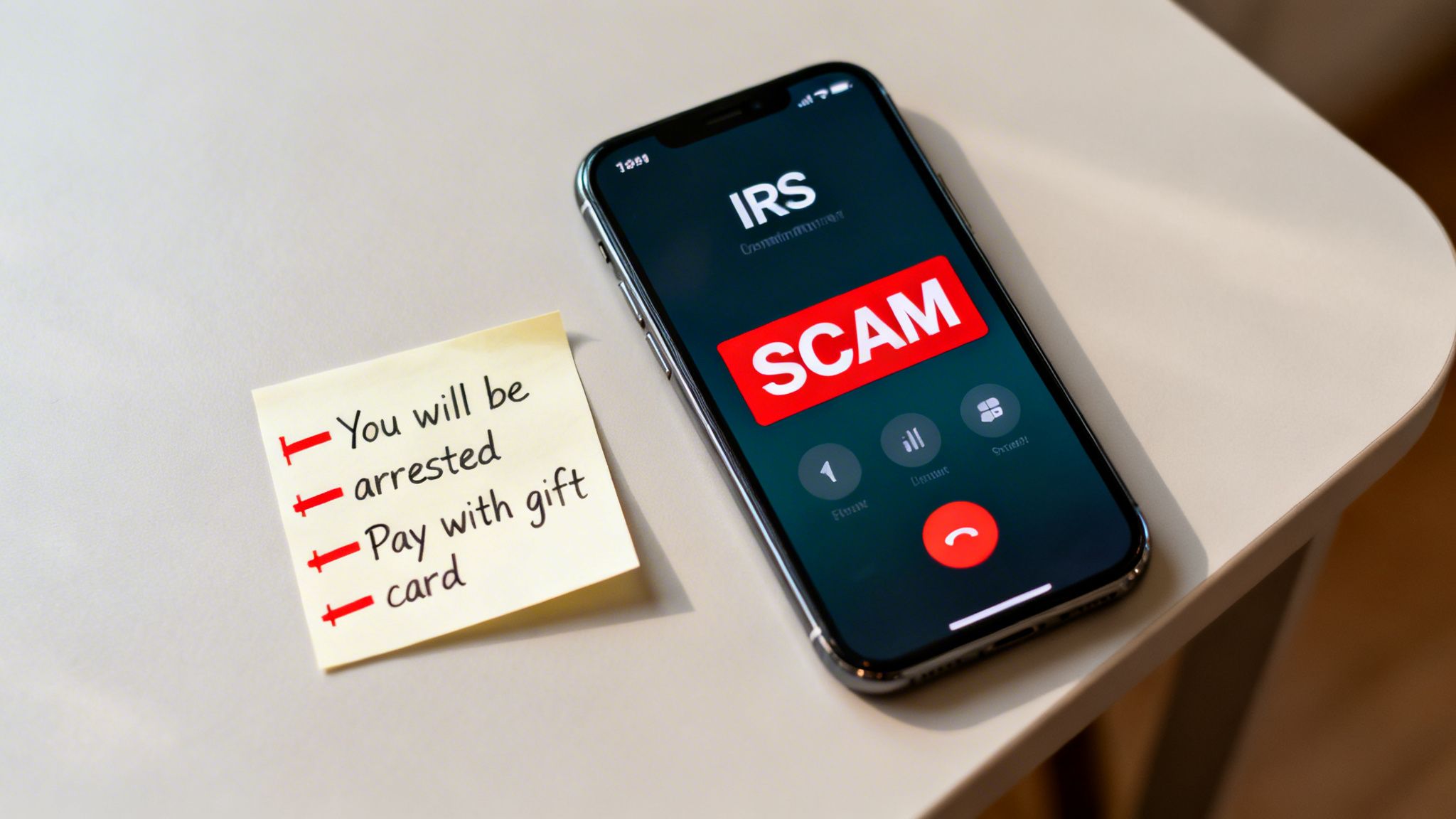
Because the IRS does use collection agencies, it’s created a perfect opening for criminals to impersonate agents and prey on taxpayers’ fears. The best way to protect yourself is to understand their playbook. Scammers create a false crisis, pressuring you to act before you have time to think.
A legitimate private collection agency (PCA) always follows a professional, predictable script. An impersonator, on the other hand, throws the rulebook out the window. If you spot even one of the red flags below, you can be certain you're dealing with a fraud.
The Psychology of Scam Calls
Think of IRS impersonators as masters of emotional manipulation. Their entire goal is to bypass your common sense by hitting the panic button. They do this by manufacturing a sense of extreme urgency and fear, often peppering their threats with immediate, life-altering consequences.
Their script is carefully designed to make you feel cornered, believing that your only way out is to do exactly what they say, right now. This is why knowing their key phrases is so important—it breaks the spell and puts you back in control of the situation.
'Red Flag' Phrases to Watch For
If you hear any of these phrases during a call, you are talking to a scammer. A real representative from the IRS or an authorized PCA would never say these things:
- "You need to pay immediately using a gift card, prepaid debit card, or a wire transfer."
- "If you don't pay up, we're sending a local sheriff to arrest you today."
- "This is your final notice before we file a lawsuit against you."
- "We need your credit card number right now to prevent the suspension of your driver's license."
- "You owe this tax, and you are not allowed to appeal or question the amount you owe."
The demand for payment with gift cards or wire transfers is the absolute biggest giveaway. These payment methods are untraceable and impossible to reverse, which is exactly why criminals love them. The IRS and its authorized agents will always instruct you to make payments directly to the "U.S. Treasury" through official, traceable channels.
Your Immediate Action Plan
The second you suspect a scam, your response should be quick and decisive. Don't argue, don't debate, and definitely don't give them any personal information.
- Hang Up Immediately. Do not engage with the caller. Just end the call.
- Report the Call. File a report with the Treasury Inspector General for Tax Administration (TIGTA) through their website or by calling 1-800-366-4484.
- Report to the FTC. It’s also a good idea to report the scam attempt to the Federal Trade Commission at ReportFraud.ftc.gov.
- Protect Your Information. If you're concerned that an impersonator has created or misused your details as part of a scam, knowing how to remove false personal information from the internet can be a crucial step in safeguarding your identity.
When to Call a Tax Attorney for Backup
You absolutely have the right to tackle your tax debt yourself. But let's be honest, in some situations, going it alone is like deciding to do your own dental work—technically possible, but rarely a good idea. Knowing how to handle a private collection agency is one thing, but knowing when to bring in a professional is a critical judgment call that can safeguard your entire financial future.
So, when does a nagging tax problem turn into a five-alarm fire that demands an attorney?
Clear Signals You Need Professional Help
Certain tax situations are just too complex or carry too much risk to navigate on your own. If any of the following scenarios sound familiar, it's a strong sign that you should seek legal counsel right away.
The debt is substantial: When you owe a significant amount of money to the IRS, the financial stakes are simply too high to risk a misstep. A small error in how you negotiate or structure a payment plan can easily cost you thousands more than it should.
Your case is complex: We're not talking about a simple math error. If you're dealing with issues like multiple years of unfiled returns, thorny payroll tax problems, or you genuinely dispute the amount the IRS claims you owe, you need deep procedural and legal knowledge on your side.
You feel completely overwhelmed: The sheer stress of dealing with collectors—especially when they're calling about a federal tax debt—can be immense. An attorney steps in and acts as an immediate shield, taking over all communications so you can get some breathing room.
The IRS threatens enforcement: If words like lien, levy, or wage garnishment are being thrown around, the clock is ticking. An experienced attorney can often intervene quickly to halt these aggressive collection actions while working out a more manageable solution.
Hiring a tax attorney isn't about admitting defeat; it's about bringing a specialist onto your team. Their job is to protect your rights, find every available resolution option, and secure a deal that reflects your actual financial situation—something a PCA has no incentive to do.
An experienced tax lawyer knows the IRS collection landscape inside and out, including powerful options that a private collector will never bring up. For example, they can build a case for penalty abatement or structure a complex settlement that protects your home, savings, and other assets.
A PCA’s main question is if you can pay. A good attorney, on the other hand, focuses on how you can resolve the debt in the most favorable way possible for you. This often requires a detailed financial analysis and strategic negotiation. You can learn more by reading our guide on how to negotiate with the IRS to see just how intricate the process can be.
Ultimately, a tax attorney provides peace of mind and a clear path forward when the pressure feels completely unbearable.
Frequently Asked Questions About IRS Collection Agencies
We’ve covered a lot of ground, but a few key questions always come up when dealing with these private agencies. Let's walk through the answers to make sure you feel confident in your next steps.
Will A Collection Agency Show Up at My House?
Absolutely not. A legitimate private collection agency (PCA) working for the IRS will only contact you by mail and phone. They are never allowed to show up at your home or your job.
If someone knocks on your door claiming to be from the IRS or a collection agency, it’s a scam. Do not give them any information. Simply close the door and report the incident to the Treasury Inspector General for Tax Administration (TIGTA).
Can I Pay the Private Collection Agency Directly?
This is a critical point: you should never pay the private collection agency directly. While you'll talk to them about setting up a payment plan, the payment itself must go straight to the government.
Every single payment must be made payable to the “U.S. Treasury.” You can pay online through the official IRS.gov/payments website or mail a check. Any collector who asks for a check payable to their company or demands payment with gift cards or a wire transfer is a fraudster.
Know the Red Flag: The payment process is non-negotiable. If a collector pressures you for a payment made out to anyone other than the "U.S. Treasury," hang up the phone. It's a guaranteed scam.
What If I Do Not Think I Owe the Tax Debt?
You always have the right to question a tax bill. If you think the amount is wrong—or that you don’t owe anything at all—you do not have to set up a payment plan.
Your first step is to tell the collection agency, preferably in writing, that you dispute the debt. From there, you can work directly with the IRS or with a qualified tax professional to get to the bottom of it. The key is to take action; ignoring the notices won't make the problem disappear, but formally disputing it protects your rights.
