
Does IRS Garnish Wages in Michigan? A Taxpayer’s Guide
Yes, the IRS can absolutely take a portion of your paycheck to cover unpaid taxes. But when they do it, they don't call it a "garnishment"—they call it a levy. That's not just semantics; it's a critical legal distinction that gives the agency immense power to access your earnings without ever stepping foot in a courtroom.
Understanding the IRS Wage Levy
When most people hear "wage garnishment," they think of a lengthy court process. A creditor, like a credit card company, has to sue you, win a judgment, and then get a judge's permission to start taking money from your pay. It's a formal, court-supervised ordeal.
The IRS, however, plays by a completely different set of rules.
They operate under powerful federal laws that allow them to bypass the courts entirely. After sending you a series of legally required notices, the IRS can issue a wage levy directly to your employer. Think of it this way: a standard garnishment needs a third-party referee (a judge), but a levy is a direct action the IRS takes on its own authority. This gives them a much faster and more aggressive path to your wages.
Key Differences Between a Levy and Garnishment
This distinction has serious real-world consequences. Because the IRS doesn’t need a court order, their collection process is far more immediate and forceful than what you'd experience with any other kind of debt. It’s why an official notice from the IRS demands your immediate attention.
Just how common is this? A major study highlighted by the National Bureau of Economic Research found that about one in every 100 American workers faces wage garnishment, putting millions at risk of losing a huge chunk of their pay to debts, including taxes.
The most important takeaway is this: An IRS levy is a direct seizure of your assets—including your wages, bank accounts, and even Social Security benefits—that does not need court approval. It is the IRS’s ultimate tool for collecting unpaid taxes.
To really see how different these two actions are, it helps to compare them side-by-side. For an even deeper dive into the specifics, you can learn more about what a tax levy is and how it works.
IRS Levy vs Standard Garnishment Key Differences
The table below breaks down the critical differences, showing just how much unique authority the IRS really has.
| Feature | IRS Wage Levy | Standard Wage Garnishment |
|---|---|---|
| Court Order Required? | No. The IRS has statutory authority to levy. | Yes. A creditor must obtain a court judgment first. |
| Legal Process | Administrative action taken directly by the IRS. | Judicial process overseen by the court system. |
| Initiation Time | Can proceed 30 days after a Final Notice is issued. | Can take months or even years of court proceedings. |
| Scope of Power | Broader; can seize wages, bank funds, and federal payments. | Generally limited to wages as specified by the court. |
As you can see, the IRS levy is a uniquely powerful collection tool, making it essential for taxpayers to understand their rights and act quickly when they receive a notice.
How an IRS Levy Unfolds Step by Step
An IRS wage levy doesn't just happen out of the blue. It’s the final move in a slow, predictable collection process—one where the IRS telegraphs its moves well in advance. If you know what to look for, you'll see it coming and have multiple opportunities to stop it before your paycheck takes a hit.
The entire process kicks off only after the IRS assesses a tax liability, which is just their formal way of recording how much you owe. From there, a clear sequence of events has to play out before they can legally touch your wages.
Step 1: The Initial Bill and Follow-Up Notices
First, you'll get a Notice and Demand for Payment. This is the opening bell, usually a notice like the CP14, that officially states the amount of tax you owe and a deadline for paying it.
If you don't pay up or get on a plan, the IRS will start sending a series of follow-up letters. These notices—often labeled CP501, CP503, and then CP504—get progressively more serious. They’re designed to remind you of the outstanding debt and warn you about what’s coming next. My best advice? Open every single piece of mail from the IRS. Ignoring them is the fastest way to lose control of the situation.
Step 2: The Final Notice of Intent to Levy
This is where things get serious. After the earlier notices are ignored, the IRS is required by law to send you a Final Notice of Intent to Levy and Notice of Your Right to a Hearing. This document, typically a Letter 1058 or an LT11, is the single most critical warning you will receive.
It’s not just another reminder; it's a legal ultimatum. The notice makes it crystal clear that the IRS plans to seize your property, including garnishing your wages, if you don't take action within 30 days. This 30-day window is your last, best chance to formally challenge the levy and work out an alternative before they bring your employer into the picture.
Think of the Final Notice as a 30-day countdown clock. Once that clock starts, doing nothing is the same as giving the IRS the green light to take your wages directly from your employer.
This flowchart shows the simple but powerful progression from an unpaid tax bill to an active wage garnishment.
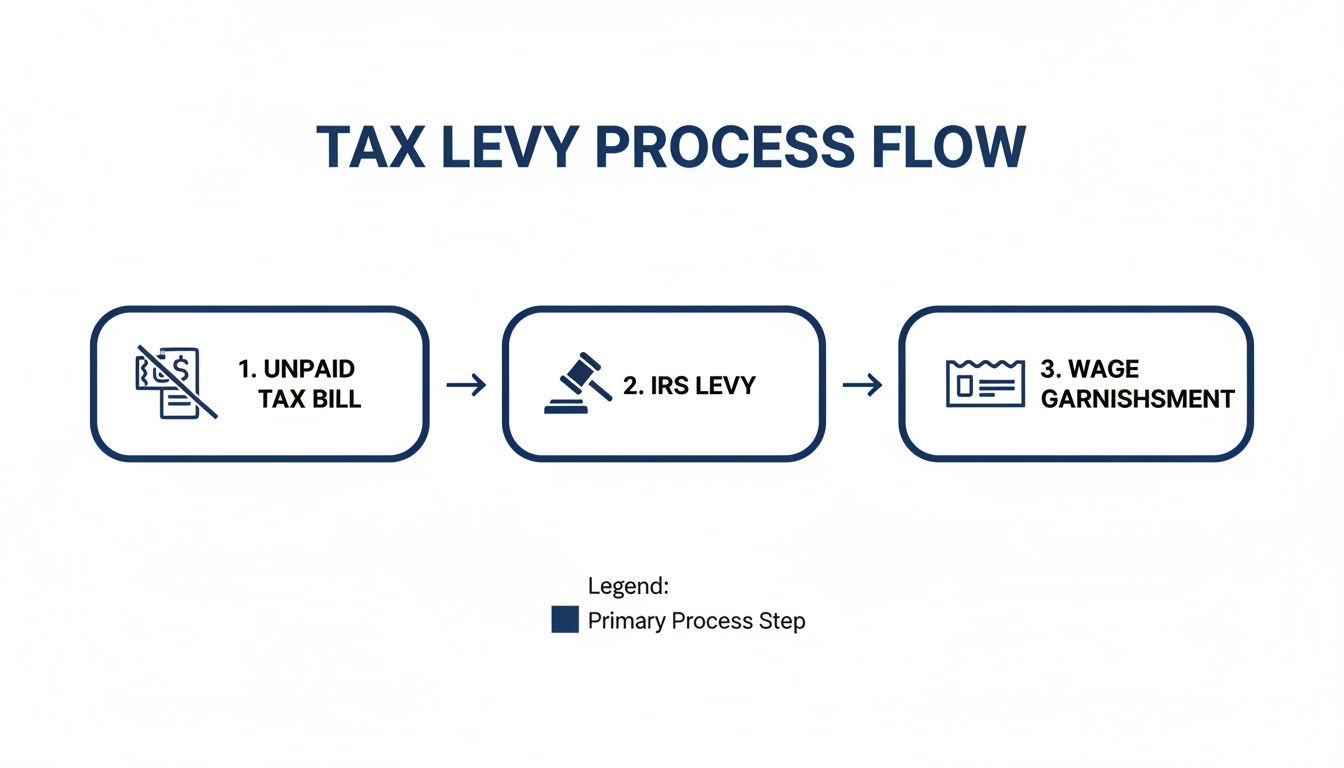
As you can see, a levy is the direct result of an unresolved tax debt. If you don’t intervene, wage seizure is the inevitable next step.
Step 3: The Levy Is Issued to Your Employer
If the 30-day deadline from the Final Notice comes and goes without a resolution, the IRS is officially authorized to issue the levy. At this point, they will send a Form 668-W(c)(DO), Notice of Levy on Wages, Salary, and Other Income, straight to your employer’s payroll department.
Your employer is now legally required to comply. They have no choice. They must use the information you provide on the form’s Statement of Exemptions and Filing Status to calculate how much of your pay is exempt. From that day forward, the non-exempt portion of every paycheck will be sent directly to the IRS until the levy is released or the debt is paid in full.
How Much of Your Paycheck Can the IRS Legally Take?
When the IRS levies your wages, the first question that hits you is usually, "How much am I actually going to have left?" The answer is rarely comforting. Unlike a private creditor whose hands are tied by the Consumer Credit Protection Act, the IRS plays by its own rulebook—one that lets them take a much bigger slice of your income.

The agency uses a specific formula to figure out what it can take. Think of it as the IRS setting a basic "survival allowance"—an amount of money you're legally allowed to keep for essential living expenses. Every dollar you earn above that exempt amount is fair game for the levy.
Understanding How the Exemption is Calculated
Your employer isn’t just pulling a number out of thin air. They are required to use IRS Publication 1494, officially titled "Tables for Figuring Amount Exempt from Levy on Wages, Salary, and Other Income." This document lays out exactly how much you get to keep based on three things:
- Your Filing Status: Single, married filing jointly, head of household, etc.
- Number of Dependents: How many qualifying dependents you claim.
- Your Pay Frequency: Whether you get paid daily, weekly, bi-weekly, or monthly.
As part of the process, your employer will give you a Statement of Exemptions and Filing Status to fill out. This is Part 3 of the official levy notice, Form 668-W. It is absolutely critical that you complete and return this form right away. If you don't, your employer has to calculate your exemption based on a married-filing-separately status with zero dependents—the worst-case scenario that leaves you with the smallest possible exemption and sends the maximum amount to the IRS.
Real-World Examples in Michigan
To see just how hard this can hit, let's look at a couple of real-world scenarios using the 2024 exemption tables for someone paid bi-weekly.
Example 1: Single Filer, No Dependents
Imagine a single taxpayer in Michigan with no kids who gets paid every two weeks. They are allowed to keep $570.83 of their take-home pay. If their bi-weekly paycheck is $1,500 after normal deductions, the IRS will take $929.17 out of every single check. That leaves them with just over $1,140 a month to cover rent, food, gas, and everything else.
Example 2: Married Couple with Two Children
Now, let's look at a married taxpayer in Michigan who files jointly, has two children, and is also paid bi-weekly. Their situation is better, with a bi-weekly exempt amount of $1,362.50. If their take-home pay is $2,500 every two weeks, the IRS would still take $1,137.50 from their check.
These examples reveal a harsh truth: an IRS wage levy isn't a minor inconvenience. It’s a powerful financial weapon designed to be painful enough to force you to deal with your tax debt immediately.
While tax levies are less frequent than other types of garnishments, they tend to hit the most vulnerable workers the hardest. Research from ADP revealed that while tax levies made up only 1.5% of all wage garnishments, they disproportionately affected workers earning between $25,000 and $40,000. You can see the full breakdown in ADP's report on wage garnishment trends on adp.com.
The Unrelenting Nature of an IRS Levy
Perhaps the most intimidating part of an IRS wage levy is that it doesn't stop. Unlike a bank levy, which is a one-time seizure of whatever is in your account on a specific day, a wage levy is relentless. It attaches to every single paycheck you get until one of three things happens:
- The tax debt, including all penalties and interest, is paid in full.
- You successfully work out a levy release with the IRS.
- The statute of limitations for the IRS to collect the tax finally expires.
This means that month after month, a huge chunk of your earnings goes straight to the U.S. Treasury, making it almost impossible to keep up with your bills, let alone plan for the future. The pressure is by design, and it highlights just how urgently you need to take action.
Your Legal Rights to Challenge an IRS Levy
Getting that “Final Notice of Intent to Levy” in the mail can feel like the final blow, but it's actually the opposite. This notice is what unlocks your most powerful legal rights to fight back. The tax code gives you a formal process to challenge the IRS's plan, and your single most important tool is the Collection Due Process (CDP) hearing.
Think of this as your legal "time out." When you file a timely request for a CDP hearing—within 30 days of the date on your notice—the IRS is legally barred from taking any collection action. They can’t touch your wages, freeze your bank account, or seize your assets while your case is under review. This gives you critical breathing room to work out a solution without the immediate pressure of a levy.
How to Request Your Collection Due Process Hearing
That 30-day clock starts the moment you get the Final Notice. To officially stop the collection process, you need to send in Form 12153, Request for a Collection Due Process or Equivalent Hearing, before that deadline expires. Missing this window is a huge misstep; you lose the automatic stay on the levy and your right to take your case to the U.S. Tax Court if you disagree with the hearing's outcome.
Filing this form tells the IRS you're not just ignoring the problem. It signals that you are asserting your legal right to find a better, more reasonable way to resolve the debt than having your paycheck seized.
A timely CDP hearing request is more than just paperwork—it’s a strategic legal move that can completely change the dynamic. It forces the IRS to pause its most aggressive tactics and actually listen to your side, giving you the space to negotiate from a much stronger position.
What Can You Argue in a CDP Hearing?
Your CDP hearing isn't just a formality. It’s a real opportunity to make your case to an impartial IRS Appeals Officer who hasn’t been involved in your file before. The goal is to convince them that a levy is overly harsh and that a less damaging alternative makes more sense.
Here are the most common arguments you can make:
- Propose a Collection Alternative: This is where CDP hearings shine. It’s your official forum to propose a workable solution, like an Installment Agreement for affordable monthly payments or an Offer in Compromise to settle the debt for less than you owe.
- Request Innocent Spouse Relief: If the tax debt comes from a joint return with a spouse or ex-spouse, you can use the hearing to argue you shouldn't be on the hook for their tax mistakes.
- Challenge the Levy Itself: You can demonstrate that the levy would cause a significant economic hardship, leaving you unable to pay for basic necessities like housing, food, and medical care for your family.
- Dispute the Tax Owed (in limited situations): Usually, you can't fight about the actual amount of tax during a CDP hearing. The big exception is if you never received the initial "notice of deficiency" or never had a chance to dispute the liability before. If that's the case, this might be your first opportunity to do so.
To make the most of your CDP hearing, you need a solid game plan. By showing up with clear financial documents and a realistic proposal, you can turn what feels like a one-sided fight into a productive negotiation. This is how you protect your income and finally get on a clear path to putting your tax problems behind you for good.
Actionable Strategies to Stop a Wage Levy
Getting a notice that the IRS plans to levy your wages can feel like a punch to the gut. But it's not a final verdict—it's a critical moment that calls for immediate action. You have several powerful, proven strategies to get an active wage levy released or even stop one before it starts. The absolute worst thing you can do is ignore the problem. The key is to face it head-on with a clear plan.
Ignoring those letters guarantees the levy will drain your paycheck. But taking decisive steps can put you back in the driver's seat. If you're staring down an IRS wage levy, understanding your rights and learning how to negotiate with creditors like the IRS opens up several paths to resolution. Let's walk through the most effective options.

Set Up an IRS Installment Agreement
The most direct way to halt a wage levy is to formalize a payment plan. An Installment Agreement (IA) is a contract you make with the IRS to pay your tax debt over time in manageable monthly payments. Once the agreement is officially in place and you've made your first payment, the IRS must release the levy.
This is the go-to solution for many taxpayers who have the means to pay their debt but just need more time. Depending on your situation, some IAs can be set up online in minutes, while others require a bit more paperwork and negotiation.
Pursue an Offer in Compromise
What happens if you simply can't afford to pay the full tax debt, even with a payment plan? This is where an Offer in Compromise (OIC) comes in. An OIC is a formal proposal to the IRS to settle your tax liability for less than the full amount you owe.
Think of it as a settlement. The IRS essentially agrees to take less because they've concluded it's the most they are likely to ever collect from you. Be warned, though—qualifying for an OIC is an intense process based on a rigid formula that scrutinizes your:
- Ability to pay
- Income and expenses
- Equity in any assets you own
The good news? While the IRS is considering your OIC, they are required to pause all collection activities, including wage levies. If they accept your offer, the levy is released for good once you fulfill your end of the deal.
Demonstrate Economic Hardship
The IRS isn't supposed to take money that you need for basic survival. You can demand that they release a levy if you can prove it is causing you an immediate economic hardship.
An economic hardship isn't just a major inconvenience; it means the levy is preventing you from paying for absolute necessities like housing, food, utilities, or critical medical care.
To make your case, you'll need to submit detailed financial information (usually on Form 433-A) that clearly documents your income and essential living expenses. If the IRS agent agrees the levy is creating a severe hardship, they will release it. This often leads to being placed in Currently Not Collectible status.
Request Currently Not Collectible Status
If your financial situation is so tight that you can't afford to pay your tax debt and cover your basic living costs, you can ask the IRS to classify your account as Currently Not Collectible (CNC). This status doesn't make the debt disappear, but it does stop all collection efforts—including wage levies—while you're experiencing financial hardship.
The IRS will check in on your finances periodically to see if your ability to pay has improved. While you're in CNC status, interest and penalties will continue to build, but it gives you the breathing room you need to get back on your feet. For a deeper dive into this process, check out our guide on how to stop IRS wage garnishment.
Each of these solutions requires careful preparation and direct communication with the IRS. Having an experienced tax attorney in your corner can make all the difference. We can analyze your unique situation, figure out the best strategy, and handle the negotiations to secure the best possible outcome for you.
Navigating Federal and Michigan State Tax Levies
If you live in Michigan, tax trouble can feel like you're fighting a battle on two fronts. It’s entirely possible to have the IRS breathing down your neck for a federal tax debt while, at the same time, the Michigan Department of Treasury is starting its own collection process.
This is a tough spot to be in. Resolving your issue with the IRS does absolutely nothing to stop the state from coming after you, and vice versa. You have to treat them as two separate problems, each with its own set of rules.
Michigan Treasury vs. IRS Collection Powers
Don't underestimate the Michigan Department of Treasury. They have a powerful toolkit for collecting unpaid state taxes, whether it's income tax, sales tax, or another liability. Just like the feds, they'll start with a Notice of Intent to Assess and eventually a Final Bill for Taxes Due. If you let those notices pile up unanswered, they will move forward with garnishing your wages or levying your bank accounts.
While the end result is similar, the way they get there is different. Here's where you'll see the biggest distinctions:
- Notice Timelines: The state often moves on a different clock. Their notice periods and the time you have to appeal can be much shorter than the IRS's standard 30-day Collection Due Process window.
- Exemption Amounts: How much of your paycheck is safe from garnishment? Michigan law has its own answer to that question, and it likely won't match the federal exemption amounts calculated on IRS Publication 1494.
- Appeal Processes: If you need to fight a state action, you're not going to U.S. Tax Court. Your appeal will likely go through a state-specific channel, like the Michigan Tax Tribunal.
It's a classic mistake to think that setting up an Installment Agreement with the IRS will put a stop to collection actions from the Michigan Treasury. They are completely separate entities, and you need a separate resolution for each.
Handling a state tax problem requires knowing Michigan's specific playbook. For a deeper dive, check out our guide on how to stop state tax garnishment here in Michigan.
Why Local Expertise Matters
When your tax problem crosses both federal and state lines, you need a strategy that covers all your bases. An approach that works perfectly with an IRS agent might fall flat with an officer from the Michigan Department of Treasury.
This is where having a team that knows the ins and outs of Michigan's tax system—from Detroit to Grand Rapids—becomes so important. As seen in discussions around topics like ATO Debt and Personal Liability, tax rules and their real-world consequences vary immensely from one jurisdiction to another. We have years of experience negotiating with both the IRS and the Michigan Treasury, allowing us to build a resolution that addresses your entire tax picture and protects your income from every angle.
Frequently Asked Questions About IRS Wage Levies
When you're facing down the power of the IRS, your mind is probably racing with urgent questions. Let's tackle some of the most common concerns taxpayers have when they learn the IRS can take money directly from their pay.
Can the IRS Take My Social Security or Disability Benefits?
Unfortunately, yes. The IRS has the authority to levy most federal payments, which includes your Social Security retirement and disability benefits. They do this through a program called the Federal Payment Levy Program (FPLP).
Through the FPLP, the IRS can take a continuous 15% cut of your monthly benefit until your tax debt is completely paid off. While that percentage is lower than a typical wage levy, it can still cause a massive financial strain for anyone living on a fixed income. It's worth noting, however, that some payments are off-limits. For instance, Supplemental Security Income (SSI) is fully protected and cannot be touched by an IRS levy.
Does Quitting My Job Stop an IRS Levy?
Quitting your job will stop the levy from that specific employer, but it's a temporary and ultimately ineffective solution. The underlying tax debt doesn't vanish, and the IRS will almost certainly find your new employer right away.
Federal law requires all businesses to report new hires. Before you even get your first paycheck at a new job, there’s a strong chance the IRS has already sent a new levy notice to your new payroll department. The better strategy is always to face the problem head-on by negotiating a formal resolution with the IRS.
The levy follows you, not the job. The IRS’s collection systems are automated to track taxpayers, making it nearly impossible to outrun a tax debt by changing employers.
How Long Does a Wage Levy Last?
An IRS wage levy is designed to be continuous and relentless. It doesn't just expire after a few paychecks. It stays in place, taking a piece of every single paycheck until one of four things happens:
- The tax debt, including all penalties and interest, is paid in full.
- You successfully negotiate a release of the levy with the IRS.
- The time limit for the IRS to collect the debt—the collection statute of limitations—expires.
- You prove to the IRS that the levy is causing you an immediate and severe economic hardship.
Think of it as a constant pressure that won't stop on its own. You have to take action to make it end.
Will Filing for Bankruptcy Stop a Levy?
Yes, filing for bankruptcy protection almost always brings immediate relief. The moment you file, the court issues an "automatic stay." This is a legal order that forces most creditors, including the IRS, to halt all collection activities right away. This includes stopping an active wage levy.
But be aware, the automatic stay is often just a temporary pause. Figuring out whether your tax debt can be permanently wiped out (discharged) in bankruptcy is a far more complex legal issue. It hinges on factors like the type of tax and how old it is. This is a major financial decision, and it’s critical to get guidance from a tax attorney who also has deep experience in bankruptcy law.
