
Someone Filed Taxes In My Name? Protect Your Identity!
You hit submit on your return, expect a confirmation, and instead get a rejection tied to your Social Security number. Or a letter arrives from the IRS asking you to verify a return you never filed. That’s usually the moment people search for someone filed taxes in my name.
The shock is real, but the path forward is usually clearer than it first appears. Tax identity theft creates two immediate problems. Someone may have tried to steal a refund, and the IRS or Michigan Department of Treasury may now have incorrect information attached to your account.
The right response is part tax procedure, part identity theft remediation, and part record-building. If you live in Michigan, you also need to think beyond the IRS. State income tax filings, wage withholding records, and employment-related Social Security number misuse can all complicate the case.
That Sinking Feeling Your Identity Was Stolen for a Tax Refund
The most common fact pattern is simple. A taxpayer files electronically, gets a duplicate SSN rejection, and thinks it must be a software glitch. It usually isn’t.
In practice, that rejection often means a fraudulent return hit the system before your legitimate one did. Sometimes the IRS catches it early. Sometimes the taxpayer first learns about it when a verification letter arrives. Either way, the emotional reaction is the same. Anger first, then confusion, then fear about what else the thief may have accessed.

This happens more often than people think
The scale is larger than most taxpayers realize. In 2024, the FTC recorded a significant number of identity theft complaints, and a Norton survey found that 22% of tax scam encounters involved a fraudulent return filed in the victim’s name. For those victimized, the average loss was $8,401 according to Norton’s tax scam statistics.
That doesn’t mean every victim loses money directly through the tax filing itself. Sometimes the bigger damage comes later. Delayed refunds, IRS notices, state notices, disputed wages, and the time it takes to prove you are who you say you are.
The first goal is containment, not perfection
People often lose time trying to figure out exactly how the theft happened. That can matter later, but not on day one.
Your first priority is to stop the problem from spreading across agencies and accounts. If your tax identity was used once, your information may also be circulating in breach data, reused for credit fraud, or exposed in criminal marketplaces. That’s why many taxpayers also look at tools such as Dark Web Monitoring to see whether email addresses, passwords, or identifying details have surfaced elsewhere.
Practical rule: Treat a duplicate SSN rejection as both a tax problem and a broader identity theft warning.
In Michigan, I also tell clients not to assume this is only a federal issue. If a thief filed a fake federal return, there’s a good chance they attempted a Michigan state filing too. A calm, documented response usually works better than a rushed one, but speed still matters in the opening days.
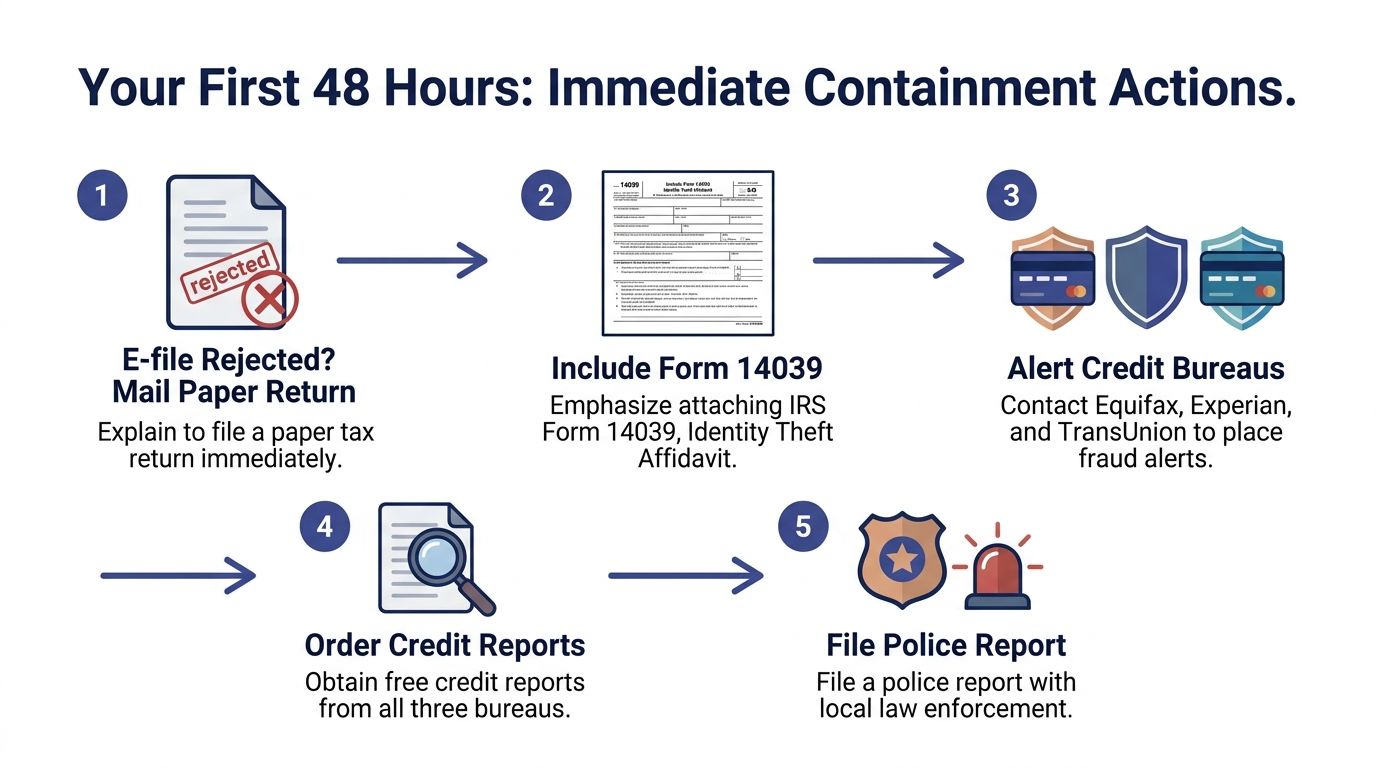
Your First 48 Hours Immediate Containment Actions
The first two days matter because they create your paper trail. You’re telling the IRS, the FTC, state tax authorities, and the credit system that the filing wasn’t yours.
If you only call one agency and wait, you leave gaps. If you build a coordinated record immediately, later notices are easier to challenge.
Start with the IRS
If your e-file was rejected because of a duplicate SSN, submit Form 14039 and file a paper return. The IRS typically acknowledges receipt within 30 days. If you receive Letter 5071C, you must use the online verification service within 30 days. The IRS targets 90 days for full resolution, though delays are common, as explained by 1040.com’s guidance on duplicate SSN filings.
Here is the practical sequence I recommend:
Print and sign your correct return.
Don’t keep retrying e-file. Once a false return is attached to your SSN, repeated electronic submissions usually waste time.Attach Form 14039.
This is the IRS Identity Theft Affidavit. It tells the agency you did not file the suspicious return.Mail the package with proof of delivery.
Use a mailing method that confirms receipt. Keep the receipt, tracking number, and copy of everything sent.Watch for IRS letters.
If the IRS sends Letter 5071C or another identity verification notice, respond fast and exactly as instructed. If you need more background on these notices, this explanation of an IRS identity verification letter is useful.
If the IRS asks you to verify identity, respond to the letter received. Don’t guess. The response method matters.
Create records outside the IRS
The IRS record is only one piece. You also need independent documentation showing that you reported the fraud promptly.
Take these steps next:
File an FTC report at IdentityTheft.gov.
This gives you an identity theft report and a recovery plan you can use with creditors, banks, and tax agencies.Report the matter to the Michigan Department of Treasury.
Michigan taxpayers should alert the state because a fraudulent federal filing often travels with a fraudulent state filing. Keep screenshots, confirmation emails, or written correspondence from the state.Place a fraud alert with a credit bureau.
Contact one of the major bureaus. That bureau is generally responsible for notifying the others. This doesn’t fix the tax issue, but it helps prevent new accounts from opening in your name.Order your credit reports.
You’re looking for unfamiliar accounts, addresses, inquiries, or employer information.File a local police report if practical.
Some taxpayers hesitate because they think police won’t investigate. Even if local law enforcement does little beyond documentation, the report can still help show consistent reporting across agencies.
What to say when you call
Keep it short and factual. Long explanations often create confusion.
Use language like this:
- To the IRS: “I attempted to file my return and received a duplicate SSN rejection. I did not file the prior return.”
- To Michigan Treasury: “I believe my Social Security number was used for tax fraud and may affect my state tax account.”
- To a credit bureau: “My Social Security number appears to be compromised in a tax identity theft incident. I want a fraud alert on my file.”
Common mistakes in the first two days
These are the errors that slow cases down:
Waiting for the problem to fix itself.
It won’t.Continuing to e-file.
Once the system sees a prior filing under your SSN, you generally need the paper process.Throwing away envelopes or letters.
Postmarks and notice numbers matter later.Assuming no state action is needed.
In Michigan, that assumption can create a second layer of cleanup months later.
Building Your Case Required Forms and Evidence
Once the immediate reports are made, the work shifts from emergency response to proof. This part is less dramatic, but it often decides whether the IRS and the state correct your account cleanly or keep sending notices.
Good identity theft cases are built, not argued. You need a file that shows what happened, when you reported it, and what records prove the filing was false.
The core documents to gather
At minimum, I want a client to assemble the following:
| Document/Form | Purpose | Where to File/Obtain |
|---|---|---|
| Form 14039 | Alerts the IRS that you are the victim of tax-related identity theft | Submit to the IRS with your paper return or through the IRS process that applies to your case |
| Paper federal tax return | Replaces the rejected e-filed return with your legitimate filing | Mail to the IRS |
| FTC Identity Theft Report | Creates an official identity theft record and recovery plan | Obtain through IdentityTheft.gov |
| IRS identity verification letter, if any | Shows what the IRS asked you to do and by when | Your mail or IRS online account records |
| Police report | Supports the timeline and seriousness of the report | Local law enforcement agency |
| Government photo ID and Social Security documentation | Helps verify your identity if the IRS or state requests proof | Your records |
| Wage and income records such as W-2s and 1099s | Confirms what income belongs to you | Employers, payers, or prior tax records |
| Copy of mailing receipts and delivery confirmation | Proves what was sent and when | Your postal or courier records |
| IRS transcript requests, including Form 4506-F if needed later | Helps identify fraudulent filing details and account activity | IRS |
Why each piece matters
Form 14039 is the formal trigger, but it doesn’t carry the case by itself. Agencies respond better when your file is consistent across every document.
A police report isn’t legally required in every case, but it can help. So can a neat call log. If you spoke with an IRS representative on Tuesday and Michigan Treasury on Wednesday, write down the date, time, number called, and the name or ID number of the person you spoke with if available.
Documentation beats memory. Six months from now, you won’t remember which letter arrived first or which agent told you to mail what.
Watch for employment-related clues
Not every tax identity theft case is about a fake refund return. Sometimes the thief used your Social Security number for work. The first sign might be an unfamiliar employer on an IRS wage and income transcript, or a tax notice reporting wages you never earned.
That’s why I often tell taxpayers to request wage and income information when the facts don’t make sense. If the income side of the account is contaminated, your case may involve more than return fraud.
If you need a closer look at the affidavit itself, this guide to the identity theft affidavit Form 14039 is a useful reference.
Build one file for federal and Michigan issues
Don’t separate your records into random stacks. Keep one organized file, digital or paper, with sections for:
- IRS filings and notices
- Michigan Treasury communications
- Identity theft reporting documents
- Employment and wage records
- Mailing proof and call notes
That file becomes your working evidence package if the refund is delayed, if a notice of unreported income appears, or if Michigan questions your return later.
In Michigan matters, state withholding discrepancies can be especially frustrating. The state may have payroll records or withholding data that don’t match your legitimate return. When that happens, having your federal and state records in one place saves time and prevents contradictory responses.
Navigating the Long Road to Recovery and an IP PIN
After the initial filing and reporting steps, many taxpayers expect silence followed by a corrected refund. That’s not usually how it goes.
The middle stage is messy. The IRS may freeze part of the account, send identity verification correspondence, issue notices that don’t seem to match reality, or take time to unwind the false filing from your actual tax record. Patience and disciplined follow-up are critical at this stage.

What the IRS is doing behind the scenes
The IRS Taxpayer Protection Program flags a large number of suspicious returns annually and resolves most before a fraudulent refund is issued. For victims, requesting a masked transcript through Form 4506-F is often a critical step, and that request can take an extended period. Securing an IP PIN after resolution is equally important because recidivism can reach 25% for taxpayers who don’t use one, according to Aura’s explanation of tax identity theft remediation.
A masked transcript can show you what was filed without exposing protected personal information in full. That can be useful when you need to understand whether the thief changed addresses, claimed dependents, fabricated wages, or used other identifying details.
What you should do while the case is pending
Most of the work during this stage is not dramatic. It is steady.
Use a system like this:
Track every IRS notice.
Don’t ignore letters just because you already filed Form 14039. Identity theft cases often generate notices automatically.Check your IRS online account periodically.
You’re looking for new correspondence, account changes, and transcript availability.Respond in writing when needed.
If a notice is wrong because of the identity theft, answer it and reference the pending identity theft claim.Keep state tax records in sync.
If Michigan sends a notice tied to the same tax year, respond with the same factual timeline you used federally.
A pending identity theft case doesn’t stop every notice from being generated. You still have to read the mail.
The IP PIN is the long-term control point
Once the IRS validates the case, future filing protection becomes the focus. The most useful tool is the Identity Protection PIN, or IP PIN.
This is the gatekeeper for future electronic filing. Without the correct IP PIN, another fraudulent e-file using your SSN becomes much harder. If you’ve already been through tax identity theft once, skipping the IP PIN is a mistake.
For a detailed look at how it works, this explanation of the IRS Identity Protection PIN covers the mechanics.
Fixing side effects from the fraud
Identity theft can trigger penalties, interest, mismatch notices, and refund delays that weren’t your fault. In some cases, that means filing Form 843 to request penalty abatement once the underlying account issue is corrected.
The key trade-off is timing. If you ask for penalty relief before the IRS has recognized the identity theft problem correctly, the request may go nowhere. If you wait until the identity theft indicator and account correction are in place, your argument is usually cleaner.
Another practical step is to request and review transcripts after the dust settles. Not because you enjoy paperwork, but because the first corrected result isn’t always the final one. I’ve seen taxpayers assume the case was over, only to discover a later automated notice tied to the same year.
When to Hire a Michigan Tax Attorney
Many taxpayers can handle a straightforward duplicate SSN filing with careful follow-through. Some cannot, and shouldn’t try to force it alone.
The dividing line is complexity. When the problem moves beyond a delayed refund and into wage issues, audits, state assessments, or repeated IRS errors, legal help often saves time and prevents costly admissions.

The case is no longer routine when wages are involved
A frequently overlooked issue is employment-related SSN misuse. In those cases, a thief uses your Social Security number to get a job. TIGTA data shows many such cases annually, with resolution delays often taking several months. Recent reports also show a 22% rise in this fraud, with disproportionate impact in states with large labor markets such as Michigan, according to the FTC’s discussion of tax identity theft and SSN misuse.
This kind of case is different from a stolen refund claim. The IRS may think you earned wages you never received. Michigan may see withholding or wage data tied to your SSN. You can end up defending against underreported income allegations instead of just proving a false return was filed.
Signs you need representation
The strongest signals are practical, not theoretical.
You should strongly consider hiring counsel if:
You received an audit or deficiency notice.
Once the IRS shifts from identity verification to proposed tax liability, the risk changes.The file includes unknown W-2 income.
That often points to employment-related identity theft, not just return fraud.Michigan Treasury is also sending notices.
Parallel federal and state disputes create more room for inconsistent responses.Your refund delay is turning into a broader account problem.
Penalties, offsets, collection notices, or transcript irregularities usually mean the matter has grown.You have a high-income or high-asset profile.
Larger, more complex returns tend to draw deeper review when identity theft scrambles the record.
When the government’s records are wrong, casual explanations often aren’t enough. You need a documented legal position.
Why Michigan cases can become more technical
Michigan taxpayers sometimes face a layered problem. The federal return is compromised, state withholding records may not line up, and the taxpayer may already be dealing with wage garnishment concerns, prior-year balances, or a pending audit.
That’s where an attorney can do work that self-help usually can’t. The job is not just filling in forms. It’s organizing the legal theory of the case, matching that theory to transcripts and payroll records, and making sure the federal and state responses don’t undermine each other.
One option is Defense Tax Partners, a Michigan tax law firm that handles IRS and Michigan Department of Treasury identity theft remediation, including correcting false tax filings, addressing notices, and seeking penalty relief when appropriate.
For Oakland County taxpayers and business owners, representation also helps control the scope of the inquiry. A bad response to an identity theft notice can drift into unrelated audit questions. A careful response keeps the case focused on what is false.
Proactive Steps to Prevent Future Tax Fraud
Once your account is repaired, the goal changes. You’re no longer cleaning up. You’re reducing the odds that you’ll ever have to do it again.
The most effective prevention strategy is to make your tax profile harder to use. That means tax-specific protections, better account security, and occasional checks for signs that your identity is circulating in places it shouldn’t.
Start with the filing process itself
The strongest preventive step is getting and using an IP PIN. If your account already went through tax identity theft resolution, this should be part of your annual filing routine.
Beyond that, file early when you can. Fraudsters often move first. A timely legitimate filing leaves less room for a false one to hit the system ahead of you.
Tighten the accounts around your taxes
Tax fraud rarely exists in isolation. It usually sits next to email compromise, reused passwords, payroll fraud, or stolen account credentials.
Use a short checklist:
Use unique passwords for tax software and financial accounts.
Reused passwords create easy entry points.Turn on two-factor authentication.
Email, banking, and tax prep accounts should all have it.Protect your IRS online account credentials.
If a thief gets into the account ecosystem around your taxes, cleanup gets harder.Shred or securely store tax documents.
W-2s, prior returns, and Social Security records should not sit in ordinary household paper piles.
Watch for identity clues outside tax season
A practical prevention habit is to periodically review what information about you is publicly visible or circulating in consumer databases. For basic self-screening, some people use guides on how to do a background check online to see what personal identifiers, addresses, and records are easy to find. That won’t replace formal monitoring, but it can help you spot exposed data that deserves attention.
Be skeptical of IRS lookalikes
One of the oldest entry points is impersonation. Fraudsters send messages that look official and ask for login information, verification codes, or identity details. The safest rule is simple. Don’t trust unsolicited texts, emails, or social media messages claiming to be from the IRS.
If a message pressures you to click fast, verify identity, or “release a refund” through a link, slow down and authenticate it independently.
Protect family members too
Dependents and older family members are often the weak point in an otherwise careful household. If a child’s SSN is used before they ever file taxes on their own, the family may not discover it until years later. Keep dependent Social Security records secure and limit where those numbers are shared.
Prevention is less dramatic than recovery, but it’s far cheaper in time and stress.
Frequently Asked Questions About Tax ID Theft
What if a thief used my dependent’s SSN
This is common and frustrating. You should still claim the dependent if you’re legally entitled to do so, but expect the return to go through the paper process if the number has already been used.
Include an explanation with the filing, keep records showing the dependent relationship, and file the identity theft affidavit for the affected person. The dispute usually turns on documentation, not who filed first.
Will a fraudulent tax return hurt my credit score
Not directly. A fake tax return does not usually appear as a tradeline on your credit report.
The concern is indirect. If someone had enough information to file taxes in your name, they may also try to open credit accounts, redirect mail, or impersonate you elsewhere. That’s why fraud alerts and credit report review matter even when the original problem looks purely tax-related.
Can I fix a fraudulent return from a prior year
Yes, though older cases are usually harder because records are scattered and memories are less reliable. You can still report the identity theft, correct the tax record, and challenge resulting notices.
Past-year cases often involve transcript review, older wage records, and timing questions about refunds, assessments, or penalties. Those cases benefit from a careful file before any response is sent.
What if the IRS keeps sending notices after I already reported the fraud
That happens. Automated systems don’t always stop immediately when an identity theft claim is pending.
Read every notice, keep a copy, and respond when necessary. If the notices are escalating or inconsistent with the account history, that’s often the point where professional help becomes worth the cost.
If someone filed taxes in your name, the worst move is delay. The best move is a documented, Michigan-aware response that addresses the IRS, state tax exposure, and the possibility that your SSN was used for more than one kind of fraud.
